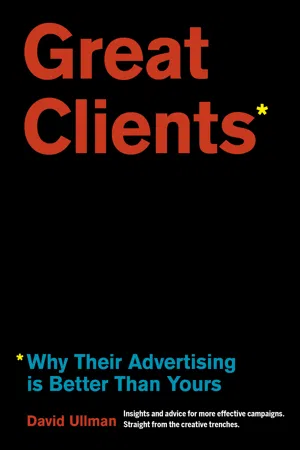
It's no secret that most advertising is silly, irritating, and boring. Everywhere we go, irrelevant ad-noise clutters our physical and mental environments. More importantly, it simply doesn't work. If your company's advertising doesn't rise above the fray, you probably blame your agency—they're not giving you their best work, or they "just don't get it." But consider this: you might be the problem. After nearly five decades in the advertising business, David Ullman has learned a few things about how to make effective ads. Forget the Mad Men image of a lone creative generating brilliant insights. David was on Madison Avenue in the '60s and '70s—that's not how it worked then, and it doesn't work that way now. Great advertising comes from great relationships. It comes from clear communication, shared goals, and trust. And all of those start with great clients. The tips and insights in this book show exactly how to work with your agency to ensure the work they produce is the best it can be. It's simple—learn how to be a great client, and you'll get great advertising.
- English
- ePUB (mobile friendly)
- Available on iOS & Android
eBook - ePub
About this book
Information
1.
What the Hell Is Advertising, Anyway?*
In the beginning...
Advertising probably began when one Neanderthal shouted to another that he had found a long pointy stick that would be great for hunting. He called it “Long Pointy Stick.” Then an Ad Neanderthal came along and counseled that it needed a new name— “something really cool, like ‘Spear.’ And with a name like that you can sell it for at least four shells!”
While historians figure that advertising—“the act or practice of calling public attention to one’s product, service, need,” according to Dictionary.com—may have started in the late 1600s, advertising as we know it really got going in the 1920s. Since then the business of advertising has grown. A lot.
According to Statista, in 2018 nearly $230 billion dollars U.S. was spent on advertising in North America. As best I can tell, there are better than 17,000 agencies in North America. The bottom line is that this is big business. It’s an industry. And it’s becoming more complex every day. Indeed, every time there’s an even minor advance in communications, the business of advertising tends to expand a bit as they put that minor advance to work to help sell stuff. Advertising is an industry that expands and grows just about 24/7/365. These days, there’s hardly a product or service that isn’t advertised. All because somewhere, some ad person thinks, “Hmmmm, I have an idea for you...”
There are those who regard advertising as manipulative, convincing people that they should buy stuff they don’t really need, things that won’t improve their life. Others say that advertising helps stimulate an economy by helping to generate mass sales that keep the cost of goods and services reasonable. Either way, advertising has become an art, a science, and a source of entertainment. The most effective link between clients and their markets is advertising agencies and their clients. The difference between a Great Client and a bad client is what this book is all about.
*What advertising can and can’t do
The claim is that advertising can sell a product. Any product. Anytime. Anywhere. All it takes is a decent ad in the right publication. Or a decent commercial on the right station at the right time. Or a decent direct mail piece delivered to the right people.
Heresy: My experience leads me to conclude that advertising really doesn’t “sell.” I may fit the Range Rover demographic, the commercials are beautifully produced, and I see them when they interrupt the program I’m watching. But they simply don’t move me to think about a test-drive.
I also see a lot of automobile insurance company advertising. They all tell me how much I’ll save and all I have to do is pick up the phone and dial this number and we’ll give you a free money-saving quote in minutes!
We had one client that proves my point. It was/is a “consumer direct” company. And boy did I have discussions with that client. His position was that when sales of policies were down, it was the fault of the advertising. I disagreed.
No matter how many calls the work we did produced (and we often produced record numbers of calls), the client was steadfast in his thinking. He measured the effectiveness of the advertising by the actual number of policies sold. I maintained my position. (I am sure he still thinks he was right. I know I was right.)
I believe that the advertising did exactly what it was supposed to do: get people to call! Once that call was made, it was up to the person who answered the call to sell the policy. If that person had just had a fight with his wife or just received a notice that he was being sued, that person would not answer the phone and express a genuine interest in helping the caller get the right policy at a money-saving price.
Back to the Range Rover example. Even if I were motivated to test-drive a Range Rover, it’s the salesman at the dealership who’ll sell me the car. Or not. If the advertising is successful, it will move people to take a test-drive. Frankly, I doubt watching a new model climb a massive staircase in China will move people to arrange for a test-drive. On the other hand, it may fall into the category called “brand building.” And that ain’t too bad.
I suppose the real point here is that the job of advertising is to move the consumer to do something—pick up the phone and call, look for products or find out where the product is sold, try a tankful of performance-improving gasoline or try that special toothpaste that’ll brighten their smile.
Advertising can educate, inform, introduce, and create an impression and a climate for salesmen and women. It can make you want a beer while watching a football game, or make you hungry for a pizza, or make you want to try a nice place to dine or travel to, and so on. But close the deal? I don’t think so.
*People make one agency different from another
An advertising agency is a group of sharply focused people helping you build your business. They do what other businesses don’t do, or don’t do well. The agency product is specialized know-how from people with talents for writing and visualizing. As such, an agency will provide the client with all the folks in all the supporting services needed by the client in order to help their business grow: account management, media planning, buying and traffic, production (print and broadcast), and just about any kind of research and creative: copywriting, art direction, photography, television production, print production, online content... you name it.
Think of an agency as if it were a Ferrari. When you peek under the hood there are a lot of moving parts at work. Great Clients know what’s connected to what; when they hear a weird squeaking sound, they can tell where it’s coming from and what it means. And then they—and agency management—do what they can to ensure that the engine continues to run smoothly. In short: The parts of any advertising agency are its people. Men and women whose daily contributions make sure the “engine” runs smoothly and can get the client’s business to where it wants to be.
*What makes an agency client a Great Client?
When I landed with BBDO, an agency with plenty of experience with Great Clients, my first assignment was to work with the Armstrong Cork account. Now, get this:In 1918, the Armstrong Cork Company signed the Batten Company to handle its advertising. Today, Armstrong is Armstrong Worldwide Industries, and the Batten Company is known as BBDO. Armstrong is still their client. These guys are doing something right!
In retrospect I can honestly say that every client I worked with received nothing less than pro service and work we honestly believed would help them reach their goals. But it seemed that the work with an extra spark or two of creativity was done for clients that actually made us part of their team and appreciated the efforts being made on their behalf.
Shortly after I joined BBDO/NY, the fellow who had been handling the creative work for Remington Arms retired. I was asked if I could work with a sporting firearms account. I said, “Let me go talk with them.”
So I trekked up to Remington headquarters in Bridgeport, Connecticut, and spent the day with the Advertising Director and the Advertising Manager. At the end of the day they asked if I’d be comfortable working with them and the products. I answered “Yes... with a proviso.” I told them I wouldn’t use pictures of guys posing with animals they’d killed, and we wouldn’t write copy about what happens when a bullet hits an animal. “I will do everything I can to sell the product on its merits,” I said. They were OK with that.
Back in my office, thanks to BBDO’s Research Department, I began a deep dive into sporting firearms, the market and consumer profiles. There was a huge amount of research available to me, but a few really salient points began to surface. For instance, most buyers spent a significant amount of time deciding which rifle or shotgun to buy. In those days, most rifles and shotguns were sold through the big chain discount sporting goods stores, and hunters had trouble getting the information they needed about the products that interested them most.
Then my small group took a long look at the competition. Remington didn’t want to compete with the low-price manufacturers, or, at the other end of the market, the custom-made or limited-production companies. That narrowed down the competition to a few significant names, which traded on their tradition and imagery: Winchester was all about cowboys. Ithaca sold a New England image. Mossberg was selling special features, bolstered on occasion by an endorsement from actor Robert Stack (a champion trap and skeet shooter). I noticed that most of the ads were in full color but were light on copy. Like they didn’t have much to say about their products.
The advertising budget wasn’t very big, but I had an idea I thought could work. I talked to the media guys at the agency, and they set up meetings with the outdoor and hunting-specific magazines to go over reader profiles, buying habits, etc. After that we began actual creative development work on what I thought could be a sensational campaign. We’d have to break a few conventions, write a whole lot of copy and work on a layout format that presented Remington as the premier authority in its field.
The concept was based on a simple need: hunters of all kinds and target shooters had trouble getting the information they needed to become better sportsmen and women. Remington would make sure they got it. We’d drop all the full-color two-page ads and develop a campaign based on single black and white pages. (We’d get twice the number of ad pages just by eliminating the high cost of color and the quality control it required.) With that plan in mind, I sat down with an Art Director and we created the campaign for “REMINGTON REPORTS. Information straight from the experts and engineers who design and make Remington rifles and shotguns.” We were now in the business of advertising information to markets filled with prospects hungry for it.
Topping off the creative was our media strategy. To make a major impression every single month, I wanted to buy the first two pages in every publication we decided to advertise in. The response to this was terrific. Most of the time the publications gave us what we wanted. Now all that we needed to do was make the presentation to Remington’s senior management. Back to Bridgeport we went.
...Table of contents
- Introduction
- 1. What the Hell Is Advertising, Anyway?
- 2. What’s So Special About Advertising Agencies?
- 3. What Do Great Clients Want?
- 4. How Great Clients Build Great Relationship*
- 5. How Great Clients Find the Right Agency
Trusted by 375,005 students
Access to over 1.5 million titles for a fair monthly price.
Study more efficiently using our study tools.
Frequently asked questions
Yes, you can cancel anytime from the Subscription tab in your account settings on the Perlego website. Your subscription will stay active until the end of your current billing period. Learn how to cancel your subscription
No, books cannot be downloaded as external files, such as PDFs, for use outside of Perlego. However, you can download books within the Perlego app for offline reading on mobile or tablet. Learn how to download books offline
Perlego offers two plans: Essential and Complete
- Essential is ideal for learners and professionals who enjoy exploring a wide range of subjects. Access the Essential Library with 800,000+ trusted titles and best-sellers across business, personal growth, and the humanities. Includes unlimited reading time and Standard Read Aloud voice.
- Complete: Perfect for advanced learners and researchers needing full, unrestricted access. Unlock 1.5M+ books across hundreds of subjects, including academic and specialized titles. The Complete Plan also includes advanced features like Premium Read Aloud and Research Assistant.
We are an online textbook subscription service, where you can get access to an entire online library for less than the price of a single book per month. With over 1.5 million books across 990+ topics, we’ve got you covered! Learn about our mission
Look out for the read-aloud symbol on your next book to see if you can listen to it. The read-aloud tool reads text aloud for you, highlighting the text as it is being read. You can pause it, speed it up and slow it down. Learn more about Read Aloud
Yes! You can use the Perlego app on both iOS and Android devices to read anytime, anywhere — even offline. Perfect for commutes or when you’re on the go.
Please note we cannot support devices running on iOS 13 and Android 7 or earlier. Learn more about using the app
Please note we cannot support devices running on iOS 13 and Android 7 or earlier. Learn more about using the app
Yes, you can access Great Clients by David Ullman in PDF and/or ePUB format, as well as other popular books in Business & Advertising. We have over 1.5 million books available in our catalogue for you to explore.