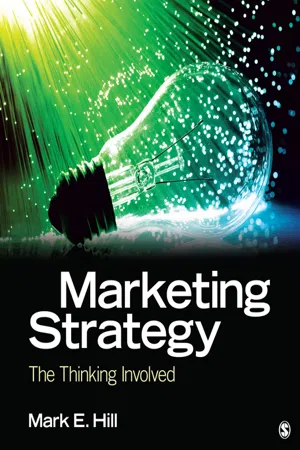
Marketing Strategy: The Thinking Involved is an innovative text that promotes the idea that effective marketing thinking leads to successful marketing strategy. The book?s theories go beyond simply introducing the reader to concepts in the field by providing tools and methods to develop marketing thinking and questioning skills that will help with application of real-life marketing strategies. As the chapters progress, the thinking/questioning develops toward higher levels and more specialized inquiry, helping readers acquire the skills needed in the practice of marketing. The book?s timely focus on developing thinking agility leading to strategic agility provides the necessary skills for navigating businesses in today?s dynamic markets. The book contains a wealth of pedagogy to support this active learning approach.
- 360 pages
- English
- ePUB (mobile friendly)
- Available on iOS & Android
eBook - ePub
SECTION 1
The Role Marketing Thinking Plays in Strategy
CHAPTER 1
Marketing Thinking
Have you ever experienced being stressed out or anxious before having to tackle a challenging task that required you to think? The stress could be from being in heavy traffic before coming to work or school. Or you could simply be anxious about all of the tasks on your list of things to do. In either case, the stress or anxiety makes the thinking tasks at hand more difficult. In a perfect world, being stress free and doing things at your leisure, when you are ready, would be ideal. However, the world we live in, with its constant demands, isn’t stress free and, hence, it’s necessary to learn how to deal with it and still get things done. Knowing what state of mind you are in and when you work most effectively is the starting point. If you know you are anxious and your mind seems to be going in many directions, then it is time to stop and take a moment to allow your mind to settle. The mind is able to focus when in a more relaxed state, and it is in this state that you are able to think more clearly and effectively.
Each chapter begins with a decompression exercise. Their purpose is for the reader to take a moment to relax before engaging in the task of thinking. A decompression exercise can involve anything that leads to relaxation such as listening to music, going for a walk, taking a bath, or simply taking a moment to notice something simple. Those offered throughout the text can be experienced in a few moments in the classroom or before studying. Preparing for thinking is no different than when athletes stretch and warm up prior to an event. Developing the practice of preparing for the task of thinking will enable you to be that much more effective at it; it will seem easier and require less time. In today’s busy world, this simple strategy of taking out time to relax before working on a challenging task can make your life that much more enjoyable while accomplishing what you to do. Give it a try. Before jumping into the chapter, try the following decompression exercise or simply take five or 10 minutes out to do something that relaxes you.
Decompression Exercise
Take a few moments and consider the following: When was the last time you noticed something simple? What was it? How did it make you feel?
Figure 1.1 A Flower

Chapter Introduction
What is it that draws people to the marketing profession? It may have something to do with its ubiquity and high visibility throughout our everyday experiences. Marketing seems to be everywhere and hard to avoid. At the same time, it is a part of contemporary society and inherently possesses interesting qualities. It can grab our attention, make us laugh, affect our preferences, and, ultimately, get us to spend money. It is in these everyday experiences with marketing that the curiosity for marketing and wanting to find out more about this profession begins. How do marketers come up with those interesting advertisements? How does marketing generate money? What goes into becoming a good marketer? And why are some marketers better at marketing than others?
To become a marketing professional requires learning how to think like a marketer. It is similar to wanting to become an artist, which is to learn their particular way of thinking to be able to engage artistic activities. The same could be said for all professions. Within business, accounting, finance, management, and so forth, each involves different forms of skilled thinking.
What does marketing thinking involve? Take, for example, marketers like Steve Jobs of Apple, Jeff Bezos of Amazon, Pierre Omidyar of eBay, and A. G. Laftey of P&G. What made their thinking different from that of others? And could it be learned? The answer is a resounding yes. All have had a major impact on their markets, changing and redefining the nature of competition to the benefit of their organizations. In a recent Harvard Business Review (HBR) article, innovators such as these were studied to reveal their “innovator’s DNA”1 to understand how they develop “ground breaking new ideas.” Several of the key “innovator’s DNA” characteristics identified in the study were the ability to form associations and to continuously ask good questions.2 Their questioning was a natural habit challenging the status quo, and this habit became infectious and an integral element of their companies’ cultures. Within the challenging of the status quo is also the inclination toward change, which involves an interest toward adapting to unfolding situations and being agile in doing so. The agility here is a thinking agility that is in contrast to the status quo. It is through developing their questioning skills that they have been able to hone their thinking agility.
Marketers have to be resourceful and insightful to be able to navigate effectively across difficult landscapes. Today’s markets are more dynamic than ever before. Financial upheavals, changing demographics, advances in technology, environmental concerns, and an increasing rate of innovations represent the landscape in which marketers conduct business. Each alone is challenging enough, but when combined, the task seems insurmountable. To be a skilled marketer today requires a particular type of thinking that isn’t fixed, but agile. Developing marketing thinking based upon an agility perspective for strategy purposes is what this textbook explores.
What is a thinking agility perspective based upon? First, it recognizes that all thinking is limited in some form or another and, as such, the limitations must be recognized to have an eye for other possibilities. Second, everything is constantly in the process of change. So the marketer’s thinking must also involve change. If the marketer’s thinking remains fixed and the marketplace is changing, then the marketer, in essence, is becoming further and further removed from what is taking place within the marketplace, putting the organization’s resources at risk. Thinking agility is consistent with a changing, dynamic marketplace. The more agile the marketer is in his or her thinking, the more able he or she would be to participate within the marketplace. Third, thinking agility is also about participating in the marketplace in ways that affect its nature, which requires new ways of understanding such changes. For example, the marketplace is transformed through new innovations with new forms of competition, practices, and/or consumption. As such, thinking agility involves understanding and developing new concepts, theories, and approaches leading to new strategies.
For example, consider the concept of value. Marketing involves marketing something. To pay for what the marketer is offering, there must be some form of value associated with it. Questions arise as to who is creating the value: the marketer, the consumer, or others? And where does the value reside? The answers to these questions have implications as to how you are thinking and their corresponding strategies.
If you assume the marketer is creating the value in the form of a product, then the value resides within the product (i.e., a value-in-product or value-in-the-thing) and the marketer is the one creating the value (an internal perspective). This view is consistent with a traditional perspective of marketing, leading to strategies based upon competition, persuasion, and targeting. On the other hand, if you assume an external perspective in which the consumer is creating the value in terms of how the product is to be used, that is, a value-in-use, or take into account brand communities via the Internet and social media where value is being created through the brand communities’ practices, that is, a value-in-practices, or consider emerging organic collaborative channel configurations referred to as holonic value nets where value stems from the orchestration within to accommodate more effectively consumers’ customized requests, that is, a value-in-orchestration, then in each case, who is creating the value is different, the concept of value has changed, and each involves a different form of thinking leading to different marketing strategies.
As we will see throughout the text, the value concept is changing with developments occurring within the marketplace as well as with marketing thinking. As the value moves around, this phenomenon can be described as chasing the value tail, which calls for greater marketing thinking agility to keep up with it. To get started, we’ll need to examine what marketing thinking entails and to begin developing our thinking agility.
Marketing Thinking
Anyone with the ability to think and an interest in marketing can learn to think in a marketing way (the italics symbolize its dynamic nature). A thinking approach to learning marketing is different from simply learning about marketing. Ins...
Table of contents
- Cover Page
- Dedication
- Title
- Copyright
- Brief Contents
- Detailed Contents
- About the Author
- Preface
- Acknowledgments
- SECTION 1: THE ROLE MARKETING THINKING PLAYS IN STRATEGY
- SECTION 2: THINKING THROUGH THE MARKETING PROCESS
- SECTION 3: REFLECTIVE VS. FORWARD-LOOKING SIDES OF MARKETING THINKING
- SECTION 4: A THINKING ORGANIZATION
- Case: Google, Inc.—Seeking the Fun in Innovation
- Index
- Credits
Trusted by 375,005 students
Access to over 1.5 million titles for a fair monthly price.
Study more efficiently using our study tools.
Frequently asked questions
Yes, you can cancel anytime from the Subscription tab in your account settings on the Perlego website. Your subscription will stay active until the end of your current billing period. Learn how to cancel your subscription
No, books cannot be downloaded as external files, such as PDFs, for use outside of Perlego. However, you can download books within the Perlego app for offline reading on mobile or tablet. Learn how to download books offline
Perlego offers two plans: Essential and Complete
- Essential is ideal for learners and professionals who enjoy exploring a wide range of subjects. Access the Essential Library with 800,000+ trusted titles and best-sellers across business, personal growth, and the humanities. Includes unlimited reading time and Standard Read Aloud voice.
- Complete: Perfect for advanced learners and researchers needing full, unrestricted access. Unlock 1.5M+ books across hundreds of subjects, including academic and specialized titles. The Complete Plan also includes advanced features like Premium Read Aloud and Research Assistant.
We are an online textbook subscription service, where you can get access to an entire online library for less than the price of a single book per month. With over 1.5 million books across 990+ topics, we’ve got you covered! Learn about our mission
Look out for the read-aloud symbol on your next book to see if you can listen to it. The read-aloud tool reads text aloud for you, highlighting the text as it is being read. You can pause it, speed it up and slow it down. Learn more about Read Aloud
Yes! You can use the Perlego app on both iOS and Android devices to read anytime, anywhere — even offline. Perfect for commutes or when you’re on the go.
Please note we cannot support devices running on iOS 13 and Android 7 or earlier. Learn more about using the app
Please note we cannot support devices running on iOS 13 and Android 7 or earlier. Learn more about using the app
Yes, you can access Marketing Strategy by Mark E. Hill in PDF and/or ePUB format, as well as other popular books in Business & Marketing. We have over 1.5 million books available in our catalogue for you to explore.