![]()
CHAPTER 1
PREPARING TO MAKE SAMPLING CHOICES
What you will learn in this chapter:
- Milestones in the history of sampling
- Major steps in selecting a sample
- Preparations important for making sampling choices
- Guidelines for preparing to make sampling choices
INTRODUCTION
The key to good research is preparation, preparation, and preparation. Hence, the key to making good sampling choices is preparation, preparation, and preparation. Sampling may be defined as the selection of a subset of a population for inclusion in a study. If done properly, it can save money, time, and effort, while providing valid, reliable, and useful results. On the other hand, if done poorly, the findings of a study may have little scientific and practical value. In order to increase the likelihood that the findings of a study will have value, preparations should be carried out before making sampling choices.
This chapter begins with a brief history of sampling, followed by a description of the major steps in selecting a sample. Preparation is the first of these steps. The preparation should include a careful review of the study’s purpose, the nature of the population, the available resources, various research design considerations, and ethical and legal considerations. Guidelines for making these preparations are described in this chapter.
MILESTONES IN THE HISTORY OF SAMPLING
Although sampling probably has always been part of human history, many of the sampling procedures used today have a relatively short history. Governments have long collected population data for taxation, military purposes, and other objectives. Typically, total enumeration was sought. On the other hand, private pollsters tended to use availability sampling such as straw polling. However, by the end of the 19th century, “scientific” procedures for selecting a sample began to surface. U.S. governmental agencies, in particular, began experimenting with these procedures that later became known as probability sampling. Private pollsters, on the other hand, continued to rely on availability sampling until 1936.
Critical changes in sampling procedures used by private pollsters came about in 1936 and again in 1948. In 1936, the failure of the Literary Digest to predict the winner of the presidential election led to a movement away from availability sampling to quota sampling. Using availability sampling of millions of respondents, the Literary Digest was successful in predicting the winner in each U.S. presidential election that was held between 1916 and 1932. However, it failed to do so in 1936. On the other hand, using a new sampling procedure that later came to be known as quota sampling, pollsters George Gallup, Elmo Roper, Paul Cherington, and Richardson Wood were successful in predicting Franklin D. Roosevelt as the winner in that election. This caused pollsters to pay more attention to quota sampling and less attention to availability sampling (Bryson, 1976; Cahalan, 1989; Katz & Cantril, 1937; Squire, 1988). These sampling procedures are described in detail in Chapter 4.
The failure of the Literary Digest’s prediction of the winner of the 1936 presidential election was primarily due to two factors: coverage bias and non-response bias.
- Coverage bias is the lack of a one-to-one correspondence between the elements in the target population and the elements encompassed by the respondent selection procedures used in a study. Sampling frame bias is the extent to which there are differences between the elements that are listed in the frame and the elements that make up the target population. The sampling frame of the Literary Digest consisted of its subscribers, listings in telephone books, and listings of automobile registrants. These lists were not representative of the 1936 voting population.
- Nonresponse bias is the extent to which there are significant differences between the respondents and nonrespondents in terms of the variables of interest in a study. The proportion of Republicans among the respondents to the Literary Digest’s straw poll was higher than the proportion of Republicans among the registered voters at that time. The magazine’s straw poll was thereby not representative of voters throughout the country.
After the 1936 election, private pollsters increasingly used quota sampling instead of straw polling in predicting the results of elections. On the other hand, U.S. governmental statisticians and academic statisticians increasingly focused their attention on probability sampling. Probability sampling became a fixture of the U.S. decennial censuses in 1940. However, it took the failure of polls utilizing quota sampling to predict the winner of the 1948 U.S. presidential election to cause private pollsters to adopt this evolving sampling procedure. Using quota sampling, the major polling companies (Gallup, Crossley, and Roper) predicted that Thomas Dewey would beat Harry S. Truman in the presidential election of that year. On the other hand, academic researchers utilizing probability sampling predicted Truman would win. Truman won the election by more than 2 million votes and 114 electoral votes.
The failure of the pollsters using quota sampling in predicting the winner of the 1948 presidential election was due to several factors: basing projections on outdated data, stopping data collection too soon, the impact of interviewer bias, and changes in party identifications that were not factored into the projections.
- The election projections were based on outdated data. The quota sampling procedures used by the pollsters were based on the 1940 census, data collected 8 years earlier. As a result of major population changes during those 8 years, 1940 census data did not reflect the 1948 voting population.
- The pollsters stopped collecting data too soon. Gallup and Crossley stopped collecting data mid-October. Roper stopped in August. At the time they stopped polling, there were yet many voters undecided. A large proportion of these voters decided to vote for Truman.
- Interviewer bias also contributed to the problem. Quota sampling has an inherent problem of interviewer bias. In using this sampling procedure, interviewers have discretion to interview whomever they desire as long as they satisfy quota control requirements of the sampling procedure. As a result, working class voters are more likely to be ignored by interviewers, and in 1948, these voters were more likely to vote Democratic.
- Changing dynamics of political party identification also contributed to the failure of the pollsters. The Progressive Party and the Dixiecrat Party also had candidates in the race. The effect of these candidates tended to help the Democratic Party. The Communist Party USA did not run a candidate for president, but endorsed the Progressive Party’s candidate. This endorsement deflected anti-communism attacks away from the Democratic Party. Many White southerners left the Democratic Party to support the Dixiecrats. This made the Democratic Party more acceptable to Blacks, and they gave it their support.
The failure of the major polling companies to predict the winner of the 1948 U.S. presidential election motivated them to move away from quota sampling and incorporate probability sampling into their polling procedures. They joined statisticians in the federal government and academia in endorsing probability sampling. Probability sampling became the dominant sampling procedure for estimating population parameters. The major types of probability sampling are described in Chapter 5.
Up to today, sampling procedures continued to evolve. To a certain extent, as modes of collecting data changed, sampling procedures changed. During the period of the 1970s through the 1990s, there was a movement from personal interview surveys to telephone surveys. Variants of random digit dialing (RDD) sampling procedures were developed to meet challenges of telephone surveys. As research methods embraced advances in electronic technology, including the use of online surveys, fax machines, and cell phones, sampling procedures were further modified and adjusted. Today, a wide range of nonprobability and probability sampling procedures are used, making sampling choices more challenging than ever before.
MAJOR STEPS IN SELECTING A SAMPLE
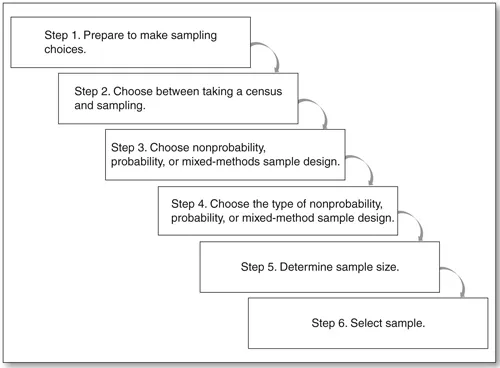
One may identify six major steps in selecting a sample (see Figure 1.1):
Step 1. Prepare to make sampling choices.
Step 2. Choose between taking a census and sampling.
Step 3. Choose nonprobability, probability, or mixed-methods sample design.
Step 4. Choose the type of nonprobability, probability, or mixed-methods sample design.
Step 5. Determine the sample size.
Step 6. Select the sample.
Figure 1.1 Major Steps in Selecting a Sample
Step 1. Prepare to Make Sampling Choices
Specific preparation should be made before making sampling choices. Such preparation should include a careful review of the purpose of one’s study, the nature of the population, available resources, research design considerations, and ethical and legal issues considerations. Guidelines for making these preparations are presented in the next section of this chapter.
Step 2. Choose Between Taking a Census and Sampling
The second step involves choosing between selecting the entire target population (taking a census) and selecting a subset of the target population (sampling). In making this choice it is important that one has a good understanding of the differences between random sampling error and systematic error. A description of these differences and guidelines for choosing between taking a census and sampling are described in Chapter 2.
Step 3. Choose Between Nonprobability, Probability, or Mixed-Methods Sample Designs
Once a decision is made to sample, the next step involves choosing between the two major types of sampling: nonprobability sampling and probability sampling. Probability sampling gives every element in the target population a known and nonzero chance of being selected. Nonprobability sampling does not. Guidelines for choosing between nonprobability sampling and probability sampling are described in Chapter 3. Guidelines for choosing mixed-methods sample designs are included in Chapter 6.
Step 4. Choose the Type of Nonprobability, Probability, or Mixed-Methods Sample Design
The next step involves choosing the specific type of nonprobability or probability sample design to be employed. One may opt to utilize a mixed-methods sample procedure combining different types of nonprobability sampling procedures, different types of probability sampling procedures, or combining nonprobability and probability sampling procedures. The major types of nonprobability sample designs are described in Chapter 4; the major types of probability sample designs are described in Chapter 5. At the end of these two chapters, guidelines are presented to assist in making a sample design choice.
Some sample designs are distinguished by the nature of their sampling units and others by the mixing of more than one sample design type. These types of designs are described in Chapter 6. Designs distinguished by the nature of their sampling units are telephone-based sampling, web-based sampling, address-based sampling, time-based sampling, and space-based sampling. In mixing different types of sample designs, one may mix different types of nonprobability sample designs, mix different types of probability sample designs, or mix nonprobability and probability sample designs. Mixed-methods sample designs are also described in Chapter 6.
Step 5. Determine the Sample Size
Having chosen a specific type of sampling design to be used to select a sample, the next step involves determining of the number of elements to be selected. Chapter 7 describes factors that should be considered in determining sample size and guidelines for doing so.
Step 6. Select the Sample
The final step in sampling involves implementing one’s sampling choices. The quality of the resulting sample is dependent substantially on the first step: preparing to make sampling choices. Guidelines for preparing to make sampling choices are presented below.
GUIDELINES FOR PREPARING TO MAKE SAMPLING CHOICES
Speci...