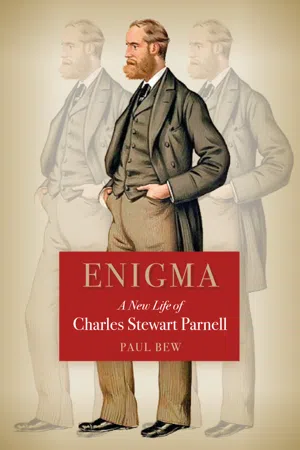
Charles Stewart Parnell is the most enigmatic figure in Irish history. An Anglo-Irish landlord from a distinguished Wicklow family, he became the most unlikely leader of Irish nationalism imaginable.
He hated the colour green. He was not a dynamic speaker. He was cold and aloof and lacked the popular touch. None the less, from the late 1870s until his fall and death in 1891, he held the whole of Ireland spellbound.
He established Home Rule for Ireland – previously a taboo subject in British politics – at the centre of Westminster affairs and effectively created the modern Irish state in embryo.
His fall was as dramatic as his rise. The affair with Mrs Katharine O'Shea, the mother of his three children, destroyed him. Ever since his fall and his premature death in 1891, Parnell has remained a remarkably potent symbol, particularly in times of crisis and conflict in Ireland. The myth has obscured the man and makes it difficult for us to see Parnell as he really was. Paul Bew presents a completely original interpretation of this fascinating and enigmatic man.
Despite the clamour of the modern Firbolg in Irish politics, the Irish people possess an instinctive knowledge of the attributes which go to make a great leader of men, and they will no more eliminate the factor of birth from this catalogue, when they can get it, than they would strike it from the pedigrees of racehorses.
SIR WILLIAM BUTLER, AN AUTOBIOGRAPHY (1911), SPEAKING OF PARNELL
Aristocratic and autocratic as he [Parnell] was, he could not recognise anything but chance in the arrangement of things. The accident of birth was everything.
A CONTEMPORARY OPINION CITED BY R. BARRY O’BRIEN, THE LIFE OF CHARLES STEWART PARNELL (1898)
1
Thomas Parnell, grandson of the mayor of Congleton in Cheshire, established the Parnell family in Ireland, when soon after the Restoration (1660) he bought an estate in Queen’s County. The early record of the line in their new country did not greatly impress local nationalist opinion. The Nation in 1876 said of the eighteenth-century Parnells: ‘Their love for Ireland was negative—a passive species of affection which seconded not the efforts of the Government of the island in its acts of oppressive cruelty.’1 Fortunately for its most famous member, Charles Stewart Parnell, the record apparently improved by the beginning of the nineteenth century. His great-grandfather, Sir John Parnell, opposed the Act of Union in 1800, and this cost him his post as Chancellor of the Irish Exchequer. In fact Sir John’s patriotism, while sound enough if one accepts the purely eighteenth-century equation of Irish nation and the Protestant ascendancy, did not embrace Catholic Emancipation. This did not stop Charles Stewart Parnell later exploiting his record as an ‘incorruptible’ when he entered politics. The less agreeable aspects of Sir John’s politics were simply glossed over: T. P. O’Connor, for example, telling a St Patrick’s Day function in London that the Parnell ‘of that day’ was a supporter of Catholic Emancipation. If he knew any better, Charles Stewart Parnell did not speak up in the name of historical accuracy.2
Two of Sir John Parnell’s sons were active in politics. Both were notably more pro-Catholic in tone than Sir John: in fact, both were strong supporters of Catholic Emancipation. A financial expert, Sir Henry Brooke Parnell (1776–1842) represented Queen’s County in parliament from 1806 to 1832, and from 1833 to 1841 represented Dundee. In 1808 he published A History of the Irish Penal Laws and was a supporter of Daniel O’Connell’s campaign for Catholic Emancipation. In 1836 Parnell became paymaster general; created Baron Congleton in 1841, his health collapsed, and in June 1842 he committed suicide by hanging himself.
It is likely, however, that a more potent influence on Charles Stewart Parnell was the attractive liberal patriotism of his grandfather, William Parnell.3 William Parnell (1777–1821) inherited the Parnell estate in Wicklow from his father’s cousin, Samuel Hayes. In his pamphlet An Inquiry into the Causes of Popular Discontent in Ireland by an Irish Country Gentleman (2nd ed., 1805), he attributed Irish unrest to the Elizabethan conquest and confiscation of land, the tithe issue and the Protestant monopoly of the agencies of the state. The last sentences of the book state its case: ‘Ireland, that is the mass of its population and force, is hostile to England; the union is a name, a sound, a fiction, there is no union: the nominal union is only an additional source of discord. Make a real union by removing all causes of discontent and leaving the common interests of the two countries to operate.’ It can hardly be a surprise that Gladstone, who read the work in September 1888, found it ‘most remarkable’.4An Historical Apology for the Irish Catholics (three editions by 1813) further extended his argument in favour of Catholic Emancipation. In 1817 Parnell was elected MP for Wicklow, a seat he held until his death in 1821.
His novel Maurice and Berghetta; or The Priest of Rahery: a tale (1819) was suffused with a similar liberal political ethos. The novel portrays the priest of Rahery, Father O’Brien, in a very positive light; by contrast, the landlords are characterised as a ‘garrison’ who had failed to win over the Irish people by acts of justice.5 Although it infuriated Irish conservatives, the book was on the whole a critical success.6 At the time of its publication in the United States the following year (by Wells & Lilly, Boston) an American reviewer felt able to refer to the ‘high reputation of this novel in England’.7
In accordance with the now established family tradition, Charles Stewart Parnell’s father, John Henry Parnell, was a man of generous political temperament. In 1845, during the Famine, he gave ‘the site, and [a] handsome subscription’ for a Catholic chapel at the town of Charlemont (on his Armagh estate) where mass had hitherto been celebrated in the open air.8 John Henry Parnell died in 1859 when his son was thirteen. Parnell’s father had been captain of cricket at Eton, and Parnell inherited both the taste and aptitude for the game—he became captain of the Wicklow county team.9 Charles’s American mother, who survived her husband by almost forty years, is often credited with the work of turning her son’s mind against the British. T. P. O’Connor observed: ‘He was extraordinarily like her, physically as well as mentally, and they had in common a certain eccentricity that was the thin barrier between insanity and reason.’10 Delia Tudor Stewart Parnell was the daughter of Admiral Stewart, popularly known as ‘Old Ironsides’, who had captured two British ships during the Anglo-American conflict of 1812. The memoir of Richard Rush, the US ambassador to London is very suggestive on the subject of Admiral Stewart’s character. As their ship hit an appalling storm, Rush asked Stewart what would he do if he encountered an enemy ship at such a moment. Stewart replied that, despite the storm, he would stick closely to the enemy ship in order to attack her when the storm ended.11 On this trip Stewart was delivering Rush to England in 1817 to take up his post at the Court of St James; on arriving at customs, the American ambassador’s material was searched just like any other traveller. It is easy to see from where Parnell inherited his tenacity and irritation with English formality. It is perhaps worth noting also that the Admiral spent his last years ‘living in sin’. His daughter had been a society belle in New York and Boston, and it seems likely that she was more than a little disappointed by life in rural Ireland, where she endured eleven confinements in rapid succession. Perhaps it is true that something of Parnell’s disdain for precedence and defiance of authority may be traced to his maternal American republican roots. But it must not be forgotten that, although Mrs Parnell kept a ‘patriotic’ house, her disregard for convention did not prevent her presenting her daughters at Queen Victoria’s court. Moreover, if mother and daughters had Fenian leanings in the 1860s, Parnell himself was decidedly unsympathetic to the ‘so-called Fenians’ who called at their Dublin home.
It is hard to resist the conclusion that the contribution of Parnell’s parents to his later political development was important, albeit in a negative way. Parnell’s father passed on an essentially decent patrician non-sectarianism. His mother passed on a vague (and inconsistent) American republicanism. But the really important fact about Parnell’s early life is that neither of his parents shared the traditional Protestant supremacism of many sections of the Irish landlord class. This did not mean that Parnell automatically became the leader of Irish nationalism—far from it—but it did mean that this was a potential development: Parnell was able to rebel against his class in his political life without rebelling against his family. But if he was unsentimental about Irish landlordism, he was also unsentimental about the rhetorical icons of nationalism—almost tone-deaf, in fact, on certain points.
He was indifferent to the details of the nationalist version of Irish history. He did not invoke the heroes and villains of this tale. His broad acceptance of the popular discourse which opposed the Union was not backed up by any strong interest in the particularities of the case. Indeed, as John Devoy pointed out in a graphic phrase, ‘his mind did not run in the same groove as that of Gaelic Irishmen’.
Parnell was capable of making a major speech in Drogheda in 1884 accepting the freedom of the town and not making any reference to Oliver Cromwell’s famous atrocities during the siege. He was also unmoved by the odium attached to the name of Lord Castlereagh (1769–1822), famous as Foreign Secretary in the Napoleonic and post-Napoleonic era. For nationalists, Castlereagh was the erstwhile liberal who had then provoked the insurrection of 1798. To compound this crime, he had ruthlessly tortured and executed the rebels. Finally and worst of all, he had corrupted the Irish parliament to pave the way for the Act of Union—the source of Ireland’s woes in the nineteenth century. Yet this tale of infamy seemed to leave Parnell unmoved.
In this context, there was one interesting, highly symptomatic exchange between Parnell and Devoy in Boulogne on 7 March 1879. In May 1878, following upon the death of the Liberal MP James Sharman Crawford, two of the north’s great political dynasties had attempted to win his Co. Down seat. The Conservative Viscount Castlereagh of the day (Charles Stewart Vane-Tempest, 1852–1915, great-grand-nephew of the Foreign Secretary, later 6th Marquis of Londonderry) defeated the Liberal William Drennan Andrews QC by 6,076 votes to 4,701. Home Rule support in this constituency was small, and there was absolutely no chance of a nationalist victory. Parnell nonetheless at this point delighted in the exercise of political power, and he had played a role in persuading the Home Rule electorate to back Castlereagh and thus teach the Liberals a lesson. Devoy was appalled: the earlier Lord Castlereagh had been the architect of the repression of the United Irishmen in 1798 and the Union in 1800. For Devoy, Castlereagh was the most evil name in modern Irish history. There was no circumstance in which nationalist electors could ever support such a name—to do so implied historic and political illiteracy. Parnell, on the other hand, was quite indifferent to such considerations and interested in the practical use of political power in the here and now. Devoy remained unconvinced:
I told him I believed it was a mistake to advise any Irishman to vote for a man with the infamous name or title of Castlereagh, and that the family of that wretch should be forever kept out of public life in Ireland.
Parnell immediately warmed up, his eyes flashed and his whole manner showed unmistakable irritation. He said such doctrine was nonsense and that by beating a Whig by voting for a Tory, or a Tory by voting for a Whig, when we could not elect our own man, was good politics and that this was the case in Down. The point was that ‘any stick was good enough to beat the dog with’, and I admitted it as a general proposition, but contended that it should not hold good in the case of notorious traitors, else the national moral sense would be impaired. Parnell was not an idealist, and his mind did not run in the same groove as that of Gaelic Irishmen, but addressed itself coolly to the material proposition that confronted him for the moment. He felt so strongly at fault being found with him over this Castlereagh matter that he referred to it more than once during the evening.12
In fact the earlier Castlereagh had been, in effect, a protégé of Sir John Parnell and an ally of William Parnell on the issue of Catholic Emancipation but it is doubtful if Parnell knew this. His irritation was more to do with his assessment of political strategy. Political strategy and matters of sentiment should be kept strictly apart in his view. Castlereagh, unlike his Liberal opponent, had given undertakings to support the Irish Catholic position on educational matters and even to support the establishment of a committee of inquiry into Irish Home Rule (to the annoyance of the leading Ulster Liberal Unionist commentator, Thomas MacKnight, who recalled the by-election as an instance of Tory cynicism encouraging the Home Rule movement with no thought for long-term consequences).13 When Castlereagh won, the local Catholic nationalist paper hailed it as the most glorious victory since that of O’Connell in Co. Clare. It proved that northern Catholics would never ‘sever their fortunes from that of their suffering brethren, the tenant farmers of the other three provinces’.14 This was the essence of the matter for Parnell; historical allusion, on the other hand, was a profound illusion.
2
At Avondale, a ‘square, very ordinary-looking building’ placed in beautiful surroundings, a mere ten minutes’ walk from the famous Vale of Avoca, Charles Stewart Parnell was born on 27 June 1846. He was what is called in Ireland a bold child, his naughtiness being redeemed somewhat by a deep affection for his sisters Emily and Fanny and his brother John. ‘Master Charley is born to rule,’ said his nurse prophetically. However, the family was less than charmed by his domineering ways. At a mere six years of age he was sent away to a girls’ school in Yeovil, Somerset. Following a severe bout of typhoid in his second term, he had to be brought home. This does not seem to have sapped his strength of will. In the early 1860s Charles attended the Rev. Alexander Whishaw’s private school at Chipping Norton, Oxfordshire. Whishaw’s academy was a crammer for Cambridge University, and Parnell, not surprisingly, rebelled vigorously against the sterile routine. There is little doubt that his apparent arrogance made him unpopular with both boys and masters. Whatever learning he acquired, he bore it lightly: his intellectual interests, such as they were, were entirely mathematic and practical scientific.
It is not too much to say that he was quite without literary accomplishments. This weakness was disguised by the fact that his colleagues and (in later years) Mrs O’Shea composed many of his communications for him. He once showed Henry Labouchere a letter that he contemplated sending to The Times. The English Radical MP recorded: ‘This was his own unaided composition, and never in my life did I see more astonishing English—confused, ungrammatical and passing comprehension.’15 On the other hand, this did not stop Parnell himself in later life defensively mocking the poor spelling of English aristocrats: ‘One I know at the present moment’, he told Mrs Stuart Menzies, ‘is a brilliant example of an hereditary legislator who wrote to me the other day and spelt barracks with one “r” and no “c”!’16
After these rather desultory educational experiences Parnell went to the hearty, philistine and (at that time) relatively academically undistinguished Magdalene College of Cambridge University from 1865 to 1869. Before he left home his mother felt it necessary to warn the college of his habit of sleep-walking. It is worth noting that Parnell got on well with his supervisor, G. F. Patrick, who considered that the young Irish squire did have a certain mathematical ability.
Parnell’s stint at Magdalene—three and a half years—was, after all, longer than the typical undergraduate residence today. The college records show that he was a poor chapel attender. He was, however, hardly alienated from his contemporaries—who organised a large boozy party for his last night, so that Parnell left Cambridge on a tide of ale. Even so, he does seem to have acquired a certain sense of being Irish—albeit in a very specific if perfectly legitimate sense—and most certainly not English. It was not, at this stage, a nationalistic sentiment which embraced all ...
Table of contents
Cover
Title
Epigraph
Preface
Foreword
Chapter 1: ‘The Accident of Birth’
Chapter 2: ‘On The Verge of Treason-Felony’
Chapter 3: ‘A Spontaneous Uprising’: The Land League
Chapter 4: ‘A Certain Value to Parliamentary Action’
Chapter 5: ‘He Knew What He Wanted’: Home Rule in 1886
Chapter 6: ‘The Bitterness of Party Conflict’: ‘Parnellism and Crime’
Chapter 7: ‘Sticking to his Corner’
Chapter 8: Conclusion
Appendix
Abbreviations
Notes
Bibliography
Images
Copyright
About the Author
Dedication
Acknowledgments
About the Publisher
Trusted by 375,005 students
Access to over 1.5 million titles for a fair monthly price.
Study more efficiently using our study tools.
Frequently asked questions
Yes, you can cancel anytime from the Subscription tab in your account settings on the Perlego website. Your subscription will stay active until the end of your current billing period. Learn how to cancel your subscription
No, books cannot be downloaded as external files, such as PDFs, for use outside of Perlego. However, you can download books within the Perlego app for offline reading on mobile or tablet. Learn how to download books offline
Perlego offers two plans: Essential and Complete
Essential is ideal for learners and professionals who enjoy exploring a wide range of subjects. Access the Essential Library with 800,000+ trusted titles and best-sellers across business, personal growth, and the humanities. Includes unlimited reading time and Standard Read Aloud voice.
Complete: Perfect for advanced learners and researchers needing full, unrestricted access. Unlock 1.5M+ books across hundreds of subjects, including academic and specialized titles. The Complete Plan also includes advanced features like Premium Read Aloud and Research Assistant.
Both plans are available with monthly, semester, or annual billing cycles.
We are an online textbook subscription service, where you can get access to an entire online library for less than the price of a single book per month. With over 1.5 million books across 990+ topics, we’ve got you covered! Learn about our mission
Look out for the read-aloud symbol on your next book to see if you can listen to it. The read-aloud tool reads text aloud for you, highlighting the text as it is being read. You can pause it, speed it up and slow it down. Learn more about Read Aloud
Yes! You can use the Perlego app on both iOS and Android devices to read anytime, anywhere — even offline. Perfect for commutes or when you’re on the go. Please note we cannot support devices running on iOS 13 and Android 7 or earlier. Learn more about using the app
Yes, you can access Enigma A New Life of Charles Stewart Parnell by Paul Bew in PDF and/or ePUB format, as well as other popular books in Historia & Biografías históricas. We have over 1.5 million books available in our catalogue for you to explore.