eBook - ePub
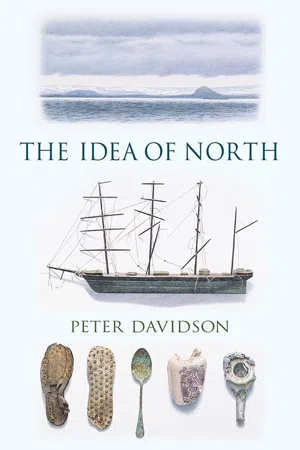
The Idea of North
About this book
As with the compass needle, so people have always been most powerfully attracted northwards; everyone carries within them their own concept of north. The Idea of North is a study, ranging widely in time and place, of some of the ways in which these ideas have found expression. Offering engaging meditation on solitude, absence and stillness, Davidson shows north to be a goal rather than a destination, a place of revelation that is always somewhere ultimate and austere.
Information
Topic
HistoireSubtopic
Théorie et critique de l'artII Imaginations of North
ICE AND GLASS
HANS CHRISTIAN ANDERSEN’S The Snow Queen is one of the paradigmatic narratives of northward journey. Once the heroine has reached the utter north to attempt the rescue of her friend who has been kidnapped by the Snow Queen, she comes to the ice palace, which is the epicentre of frost and cold. Ice, glass and mirrors interchange and duplicate throughout the story of The Snow Queen. A splinter of mirror-glass from the distorting mirror of an evil magician enters the heart of the innocent child, Kay. At once the sliver of glass takes on the property of ice.
It was one of those glass splinters from the Magic Mirror, the wicked glass . . . Poor Kay had also received a splinter in his heart – it would now become hard and cold like a lump of ice.1
The property of the icy glass is to make Kay cold, to draw him to the epicentre of coldness, to the palace of the Snow Queen in the uttermost north, in ‘terrible, icy-cold Finnmark’. (The only mitigating element in Finnmark is the humanity of the Sami shaman or wise woman who helps the child Gerda on her northward journey to rescue Kay.) This is the Scandinavian imagination of the power of the winter and the cold at its bleakest: the Snow Queen’s palace is the centre of metaphorical and actual cold, all that stands against metaphorical or actual warmth, desolate and desolating:
The walls of the palace were formed of the driven snow, its doors and windows of the cutting winds; there were above a hundred halls, the largest of them many miles in extent, all illuminated by the Northern Lights; all alike vast, empty, icily cold, and dazzlingly white . . . In the midst of the empty, interminable snow-saloon lay a frozen lake; it was broken into a thousand pieces; but these pieces so exactly resembled each other, that the breaking of them might well be deemed a work of more than human skill. The Snow Queen when at home, always sat in the centre of this lake; she used to say that she was then sitting on the Mirror of Reason, and that hers was the best – indeed, the only one – in the world.2
Kay, black with cold, but unaware of it, is playing with the shards of the cracked mirror-ice. He is in hell: his are the futile endless jobs of the damned. He is trying to make the word ‘eternity’ out of the fragments of ice, but he cannot remember what word it is that he is trying to form. Knowing his hopeless condition, the Snow Queen has promised him freedom, the whole world and a new pair of skates (to engrave bright lines on the mirrors of ice) if he should succeed in the hopeless task.
Against the northern winter, the only antidote is society, interconnectedness with others. Thus, in exact allegory, Kay is released from his wintry servitude by the warmth of Gerda’s tears. He finds it within himself to cry also, to melt the ice in his heart and eyes. As soon as they return to society, to the safe embrace of the orderly northern city, they forget ‘the cold, hollow splendour of the Snow Queen’s Palace’ so that ‘it seemed to them only an unpleasant dream’.3
As an image of the final heart of the north, the palace of the cold is a powerful one. In Selma Lagerlöf’s The Further Adventures of Nils, the hero has a dream of northernmost Sweden as isolated, bleak and negative: warmth, civilization, the brave Sami people, trees, animals and vegetation can only reach so far north.4 As the child Nils progresses northwards, all these fall by the way: they can go so far and no further. When he finally comes face to face with the utmost north of his country, it takes the form of a cave of ice, inhabited by an old witch with hair of icicles, body of ice, cloak of snow. The Ice Witch is attended by three black wolves whose mouths issue cold, the north wind and the winter darkness. The sun confronts her for a moment and her mantle begins to melt, but the breath of the wolves drives even the sun to flee to the south, as the Ice Witch screams that the sun will never conquer her, for the far north belongs only to the ice and the black cold. The ice witch rises again and again – in Edith Sitwell’s The Song of the Cold, as Emma Tennant’s Aunt Thelma in her Wild Nights, and in the work of later writers for children, as the Great Cold in Tove Jansson’s Moominland Midwinter, and, of course, as the White Witch in C. S. Lewis’s The Lion, the Witch and the Wardrobe and The Magician’s Nephew.5
When first we moved to the 57th parallel, my wife dreamed that the incarnate cold had manifested herself on the snowy lawns around the house. She told me about it in high summer at night when Andrew was smoking at the greenhouse door and moths were battering the Venetian lantern as I watered the vine, the tobacco plants and the black Mexican morning glories.
She had dreamed it on a still night in deep winter when we were snowed in. She had gone out of the house in her dream sensing that the animating spirit of the cold was coming dangerously close. Moving across the white levels of the lawns was a terrible old woman with long straight white hair and mad, sightless eyes like a gannet’s. My wife, sensing the spirit’s power for destruction, propitiated the incarnate cold with the only gift that she would find acceptable: a fan to make the cold air colder still. The old woman took it and moved on down the course of the frozen burn. Did she give the cold my grandmother’s painted fan from the fan case in the back drawing room? Spanish late Baroque showing the chariot of day rising above the arid mountains on the one side and the personification of the night on the other, in brocade and pearls, standing by a carved fountain draped with roses and the scented jessamine called dama de noche.
Although the Arctic itself is conceptualized as a man’s world, a proving ground, ‘no place for women’, it is for that very reason sometimes seen as female in itself (for example, by Robert Service, ‘I wait for the men who will win me . . .’).6 The principle of cold tends to be female, in both the east (where cold is associated with yin, the female principle) and in the west: in the English medieval winter ballads of holly and ivy, Ivy is cold and female, Holly is fiery and male – winter misery, yuletide pleasure.7
Margaret Atwood has recently drawn attention to a different approach to embodying the north, the way that the ice demon called the Wendigo, a figure from the mythology of the Algonkian speakers of the north-eastern Canadian wilderness, has become a potent symbol for Canadian writers.8 It is an ogreish and ravenous entity with a heart of ice, which eats moss, frogs and mushrooms, or, preferably, human beings. Unsettlingly, the line between humans and Wendigos, as between humans and vampires, is a fluid one: a human can become a Wendigo as the result of either being bitten by one, tasting human flesh or being bewitched. A Wendigo human can be killed, but it is important in such a case to remove the heart and burn it so as to melt the ice. Kay’s ice heart in The Snow Queen was the allegory of solipsism, withdrawal from community, the selfishness that is invariably fatal in the far north.
The belief that one has become a Wendigo is a recognized psychosis among Algonkian speakers, and to a number of modern Canadian writers the Wendigo is a spirit of the north. To Paulette Jiles, it is the person who has been conquered by the north, who has disappeared into a malignant or even diabolic wilderness and been swallowed alive:
He is the Hungry Man, the one who reached this wasteland of the soul and did not emerge . . .
Sometimes he wants to be killed . . .
he wants his soul or what there is of it
to spring heavenwards. . . .
People shoot the Windigo, they
do not pray for him, or it.9
Wendigos are people who have crossed that invisible but fatal barrier that divides the natural from the supernatural north, and lost themselves in so doing: like Virgil’s ghosts, it seems as if they may then hold out their arms in longing from the opposite bank.
In another Canadian story, ‘A Tale of the Grand Jardin’, by W. H. Blake, a fisherman tells a tale: he was travelling in a region known as la Rivière à l’Enfer, and camped by a lake of black water – the name of the river, if nothing else, an indication that the speaker is very near that perilous boundary – where he is attacked by a Wendigo, who seems to be all that remains of an experienced guide called Paul Duchêne: familiarity with the wilderness, skill, strength and energy are not necessarily enough to save a man who becomes susceptible to its diabolic aspects.10
Ice, rock crystal and glass interchange and interrelate in Scandinavian mythologies of the otherworld. In Norse myth the sinister kingdom of the giant Guthmund, somewhere on the edge between this world and the other, is called Glæsisvellir, ‘glittering’ or ‘glassy plains’. The glittering ice recurs in the medieval Norwegian otherworld-journey poem, the Draumkvedet.
Then I came to those lonely lakes,
Where the glittering ice burns blue;
But God put warning in my heart,
And thence my step I drew.
I was in the otherworld,
And no one knew I there
But only blest godmother mine
With gold on her fingers fair.11
The ‘godmother’ is the Virgin Mary, in her frequent medieval role as protectress. These descriptions surely owe their origins to observations of the icebergs fusing in the imagination with the idea of the crystal city in the Book of Revelation.
Ice and glass come together frequently in the work of Osip Mandelstam (1891–1938); for example, in his first collection, Kamen (Stone), which pre-dates the Russian Revolution, even an Impressionist scene of the lovely caducity of the northern summer is refracted through images of ice and glass – and snow:
The snowy hive more slow,
The window’s crystal more clear . . .
. . . ice diamonds glide
In the eternally frozen stream . . .12
An English imagination of the Mandelstams’ later internal exile in Russia, in David Morley’s Mandelstam Variations, is enclosed and reflected by ice and glass: the poem is a fantasia on lines of Mandelstam, but also a set of variations on the idea of ice and glass and their resemblances: there are recollections of glass factories, of shaving in exile in the mirror of a sliver of ice. The image of turning to ice is his image for the process of exile:
I’d read about glaciers and I’d seen glaciers. How a stream runs
Under their bellies, sluices from their lower reaches . . .
And the taste of it as water, both sweet and sullied
Or tender as blown glass. Which explains how in poems I confuse
Glaciers and glaziers. Which won’t explain how I am becoming
Both ice and glass.13
The centred text is symmetrical in its own ice mirror, symmetries of vowels in the lines, the image of becoming ice-glass expresses hardening in exile in the unremitting cold, but also a process of a deepening mode of poetic expression moving consistently into clarity. At the end of this section the ice mirror becomes a mirror of truth, the place of exile becomes a place of freedom and the ice turns to gems, real diamonds in the discourse of the dream:
I became frozen to my image. Out of earth, out of water,
I ran clutching the ice-mirror. Through forests,
Through rain. But all I know is: I
Would wake walking, in controlled
Free-fall, diamonds
In my fist.
There exist, in reality, simulacra of the ice palaces of the Snow Queen and the ice witch. In Italy, on the border of southernmost Tuscany and Lazio, in Niki de Saint-Phalle’s Tarot Garden there is a version of the ice palace.14 The largest of her Tarot Card sculptures, a Sphinx, standing for the atout of the Empress, has a substantial room within, floored in white tiles, patterns repeating like snowflakes, and entirely lined with interlocking fragments of bright silver mirrors. The effect is an extraordinary one: the brightest Mediterranean sunlight through the windows is splintered and refracted by the mirror pieces, blanched to snow dazzle by the whiteness of the floor. It is a place of displacement within the thaumaturgic garden, the brightness of the north created from the light of the south.
In the north of Europe there are in actuality palaces of ice that ris...
Table of contents
- Front Cover
- Half Title
- Title Page
- Copyright
- Contents
- Introduction: True North
- I Histories
- II Imaginations of North
- III Topographies
- Epilogue: Keeping the Twilight
- References
- Acknowledgements
- Photographic Acknowledgements
- Index
Trusted by 375,005 students
Access to over 1.5 million titles for a fair monthly price.
Study more efficiently using our study tools.
Frequently asked questions
Yes, you can cancel anytime from the Subscription tab in your account settings on the Perlego website. Your subscription will stay active until the end of your current billing period. Learn how to cancel your subscription
No, books cannot be downloaded as external files, such as PDFs, for use outside of Perlego. However, you can download books within the Perlego app for offline reading on mobile or tablet. Learn how to download books offline
Perlego offers two plans: Essential and Complete
- Essential is ideal for learners and professionals who enjoy exploring a wide range of subjects. Access the Essential Library with 800,000+ trusted titles and best-sellers across business, personal growth, and the humanities. Includes unlimited reading time and Standard Read Aloud voice.
- Complete: Perfect for advanced learners and researchers needing full, unrestricted access. Unlock 1.5M+ books across hundreds of subjects, including academic and specialized titles. The Complete Plan also includes advanced features like Premium Read Aloud and Research Assistant.
We are an online textbook subscription service, where you can get access to an entire online library for less than the price of a single book per month. With over 1.5 million books across 990+ topics, we’ve got you covered! Learn about our mission
Look out for the read-aloud symbol on your next book to see if you can listen to it. The read-aloud tool reads text aloud for you, highlighting the text as it is being read. You can pause it, speed it up and slow it down. Learn more about Read Aloud
Yes! You can use the Perlego app on both iOS and Android devices to read anytime, anywhere — even offline. Perfect for commutes or when you’re on the go.
Please note we cannot support devices running on iOS 13 and Android 7 or earlier. Learn more about using the app
Please note we cannot support devices running on iOS 13 and Android 7 or earlier. Learn more about using the app
Yes, you can access The Idea of North by Peter Davidson in PDF and/or ePUB format, as well as other popular books in Histoire & Théorie et critique de l'art. We have over 1.5 million books available in our catalogue for you to explore.