Why do so many writers and audiences turn to theatre to resolve overwhelming topics of pain and suffering? This collection of essays from international scholars reconsiders how theatre has played a crucial part in encompassing and preserving significant human experiences.
Plays about global issues, including terrorism and war, are increasing in attention from playwrights, scholars, critics and audiences. In this contemporary collection, a gathering of diverse contributors explain theatre's special ability to generate dialogue and promote healing when dealing with human tragedy.
This collection discusses over 30 international plays and case studies from different time periods, all set in a backdrop of war. The four sections document British and American perspectives on theatres of war, global perspectives on theatres of war, perspectives on Black Watch and, finally, perspectives on The Great Game: Afghanistan. Through this, a range of international scholars from different disciplines imaginatively rethink theatre's unique ability to mediate the impacts and experiences of war.
Featuring contributions from a variety of perspectives, this book provides a wealth of revealing insights into why authors and audiences have always turned to the unique medium of theatre to make sense of war.
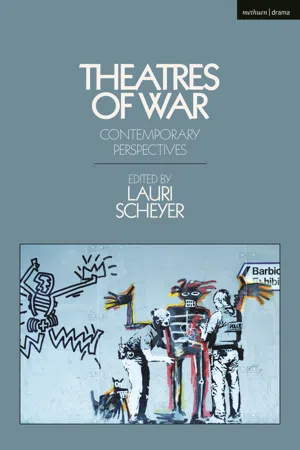
- 216 pages
- English
- ePUB (mobile friendly)
- Available on iOS & Android
eBook - ePub
About this book
Information
Section One
British, Irish, and American Perspectives on Theatres of War
1
“Carry on to the Place of Pain”: Embodiment and Aversion in Sean O’Casey’s The Silver Tassie
Sean O’Casey’s play The Silver Tassie offers a thorough critique of the ideology of war, focusing largely on the mass psychological inability of society to reconcile its own investment in war with the effects that war registers on the bodies of dead and surviving soldiers. O’Casey also critiques social discourses around masculinity that forge the pervasive expectation that soldiers should be unscathed by their traumatic experiences in battle, and overcome, on their own and silently, whatever physical and psychological problems they bring back from the war. In his compelling examination of the processes that structure the return of the wounded soldier to the home society, O’Casey focalizes attention on how the mass disavowal of the wounded soldier is part of a larger problem around the meaning of war for any society, even when ideology or propaganda does the work of convincing a nation that the war was, in the first instance, a just one. The Silver Tassie turns its critical gaze away from war itself and back onto the audience to ask fundamental questions about how wars are simultaneously acknowledged and disavowed by societies that wage them, and how this dynamic influences the reception of the soldier who returns wounded and scarred by battle.
The Silver Tassie opens in the Dublin apartment of the Heegan family. Harry Heegan is home on a short leave from the war and has been instrumental in winning the coveted Silver Tassie for his home football club. His girlfriend, Jessie, is physical in her affections and hints at marriage between the two upon Heegan’s return from the front. Act 2 shifts to the trenches of France and is dominated by dark shadows and foreboding archetypal symbols and imagery, and also asserts, in its mostly incantatory dialogue, the uncanny and monstrous aspects of war. Act 3 shifts back to Dublin and is set in the hospital ward where Heegan is recovering from battle injuries, but where, it is also clear, he will be permanently paralyzed. Jessie now refuses to see her former boyfriend, signaling her intention to leave Heegan for another soldier who returned uninjured from the war. The break between Harry and Jessie is confirmed in Act 4, set in the dance hall of the football club; Jessie makes clear her amorous desires for Heegan’s former friend and fellow soldier, Barney. Angry and dismayed about the future, Heegan smashes the cup that he had been instrumental in winning.
The Silver Tassie occupies a central place in O’Casey’s biography as the play that severed the relationship between the playwright and the Abbey Theatre, which produced O’Casey’s previous work to much acclaim. Critics and biographers have been unstinting in their support for O’Casey against The Abbey’s decision not to produce the play in 1928, and most critics now agree that W.B. Yeats’s view that the play strayed too far from specifically Irish cultural and historical matters is not credible, since many Irish soldiers enlisted in the British Army to fight in the First World War. What is more likely is that the play served as a reminder, to Yeats and others, of how fraught the issue of Irish service in the British Army during the First World War had been, and O’Casey’s play threatened to stir up this divisive controversy. As Irish war historians like John S. Ellis have noted, the emergence of the First World War was politically fraught in Ireland because it exposed deep political and social fissures within the nation, especially around recruitment. The Silver Tassie takes up this debate, and while O’Casey would not have identified himself with the nationalist position in Ireland, his play offers something near to a dismantling of the Unionist and constitutionalist view of the war, which the Abbey directorate, especially Yeats and Lady Gregory, supported. As Ellis asserts, “constitutionalists widely believed that the blood of nationalist and unionist soldiers would provide the cement that would seal the national divisions of Ireland” (2001: 20).
Recruitment, in Ireland as elsewhere, relied on exploiting pervasively held social investments in masculinity, especially around perceptions of strength, bravery, aggressivity, and self-sacrifice. There is, in Act 1 of The Silver Tassie, a somewhat exaggerated and irrationally giddy celebration of youth, vitality, and aggressivity because these are traits that men, according to O’Casey, learn in peacetime and use in war. For example, shortly after Harry appears on stage hoisting the Silver Tassie, he narrates the moment where he scores the winning goal:
HARRY. Slipping by the back rushing at me like a mad bull, steadying a moment for a drive, seeing in a flash the goalie’s hands sent with a shock to his chest by the force of the shot, his half-stunned motion to clear, and then carrying him, the ball and all with a rush into the centre of the net.
BARNEY. [enthusiastically] Be-God, I did get a thrill when I seen you puttin’ him sittin’ on his arse in the middle of the net! (1965: 40–1)
The imagery and diction here is expressly militaristic: the domination of space and attacking strategy implied in the phrase “slipping by the back” gives way to the evasive gesture required when the enemy rushes at you headlong “like a mad bull.” A soldier would “[steady] a moment” before shooting and might also see the enemy take the bullet in the chest in a “half-stunned” way. Barney completes the picture: not only has the enemy been shot and stunned, but has also been knocked to the ground, in a virtual or proxy death that points to how sport allows competitors to engage in vicarious life and death scenarios.
Furthermore, in Act 1, Harry is, largely because of his prowess in the realm of sport, also the object of sexual attention from both Jessie and Susie Monican. Jessie’s flirtations with Harry are overt, while Susie sublimates her seemingly unrequited desire for Harry through overt religiosity. She chides Barney’s attempts to flirt with her, but encourages Harry’s flirtation, despite the fact that Harry is informally betrothed to Jessie.
SUSIE. [slipping her arm around Harry’s neck, and looking defiantly at Barney]. I don’t mind what Harry does; I know he means no harm, not like other people. Harry’s different. (1965: 42)
Harry is different because he is revealed, in Act 1, to be something like the apotheosis of heteronormative masculine agency: he is sexually forward, athletic and vital, and also carefree and adventure-seeking. He does not dwell on the consequences of his actions or choices, recede from any challenge, and he boldly embraces the moment for whatever pleasure it gives him.
The overdetermination of agential, even aggressive masculinity in Act 1 is undercut in the surreal battle scene of Act 2, where the men are depicted as static and helpless in the face of the technologies of war. The bleak and archetypal images of sacrificial death describe a world that is so unrecognizable as to be rendered fundamentally incompatible with the world of Act 1. O’Casey’s highly expressionist mode in Act 2 is meant to stress the irreconcilability of the world of war and the world of relative peace, and portend the unlikeliness of a return to normalcy for the men who serve. This sense of rupture is communicated in a number of ways in the scene, but most strikingly in mesmeric, almost incantatory passages like the following:
CORPORAL. Dreams of line, of colour, and of form;
Dreams of music dead for ever now;
Dreams in bronze and dreams in stone have gone
To make thee delicate and strong to kill. (1965: 64–5)
Dreams of music dead for ever now;
Dreams in bronze and dreams in stone have gone
To make thee delicate and strong to kill. (1965: 64–5)
Act 2 is meant to communicate the conditions of battle less through denotation than visceral affect, with the corollary proposition that war is not something the soldier understands, or even necessarily does, but is something that happens to him or her viscerally, deepening, as James Moran observes, its symbolic meaning “through song, rhythmical movements and repetitive chant” (2013: 78). In important ways, this description of war confirms an argument advanced by Elaine Scarry in her landmark work, The Body in Pain. War, Scarry says, exposes the body to pain that “remains inarticulate or else the moment it first becomes articulate it silences all else: the moment language bodies forth the reality of pain, it makes all further statements and interpretations seem ludicrous and inappropriate, as hollow as the world content that disappears in the head of the person suffering” (1985: 60). O’Casey centralizes this aspect of pain and injury in Acts 3 and 4, where Heegan is progressively alienated from others and the social world, in contrast to Act 1, where he is literally and figuratively centralized in the world of the play. O’Casey’s blocking of Act 1 has Heegan occupy the center of the stage with the other characters gathered around him, intimating he is the center of this social world. Heegan dominates the space of the stage physically, lifting up the women and exuberantly pushing and shoving the men. This will all be starkly contrasted in Acts 3 and 4, where the scene blocking has Heegan in the center of the stage far less, and where he does not physically dominate the space in the same expressive ways that he does in Act 1.
Harry’s displacement from the center of society to the margins is confirmed at the beginning of Act 4:
JESSIE. [hot, excited, and uneasy, as with a rapid glance back she sees the curtains parted by Harry]. Here he comes prowling after us again! His watching of us is pulling all the enjoyment out of the night. It makes me shiver to feel him wheeling after us.
BARNEY. We’ll watch for a chance to shake him off, an’ if he starts again we’ll make him take his tangled body somewhere else. [As Harry moves forward from the curtained entrance] Shush, he’s comin’ after us. (1965: 88)
Harry has become something of a spectral presence, reminding the social world of its recent wartime past. That Jessie is looking backward at Harry suggests that it is the recent past that is chasing after her. In terms that we might borrow from Scarry, Harry embodies a past that continues to haunt a present that seeks to disqualify and disown that past formation. Barney’s response to Jessie, that they simply go somewhere else, confirms O’Casey’s (and Scarry’s) view that it is easier for a society to attempt to evade this kind of self-understanding than face it. Through these three characters, O’Casey allegorizes the ways in which the returning soldier is socially decentered and becomes the site of intense feelings of aversion and avoidance.
The character of Jessie has proven most vexing for even O’Casey’s more perceptive critics. Bernard Benstock condemns what he calls “Jessie’s treachery in choosing the healthy Barney in preference to the crippled Harry Heegan” (1976: 158) adding that “Jessie is incapable throughout of feeling anything for anyone but herself, and is unable to hide her discomfort in the presence of the cripple who had been her lover” (1976: 158). Heinz Kosok notes that “without reflection, she simply and instinctively admires the strongest and most impressive” (1985: 97) male characters: in Act 1, this is Harry, while in Acts 3 and 4, this is Barney. The problem with both readings, which is endemic to much of the criticism of the play, is that Benstock and Kosok are reading the character of Jessie on the level of psychological and social realism after the play has made a decisive turn toward allegory. Jessie is not acting out human instincts (Kosok) or self-serving choices (Benstock) but is emblematic of the wider social reception that the wounded, returning soldier can expect to receive.
What O’Casey focalizes for the audience through the character of Jessie, then, is the mass disavowal the postwar society performs around the figure of the dead and wounded soldier. As Scarry contends, a society must transform itself into a war society in order to succeed in war, but it will, as a rule, have no interest in continuing to see itself as a murder and maiming society after the war is over. The disavowal of that disturbing, prior sense of self is transacted through the disavowal of the war dead and the returning, injured soldier. As Scarry notes in her reading of the mass psychosis around war and aversion:
The only thing more overwhelming than that a human community should have a use for death, the extreme “use for” that is signaled by the shift from “it is needed” to “it is required” (and soldiers understand that it is this use to which have been summoned, this to which they have consented: that they are going either “to die for one’s country” or “to kill for one’s country”) the only thing more overwhelming than that fact that it will have this use for death is that the community will then disown that use and designate those deaths “useless.” (1985: 73)
It is not just Jessie and Barney who want Heegan removed from society; they are simply the most overt voices advocating for this. It is all of the characters who believe that Harry should be removed from social space for the collective benefit. For example, the otherwise oblivious figure of Simon notes, in Act 4, “To carry life and colour to where there’s nothing but the sick and helpless is right; but to carry the sick and helpless to where there’s nothing but life and colour is wrong” (1965: 90). Harry’s father, Sylvester Heegan, remarks that “When we got the invitation from the Committay to come, wearin’ his decorations, me an’ the old woman tried to persuade him that, seein’ his condition, it was better to stop at home, an’ let me represent him, but [with a gesture] no use!” (1965: 91). Simon and Sylvester might believe that absenting him from society would spare Harry what Ron Ayling, in discussing an earlier O’Casey play, terms “the spiritual anguish” (1980: 30) that his characters frequently embody, but both advocate that Harry be removed from social space so others do not have to face the effects of the war on its injured victims. In fact, late in the play, Susie Monican, who seems genuinely sympathetic toward Harry in Act 3, observes, “Teddy Foran [who has also been injured in the war] and Harry Heegan have gone to live their own way in another world. Neither I nor you can lift them out of it. No longer can they do the things we do” (1965: 105).
The “we” that Susie utters here is meant to include not just the characters on stage, but, importantly for O’Casey, the audience as well. As The Silver Tassie concludes, the audience itself becomes increasingly the object of O’Casey’s critical attention. This is made evident in a number of subtle and explicit ways in the play, but among the more interesting and important involves a protracted exchange between Simon and Sylvester Heegan around their aversion to the ringing telephone at the dance hall. What quickly emerges is that neither feels sufficiently confident in handling the new technology of the telephone to accept the call:
SYLVESTER. [nervously] I never handled a telephone in my life.
SIMON. I chanced it once and got so hot and quivery that I couldn’t hear a word, and didn’t know what I was saying myself. (1965: 91)
Two things are accomplished in this scene. The first is that O’Casey is able to extend the view, central to the play, that we are frightened by things that are unfamiliar to us, that force us to change our abiding perception of the world. The men certainly fare poorly in the task, taking so long to answer the telephone that the caller hangs up. In this respect, they resemble some of the “failed masculine subjects” (2006: 42) that are central, as Cathy Airth reminds us, to O’Casey’s earlier plays. But more than this, this scene is, like all of Act 4, meant to engage with the ethics of spectatorship. Here, O’Casey presents us with a comic scene that invites the audience to laugh at the spectacle of incapacity and uncertainty that plagues both male characters. Significantly, the audience is laughing at two people who cannot perform a behavior that many, even at the time, would have seen as automatic, effortless, and not fraught to the point of panicked insecurity. Immediately following this jocular scene, we are confronted with the depths of Harry’s anger over his plight, which, similarly, derives from his inability, in his current state, to perform acts that we might take for granted. Now, though, the members of the audience have to ask themselves what it was that made them laugh at Sylvester and Simon. What is it that we find funny in people who cannot do things that we think are easy? What does it say about society that laughter could resonate through a crowded theatre where...
Table of contents
- Cover
- Halftitle Page
- Title Page
- Contents
- Acknowledgments
- Introduction: Theatres of War: Contemporary Perspectives
- Section One British, Irish, and American Perspectives on Theatres of War
- Section Two Global Perspectives on Theatres of War
- Section Three Perspectives on Black Watch
- Section Four Perspectives on The Great Game: Afghanistan
- Contributor Biographies
- Imprint
Trusted by 375,005 students
Access to over 1.5 million titles for a fair monthly price.
Study more efficiently using our study tools.
Frequently asked questions
Yes, you can cancel anytime from the Subscription tab in your account settings on the Perlego website. Your subscription will stay active until the end of your current billing period. Learn how to cancel your subscription
No, books cannot be downloaded as external files, such as PDFs, for use outside of Perlego. However, you can download books within the Perlego app for offline reading on mobile or tablet. Learn how to download books offline
Perlego offers two plans: Essential and Complete
- Essential is ideal for learners and professionals who enjoy exploring a wide range of subjects. Access the Essential Library with 800,000+ trusted titles and best-sellers across business, personal growth, and the humanities. Includes unlimited reading time and Standard Read Aloud voice.
- Complete: Perfect for advanced learners and researchers needing full, unrestricted access. Unlock 1.5M+ books across hundreds of subjects, including academic and specialized titles. The Complete Plan also includes advanced features like Premium Read Aloud and Research Assistant.
We are an online textbook subscription service, where you can get access to an entire online library for less than the price of a single book per month. With over 1.5 million books across 990+ topics, we’ve got you covered! Learn about our mission
Look out for the read-aloud symbol on your next book to see if you can listen to it. The read-aloud tool reads text aloud for you, highlighting the text as it is being read. You can pause it, speed it up and slow it down. Learn more about Read Aloud
Yes! You can use the Perlego app on both iOS and Android devices to read anytime, anywhere — even offline. Perfect for commutes or when you’re on the go.
Please note we cannot support devices running on iOS 13 and Android 7 or earlier. Learn more about using the app
Please note we cannot support devices running on iOS 13 and Android 7 or earlier. Learn more about using the app
Yes, you can access Theatres of War by Lauri Scheyer in PDF and/or ePUB format, as well as other popular books in Media & Performing Arts & Theatre. We have over 1.5 million books available in our catalogue for you to explore.