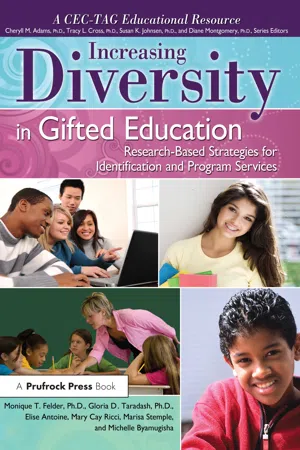
Increasing Diversity in Gifted Education provides guidance for meeting the educational needs of high-potential students across many racial, ethnic, language, and economic groups as well as some categories of disability. Using this book, educators of high potential and gifted students from backgrounds that are traditionally underrepresented and underserved in gifted and advanced instructional settings, can guide these students to achieve and make significant contributions to all aspects of American society. Practitioners will also gain the information and knowledge needed to increase the identification of culturally, linguistically, and ethnically diverse (CLED) and twice-exceptional students for gifted education programs and services.
eBook - ePub
Increasing Diversity in Gifted Education
Research-Based Strategies for Identification and Program Services
- 132 pages
- English
- ePUB (mobile friendly)
- Available on iOS & Android
eBook - ePub
Increasing Diversity in Gifted Education
Research-Based Strategies for Identification and Program Services
About this book
Information
CHAPTER 1
Overview of Gifted Identification Issues Related to Students from Culturally, Linguistically, and/or Ethnically Diverse (CLED) Backgrounds and Those With Disabilities
DOI: 10.4324/9781003235767-1
“Some of the attitudes that create barriers are things like poor kids and gifted programs just don’t go together. I mean, I think that people in their heart of hearts really think that when kids are poor they can’t possibly perform at the level of kids that are advantaged because they haven’t had certain kinds of advantages in their home.”—Dr. Mary Frazier (Grantham, 2002, p. 50)
IDENTIFICATION
The definition of giftedness adopted by a school district delineates the first entry point to gifted identification and placement. Definitions of giftedness and state plans, which outline the criteria to qualify for gifted programs and services, are developed by various entities. They may be written by the state legislatures, state departments of education, the state boards of education, or a body named to address education issues. According to the National Association for Gifted Children and Council of State Directors of Programs for the Gifted’s (NAGC & CSDPG, 2013) 2012–2013 State of the Nation in Gifted Education: Work Yet to be Done report, although half (i.e., 27 out of 47) of the states reported more inclusive definitions, only five states included culturally/ethnically diverse populations and only five included gifted students from low-socioeconomic (SES) backgrounds in their definition of gifted. A mere three states included English language learners, and a disappointing two included gifted students with disabilities (NAGC & CSDPG, 2013). As school systems develop their plans for identifying and serving gifted and talented students, care must be taken to be inclusive of all populations. Additionally, all pertinent materials must be accessible. For instance, Texas ranks second in Hispanic/Latino population size and the Texas State Plan for the Education of Gifted/Talented Students (Texas Education Agency, 2009) is printed in both English and Spanish in the same booklet.
The definition of giftedness that has been most widely adopted by states was issued in the Marland Report (Marland, 1972), which defined gifted children as those capable of high performance, including those with demonstrated achievement and/or potential ability in any of the following areas (singly or in combination): general intellectual ability, specific academic aptitude, creative or productive thinking, leadership ability, visual and performing arts, and psychomotor ability. The United States Department of Education, Office of Educational Research and Improvement (1994), expanded the definition of gifted to include children who show potential for remarkably high levels of accomplishment when compared with others of their age, experience, or environment. The criteria of showing potential for high levels of accomplishment increased the opportunity to include more CLED students. Although most states have adopted a broad definition of giftedness, few actually identify or serve students in all areas.
Exclusive definitions of gifted and talented students or those that focus on only one area of giftedness can be unsuitable for use when identifying CLED students, students in some categories of disability, and students from low-SES backgrounds. Each culture defines giftedness in its own likeness or based on its own image; hence, giftedness in one culture may be expressed differently from giftedness in another culture.Addressing the challenges of identification can be even more complex when a student is a recent immigrant. When seeking to identify recent immigrants who may be gifted, educators need to have knowledge of linguistic and cultural backgrounds, sociocultural peer-group expectations, cross-cultural stress, intergenerational conflict and attitudinal factors to support effective identification practices (Harris, 1993). Assessment of teacher awareness of immigrant issues and hardships and providing regular opportunities for conversations regarding the implications of negative attitudes and possible biases with teachers are suggested areas of focus for professional development (Harris, 1993; Harris, Guenther, Rosemarin, & Eriksson, 2009).
All children come to the classroom shaped by a myriad of cultural and social influences. Yet, “most schools are middle-class systems that operate from middle-class values” (Slocumb & Payne, 2000, p. 28). Just talking about differences remains an uncomfortable proposition for professionals and laypersons (Ford, 2010). As a result, most school systems use teacher surveys and other subjective performance indicators based on middle-class norms and values as part of their gifted and talented identification and programming processes. Environmental factors such as poverty are typically not considered. Understanding issues of poverty should be central in the gifted and talented identification and programming process, as some immigrant and CLED students may come from low-SES backgrounds and may not have had the same opportunities as their middle class peers.
Teachers, counselors, and administrators are often the school personnel who refer students for gifted and talented services and provide input for gifted identification processes; yet, too often they are unaware of the characteristics of gifted and talented students with disabilities and those from diverse backgrounds. Teachers who have had training in gifted and talented identification recognize certain behaviors as indicators of potential; however, this training, which has been modified and refined over the decades, typically focuses on behaviors and characteristics of children who are White, middle-class, and without disabilities (Neumeister & Burney, 2011). As school populations have become increasingly diverse through the 1990s, the need for a change in teacher training became apparent. NAGC and The Association for the Gifted, Council for Exceptional Children (CEC-TAG) also revised their Teacher Knowledge and Skill Standards for Gifted and Talented Education in 2006 to respond to this need for better understanding of diversity. This revision of gifted teacher preparation standards infuses issues of human diversity and its impact on families, communities, and schools throughout the standards.
Increasing the identification and placement of underrepresented minorities and students in some categories of disability such as twice-exceptional students in gifted and talented programming will not automatically create equitable access, participation, or achievement for them. For example, because of cultural differences and their developing language acquisition, English language learners may not display the typical characteristics considered by teachers making referrals for gifted screening (Matthews, 2006, 2014). Behaviors, which may be culturally based, may not be recognized as indicators of academic success. In the chapter on English language learners, cultural bias is examined. Obstacles to identification and suggestions to teachers for best practices are outlined.
Behaviors and characteristics that are recognized in the Hispanic/Latino community as indicators that the child “has something special” may not be recognized at all in the school setting. Immigration concerns may have a smothering effect on demonstration of exceptional potential. The chapter on Hispanic/Latino gifted learners will present research focusing on the effects of community and immigration on identification.
Traditionally recognized definitions of giftedness, singular in nature with a focus primarily on academic intelligence, support identification based on high IQ scores and act as a barrier to diverse gifted learners being identified and reaching their full potential. The awareness of characteristics that may differ from mainstream gifted students can aid in identification. The chapter on African American gifted learners presents practical applications and research-based guidelines to guide culturally sensitive identification.
Twice-exceptional learners can present unique characteristics that may mask their giftedness. There is a need to understand their unique array of strengths and weaknesses. They may possess advanced visual-spatial reasoning ability, problem-solve using images, and think in pictures versus in words. In-depth descriptors of these gifted students are presented. Obstacles to identification are identified and research-based best practices for success using a variety of materials and strategies are also presented. In all of the populations presented in this book, parents play a key role in the referral and identification processes; hence, outreach to parents of diverse gifted or potentially gifted students, including twice-exceptional students, is also critical.
When teachers and other professionals understand the characteristics, strengths, and weaknesses of CLED gifted children as well as the characteristics, strengths, and weaknesses of gifted students with disabilities, they will have established the foundation that supports appropriate identification and service to these groups of students. Professional development that is designed to develop cultural competence and cultural proficiency (Lindsey, Robins, & Terrell, 2003) is a key component in the framework that guides teachers and school leaders to evaluate behaviors using a cultural lens that can reveal the hints and clues of exceptional potential in the CLED student population.
In the 1970s, gifted and talented educators came together to write, speak, and advocate for gifted children—children who were at risk from benign neglect. Through the combined advocacy of the great pioneers in the field, dedicated teachers, and committed parents, children with gifts and talents were recognized and supported as learners with unique needs who had the potential to change society when the path was prepared for them. In the 21st century, that same group commitment and advocacy are necessary to bring about results for another group of gifted children suffering from unrealized potential—gifted and talented students from CLED backgrounds and those with disabilities.
REFERENCES
- Ford, D. Y. (2010). Culturally responsive classrooms: Affirming culturally different gifted students. Gifted Child Today, 33(1), 50–53.
- Grantham, T. (2002). Straight talk on the issue of underrepresentation: An interview with Dr. Mary Frazier. Roeper Review, 24, 50–51.
- Harris, C. (1993). Identifying and serving recent immigrant children who are gifted. ERIC Clearinghouse on Disabilities and Gifted Education. Retrieved from http://www.gifted.uconn.edu/siegle/tag/Digests/e520.html
- Harris, C., Guenther, C., Rosemarin, S., & Eriksson, R. (2009, August). Gifted immigrants and refugees—The gold unmined. Presentation at the 18th World Council for Gifted and Talented Children, Vancouver, Canada.
- Lindsey, R., Robins, K., & Terrell, R. (2003). Cultural proficiency: A manual for school leaders. Thousand Oaks, CA: Corwin Press.
- Marland, S. P., Jr. (1972). Education of the gifted and talented: Report to the Congress of the United States by the U.S. Commissioner of Education and background papers submitted to the U.S. Office of Education, 2 vols. Washington, DC: U.S. Government Printing Office. (Government Documents, Y4.L 11/2: G36)
- Matthews, M. (2006). Working with gifted English language learners. Waco, TX: Prufrock Press.
- Matthews, M. S. (2014). Advanced academics, inclusive education, and English language learners. In M. S. Matthews & J. A. Castellano (Eds.), Talent development for English language learners: Identifying and developing potential (pp. 1–13). Waco, TX: Prufrock Press.
- National Association for Gifted Children, & The Association for the Gifted, Council for Exceptional Children. (2006). NAGC-CEC teacher knowledge and skill standards for gifted and talented education. Retrieved from http://www.nagc.org.442elmp01.blackmesh.com/sites/default/files/standards/NACG-CEC%20CAEP%20standards%20(2006).pdf
- National Association for Gifted Children, & Council of State Directors of Programs for the Gifted. (2013). 2012–2013 State of the nation in gifted education: Work yet to be done. Washington, DC: Authors. Retrieved from http://www.nagc.org/sites/default/files/Advocacy/State%20of%20the%20Nation.pdf
- Neumeister, K., & Burney, V. (2011). An introduction to gifted education:The complete kit for facilitators, coordinators, and in-service training professionals. Waco, TX: Prufrock Press.
- Slocumb, P., & Payne, R. (2000). Removing the mask: Giftedness in poverty. Highlands, TX: aha! Process, Inc.
- Texas Education Agency. (2009). Texas state plan for the education of gifted/talented students Austin, TX: Author. Retrieved from http://www.tea.state.tx.us/index2.aspx?id=6420
- U.S. Department of Education, Office of Educational Research. (1994). National excellence: A case for developing America’s talent. Washington, DC: U.S. Government Printing Office.
CHAPTER 2
African American Gifted Learners
DOI: 10.4324/9781003235767-2
The academic performance of African American students is a longstanding and ongoing national problem. More than four decades of data indicate that African Americans are among the ethnically diverse students who are not achieving at the same rate as their White, Asian, and more socioeconomically privileged peers (Ford, 2011). When the United States Department of Education collected data on African American students identified for gifted programs in 1996, the data indicated that while African American students comprised approximately 17% of the student population, they made up approximately 8% of the students enrolled in gifted and talented programs. This represented approximately 250,000 African American students who were not being provided the opportunity to participate in programs for the gifted (Ford, 2013; United States Department of Education, 1996). Sixteen years later the data remain relatively unchanged. In 2012, the United States Department of Education Office for Civil Rights reported that African Americans represent 19% of the student population, yet they make up 10% of students participating in gifted programs. These data indicate that African American students continue to be disproportionately underrepresented in gifted programs. Hence, it is no surprise that African American students remain under-identified as gifted and talented and are underrepresented in gifted and talented programs and services (Ford, Harris, Tyson, & Trotman, 2002).
Why are African American students so grossly underidentified and underrepresented in gifted and talented programs and services? Although more research in this area is clearly warranted, research conducted to date indicates that there are many reasons for these situations. The reasons include: (a) use of a conservative definition of giftedness or definitions that do not include the characteristics of some African American students (i.e., oral tradition—a preference to explain something verbally instead of taking a paper-and-pencil test [VanTassel-Baska & Stambaugh, 2007]); (b) issues with screening and selection processes (e.g., intelligence tests as gatekeepers [Ford, 2013]); (c) issues with school personnel and professional development; and, last but not least; (d) instructional and cultural issues (Ford, 2011, 2013).
CONSERVATIVE DEFINITIONS OF GIFTED...
Table of contents
- Cover
- Half Title
- Title Page
- Copyright Page
- Table of Contents
- Introduction
- Chapter 1: Overview of Gifted Identification Issues Related to Students From Culturally, Linguistically, and/or Ethnically Diverse (CLED) Backgrounds and Those With Disabilities
- Chapter 2: African American Gifted Learners
- Chapter 3: Hispanic/Latino Gifted Learners
- Chapter 4: Gifted English Language Learners
- Chapter 5: Twice-Exceptional Students
- Chapter 6: Promising Practices From the Field: Identifying and Retaining Diverse Students in Gifted Programs: Voices of the Teachers of CLED Students
- Chapter 7: One Perspective: The Challenges and Triumphs of a Former CLED Student in Programs for Gifted Middle School and High School Students
- Chapter 8: Closing Words
- Appendix A: Resources
- Appendix B: Diverse Gifted Learners: Teacher Survey Protocol
- About the Authors
Trusted by 375,005 students
Access to over 1.5 million titles for a fair monthly price.
Study more efficiently using our study tools.
Frequently asked questions
Yes, you can cancel anytime from the Subscription tab in your account settings on the Perlego website. Your subscription will stay active until the end of your current billing period. Learn how to cancel your subscription
No, books cannot be downloaded as external files, such as PDFs, for use outside of Perlego. However, you can download books within the Perlego app for offline reading on mobile or tablet. Learn how to download books offline
We are an online textbook subscription service, where you can get access to an entire online library for less than the price of a single book per month. With over 1.5 million books across 990+ topics, we’ve got you covered! Learn about our mission
Look out for the read-aloud symbol on your next book to see if you can listen to it. The read-aloud tool reads text aloud for you, highlighting the text as it is being read. You can pause it, speed it up and slow it down. Learn more about Read Aloud
Yes! You can use the Perlego app on both iOS and Android devices to read anytime, anywhere — even offline. Perfect for commutes or when you’re on the go.
Please note we cannot support devices running on iOS 13 and Android 7 or earlier. Learn more about using the app
Please note we cannot support devices running on iOS 13 and Android 7 or earlier. Learn more about using the app
Yes, you can access Increasing Diversity in Gifted Education by Monique Felder,Gloria Taradash,Elise Antoine in PDF and/or ePUB format, as well as other popular books in Education & Inclusive Education. We have over 1.5 million books available in our catalogue for you to explore.