An interdisciplinary examination of nineteenth-century French art pertaining to religion, exile, and the nation's demise as a world power, this study concerns the consequences for visual culture of a series of national crises—from the assault on Catholicism and the flight of émigrés during the Revolution of 1789, to the collapse of the Empire and the dashing of hope raised by the Revolution of 1830.
The central claim is that imaginative response to these politically charged experiences of loss constitutes a major shaping force in French Romantic art, and that pursuit of this theme in light of parallel developments in literature and political debate reveals a pattern of disenchantment transmuted into cultural capital. Focusing on imagery that spoke to loss through visual and verbal idioms particular to France in the aftermath of the Revolution and Empire, the book illuminates canonical works by major figures such as Eugène Delacroix, Théodore Chassériau, and Camille Corot, as well as long-forgotten images freighted with significance for nineteenth-century viewers. A study in national bereavement—an urgent theme in the present moment—the book provides a new lens through which to view the coincidence of imagination and strife at the heart of French Romanticism.
The book will be of interest to scholars working in art history, French literature, French history, French politics, and religious studies.
The Open Access version of this book, available at http://www.taylorfrancis.com, has been made available under a Creative Commons Attribution-Non Commercial-No Derivatives 4.0 license.
Merely one year before First Consul Napoleon Bonaparte reestablished Catholicism in France, visitors to the Salon of 1800 could view a remarkable example of contempt for the nation’s Christian heritage. Louis-François Petit-Radel (1739–1818), an architect with the title of inspector general of civil structures, exhibited a guide to the “Destruction of a Church in the Gothic Style, by Means of Fire”:
In order to minimize the dangers which this kind of operation entails, the piers are to be hollowed, near their bases, at a height of two stone courses. As stones are removed, half their volume is replaced by dry wood. This is continued throughout. Kindling is then inserted, and fire set to the wood. When enough of the wood has burned, it gives way under the weight of the masonry, and the whole structure collapses in less than ten minutes.1
This dispassionate language, so at odds with its latent fury, was of a piece with the detachment of the architect, whose entry above was accompanied by two others—an interior of an Egyptian temple and a Roman gallery leading up to a naumachia (i.e., an arena in which naval battles were staged). As noted in the Salon guidebook: “The author wished to present, in these three pictures, the parallel between Roman, Egyptian, and Gothic architecture.”2
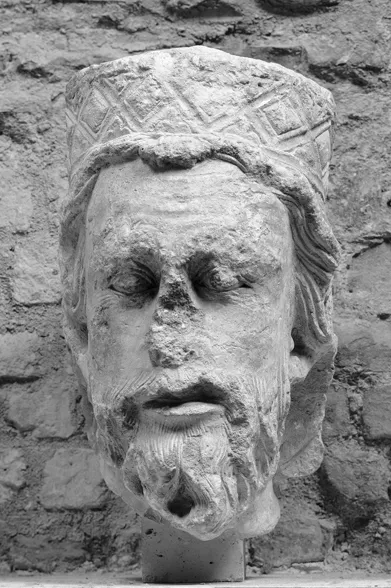
That a lesson in the destruction of a medieval monument could figure in a demonstration of archaeological erudition not only normalizes anti-ecclesiastical violence, but also speaks of hatred for the monarchy from which the Church was inseparable. In the autumn of 1793, great effort went into a brutal act of separation in central Paris. With the Reign of Terror dawning, scaffolding more than 15 meters high was erected to reach the 28 polychrome statues (each of 3.5 meters) of kings of Judah adorning the façade of Notre-Dame. Mistaken for French monarchs since the late thirteenth century, the Old Testament royals were zealously set upon.3 When obliteration of the finials of crowns and scepters was deemed insufficient, the figures were removed and lowered—an arduous operation (December 1793–September 1794) supervised by the architect Bernard Poyet (1742–1824). In 1977, a cache of 21 severed heads of these ancestors of Christ was unearthed with more than 300 other sculptural fragments during excavation at the stables of the hôtel Moreau (20, rue de la Chaussée-d’Antin), which had belonged to Jean-Baptiste Lakanal-Dupuget (brother of the deputy to the Convention, Joseph Lakanal). I show one of the salvaged items (Figure 1.1).4
Lakanal-Dupuget’s architect apparently acquired the rubble as fill in March 1796. Previously, according to the Parisian chronicler Louis-Sébastien Mercier (1740–1814), it had remained heaped behind the cathedral, serving as a public latrine.5 Bearing witness to anti-monarchic rage, the battered heads speak of tacit acknowledgment, on the part of Poyet and the mason he directed, of the symbolic power of these royal cathedral guardians.
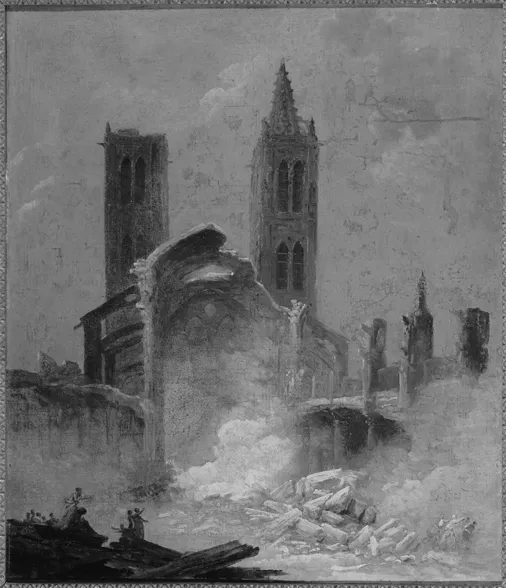
In the year that Petit-Radel’s leveling procedure was exhibited in the Salon, it was successfully tested on the early fourteenth-century Parisian church of Saint-Jean-en-Grève in the parish of the Hôtel-de-Ville. Taken out of ecclesiastical service in 1790, the church was demolished (1797–1800). Its demolition was recorded by the preeminent specialist in ruins, Hubert Robert (1733–1808; Figure 1.2).6
Figure1.2 Hubert Robert, The Demolition of the Church of Saint-Jean-en-Grève in 1800, ca. 1800, oil on canvas, 80 × 71 cm. Paris, Musée Carnavalet. CCO Paris Musées/Musée Carnavalet.
Combustion glows and smokes at the base of an exposed pier as the asymmetrical bell towers of the west end await obliteration. Diminutive spectators occupying a shaded foreground repoussoir share our view from the east into the structure’s receding bowels. Robert’s conventionally scenic composition aestheticizes an event redolent with fanaticism. This sad memento anticipates the photographs of the charred remains of public buildings (such Saint-Jean-en-Grève’s neighbor, the Hôtel de Ville) that would provide a tourist attraction in post-Commune Paris. On 22 December 1801, a newspaper marveled at the efficiency and safety with which the bell tower of the church of Saint-André-des-Arts (where Voltaire had been baptized) had succumbed to the same technique: with minimal dispersion of stone, it was reported, the tower fell within its cramped setting 10 minutes after the fire was set.7
Petit-Radel’s disregard for medieval architecture was longstanding. In response to an inquiry from the revolutionary government regarding the conservation of the Abbey church of Saint-Denis, he proposed demolition of the vaulted roof so as to permit conversion of the structure to a covered, enclosed market.8 Even before the Revolution, he nursed antipathy toward the Gothic style. In 1784, he brought the late Gothic Parisian church of Saint-Médard up to date by fitting out the choir columns with neo-classical fluting and Doric capitals, sounding an anachronistic note beneath the groin vaulting.9
Anticipating the frightful recipe displayed in the Salon of 1800, Petit-Radel’s remodeling of Saint-Médard also foreshadowed revolutionary de-Christianization. This campaign began in September 1793, climaxed in the spring of 1794, abated between February 1795 and the autumn of 1797, and resurged from September 1797 to December 1799.10 In the heady days of the early Revolution, notwithstanding resentment of the wealth, dysfunction, and exploitative aspect of the clerical establishment, there was little evidence of either irreligion or denigration of Catholicism. Initially, government intrusion into Church affairs was guided by patriotic interest in state stewardship of worship, and a wish to respectfully position the established faiths within the new, revolutionary order. When, on 2 November 1789, the Constituent Assembly nationalized church property, the government assumed support of all aspects of ecclesiastical life, including churches, clergy, seminaries, teaching, and charity. Having dissolved all French monasteries and convents (February 1790), the Assembly promulgated the Civil Constitution of the Clergy (ratified 24 August 1790); this transformed French clerics into civil servants, henceforth to be elected by the laity, including nonbelievers. Well-meaning reform rapidly shaded into intolerance. Clergymen were compelled (by a decree, unwillingly signed by the king, 26 December 1790) to swear allegiance to the Civil Constitution.11 Pursuant to a law of 26 August 1792, all réfractaire priests (i.e., those who refused the oath) were required to leave France within 15 days or be deported to French Guiana. Legal coercion preluded mob violence. Three bishops and 220 priests were among the victims when, amid war hysteria, some 1400 Parisian prison inmates suspected of opposition to the Revolution were massacred on 2–4 September 1792.
On 10 November 1793, shortly after a decree (23 October) required the complete removal of the sculptures of biblical kings from the facade of Notre-Dame, members of the Convention attended a Festival of Reason staged inside the cathedral that featured an opera actress personifying Liberty. A month later (23 November), the Commune of Paris ordered that all churches be closed. By the spring of 1794, most churches that remained open had been repurposed as temples of Reason. Representing the Convention in a crusade against religious fanaticism, superstition, and the “selfish rich” in the départements of Nièvre and Allier in central France, Joseph Fouché (1759–1820) considered de-Christianization essential to the Revolution’s mission of moral regeneration.12 Ever mindful of the importance of symbols, this former Oratorian led a dance in the town of Moulins around a bonfire of chasubles, copes and nun’s veils; on 10 October 1793, he decreed that churches be stripped of their ornaments and that cemeteries be inscribed “DEATH IS AN ETERNAL SLEEP.” In the département of Nord alone, 425 churches and 60 chapels were destroyed in two years.13
In view of this persecution, it is hardly surprising that the clerical corps was decimated during the 1790s. As many as 20,000 of the approximately 115,000 priests active before the Revolution are believed to have abandoned their ministry; another 30,000 either emigrated or were deported.14 That so many managed to hold on speaks to the resilience of worship, whose imperatives are no less universal than those of sports, music, and picture making. De-Christianization met strong popular resistance, and the downfall of the radicals led by Maximilien Robespierre (1758–94) heralded a Catholic revival strengthened by the revolutionary ideals of popular sovereignty and religious liberty.15 Nor was the Reign of Terror uniformly hostile to religion. Robespierre detested atheism, advocated religious tolerance, and, in accord with revolutionary precedent, venerated the Supreme Being—reference to whom was included in each iteration of the Declaration of Rights of Man and Citizen heading the Revolution’s three ephemeral constitutions.16
The cult of the Supreme Being stemmed from the Enlightenment’s deist legacy, most famously embodied in “The Profession of Faith of the Savoyard Vicar,” which occupies a sizeable portion of Jean-Jacques Rousseau’s Émile, or On Education (1762). There, reference to the Being (Être) is employed interchangeably with God (Dieu). Through the Savoyard vicar’s exhortation of the young Émile, Rousseau (1712–78) proposed a tolerant, natural religion of the heart, unconcerned with transcendence, salvation or damnation. This theology (for which the author was condemned by the Sorbonne and the Parlement of Paris) was institutionalized by Robespierre in 1793. On 8 June 1794 (just weeks before the execution of “the Incorruptible”), the Cult of the Supreme Being was celebrated in a vast pageant staged by Jacques-Louis David.17 Notwithstanding the magic of David’s choreography, it is hardly surprising that a creed so intangible and doctrinally spare did not endure. The short-lived Cult of the Supreme Being was succeeded by a second monotheistic revolutionary religion, Theophilanthropy, first celebrated in January 1797. Neither this nor the Culte décadaire (established by laws and a decree in August and September 1798)—which marked the ten-day weeks of the revolutionary calendar with patriotic festivals celebrating stirring themes ranging from maternal tenderness to martyrs of liberty—could survive outside of the ideological hothouse of the 1790s.
The Concordat
Napoleon’s coup d’état of 18 Brumaire (9 November 1799) put paid to the Revolution, and Catholicism officially returned to France on 15 July 1801 with the conclusion of secret negotiations for the Concordat.18 Fruit of 21 drafts, this treaty between the first consul and Pope Pius VII (1742–1829) proclaimed Catholicism the religion of the great majority of the French people, but (to the pontiff’s disappointment) denied that it was either the state religion or the sole protected faith. Guaranteeing liberty of religion, asserting the public nature of worship, and providing for state salaries to the clergy, the Concordat required all ecclesiastics to swear allegiance to the government; to report conspiracy against the state; and to lead solemn and public prayer for the Republic and the consuls. These assertions of governmental prerogative were accompanied by a provision making permanent a revolutionary legacy: the pope renounced all claim to nationalized Church property. All of this was consistent with the Janus-faced aspect of Napoleonic polic...
Table of contents
Cover
Half Title
Series Page
Title Page
Copyright Page
Dedication
Table of Contents
List of Figures
Acknowledgments
Introduction
1 Amid the Debris of Our Temples
2 Agony in the Garden
3 Banished
4 “He’s Not Dead!”
5 Heroism Lost
Epilogue: After the Terrible Year
Bibliography
Index
Trusted by 375,005 students
Access to over 1.5 million titles for a fair monthly price.
Study more efficiently using our study tools.
Frequently asked questions
Yes, you can cancel anytime from the Subscription tab in your account settings on the Perlego website. Your subscription will stay active until the end of your current billing period. Learn how to cancel your subscription
No, books cannot be downloaded as external files, such as PDFs, for use outside of Perlego. However, you can download books within the Perlego app for offline reading on mobile or tablet. Learn how to download books offline
Perlego offers two plans: Essential and Complete
Essential is ideal for learners and professionals who enjoy exploring a wide range of subjects. Access the Essential Library with 800,000+ trusted titles and best-sellers across business, personal growth, and the humanities. Includes unlimited reading time and Standard Read Aloud voice.
Complete: Perfect for advanced learners and researchers needing full, unrestricted access. Unlock 1.5M+ books across hundreds of subjects, including academic and specialized titles. The Complete Plan also includes advanced features like Premium Read Aloud and Research Assistant.
Both plans are available with monthly, semester, or annual billing cycles.
We are an online textbook subscription service, where you can get access to an entire online library for less than the price of a single book per month. With over 1.5 million books across 990+ topics, we’ve got you covered! Learn about our mission
Look out for the read-aloud symbol on your next book to see if you can listen to it. The read-aloud tool reads text aloud for you, highlighting the text as it is being read. You can pause it, speed it up and slow it down. Learn more about Read Aloud
Yes! You can use the Perlego app on both iOS and Android devices to read anytime, anywhere — even offline. Perfect for commutes or when you’re on the go. Please note we cannot support devices running on iOS 13 and Android 7 or earlier. Learn more about using the app
Yes, you can access Loss in French Romantic Art, Literature, and Politics by Jonathan P. Ribner in PDF and/or ePUB format, as well as other popular books in Arte & Arte europea. We have over 1.5 million books available in our catalogue for you to explore.