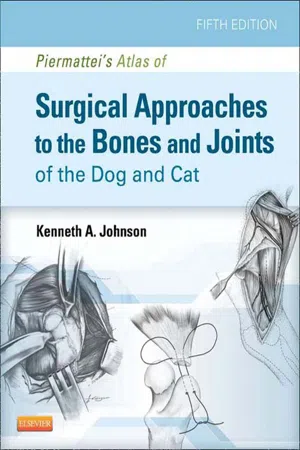
- NEW! Six all-new approaches to surgical procedures have been added to the text. They include: - Approach to the Lumbosacral Intervertebral Disk and Foramen Through a Lateral Transilial Osteotomy- Approach to the Medial Region of the Shoulder Joint- Minimally Invasive Approach to the Shaft of the Humerus- Approach to the Lateral Aspect of the Hemipelvis- Minimally Invasive Approach to the Shaft of the Femur- Minimally Invasive Approach to the Shaft of the Tibia- NEW! Expanded coverage of modifications required when performing orthopedic surgery on the cat include: - Approach to the Lateral Aspect of the Humeral Condyle and Epicondyle in the Cat- Approach to the Craniodorsal Aspect of the Hip Joint Through a Craniolateral Incision in the Cat- Approach to the Shaft of the Femur in the Cat- NEW! Updated images provide a better picture of various surgical approaches.
eBook - ePub
Piermattei's Atlas of Surgical Approaches to the Bones and Joints of the Dog and Cat
- 488 pages
- English
- ePUB (mobile friendly)
- Available on iOS & Android
eBook - ePub
Piermattei's Atlas of Surgical Approaches to the Bones and Joints of the Dog and Cat
About this book
Information
Topic
MedicineSubtopic
Veterinary MedicineSection 1
General Considerations

Attributes of an Acceptable Approach to a Bone or Joint
The bones and joints must be exposed in a manner that ensures the preservation of the anatomic and physiologic functions of the area invaded. Major blood vessels, nerves, ligaments, and tendons must be avoided or protected. Maximal use must be made of muscle separation, with incision of muscles being avoided whenever possible. Transection of muscle bellies must be kept at an absolute minimum; tenotomy or osteotomy of the muscles at their origin or insertion is much preferred. Skin incisions must be made in such a manner that the vascular supply to the wound margins is not impaired and so that underlying implants such as bone plates do not create tension on the skin closure. No pedicles or sharp angles should exist in the incision because these points commonly undergo avascular necrosis and may produce wound breakdown, infection, or excessive scar formation. A cosmetically acceptable scar should be one goal of the surgery.
In general, the procedure should not add unnecessary trauma to that which the injured area has already sustained. Although the incision may be longer, an adequately large exposure is, in the final analysis, less traumatic than a smaller exposure. With the smaller approach, the surgeon tends to exert excessive pressure when retracting muscles, which directly injures the muscle and also impairs circulation to the area.
Factors to Consider When Choosing an Approach
The Area to be Exposed
The problem of choosing the best approach is easily solved in some instances. For example, there is only one logical way to expose the midshaft of the femur (see Approach to the Shaft of the Femur, Plate 77), and therefore the decision is easily made. Other regions do not lend themselves to such clear-cut answers. In some instances, the choice is purely a matter of the surgeon's personal preference. The hip joint perhaps illustrates this best, there being many choices for exposure of this general region. Ultimately, it rests with the surgeon to evaluate all approaches and to adapt those most suitable.
The exposure required for bone plating is generally more extensive than for bone-pinning techniques. In this instance, it may be useful or necessary to combine two or more of the approaches illustrated. This is discussed further in the section “The Type of Fracture or Luxation.”
Minimally Invasive Exposure of Bones and Joints
With the trend in fracture surgery toward “biological fracture repair,” there is a much greater recognition of the importance of preservation of soft-tissue attachments, bone blood supply, and fracture hematoma, all of which have a critical role in the early phase of bone healing. This evolution has been facilitated by the greater availability of preoperative computed tomography imaging for fracture planning, intraoperative fluoroscopic imaging, indirect fracture reduction techniques, and new fracture fixation implants.
Perfect anatomic reduction of intra-articular fractures is possible with the aid of intra-operative fluoroscopic imaging, and therefore a complete open approach to the joint might not be required. This allows insertion of Kirschner wires and lag screws through small “stab incisions” to complete the fracture stabilization. Moreover, indirect reduction techniques can be applied to diaphyseal fractures to obtain overall alignment without the need for anatomic fracture reduction. For diaphyseal fracture stabilization, the technique of minimally invasive plate osteosynthesis can be applied. Small skin incisions are made in the proximal and distal metaphyseal regions of the bone, without exposing the fracture site directly. Afterward the two incisions are connected by a longitudinal epiperiosteal tunnel, so that the bone plate can be slid through the tunnel, across the fracture site (e.g., see Minimally Invasive Approach to the Shaft of the Humerus, Plate 36).
The minimally invasive approach to fracture repair is more technically demanding than traditional open reduction and internal fixation. The surgeon should have additional training and experience to perform it well. The availability of intraoperative fluoroscopic imaging is important for the evaluation of the fracture reduction and implant position. However, surgeons should be ready to convert from a minimally invasive approach to an open approach if the procedure becomes too difficult. Timely conversion to an open approach is important if the surgeon is to avoid excessive exposure of surgical personnel and the patient to radiation, undue damage to the soft tissues, inadequate fracture alignment, and technical mistakes in implant placement resulting in poor fixation.
Breed, Size, and Conformation of the Animal
The region of the hip may also be used to illustrate the relationship of the patient's physique to the problem. We are speaking here not only of the size, but also of the body conformation and the degree of obesity of the patient. Chondrodystrophoid breeds are a particular challenge. The shapes and contours of many muscles in the limbs are distorted, and close attention is required to ensure that you end up where you really want to be.
The obese patient is also a serious problem for the surgeon, for it is difficult to identify muscles when their fascial sheaths are obscured by fat. The only help for this problem is to dissect fat off the deep fascia with the skin to allow better visualization of the underlying muscles. A longer skin incision may be required to achieve adequate exposure at the level of the bones.
The Type of Fracture or Luxation
Multiple injuries require multiple approaches or perhaps a combination of methods. By scanning the approaches to various areas of a bone, one can easily note those that lend themselves to combining. An example might be a combination of one of the approaches to the hip or pelvis with the Approach to the Shaft of the Femur (Plate 77). The most likely alternative approaches are listed for each procedure.
Associated Soft-Tissue Damage or Infection
When a choice of approaches exists, the extent and location of associated injuries can influence the choice of approach. Bruising and hematoma formation mak...
Table of contents
- Cover image
- Title page
- Table of Contents
- Copyright
- Dedication
- Preface
- Section 1: General Considerations
- Section 2: The Head
- Section 3: The Vertebral Column
- Section 4: The Scapula and Shoulder Joint
- Section 5: The Forelimb
- Section 6: The Pelvis and Hip Joint
- Section 7: The Hindlimb
- References
- Index
Trusted by 375,005 students
Access to over 1.5 million titles for a fair monthly price.
Study more efficiently using our study tools.
Frequently asked questions
Yes, you can cancel anytime from the Subscription tab in your account settings on the Perlego website. Your subscription will stay active until the end of your current billing period. Learn how to cancel your subscription
No, books cannot be downloaded as external files, such as PDFs, for use outside of Perlego. However, you can download books within the Perlego app for offline reading on mobile or tablet. Learn how to download books offline
Perlego offers two plans: Essential and Complete
- Essential is ideal for learners and professionals who enjoy exploring a wide range of subjects. Access the Essential Library with 800,000+ trusted titles and best-sellers across business, personal growth, and the humanities. Includes unlimited reading time and Standard Read Aloud voice.
- Complete: Perfect for advanced learners and researchers needing full, unrestricted access. Unlock 1.5M+ books across hundreds of subjects, including academic and specialized titles. The Complete Plan also includes advanced features like Premium Read Aloud and Research Assistant.
We are an online textbook subscription service, where you can get access to an entire online library for less than the price of a single book per month. With over 1.5 million books across 990+ topics, we’ve got you covered! Learn about our mission
Look out for the read-aloud symbol on your next book to see if you can listen to it. The read-aloud tool reads text aloud for you, highlighting the text as it is being read. You can pause it, speed it up and slow it down. Learn more about Read Aloud
Yes! You can use the Perlego app on both iOS and Android devices to read anytime, anywhere — even offline. Perfect for commutes or when you’re on the go.
Please note we cannot support devices running on iOS 13 and Android 7 or earlier. Learn more about using the app
Please note we cannot support devices running on iOS 13 and Android 7 or earlier. Learn more about using the app
Yes, you can access Piermattei's Atlas of Surgical Approaches to the Bones and Joints of the Dog and Cat by Kenneth A. Johnson in PDF and/or ePUB format, as well as other popular books in Medicine & Veterinary Medicine. We have over 1.5 million books available in our catalogue for you to explore.