- NEW! Genetic and Biomarker Testing of Cardiovascular Diseases chapter covers genetic testing for mutations associated with specific cardiac diseases and testing for circulating substances indicative of heart disease or injury.- NEW! Nutrition and Cardiovascular Disease chapter focuses on the significant role nutrition can play in preventing or treating cardiac disease.- NEW! Significantly revised Echocardiography chapter features the latest information on indications and the role of the electrocardiogram in clinical practice.- NEW! All new doppler echocardiogram images in the Feline Cardiomyopathy chapter show the primary cardiomyopathies, including: severe hypertrophic cardiomyopathy, severe hypertrophic obstructive cardiomyopathy, severe dilated cardiomyopathy, severe endomyocardial fibrosis and restrictive cardiomyopathy, severe unclassified cardiomyopathy, and severe arrhythmogenic right ventricular cardiomyopathy.- NEW! Section on hybrid cardiac procedures in the Cardiac Surgery chapter include image-guided catheter-based interventions with direct transcardiac (transatrial, transventricular, transapical) surgical approaches to the heart.
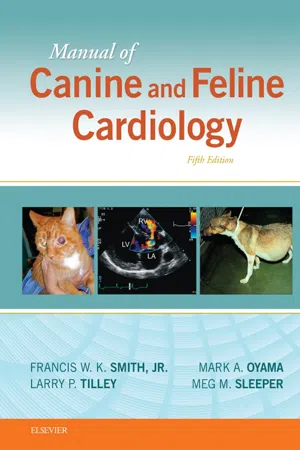
eBook - ePub
Manual of Canine and Feline Cardiology
- 472 pages
- English
- ePUB (mobile friendly)
- Available on iOS & Android
eBook - ePub
Manual of Canine and Feline Cardiology
About this book
Information
Topic
MedicineSubtopic
Veterinary MedicineSection 1
Diagnosis of Heart Disease
1
History and Physical Examination
Rebecca E. Gompf
Despite the technical nature of many cardiovascular diagnostics, such as electrocardiography, radiography, and echocardiography, the history and physical examination remain the most crucial initial steps in the establishment of the correct diagnosis. Findings from a careful history and physical examination prompt the clinician to the probability or presence of heart disease. Results of the cardiovascular physical examination will usually allow the clinician to make a tentative diagnosis or formulate a specific differential diagnosis. The history and physical examination also provide important information regarding the stage of heart disease present, which may significantly affect therapy.
A good history and physical examination are invaluable in making a diagnosis of heart disease and helping to differentiate heart disease from pulmonary disease. Besides helping to make the diagnosis, a good history and physical examination help to tell the extent of the problem, the animal’s response to previous therapy, the owner’s ability to medicate the animal consistently, and the presence of other medical problems. Clinicians should obtain a thorough history and physical examination to properly diagnose and treat an animal with heart disease.
Medical History
Signalment
Age
Young animals usually have congenital diseases (e.g., patent ductus arteriosus [PDA]), whereas older animals usually have acquired diseases, such as degenerative diseases (e.g., mitral and tricuspid regurgitations) or neoplastic diseases (e.g., heart base tumor). There are exceptions because cardiomyopathies can occur in young dogs and cats (aged 6 months or younger) and older dogs can have congenital heart defects that were not diagnosed when they were young (e.g., PDA, atrial septal defect). Also, cardiac disease in older animals can be modified or affected by other concurrent disease processes (e.g., collapsing trachea or other respiratory diseases and renal or liver disease).
Breed
Certain cardiac defects are more common in some breeds of animals; however, there can be regional differences in the rate of occurrence of cardiac problems. See the Appendix for a summary of some of the cardiac defects found in certain breeds of dogs and cats.
Sex
Males are more susceptible to certain cardiac diseases (e.g., male Cocker Spaniels to chronic valvular heart disease of the mitral valve and large-breed males to dilated cardiomyopathy). However, sick sinus syndrome occurs in the female Miniature Schnauzer, and PDA is more common in females of small breed dogs.
Weight
The animal’s weight influences several aspects of treatment, including the dose of cardiac medication, evaluation of the response to diuretic medication, and monitoring of cardiac cachexia. A Pickwickian syndrome (characterized by severe obesity, somnolence, and hypoventilation) can occur in an animal that is so obese that its ability to breathe is restricted.
Utilization of the Animal
Knowing how an animal is going to be used when giving a long-term prognosis for a cardiac disease is important. For example, hunting dogs with severe heartworm disease may not be able to hunt again after treatment. Also, some animals with congenital heart defects may have normal life spans and may make good pets; however, they should not be used for breeding purposes because the defect could be perpetuated.
The age, breed, and sex of the animal may help the clinician to make an accurate diagnosis; however, there are always exceptions to every rule. Clinicians should not ignore the fact that an animal could have an atypical problem for its age, breed, or sex.
History
• A good history will establish the presence of a cardiac problem, help to differentiate between cardiac and respiratory problems, and help to monitor the disease course and the response to therapy. It must be done carefully to prevent an owner from giving a misleading history. It includes several key questions, such as the reason the animal is being presented, the problems noted by the owner, the onset and duration of the problem(s), the progression of the disease, any known exposure to infectious diseases, the vaccination history, any current medications the animal is receiving, the animal’s response to any medications that have been given, and the owner’s ability to give the medication(s).
• The history will also define the animal’s attitude and behavior because the owner will be asked whether the animal is listless and depressed or alert and playful. Does the animal tire easily with exercise?
• The patient’s history ...
Table of contents
- Cover image
- Title page
- Table of Contents
- Copyright
- Dedication
- Contributors
- Preface
- Acknowledgments
- Section 1. Diagnosis of Heart Disease
- Section 2. Cardiovascular Disease
- Section 3. Treatment of Cardiovascular Disease
- Appendix 1. Canine and Feline Breed Predilections for Heart Disease
- Appendix 2. Cardiopulmonary Drug Formulary
- Appendix 3. Echocardiographic Normal Values
- Appendix 4. Available Canine and Feline Genetic Tests for Breed-Specific Cardiac Diseases
- Index
Trusted by 375,005 students
Access to over 1.5 million titles for a fair monthly price.
Study more efficiently using our study tools.
Frequently asked questions
Yes, you can cancel anytime from the Subscription tab in your account settings on the Perlego website. Your subscription will stay active until the end of your current billing period. Learn how to cancel your subscription
No, books cannot be downloaded as external files, such as PDFs, for use outside of Perlego. However, you can download books within the Perlego app for offline reading on mobile or tablet. Learn how to download books offline
Perlego offers two plans: Essential and Complete
- Essential is ideal for learners and professionals who enjoy exploring a wide range of subjects. Access the Essential Library with 800,000+ trusted titles and best-sellers across business, personal growth, and the humanities. Includes unlimited reading time and Standard Read Aloud voice.
- Complete: Perfect for advanced learners and researchers needing full, unrestricted access. Unlock 1.5M+ books across hundreds of subjects, including academic and specialized titles. The Complete Plan also includes advanced features like Premium Read Aloud and Research Assistant.
We are an online textbook subscription service, where you can get access to an entire online library for less than the price of a single book per month. With over 1.5 million books across 990+ topics, we’ve got you covered! Learn about our mission
Look out for the read-aloud symbol on your next book to see if you can listen to it. The read-aloud tool reads text aloud for you, highlighting the text as it is being read. You can pause it, speed it up and slow it down. Learn more about Read Aloud
Yes! You can use the Perlego app on both iOS and Android devices to read anytime, anywhere — even offline. Perfect for commutes or when you’re on the go.
Please note we cannot support devices running on iOS 13 and Android 7 or earlier. Learn more about using the app
Please note we cannot support devices running on iOS 13 and Android 7 or earlier. Learn more about using the app
Yes, you can access Manual of Canine and Feline Cardiology by Francis W. K. Smith,Larry P. Tilley,Mark Oyama,Meg M. Sleeper in PDF and/or ePUB format, as well as other popular books in Medicine & Veterinary Medicine. We have over 1.5 million books available in our catalogue for you to explore.