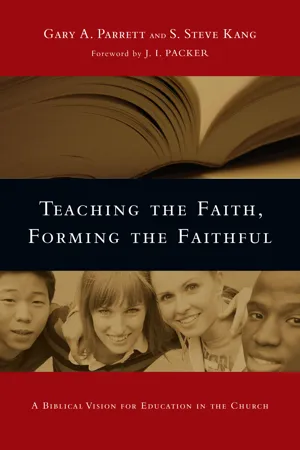
Why does the church teach? And what should it teach? In recent years, traditional Sunday school and education programs have declined in influence and effectiveness. Education in the church is often sidelined by other competing priorities, and ourefforts become haphazard and random.As a result, many Christians have not learned the fundamental doctrinal content of the faith. As a response, a growing number of church ministries have moved toward an emphasis on Christian spiritual formation. Butchurches must hold together education and formation, the teaching of the faith and the forming of the faithful.In this comprehensive text, Gary Parrett and Steve Kang attend to both the content and process of educational and formational ministries.They set forth a thoroughly biblical vision for intentional teaching of the Christian faith, with a holistic concern for what and whom is taught as well as how and why.Fully apprised of developments in educationaltheory and pedagogy, Parrett and Kang propose a core curriculum for recovering the full scope of Christian proclamation and reinvigorating the teaching ministry of the church. Their vision has implications not merely for catechesis, but for preaching, worship, children's and youth ministry, and much more.The body of Christ can become all that God intends it to be, through intentional practices that foster personal and corporate formation. Here is guidance for individuals and congregations on that journey.
eBook - ePub
Teaching the Faith, Forming the Faithful
A Biblical Vision for Education in the Church
- 461 pages
- English
- ePUB (mobile friendly)
- Available on iOS & Android
eBook - ePub
Teaching the Faith, Forming the Faithful
A Biblical Vision for Education in the Church
About this book
Trusted by 375,005 students
Access to over 1 million titles for a fair monthly price.
Study more efficiently using our study tools.
Information
Topic
Theology & ReligionSubtopic
Christian Ministry
PURPOSE
A Mission to Fulfill
“Tell me a story, and put me in it!”
▼
SOME YEARS BACK, NEW TESTAMENT SCHOLAR GORDON FEE was sitting with other attendees at a workshop about the power of story. The speaker was Eugene Peterson, his faculty colleague. Peterson mentioned an episode in which his four-year-old grandson jumped onto his lap and demanded, “Grandpa, tell me a story, and put me in it.” Upon hearing this account, Fee began to weep, overwhelmed by the fact that this is precisely what God has done for all of us.1 God is unfolding the great Story, and he has invited us to take our places in that story.
In this first section of the book, we consider this great Story into which God has invited us. It is a grand drama of redemption and reconciliation. Growing in our understanding of the Story, and of our places in it, is critical for teaching and formation in the church. In chapter one, we overview the Story itself, drawing heavily on Paul’s writing in the letter to the Ephesians to catch a glimpse of God’s intended instrument for his ongoing work of reconciliation—the church of Jesus Christ. In chapter two, we consider how the Story and our place in it can help us answer the important question of why the church must ever engage in faithful ministries of teaching and formation. Some of the themes introduced in these first two chapters will be revisited throughout the remainder of the book.

The Poiēma of God
For we are God’s workmanship, created in Christ Jesus to do good works, which God prepared in advance for us to do.
EPHESIANS 2:10
▼
AS THE FAMILIAR TALE HAS IT, THE PROFESSOR of a Philosophy 101 class enters the classroom to administer the final exam. Stepping silently to the blackboard, he writes there the one-word question “Why?” Turning to the class, he says, “Here is your exam question. Write.”1
There is, as well, the persistent image of the toddler, curious about everything but limited by experience, exposure, knowledge and vocabulary. And so it is that she begins to ask her parents, “Why?” No matter what answer they offer, the child’s response is invariably a follow-up question: “Why?”
Tragically, many of us in positions of ministry leadership seem less wise than either the philosophy professor or the toddler. “Why?” is nearly always the most critical of questions, yet it often remains unasked. We are impatient. We prefer to dive in with other questions, questions that strike us as being more relevant. “How?” typically tops the list. The tyranny of the “urgent” needs and demands of those we serve presses us to swift response. We feel a need to act and to do so now. It is not surprising then that books with titles or subtitles promising how-to solutions for pastors, teachers and other servants typically top the charts of best-selling Christian books, just as is the case in other publishing markets. Perhaps it is a sign of the times.
How is certainly a critical question. We would be unwise to neglect it. In this book, we will try to tackle it head-on. But critical as it is, it is not the first question. It must not be the first question. Why is the proper question with which to begin our exploration of the church’s teaching ministry. Constantly asking this question, and answering it faithfully, will guide us toward an understanding of which questions we will need to ask further as we journey on. “He knows the ‘why’ for his existence, and will be able to bear almost any ‘how.’”2
The first question before us, given the topic of the book, is “Why teach?” Why does the church of Jesus Christ engage in a ministry of teaching? In asking this, we are seeking both a rationale and a telos.3 Both aspects of the why query are important. Concerning a rationale, we seek to set forth a foundation, a starting point for our endeavor. What is it that prompts us to act? Concerning a telos, we are probing the issue of the “ends” toward which we teach—our aims, goals, objectives and so on. We will address both of these aspects in some detail in chapter two.
GOD’S PURPOSES FOR THE CHURCH
However, the question “Why does the church teach?” actually evokes other, even more primary questions. In this chapter, we will examine two such questions before addressing the “Why teach?” inquiry in the chapter that follows. These questions are Why does the church exist? And, Why does the church exist on earth—in space and in time? To run ahead to the question of why the church teaches, without first probing more fundamental issues such as these would be presumptuous or, at the very least, premature. On the other hand, attending to these two questions will take us a long way toward understanding why the church must engage in a ministry of teaching.
The Westminster catechisms famously framed the most primary of all our questions: “What is the chief end of man?” The Larger Catechism answers, “The chief end of man is to glorify God and fully to enjoy Him forever.”4 Surely the catechism gets it right at this most fundamental of points. All things, including especially humans, exist ultimately for the glory of God. This is our telos, as the Scriptures consistently affirm.5 The question “Why does the church exist?” therefore has an obvious answer that also readily affirms that which is true of every human being and indeed of all things in heaven and on earth. We, the church of Jesus Christ, exist to give glory to our sovereign King.
With this in mind, we turn to our second essential question: Why does the church exist in space and in time? Why must the church endure this precarious and often painful, time-locked sojourn on earth? Why do we have to speak not only of the church triumphant but also of the church militant and, indeed, of the suffering church? If our ultimate end is to bring glory to God and fully to enjoy him forever, why does God not simply take us to be with him—face to face—upon conversion?
WHY DID JESUS COME TO EARTH?
One way to approach these concerns is to ask a similar question about Jesus Christ. Why did the eternal Son of God leave the glory and splendor of unbroken fellowship with the Father and the Holy Spirit in heaven to sojourn among us for a few decades? Answering the question about his earthly sojourn will perhaps prove helpful toward helping us understand our own. Thankfully, Jesus and the New Testament writers have much to say concerning the motives for the incarnation of God’s Son. Here are some pieces of the puzzle:
- The Son of Man did not come to be served, but to serve, and to give his life as a ransom for many. (Mk 10:45)
- The Son of Man came to seek and to save what was lost. (Lk 19:10)
- God so loved the world that he gave his one and only Son, that whoever believes in him shall not perish but have eternal life. (Jn 3:16)
- I have come that they may have life, and have it to the full. (Jn 10:10)
- For this reason I was born, and for this I came into the world, to testify to the truth. (Jn 18:37)
- But when the time had fully come, God sent his Son, born of a woman, born under law, to redeem those under law, that we might receive the full rights of sons. (Gal 4:4-5)
- Here is a trustworthy saying that deserves full acceptance: Christ Jesus came into the world to save sinners—of whom I am the worst. (1 Tim 1:15)
- Since the children have flesh and blood, he too shared in their humanity so that by his death he might destroy him who holds the power of death—that is, the devil—and free those who all their lives were held in slavery by their fear of death. (Heb 2:14-15)
- The reason the Son of God appeared was to destroy the devil’s work. (1 Jn 3:8)
From such texts as the above we can begin to understand some of the principle motives for the incarnation. Simply put, God the Son became human to redeem humans, to reconcile them to God and to one another, and in so doing, to crush the evil one and destroy his works.
These emphases are clearly in view in what may be the most important passage regarding the mission of Jesus—Luke 4:14 and following. The story is situated near the beginning of Jesus’ ministry. He has been baptized by John and tested by the devil. He now returns to his hometown of Nazareth “in the power of the Spirit” and goes where he had always gone on the Sabbath, to the synagogue (Lk 4:14, 16). It was given to him to read from a passage in Isaiah. We know the text he read as Isaiah 61:1-2: “The Spirit of the Lord is on me, because he has anointed me to preach good news to the poor. He has sent me to proclaim freedom for the prisoners and recovery of sight for the blind, to release the oppressed, to proclaim the year of the Lord’s favor” (Lk 4:18-19). All of these things became dramatically manifest in the subsequent earthly ministry of Jesus.
As significant as what Jesus did read from Isaiah’s scroll is what he did not read on that occasion. He stopped his reading abruptly, in midsentence. Isaiah 61:2 goes onto say, “and the day of vengeance of our God, to comfort all who mourn.” Before reaching these words, however, Luke records that Jesus “rolled up the scroll, gave it back to the attendant and sat down,” and went on to say, with all eyes fixed on him, “Today this scripture is fulfilled in your hearing” (Lk 4:20-21). The word of God that Jesus had come to fulfill was a word of good news, a proclamation of an extended time of God’s favor. He had not come in this, his first advent, to execute God’s vengeance. Nor had he come to bring a final comfort to all who mourn. For fulfillment of these things, we eagerly await the second coming of the Lord.
The Bible portrays that coming Day as one of both horror and hope. For those on whom the wrath of God falls, it is the “great and dreadful day of the LORD” (Joel 2:31). For those whose names are written in God’s book, it is the “blessed hope” (Tit 2:13). In either case, it is not this day. We who live between the first and the second advents of our Lord are living still in the “year of the Lord’s favor” (see also 2 Pet 3:8-14).
The implications of this for the ministry of the church are profound. The believer or congregation that misses these, and believes that it is our duty to execute God’s vengeance, can only perpetrate evil. Sadly, many have done precisely that over the course of the two millennia of the church...
Table of contents
- Cover
- Title Page
- Contents
- Foreword by J. I. Packer
- List of Tables and Figures
- Preface
- Part 1: PURPOSE: A Mission to Fulfill
- Part 2: PROCLAMATION: A Message to Obey and Teach
- Part 3: PEOPLE: Of Teachers and Learners
- Part 4: PRACTICES: Strategies for Teaching and Forming
- Conclusion: The Beautiful Body of Christ!
- Name Index
- Subject Index
- Scripture Index
- Notes
- Praise for Teaching the Faith, Forming the Faithful
- About the Authors
- More Titles from InterVarsity Press
- Copyright Page
Frequently asked questions
Yes, you can cancel anytime from the Subscription tab in your account settings on the Perlego website. Your subscription will stay active until the end of your current billing period. Learn how to cancel your subscription
No, books cannot be downloaded as external files, such as PDFs, for use outside of Perlego. However, you can download books within the Perlego app for offline reading on mobile or tablet. Learn how to download books offline
Perlego offers two plans: Essential and Complete
- Essential is ideal for learners and professionals who enjoy exploring a wide range of subjects. Access the Essential Library with 800,000+ trusted titles and best-sellers across business, personal growth, and the humanities. Includes unlimited reading time and Standard Read Aloud voice.
- Complete: Perfect for advanced learners and researchers needing full, unrestricted access. Unlock 1.4M+ books across hundreds of subjects, including academic and specialized titles. The Complete Plan also includes advanced features like Premium Read Aloud and Research Assistant.
We are an online textbook subscription service, where you can get access to an entire online library for less than the price of a single book per month. With over 1 million books across 990+ topics, we’ve got you covered! Learn about our mission
Look out for the read-aloud symbol on your next book to see if you can listen to it. The read-aloud tool reads text aloud for you, highlighting the text as it is being read. You can pause it, speed it up and slow it down. Learn more about Read Aloud
Yes! You can use the Perlego app on both iOS and Android devices to read anytime, anywhere — even offline. Perfect for commutes or when you’re on the go.
Please note we cannot support devices running on iOS 13 and Android 7 or earlier. Learn more about using the app
Please note we cannot support devices running on iOS 13 and Android 7 or earlier. Learn more about using the app
Yes, you can access Teaching the Faith, Forming the Faithful by Gary A. Parrett,S. Steve Kang in PDF and/or ePUB format, as well as other popular books in Theology & Religion & Christian Ministry. We have over one million books available in our catalogue for you to explore.