Many a Westerner has had a cross-cultural experience of honor and shame. First there are those stuttering moments in the new social landscape. Then after missed cues and social bruises comes the revelation that this culture—indeed much of the world—runs on an honor-shame operating system. When Western individualism and its introspective conscience fails to engage cultural gears, how can we shift and navigate this alternate code? And might we even learn to see and speak the gospel differentlyif we did? In Ministering in Honor-Shame Cultures Jayson Georges and Mark Baker help us decode the cultural script of honor and shame. What's more, they assist us in reading the Bible anew through the lens of honor and shame, often with startling turns. And they offer thoughtful and practical guidance in ministry within honor-shame contexts. Apt stories, illuminating insights and ministry-tested wisdom complete this well-rounded guide to Christian ministry in honor-shame cultures.
eBook - ePub
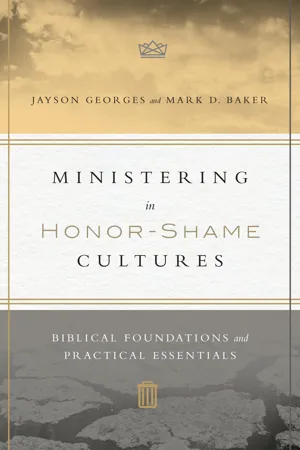
Ministering in Honor-Shame Cultures
Biblical Foundations and Practical Essentials
- 294 pages
- English
- ePUB (mobile friendly)
- Available on iOS & Android
eBook - ePub
Ministering in Honor-Shame Cultures
Biblical Foundations and Practical Essentials
About this book
Information
Print ISBN
9780830851461
Subtopic
Biblical Studies- 1 -
A WORLD of SHAME
There is nothing in this entire world that you need to protect more than your honor. Because you’re nothing without your honor. You’d be dirt, just dirt and nothing else. If someone tried to take my honor, then
I’d do anything to get it back. Literally anything.
I’d do anything to get it back. Literally anything.
A MUSLIM IMMIGRANT TO GERMANY
What is more sacred than honor?
DIO CHRYSOSTOM, ORATIONES
A
ISHA ACTIVELY LIVED OUT HER FAITH as a mature Christian. From the time she trusted Christ as a university student, Aisha was a fruitful disciple maker in her campus ministry. After that season, Aisha and her husband joined a local church-planting team. To assist them, my (Jayson’s) team hosted a weekend of training. Over the previous months I had begun exploring honor and shame in the local culture and in Scripture with increased intensity. The training time with Aisha and her teammates provided an opportunity to dialogue with national Christians on the topic. We examined the biblical story through the lenses of honor and shame for over an hour. Reading the Bible in honor-shame terms came easily to them since their Central Asian culture mirrored the social world of the Bible in many ways. They became increasingly animated as the study progressed. Aisha grasped the implications full well. She spoke with wonder and joy, but also with sadness and confusion. Her eyes watered up, and she begged to know, “Why has nobody told me this before? I have shared with my sister many times that God forgives her sins, but she just says her shame is too great for God.” Her understanding of the gospel, similar to that of many Christians, did not address shame. The consequences of that reality upset her and filled her with sorrow. What was lacking in Aisha’s explanation of how Jesus saves? Why did Aisha’s theology say so little about the very forces of shame that defined her sister?1
Mike ministered to refugees in the United States by sharing life together and helping them get settled. He would often visit Abdul’s house and be regaled with generous hospitality. Being from Iraq, Abdul maintained Middle Eastern values of hospitality and eating. Visits to Abdul’s house would extend for hours. Good conversation and food were guaranteed. One day, Abdul came to visit Mike. But when he arrived, Mike was busy preparing to leave for a scheduled meeting. Upon opening the door, he greeted Abdul, but explained he was busy and closed the door. Mike’s actions offended Abdul. Though polite on the surface, internally he left angered and confused by Mike’s not welcoming him into the home. Mike continued on his way out the door, unaware that his actions might be offensive to Abdul. Why did Mike assume he acted appropriately? Why was Abdul offended? What cultural values influenced Mike’s actions?
Enrique was an eager disciple, soaking up all the theological input I (Mark) gave him and earnestly seeking to live it out. I invited him to go with me to a conference on holistic mission in a nearby Honduran city. Aware of his limited finances I offered to pay for 75 percent of the cost, including meals and an overnight stay at the retreat center, if he would pay the rest. He enthusiastically accepted my offer, and gave me the amount of money I had requested. Enrique later asked me if Francisco, a young man he was discipling, could come as well. I agreed that Francisco could come under the same financial arrangement, and asked Enrique to explain that to Francisco. The day came to leave for the retreat. Enrique had not given me Francisco’s portion, and neither did he mentioned anything about it. I assumed he would give me the money before we registered. We got off one bus, and took a local bus to the retreat center. The closer we got the more concerned I became. I wanted to talk to Enrique alone about the money, but had no opportunity. Finally, just a few steps from the door of the building where we would register, I stopped in the middle of the path and directly asked Francisco, “Could you give me your portion of the registration fee now, so that we have the money straight before we have to actually register?” They both looked very uncomfortable; Francisco turned away, and Enrique looked at me, his expression communicating, “I can’t believe you just did that.” But all he said was, “He was not able to get the money.” I asked, “Why didn’t you tell me? We had an agreement.” They said nothing. They simply bowed their heads slightly and looked down. I alone walked to pay the fee for all three of us. Although I tried to mend the relations, the damage done in that moment hung over us the whole event. Why was our sense of the right thing to do so different? Was I wrong to have asked? Why did Enrique not mention the lack of finances beforehand?
Q: Why did Aisha’s sister not welcome the gospel?
Q: Why was Abdul offended?
Q: Why did Enrique not communicate about Francisco’s finances?
A: Honor and shame. They all interpreted their circumstances through the lenses of honor and shame.
The values of honor and shame guide most of life in Majority World cultures: how you hear the gospel, how you relate to others and how one should communicate. For Aisha’s sister, Abdul and Enrique, their cultural compass directed them toward honor and away from shame. Avoiding shame and maintaining honor was the default operating system of their culture.
Most of the world thinks and lives according to the cultural values of honor and shame. Christians ministering among Majority World peoples encounter this reality in many ways. For this reason, we must use an “honor-shame missiology”—a biblically rooted approach to Christian ministry among the nations that proclaims and mediates God’s honor for the shamed.
A foreign culture is like the night sky—initially fascinating, but quickly daunting without a configuration to meaningfully connect the dots. Amateur stargazers see stars, but miss the constellations. Honor-shame is like the lines between stars; they give meaning and structure to life. Westerners rarely get honor-shame dynamics; they seem foreign. When we fail to connect the dots, we experience cultural frustration and miss kingdom opportunities. In light of the prominence of honor and shame for shaping life in many cultures, too much is at stake to not account for them in Christian mission.
THE DEPTH OF SHAME
On April 15, 2013, two pressure-cooker bombs exploded at the Boston Marathon. The tragedy and ensuing manhunt for the Tsarnaev brothers fueled a media frenzy. As the media dug into the bombers’ background, they interviewed people whose lives intersected with the Tsarnaevs. Their American friends and classmates expressed mostly disbelief and sorrow about the tragedy. Meanwhile, their Chechen uncle lashed out at them, outraged over the social repercussions. Listen to his words: “You put a shame on our entire family—the Tsarnaev family. And you put a shame on the entire Chechen ethnicity. . . . Everyone now puts that shame on the entire ethnicity.”2 When the Boston Marathon bombing occurred, we suspect most Americans did not think all Chechens are shameful, yet that was the Chechen uncle’s primary response. He interpreted the event as fundamentally shame inducing. Americans grieved the loss of safety, but the Chechen uncle feared the shameful actions of two members would infect the whole group.
The testimony of international Christian apologist Ravi Zacharias reveals the powerful force of shame in many cultures. As a young boy in India, he lived to play cricket but was a jokester at school. This conflicted with cultural values. Zacharias explains, “Indian children are raised to live with books and get to the top of the class, or else face failure and shame.”3 His subpar report cards from school reflected poorly on his parents, and led to humiliating thrashings from his father. As a teenager Zacharias made a halfhearted commitment at an evangelistic rally, but his life of failure at school continued to haunt him. He decided to end his life to escape the shame. At age seventeen Zacharias reasoned to himself, “A quiet exit will save my family from further shame.” Zacharias’s attempt to end his own life was motivated by shame, not depression. His family’s reputation was more important than his own life. (His attempt to overdose on drugs was unsuccessful, and he eventually recommitted his life to Christ while recovering in the hospital.) When social reputation is the basic foundation of life and identity, people’s pursuit of respect, honor and status frames every facet of life.
In 2014 a group of militant Muslims overtook regions of war-torn Syria and declared themselves the Islamic State of Iraq and Syria—ISIS. Interestingly, they interpreted those political events as the liberation from disgrace and restoration of status. Note the honor-shame language in their propaganda magazine:
Soon, by Allah’s permission, a day will come when the Muslim will walk everywhere as a master, having honor, being revered, with his head raised high and his dignity preserved. . . .
The time has come for those generations that were drowning in oceans of disgrace, being nursed on the milk of humiliation, and being ruled by the vilest of all people, after their long slumber in the darkness of neglect—the time has come for them to rise. The time has come for [the Muslim world] to wake up from its sleep, remove the garments of dishonor, and shake off the dust of humiliation and disgrace, for the era of lamenting and moaning has gone, and the dawn of honor has emerged anew.4
As morbid and evil as the ISIS ideology is, it reflects an inescapable reality—humans crave honor and abhor shame. The desire for honor and glory cannot be dismissed as a byproduct of sin or some cultural abnormality, but an innate part of being human, somehow rooted in God’s creation. God created every human in his image, and “crowned them with glory and honor” (Ps 8:5). According to recent scientific research, the pursuit of honor and avoidance of shame appears hardwired into the human brain. The limbic system within our brain senses social threats (e.g., shame) the same way as physical threats. Both types of imminent danger trigger the same self-preservation instincts and share a common neural basis in the brain.5 The human brain, and soul, was designed for honor. C. S. Lewis notes,
Glory, as Christianity teaches me to hope for it, turns out to satisfy my original desire and indeed to reveal an element in that desire which I had not noticed. . . . Apparently, then, our lifelong nostalgia, our longing to be reunited with something in the universe from which we now feel cut off, to be on the inside of some door which we have always seen from the outside is no mere neurotic fancy, but the truest index of our real situation.6
Though designed to experience God’s true glory, our honor was exchanged for shame in the Garden of Eden. As a result, humans crave honor and grasp for it in warped and destructive ways, apart from God’s original design.
In World War II the American military faced an unprecedented problem. For the first time a Western nation was warring with a modern military not from the Western cultural tradition. So in June 1944, the US Office of War Information assigned the American anthropologist Ruth Benedict to investigate and explain Japan’s “exceedingly different habits of acting and thinking.”7 Benedict had gained renown for her ability to explain worldviews. To help Westerners understand the anomalies of Japanese culture, Benedict highlighted the unique role of honor and shame. She explained the basic cultural difference as follows: “Shame cultures rely on external sanctions for good behavior, not, as guilt cultures do, on an internalized conviction of sin.”8 With Benedict’s analysis, American policy in Japan during the war and subsequent occupation accounted for the realities of shame. In the same vein, contemporary scholars in a variety of fields—diplomacy, crime, ethics, psychology, community development, politics and social reform9—now recognize that honor and shame must be considered before developing practices and policies for catalyzing social change.
Despite heightened attention to honor and shame among social scientists, honor and shame play a negligible role among Christian theologians and missionaries. As the US Office of War did during World War II, those involved in global mission would also do well to examine honor and shame at a cultural level. In this book we turn, however, not just to anthropology for insight, but to the Bible itself. Just as Westerners fail to adequately observe cultural underpinnings of honor and shame in today’s world, Western Christians also often overlook the prominent role of honor and shame in the Bible, though it comes from an honor-shame context.
A BIBLE COVERED IN SHAME (AND HONOR)
Nurdin and I (Jayson) became friends through an English club...
Table of contents
- Cover
- Title Page
- Contents
- Acknowledgments
- 1 A World of Shame
- Part One: Cultural Anthropology
- Part Two: Biblical Theology
- Part Three: Practical Ministry
- Appendix 1: Key Scriptures on Honor-Shame
- Appendix 2: Biblical Stories Addressing Honor-Shame
- Appendix 3: Recommended Resources
- Notes
- Name and Subject Index
- Scripture Index
- Praise for Ministering in Honor-Shame Cultures
- About the Authors
- Honor-Shame
- More Titles from InterVarsity Press
- Copyright Page
Trusted by 375,005 students
Access to over 1.5 million titles for a fair monthly price.
Study more efficiently using our study tools.
Frequently asked questions
Yes, you can cancel anytime from the Subscription tab in your account settings on the Perlego website. Your subscription will stay active until the end of your current billing period. Learn how to cancel your subscription
No, books cannot be downloaded as external files, such as PDFs, for use outside of Perlego. However, you can download books within the Perlego app for offline reading on mobile or tablet. Learn how to download books offline
Perlego offers two plans: Essential and Complete
- Essential is ideal for learners and professionals who enjoy exploring a wide range of subjects. Access the Essential Library with 800,000+ trusted titles and best-sellers across business, personal growth, and the humanities. Includes unlimited reading time and Standard Read Aloud voice.
- Complete: Perfect for advanced learners and researchers needing full, unrestricted access. Unlock 1.5M+ books across hundreds of subjects, including academic and specialized titles. The Complete Plan also includes advanced features like Premium Read Aloud and Research Assistant.
We are an online textbook subscription service, where you can get access to an entire online library for less than the price of a single book per month. With over 1.5 million books across 990+ topics, we’ve got you covered! Learn about our mission
Look out for the read-aloud symbol on your next book to see if you can listen to it. The read-aloud tool reads text aloud for you, highlighting the text as it is being read. You can pause it, speed it up and slow it down. Learn more about Read Aloud
Yes! You can use the Perlego app on both iOS and Android devices to read anytime, anywhere — even offline. Perfect for commutes or when you’re on the go.
Please note we cannot support devices running on iOS 13 and Android 7 or earlier. Learn more about using the app
Please note we cannot support devices running on iOS 13 and Android 7 or earlier. Learn more about using the app
Yes, you can access Ministering in Honor-Shame Cultures by Jayson Georges,Mark D. Baker,Jason Borges in PDF and/or ePUB format. We have over 1.5 million books available in our catalogue for you to explore.