- 256 pages
- English
- ePUB (mobile friendly)
- Available on iOS & Android
eBook - ePub
About this book
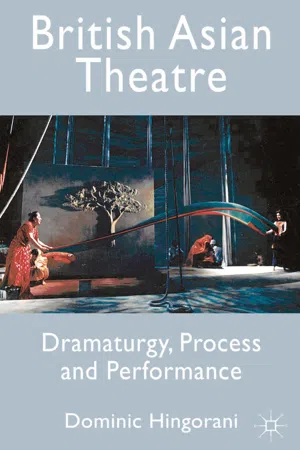
This highly accessible and original introduction to British-Asian theatre explores the creativity, innovation and diversity of major British-Asian theatre companies. Including coverage of Tara Arts, Tamasha and Kali theatre companies, as well as important writers such as Hanif Kureishi and Gurpreet Kaur Bhatti, the book analyses the dramaturgy, cultural and political contexts and critical receptions that have informed major productions. Complete with plot summaries and illustrated throughout, the text explores the extraordinary contribution that British-Asian theatre has made to the British stage over the past thirty years.
Information
1
Introduction: British Asian Theatre on the Map
British Asian theatre from 1976
This book takes as its historical starting point the publication of the Arts Council sponsored report by Naseem Khan, The Arts Britain Ignores: The Arts of Ethnic Minorities in Britain (1976), which was the first official sign that the theatrical work by practitioners from ethnic minority communities in Britain was to be considered a part of British culture. While there was, of course, a great deal of theatrical activity from the Asian community prior to this date, the report heralded a radical reconceptualisation of the relationship between Asian practitioners positioned on the ‘margins’ and the ‘centre’ of British theatre.
If we look at the historiography of British theatre from that time, the presence of Asian artists and their contribution to that tradition has largely ignored. It is only recently that a number of excellent works specifically exploring Black and Asian theatre have been published, including Gabrielle Griffin’s Contemporary Black and Asian Women Playwrights in Britain (2003), Alternatives Within the Mainstream (2006), edited by Dimple Godiwala, Staging New Britain (2006), edited by Geoffrey Davis and Anne Fuchs, and British South Asian Theatres: A Documented History (2010) and Critical Essays on British South Asian Theatre (2010), both edited by Graham Ley and Sarah Dadswell. It should also be noted that Jen Harvie’s Staging the UK (2005) contains a fascinating discussion of ‘Bollywood in Britain’, focusing on the work of Tamasha.
Although there is an increasing wealth of published works by British Asian writers, there is no doubting the key role played by pioneering anthologies in those early years such as Black and Asian Women Writers (1993), edited by Kadija George and Black and Asian Plays Anthology (2000), with an appendix of published plays by Black and Asian playwrights compiled by Susan Croft of the Theatre Museum1 as well as the Salidaa2 (South Asian Diaspora Literature and Arts Archive) archive in bringing visibility to the work; indeed it is worth noting that of the more than 100 plays produced by Tara Arts since 1977 only three have been published, none of which include their pioneering ‘Binglish’ work at the National Theatre. I am delighted that electronic access to the scripts of the productions discussed in this book, and relevant archival material relating to those productions are now available through the Tara Arts website.3 The publication of these scripts not only provides a vital resource for playwrights and practitioners but also for those wishing to study, critique and evaluate the cultural, sociopolitical and theatrical impact of British Asian theatre on British theatre and beyond.
This book focuses on the three major British Asian theatre companies over the past 30 years; Tara Arts, Tamasha and Kali with a further chapter devoted to British Asian playwrights. It will not only examine the key productions of those producing companies and writers but crucially pay attention to how and why the work was made by examining the dramaturgies, rehearsal processes, productions and critical receptions as well as the social, cultural and political contexts. In short, this book will ask whether British Asian theatre over the last 30 years amounts to more than just ‘a bunch of darkies on stage?’ (Verma 1994b: 2), as Jatinder Verma, Artistic Director of Tara Arts, has provocatively conjectured.
‘The arts Britain ignores’
Naseem Khan’s groundbreaking report, The Arts Britain Ignores: The Arts of Ethnic Minorities in Britain published in 1976, for the first time officially recognised that a cultural incursion located on the borders of British theatre was taking place, an incursion that included the performance practices of the South Asian community in Britain. The report’s official recognition not only served a valuable postcolonial purpose in providing visibility and documentation for the artistic endeavours of ethnic minority groups but also attempted to overturn the actual position of those marginalised groups in relation to the ‘centre’. For the first time this document contained the view that ‘ethnic arts’ should not be regarded as an exotic extra outside of British theatre but should be understood, funded and fostered as though they were part of British theatre – not, of course, that these things necessarily occurred (my italics).
Before 1976, theatre companies from minority communities in Britain were classed as ‘ethnic theatre’, a term derived from ‘ethnic minority communities’ theatre’ and a category that was criticised as it ‘diminishes the work to the level of exotica and pushes it out onto the peripheries of British life’ (Khan 1980: 69). Indeed, the report criticised not only the conceptual approach to ‘ethnic minority’ arts but also the funding strategy. Most local authorities were found to make no separate provision for ‘ethnic minorities’ in a ‘colour blind’ approach to funding, which led to ‘effective discrimination’ (Khan 1976: 6) as those communities had little or no knowledge of the possible availability of such funding. The report also crucially insisted on the recognition of the creative potential inherent in cultural difference as well as the heterogeneity of different ethnic communities that ‘have certain talents, tastes, traditions that need consideration for them to develop’ (Khan: 6) in relation to arts funding.
Critics of the report pointed to the fact that it did not recognise a ‘crucial distinction […] between Black and white immigrant communities whose creative abilities were perceived very differently by British society […] Black creativity is underlined by a racism that is historically specific’ (Owusu 1986: 56). Although grouping ethnic minority communities together in the report was intended to engender a sense of solidarity between them it was also criticised as it ‘contributed […] to the formulation of a blanket category of “deprived people” which allowed members of funding bodies […] to add women, gays, disabled people and the unemployed to the melting pot’ (Owusu: 56) which continually locates and positions these groups on the margins. Indeed, these criticisms are still the subject of debate in current funding that has the effect of annexing them and creating internal competition for limited resources. Furthermore, theatre companies from minority groups have also been charged with the job of bringing in a ‘new audience’, an Asian one in respect of the companies we are discussing, a role that in some respects conflates their function with an element of social work.
The report called for positive steps such as the creation of a Minority Arts Agency to be established as a service agency and funded by the Arts Council and Race Relations Commission so that it could:
a) maintain an up-to-date register of groups and individuals
b) advise groups on venues, grant sources, possible personnel
c) publicise the activities and needs of minority groups amongst local authorities, regional arts associations and all other bodies covered in these Recommendations
d) give general advice to ethnic minorities arts groups and organisations and to individual artists (Khan 1976: 143).
While these tangible practical measures were taken to record and facilitate minority groups’ access to the arts and arts funding, it must also be recognised that the report did not articulate the ways in which minority groups would engage with funders. However, the Minority Art Advisory Service (MAAS) committee did come into being with Khan at its head and the report was rightly credited for making ‘African, Asian, Caribbean and other ethnic artists and arts organisation around the country […] an incontrovertible fact’ (Verma 2003).
In this way, The Arts Britain Ignores recognised that in the 1970s the historical disadvantages faced by ‘ethnic minority arts … [were] … lack of premises to rehearse, lack of comparable back up that is afforded to equivalent native British groups, lack of acceptance within the arts structure’ (Khan 1976: 5). The repositioning of ‘ethnic arts’ such as Asian theatre in Britain as part of British theatre had direct political and practical implications in beginning to destabilise these funding boundaries. The report realised that, beneath the seemingly egalitarian approach of local authorities not making dedicated provision for ethnic artists, was the fact that they were ignored.
The exposure of this wilful ‘ignorance’ by funding bodies such as the Arts Council paved the way for British Asian theatre companies, especially those trying to ‘find local writers and sometimes look at the British setting’ (Khan 1976: 71) such as Tara Arts, to access funding for the first time. Indeed, it is worth noting the paradox that grew up in the 1980s and 1990s as the Arts Council and other funding bodies such as the Greater London Council and other Metropolitan County Councils ‘made a virtue of Ethnicity: the more “different” you were, the more likely you were to gain funds’ (Verma 1989b: 773). This meant that while there was a positive benefit in the recognition of Asian theatre in Britain with funding set aside for it, this also had the paradoxical effect of keeping that work marginalised and corralled in an ethnic ghetto.
Since the Khan report there have been a great number of Arts Council initiatives and conferences to promote diversity in the British theatre, key among them being the Eclipse Report that gave rise to the Decibel initiative. The catalyst for The Eclipse Report – Developing Strategies to Combat Racism in Theatre (2002) developed from the conference held on 12–13 June 2001 at Nottingham Playhouse was the Macpherson4 report of 1999. The Macpherson report was a response to the police’s handling of the murder inquiry into the death of Steven Lawrence, a black teenager stabbed to death in 1993 in an unprovoked racist attack while waiting for a bus in Eltham, south-east London. The report damningly concluded that the failure of the police was largely due to ‘institutional racism’:
Institutional Racism consists of the collective failure of an organisation to provide an appropriate and professional service to people because of their colour, culture or ethnic origin. It can be seen or detected in processes, attitudes and behaviour which amount to discrimination through unwitting prejudice, ignorance, thoughtlessness and racist stereotyping which disadvantage minority ethnic people.
The Stephen Lawrence Inquiry (1999)
The aims of the Eclipse conference were:
– to discuss and devise strategies to combat racism in theatre
– to explore ways of developing our understanding and knowledge of African, Caribbean and Asian theatre (Arts Council 2001: 4).
The relevance of the conference is amply demonstrated by reproducing some of the (limited) evidence put to the conference:
– Out of 2,009 staff employed in English theatre only 80 (4 per cent) are African Caribbean and Asian (The Arts Council of England Annual Statistics 1999/2000)
– The Boyden Report found that only 16 out of 463 (3.5 per cent) board members of English producing theatres were African Caribbean and Asian (The Boyden Report on the Review of Theatre in the English Subsidised Sector 1999)
– An Arts Council of England survey of 19 arts organisations found that out of 2,900 staff, 177 (6 per cent) were either African Caribbean, Asian or Chinese, with 100 of those staff working in the area of catering or Front of House. One was employed at senior management level (The Arts Council of England 1998). The African Caribbean and Asian artists’ workshops, however, fully endorsed the definition of institutional racism as being relevant to the theatre sector in this country (Arts Council 2002: 9).
Peter Hewitt, chief executive of the Arts Council at that time, said the report recognised that institutional racism in the theatre was endemic with a ‘distinct lack of representation of Black and Asian communities at board level, on the staff, in the programming and in the audiences of regional theatres’ (Hewitt, quoted in Akbar 2002). A number of recommendations were made in order to address these issues, from confronting stereotypes, recognising the existing skills of ethnic minority artists and providing training for development, recruitment policies and recognising the fact that at that time there was no artistic director from an ethnic minority running a building.
The aim of the Decibel initiative that grew out of Eclipse was to ‘promote and strengthen the infra structure of culturally diverse arts in England’ (Arts Council 2003), that included profiling and showcasing the work of culturally diverse companies and artists, both established and emerging, in order to promote work that ‘reflects the cultural society of this country in the 21st century’ (ibid.). However, while there was no doubting the good work such initiatives have done, the latest Arts Council report from Sir Brian McMasters clearly shows that there is still a great deal of progress to be made.
In his report ‘Supporting Excellence in the Arts – From Measurement to Judgement’ (2008) McMasters was asked to consider how ‘public subsidy can best support excellence in the arts’ (5). It was a wide-ranging report that had many positive recommendations concerning the ‘Arts’ in their widest sense in relation to encouraging excellence, engaging audiences and limiting funding bureaucracy. However, I would highlight his key finding in the section on ‘Diversity’ in the report that states that ‘we live in one of the most diverse societies the world has ever seen, yet that is not reflected in the culture we produce, or in who is producing it’ (11). Indeed, while the report recognised that some improvement in the support of BME (Black Minority Ethnic) companies had occurred it recommends that funding bodies should not only prioritise diverse work but also ‘act as the guardians of artists’ freedom of expression, and provide the appropriate support to deal with what can be a hostile reaction to their work’ (ibid.); particularly pertinent in respect of the reaction that greeted Gurpreet Kaur Bhatti’s play Behzti (2004) discussed in Chapter 8.
‘Race’, ethnicity and hybridity
Any discussion of British Asian theatre has to recognise that it takes place within the context of a range of cultural issues relating to ‘race’, identity and representation. Naseem Khan’s report recognised that culture is dynamic and processual rather than fixed and static since ‘cultural expressions spring out of social conditions, they should change with conditions otherwise merely the effect is preserved without the cause’ (Khan 1976: 8). As we shall see, British Asian theatre has not only been concerned with the reproduction of culturally ‘traditional’ forms from the South Asian subcontinent such as Kathakali5 but has also focused on the contemporary frame and the emergence of new and dynamic forms as a result of this hybrid cultural location.
British Asians in Britain belong to what Stuart Hall describes as ‘cultures of hybridity’ that are defined as such because they have had ‘to renounce the dream or ambition of rediscovering any kind of “lost” cultural purity or ethnic absolutism’ (Hall 1992b: 310). In response to the need for the postwar6 reconstruction of Britain during the 1950s there was a rapid rise in the number of immigrants from Commonwealth countries, in particular from the Caribbean and the newly partitioned India and Pakistan that came to be symbolised by the arrival of the Windrush 7 in 1948. As a result of this the 1970s saw the emergence of a ‘second generation’ of ‘British Asians’, those of Asian heritage born or largely brought up and...
Table of contents
- Cover
- Title
- Copyright
- Contents
- List of Illustrations
- Acknowledgements
- 1 Introduction: British Asian Theatre on the Map
- 2 Tara Arts 1977–1984: Creating a British Asian Theatre
- 3 Tara Arts 1984–1996: Creating a ‘Binglish’ Theatre
- 4 Tamasha Theatre Company 1989: Authenticity and Adaptation
- 5 Tamasha Theatre Company 1989 – East is East: From Kitchen Sink to Bollywood
- 6 Kali Theatre Company 1990–2007: Producing British Asian Women Playwrights
- 7 Tara Arts 1997–2007: Mapping a ‘Binglish’ Diaspora
- 8 New Writers from 1977: Kureishi, Bancil, Bhatti and Khan-Din
- Conclusion
- Notes
- Bibliography
- Index
Trusted by 375,005 students
Access to over 1.5 million titles for a fair monthly price.
Study more efficiently using our study tools.
Frequently asked questions
Yes, you can cancel anytime from the Subscription tab in your account settings on the Perlego website. Your subscription will stay active until the end of your current billing period. Learn how to cancel your subscription
No, books cannot be downloaded as external files, such as PDFs, for use outside of Perlego. However, you can download books within the Perlego app for offline reading on mobile or tablet. Learn how to download books offline
Perlego offers two plans: Essential and Complete
- Essential is ideal for learners and professionals who enjoy exploring a wide range of subjects. Access the Essential Library with 800,000+ trusted titles and best-sellers across business, personal growth, and the humanities. Includes unlimited reading time and Standard Read Aloud voice.
- Complete: Perfect for advanced learners and researchers needing full, unrestricted access. Unlock 1.5M+ books across hundreds of subjects, including academic and specialized titles. The Complete Plan also includes advanced features like Premium Read Aloud and Research Assistant.
We are an online textbook subscription service, where you can get access to an entire online library for less than the price of a single book per month. With over 1.5 million books across 990+ topics, we’ve got you covered! Learn about our mission
Look out for the read-aloud symbol on your next book to see if you can listen to it. The read-aloud tool reads text aloud for you, highlighting the text as it is being read. You can pause it, speed it up and slow it down. Learn more about Read Aloud
Yes! You can use the Perlego app on both iOS and Android devices to read anytime, anywhere — even offline. Perfect for commutes or when you’re on the go.
Please note we cannot support devices running on iOS 13 and Android 7 or earlier. Learn more about using the app
Please note we cannot support devices running on iOS 13 and Android 7 or earlier. Learn more about using the app
Yes, you can access British Asian Theatre by Dominic Hingorani in PDF and/or ePUB format, as well as other popular books in Media & Performing Arts & Theatre. We have over 1.5 million books available in our catalogue for you to explore.