- 208 pages
- English
- ePUB (mobile friendly)
- Available on iOS & Android
eBook - ePub
Acting in Documentary Theatre
About this book
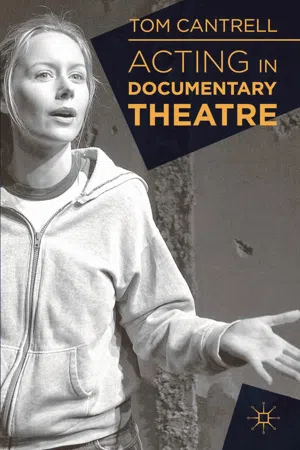
Using new interview material with actors, directors and writers, this book explores the challenges of performance in documentary theatre. Through a series of high profile case studies, Cantrell uses acting theory to examine the actors' complex processes, and makes a significant contribution to our understanding of stage performance.
Information
1
Talking to Terrorists
INTRODUCTION
Talking to Terrorists, written by Robin Soans and directed by Max Stafford-Clark, was produced by Stafford-Clark’s company, Out of Joint, in 2005. The play was compiled by Soans from a series of interviews conducted by the writer, director and actors. The unusual involvement of the actors in the creation of the material as well as its performance led to them developing particular preparatory and rehearsal strategies. In this chapter I will focus on the actors’ experiences of Stafford-Clark’s working methods, particularly the foregrounding of actor-subject meetings (in which the actors met and interviewed the person they played) and the way in which the material for the play was shared with the writer and director. The little testimony that exists on this subject has generally been formulated by Stafford-Clark, who has made certain claims about how these techniques function for actors. These claims are subjected to scrutiny in this study. This chapter is based on new interview material with actors providing, for the first time, a detailed analysis of the innovative techniques the actors developed within these working processes.
Max Stafford-Clark’s documentary productions
Max Stafford-Clark is a distinguished director of new plays. During his tenures as director of the Traverse Theatre, Edinburgh (1966–70, artistic director from 1968), Joint Stock Theatre Company (1974–79), the Royal Court Theatre (1979–93), and more recently with his own company, Out of Joint (since 1993), he has commissioned and premiered some of the most exciting new writers. Most relevant to this study is Stafford-Clark’s long-standing advocacy of political theatre, and of documentary forms in particular. Indeed, he chose a documentary play as the inaugural production of Joint Stock, staging an adaptation of Heathcote Williams’ novel The Speakers (1966), which, as co-director William Gaskill remembers, ‘was largely [constructed from] actual conversations and speeches recorded by Heathcote at the time he knew the speakers in Hyde Park’ (1988: 135). This was closely followed in 1976 by Yesterday’s News, for which the cast interviewed those involved with what became known as the ‘Colonel Callan affair’. Stafford-Clark stated:
I think it was David Rintoul, one of the actors, who had read about this incident, in which Colonel Callan ... had shot some of his own troops in Angola, they were mercenaries which had been recruited ... and we followed the story. (2004)
The play was thus performed almost contemporaneously with the story it staged. Alongside these documentary productions have been plays that whilst not wholly fact-based, have involved substantial research periods, such as David Hare’s Fanshen (1974), which was based on the Chinese Revolution, and Caryl Churchill’s Cloud Nine (1979), which took the actors’ own sexual orientations and experiences as the starting point.
With Out of Joint, Stafford-Clark’s documentary plays have grown in number. In 2000, he directed A State Affair, his first collaboration with Robin Soans. The production was a contemporary response to Andrea Dunbar’s play, Rita, Sue and Bob Too (1982), and was based on the cast’s and writer’s interviews on the Bradford and Leeds housing estates in which Dunbar grew up, and which in 2000 were still areas of severe deprivation. In 2003, he directed the premiere of David Hare’s play, The Permanent Way, which investigated the privatisation of the railways and the personal tragedies of those involved in rail disasters since. His most recent documentary play, Mixed Up North (2008), was, after Talking to Terrorists, his third collaboration with Robin Soans, and was based loosely on the cast’s and creative team’s interviews with staff and young people in a youth drama group in Burnley, formed following the riots in 2001.
Contested ground: the received narrative of Stafford-Clark’s working methods
The processes of research and rehearsal in Talking to Terrorists follow a path that Stafford-Clark has developed throughout his career. A key feature of his work has been creating plays by means of research phases involving the actors and the writer. In a recent interview with Hammond and Steward he stated, ‘I’ve always used research ... Extensive research was always part of Joint Stock’s repertoire’ (2009: 50). Michael Billington has noted that this emphasis strongly associated Joint Stock’s work with fact-based plays. He stated that the group ‘stimulated companies to seek their source material in fact: something that was to have enormously beneficial results for British theatre over the next quarter of a century’ (2007b: 268). Actors, the writer and the director together research a theme and collate material for the writer to use as the basis of the play. This is followed by a writing period, during which the play is drafted, then the play is cast and rehearsed. John Ginman explains:
Stafford-Clark identifies two types of new plays produced by Out of Joint: the workshop plays, where actors have contributed to the research and development of the project from a relatively unformed idea that may be initiated by Stafford-Clark himself; and those where the company rehearses and stages a writer’s script from a developed or complete draft. (2003: 18)
The so-called ‘workshop plays’ are by no means new to Stafford-Clark in his projects with Out of Joint, but, as we have seen, date back to his work with Joint Stock in the 1970s.
In his own publications, in the recent wave of interviews, and as a result of his distinguished status in the theatre community, published accounts of Stafford-Clark’s practice have almost exclusively been articulated by the director himself. Whilst illuminating, this material has meant that actors have traditionally been de-privileged in the creative narrative, their testimony sporadic and often anecdotal. This is a problem which this case-study seeks to address.
Stafford-Clark has argued that the roles of actor/writer/director are broken down during the research phases for his productions, with everyone contributing. As he states in one interview:
all of you act as a research team during the workshop process. Your role becomes more of a conventional director during the rehearsal process. The roles are much looser in the workshop ... and become much tighter in the rehearsal period. (Wu 2000 : 58)
He has also maintained that involving the cast in the play’s research period nourishes the actor in a way that is impossible in a three- or four-week rehearsal period:
The role of the actor is often a passive one: you are summoned to do a job, you get it or you don’t get it ... So that to say, ‘Look, this is a level playing-field, we’re all in this together, and we don’t quite know where it’s going, and we’d like you to go off and talk to these stockbrokers’, is perhaps unexpected and stimulating. (Wu 2000 : 60)
It should be remembered that it was Stafford-Clark who hired or rejected the actors, and that the actors did not choose the director, writer or area to research. His suggestion that actors are often ‘passive’ is provocative, and many actors would entirely disagree. Yet he is adamant that the experience is empowering for an actor:
an actor’s job is first of all to observe, and by saying, ‘Your observation is very important and could indeed be crucial in the formation of the play’, you give the actor an importance and a role that they don’t normally have. (Wu 2000 : 60)
Although he may be underselling the actors’ other work in order to emphasise the inclusive nature of his own processes, these comments seriously under-acknowledge the actors’ role. Stafford-Clark’s narrative is that actors are given a sense of ownership of the material and are hierarchically elevated by his particular working processes. This is a claim I will explore in the case of Talking to Terrorists.
Talking to Terrorists
Talking to Terrorists opened at the Theatre Royal, Bury St Edmunds on 21 April 2005, and toured nationally for nine weeks, before playing at the Royal Court Theatre Downstairs for five weeks. The play is a compilation of interwoven interviews from a wide range of people associated with so-called terrorist acts. Individuals depicted include those directly responsible for attacks; victims of terrorism; experts in mediation and peace-work, such as politicians and diplomats; and a psychologist who explores possible reasons for these acts.
The individuals interviewed for the play were all contacted through Scilla Elworthy, who was instrumental in the play’s genesis. Elworthy is a three-time Nobel Peace Prize nominee who is internationally renowned for her work in promoting and facilitating dialogue between nations in conflict. She is the founder of the Oxford Research Group think-tank (ORG), which negotiates between the policy-makers, politicians and the military in areas of conflict, aiming ‘to promote a more sustainable approach to security for the UK and the world’ (Oxford Research Group website).1 Elworthy’s involvement in Talking to Terrorists came about through a meeting with Stafford-Clark:
Max read about my work in the paper and got in touch ... Max asked me what I was doing, and I said ‘well, in a nutshell, I’m talking to terrorists’. He said that that sounded like a title of a play ... After a long discussion I told him about the various protagonists whom he could talk to, from cabinet ministers to the actual people on the ground, who are affected by terrorism as well as the people who could be classified as terrorists.
The whole project was driven by Elworthy’s access to key contacts and the trusting relationships she had built with these individuals through her work. Her confidence that Stafford-Clark would respect their testimony was also paramount: ‘If I hadn’t trusted him, I would never have opened up my address book to him.’ Based on this mutual understanding, Elworthy and Stafford-Clark arranged a series of interviews which provided the material for the play.
The multifarious nature of Elworthy’s work was evident in the final production of Talking to Terrorists, which included 29 interviewees from a diverse range of conflicts. The first category of those who appear are the ‘terrorists’ of the play’s title, although understandably they are all ex-terrorists, or rather, individuals who were once associated with groups which used terror as a political tool. The play features five such interviews, covering conflicts in Northern Ireland, the Middle East and Africa, with ex-members of the Irish Republican Army (IRA) and the Ulster Volunteer Force (UVF), an ex-member of the Kurdish Workers Party (PKK) and an ex-head of the Al Aqsa Martyrs Brigade, Bethlehem (AAB), and an ex-member of the National Resistance Army, Uganda (NRA). All interviewees remain anonymous in the play-text, either by use of the abbreviations above, or by changing their names.
The second category of individuals comprises those who have been direct victims of terrorism. Again, the identities of the individuals in the printed text have been concealed. However, unlike those interviewed about their membership of terrorist groups, some of these individuals are recognisable and their identity is already in the public domain. The victims of terrorist acts are: an ‘Archbishop’s Envoy’: the celebrated humanitarian Terry Waite, who was held hostage in Lebanon for over four years (1987–91) whilst working for the then Archbishop of Canterbury, Robert Runcie; an ‘ex-Secretary of State’ and his wife: Norman and Margaret Tebbit, who were injured in the Brighton hotel bombing during the 1984 Conservative Party Conference; and ‘Caroline’, a landowner and Conservative Party activist who was also caught in the Brighton bombing.
The third category comprises neither terrorists nor direct victims, but individuals who are concerned with these struggles, such as mediators, aid workers, foreign diplomats, army personnel and politicians. This category includes an ex-Ambassador, Craig Murray, formerly Ambassador to Uzbekistan, and his partner Nadira Alieva, called Nodira in the play; an ex-government minister, Mo Mowlam, who was Secretary of State for Northern Ireland from 1997 to 1999; Phoebe, a relief worker for Save the Children; a British Army Colonel; and Rima, a freelance journalist.
Research phase one: April 2004
The material for the play was generated from interviews which took place in two research phases, and during rehearsals. The first research phase ran for two weeks, from 19 to 30 April 2004. Stafford-Clark and Elworthy were joined by the original commissioned writer of Talking to Terrorists, April de Angelis, and a team of 12 actors. Together they conducted research for the play. Seven of the actors were recruited from the cast and creative team of Stafford-Clark’s production of Hare’s The Permanent Way, which by April was midway through its run at the National Theatre. Only three of the initial research team, Chris Ryman, Lloyd Hutchinson and Chipo Chung, appeared in the final production of Talking to Terrorists.2
In this two-week period the first round of interviews took place, including those with ex-Ambassador Craig Murray and the ex-member of the IRA talking to the group at the Out of Joint rehearsal room. Also as part of the first research phase, Chris Ryman, Stafford-Clark and de Angelis flew out to Ireland to interview the ex-head of the AAB in Dublin and conduct further interviews with the ex-IRA member. Scilla Elworthy and Chris Ryman travelled to Luton to visit a mosque and talk to the imam, whilst Chipo Chung and Ian Redford interviewed the British Army Colonel at his Wiltshire base. However, despite the number of interviews completed, the writing did not progress. De Angelis left the project towards the end of 2004, and was replaced by Robin Soans. Soans is an actor and playwright who has become known for his documentary plays. In addition to A State Affair, Talking to Terrorists and Mixed Up North for Out of Joint, his documentary work has included Across the Divide (1997), The Arab-Israeli Cookbook (2004), and Life After Scandal (2007). He took over from April de Angelis at the beginning of the second research period in November 2004.
Research phase two: November–December 2004
The second research phase began on the 22 November 2004, and interviews continued through December. It was the main research phase for the production, and involved Soans and the actors (the same team as for the first research phase) re-interviewing the individuals to whom de Angelis had already spoken, and talking to new individuals.
In the first research phase, interviewees had often talked to the group at the rehearsal rooms. By contrast, in the second phase, many of the team travelled to meet their subjects. For example, Soans and Stafford-Clark visited Mo and John Mowlam, and Norman and Margaret Tebbit, in their own homes. Soans also visited Terry Waite and ‘Caroline’ at their respective homes during this period. Soans and Lloyd Hutchinson together re-visited the ex-member of the IRA in a Belfast hotel, and with Chris Ryman talked (as Ryman had previously done with de Angelis) to the ex-head of the AAB in Dublin. Soans and Stafford-Clark also flew out to Denmark to interview the ex-member of the Ugandan National Resistance Army. Interviewees who talked to the cast in the Out of Joint rehearsal rooms in Finsbury Park included Phoebe from Save the Children and ex-Ambassador Craig Murray and his partner Nadira.
It is important to note that although the actors were present at some of the meetings, this does not mean that they were solely responsible for creating the material for the play. Soans told me that between the second research phase and the completion of the script, he had met every single individual apart from the British Army Colonel: ‘I didn’t interview [the Colonel]. That was on the first Monday and I couldn’t go ... David Hare stood in for me that day, and wrote comprehensive notes on him.’ This meant that although actors were present at the interviews, and often portrayed the individuals they met, Soans was not reliant on the actors for material. Thus, although the actors were involved with the process, Soans still functioned as a writer, assisted by the actors.
Similarly, the actors did not act as independent researchers since the questions they asked were planned and pre-determined by Stafford-Clark and Soans. Prior to their meeting, the actors were given precise instructions; as Lloyd Hutchinson stated, ‘everybody’s briefed before we go away’. Chipo Chung was clear that she was ‘asking very particular questions’, and that the actors did not work to their own open brief.
Very few of the interviews were recorded, which makes Stafford-Clark’s methods unusual in documentary theatre. As he stated, ‘The actors did not tend to record but rather took notes’, whilst Soans confirmed that
I only use a notepad and pencil. If someone comes to us, I think it is acceptable for there to be a microphone on the table, but if I go to talk to someone like Mo Mowlam in her house, I’m not going to start messing around with finding a plug ... and also, it takes people ages to relax if you’re pointing a microphone at them.
Of co...
Table of contents
- Cover
- Title page
- Copyright
- Contents
- List of Illustrations
- Acknowledgements
- Introduction
- 1. Talking to Terrorists
- 2. My Name is Rachel Corrie
- 3. Called to Account
- 4. The Girlfriend Experience
- Notes
- Bibliography
- Index
Trusted by 375,005 students
Access to over 1.5 million titles for a fair monthly price.
Study more efficiently using our study tools.
Frequently asked questions
Yes, you can cancel anytime from the Subscription tab in your account settings on the Perlego website. Your subscription will stay active until the end of your current billing period. Learn how to cancel your subscription
No, books cannot be downloaded as external files, such as PDFs, for use outside of Perlego. However, you can download books within the Perlego app for offline reading on mobile or tablet. Learn how to download books offline
Perlego offers two plans: Essential and Complete
- Essential is ideal for learners and professionals who enjoy exploring a wide range of subjects. Access the Essential Library with 800,000+ trusted titles and best-sellers across business, personal growth, and the humanities. Includes unlimited reading time and Standard Read Aloud voice.
- Complete: Perfect for advanced learners and researchers needing full, unrestricted access. Unlock 1.5M+ books across hundreds of subjects, including academic and specialized titles. The Complete Plan also includes advanced features like Premium Read Aloud and Research Assistant.
We are an online textbook subscription service, where you can get access to an entire online library for less than the price of a single book per month. With over 1.5 million books across 990+ topics, we’ve got you covered! Learn about our mission
Look out for the read-aloud symbol on your next book to see if you can listen to it. The read-aloud tool reads text aloud for you, highlighting the text as it is being read. You can pause it, speed it up and slow it down. Learn more about Read Aloud
Yes! You can use the Perlego app on both iOS and Android devices to read anytime, anywhere — even offline. Perfect for commutes or when you’re on the go.
Please note we cannot support devices running on iOS 13 and Android 7 or earlier. Learn more about using the app
Please note we cannot support devices running on iOS 13 and Android 7 or earlier. Learn more about using the app
Yes, you can access Acting in Documentary Theatre by Tom Cantrell in PDF and/or ePUB format, as well as other popular books in Media & Performing Arts & Performing Arts. We have over 1.5 million books available in our catalogue for you to explore.