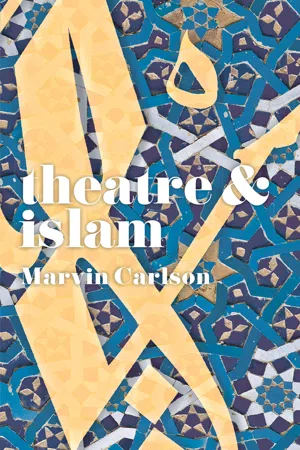
This insightful and engaging new title in the Theatre & series explores the various connections between theatre and Islam. Drawing on both historical and recent examples to trace their relationship and offer a new perspective on a topical subject, this persuasive text argues against a long-standing assumption that Islam has worked in opposition to theatrical presentation. From the 13th century puppet plays of Ibn Daniyal to Islamic themes in 21st century productions, Theatre and Islam is chronologically wide-ranging and ambitious in its scope.
Ambitious yet concise, this is the perfect introduction for undergraduate and postgraduate students of religious studies, Islamic studies, Middle Eastern studies and drama.
- 84 pages
- English
- ePUB (mobile friendly)
- Available on iOS & Android
eBook - ePub
Theatre and Islam
About this book
Information
theatre & islam
Introduction
Perhaps no title in the already extensive, varied, and growing series of books in the “Theatre &” series is likely to engender as much surprise as “Theatre & Islam.” While theatre’s involvement with a wide range of human institutions and practices is a phenomenon that will be readily accepted by most readers, there has long been an assumption, perhaps especially firmly held by theatre scholars themselves, that Islam as a faith was so fundamentally opposed to theatre that the two were essentially incompatible. For evidence of this, one need look no further than the most widely read and highly respected scholarly study of world theatre history in the late twentieth century, at least in the English-speaking world: Oscar Brockett’s History of the Theatre, first published in 1968 and with new editions appearing every five years or so, maintaining its unrivaled position into the new century.
As the decades passed, the new editions of Brockett’s key work faithfully reflected an increasingly global attention to theatre. Beginning with an attention only to Europe, the United States, and a few classic oriental forms, the History gradually added more and more material on Asia, Africa, and Latin America. The Islamic world remained unconsidered, however, and indeed was specifically presented as a part of the world outside the boundaries of theatre. In the ninth edition, the first of this century (2003), when such previously neglected regions as Latin America and sub-Saharan Africa had begun to receive significant attention, the Islamic world remained unconsidered. Indeed, the book assured its readers that they need not be concerned by this, because theatre was not a form of any interest or importance in this vast area of the world. The 2003 edition confidently reaffirms a statement also found in earlier editions: “[Islam] forbade artists to make images of living things because Allah was said to be the only creator of life … the prohibition extended to the theatre, and consequently in those areas where Islam became dominant, advanced theatrical forms were stifled.”1
There are many problems with both the argument and the conclusions of this self-confident and wide-ranging pronouncement. Certainly there is a long tradition of aniconism (absence of material representations of natural or supernatural figures) in Islam, but Brockett does not mention the fact (although it comes up elsewhere in his text) that this same suspicion of images is a major concern in all three of the world’s major monotheistic religions (Islam, Judaism, and Christianity), not so much because only God could create but more because of a fear (expressed most familiarly
in the second of the Ten Commandments) of competition from the “graven images” of other rival deities. Brockett suggests that there is almost universal agreement on “Islamic” opposition to theatre, but there is in fact a wide variety of opinions, as there is in Judaism and Christianity. “Advanced” theatrical forms are of course a code for modern Western forms, while the many highly developed performative traditions of the world that do not conform to this Western model, such as dance-drama, puppet theatre, or enacted storytelling, are conveniently ignored. Many of these use images of living beings, which in fact have never been generally prohibited in Islam. True, certain Islamic sects and clerics have condemned such representation, but so did Augustine and Tertullian, but we can hardly use that as a basis for saying that Christianity as a whole prohibited such activity, as Brockett, Hildy, and many others in the West have for Islam. Yet this bias continues, as John Bell noted in a 2005 survey of Western scholarship and the ignorance of Islamic performance in the West. Because Brockett and Hildy’s book “is so widely used and respected,” its “faulty scholarship remains dominant, the voice of authority.”2
in the second of the Ten Commandments) of competition from the “graven images” of other rival deities. Brockett suggests that there is almost universal agreement on “Islamic” opposition to theatre, but there is in fact a wide variety of opinions, as there is in Judaism and Christianity. “Advanced” theatrical forms are of course a code for modern Western forms, while the many highly developed performative traditions of the world that do not conform to this Western model, such as dance-drama, puppet theatre, or enacted storytelling, are conveniently ignored. Many of these use images of living beings, which in fact have never been generally prohibited in Islam. True, certain Islamic sects and clerics have condemned such representation, but so did Augustine and Tertullian, but we can hardly use that as a basis for saying that Christianity as a whole prohibited such activity, as Brockett, Hildy, and many others in the West have for Islam. Yet this bias continues, as John Bell noted in a 2005 survey of Western scholarship and the ignorance of Islamic performance in the West. Because Brockett and Hildy’s book “is so widely used and respected,” its “faulty scholarship remains dominant, the voice of authority.”2
Unhappily, this view of the incompatibility of Islam with theatre has by no means been restricted to Western scholars; many Arab writers, from classic times to the present, take a similar position. Their concern has often been traced back to the Arabs’ first encounter with Greek heritage through Syriac translations, which took place during the golden age of the Abbasid dynasty (the second century of Islam). Mohammed Al-Khozai, for example, argues that by “this time Arabic poetry was maturing; and because of the new monotheistic faith, it was unlikely that Arab scholars would turn to what they considered a pagan art form.”3 The Greek drama posed a particular problem because of its celebration of simulacra and conflict. This constituted a real danger to the newly established monotheistic Arabo-Islamic structure and to the social and political orders. Mohammed Aziza concludes that because of these serious cultural differences, “It was impossible for drama to originate in a traditional Arabo-Islamic environment.”4
This historical argument, even if correct, would apply largely to the early period of Islam (from the early seventh century), when the new faith was struggling to differentiate itself from its religious and cultural predecessors. However, the continuing opposition of many conservative Muslim clerics to representation in general and theatre in particular reflects a more basic concern, doubtless closely tied to the uneasiness in all monotheistic religions with the concept of representation. Both Arab and Western authors have, like Brockett and Hildy, long asserted that Islam as a faith does not allow 5 In their critique of the reported Islamic injunction against taswir, these authors state categorically that “the Qur’an does not expressly forbid the representation of the human form. In fact, no single verse refers to it at all.”6
The only authority for this injunction they could discover comes from the post-Qur’anic writings known as hadith. These are collections of sayings, reports, and commentaries on the Qur’an that were transmitted orally after the death of the prophet and later gathered and circulated by Islamic scholars. Although the authority granted to the hadith varies widely within the Islamic world, most Muslims consider them an important supplement to the Qur’an, though lacking its ultimate authority. One such hadith, collected by the Persian scholar al-Bukhari in the ninth century, seems to be a straightforward prohibition of figurative art: “when he makes an image, man sins unless he can breathe life into it.” Khatibi and Sijelmassi, after categorizing this hadith as “unverifiable,” go on to assert that even if it is authentic, the prohibition it articulates
was directed against the surviving forms of totemism which, anathematized by Islam, could conceivably reinfiltrate it in the guise of art. The principle of the hidden face of God could be breached by such an image. In one sense, theology was right to be watchful; it had to keep an eye on its irrepressible enemy – art.
In opposition to the widespread view that Islam is opposed to representation, they remind us of an alternative tradition wherein the Prophet Mohammed “permitted one of his daughters to play with dolls, which are of course derived from the totemic gods. Moreover, there are numerous examples of figurative sculpture in Moslem art, and of drawings both of animals and humans.”7 On the whole, the Shia branch of Islam, centered in Persia, was more flexible on this matter, and the second Caliph8 al-Mansur, in the eighth century, even allowed representative sculpture in his palace in Baghdad.
When Islam was established as a new religion, in the early seventh century, not only the middle East, where it appeared, but all of Europe offered little of what most people today would call theatrical activity. The magnificent theatre culture of Greece and Rome now survived only in hundreds of crumbling monuments, used only for grazing animals or for looting stones to employ in more modest later structures. The only major theatre of that time was far to the east, where the spread of Buddhism, associated from the beginnings with masked dance performance, had by the seventh century established a major dramatic tradition in the Sanskrit theatre of India and significant dance theatre in Japan, China, and central Asia.
Islam, unlike Buddhism but like Christianity and Judaism, from the beginning emphasized not ritual but a sacred text and so did not, at least in its earliest manifestations, generate theatrical material from within its own religious observances. Nevertheless, as it developed in cultural significance and geographical extent, it inevitably interacted both positively and negatively with other elements of the surrounding society. Although this society did not, as did the Sanskrit culture of contemporary India, have a significant theatre tradition, it nevertheless offered a variety of distinctly theatrical forms, all of which were inevitably influenced by the rise of Islam. Chief among these were the simple folk farces found in cultures around the world, puppet shows, and various forms of public address, particularly storytelling.
Storytelling in the Islamic Tradition
Of these, the third was the one most commonly used by the Islamic faith. The public storyteller is a figure that goes far back in the history of the Middle East and North Africa, the central area for the development of Islam and this sort of activity, with many variations, was central to the early spread of that faith. Soon after the death of the prophet, the basic text of the Qur’an began to be supplemented by a body of related material—anecdotes, fragments of history, and reported deeds and sayings of the prophet. In contrast to the sacred written text, this material was passed down orally under a variety of names, a number of them predating Islam: hàditha (discourse), hikma (wise saying), sira (chronicle), naba (instructive story), nadira (anecdote) qissa (fable), and others.9
The appearance of storytellers offering dramatic interpretations of Islamic material is recorded as early as 650, less than 20 years after the prophet’s death, and although they were often denounced by orthodox Muslims, their general popularity continued to grow. During the early years of the Umayyad dynasty, beginning in 661, storytelling was generally supported by leaders of the faith and recognized as an official profession, and representatives were welcomed at the court.10 The most common term for this activity was qissa, which has been divided by some modern scholars into two general types. The first and original type was an “instrument of official religious propaganda,” and the second, an elaboration on the first, extended its subject matter into a much broader field, drawing upon religious stories and events and tribal epic material.11
In the early ce...
Table of contents
- Cover
- Half Title
- Series Page
- Title Page
- Copyright
- Content
- Series Editors’ Preface
- Introduction
- Index
Trusted by 375,005 students
Access to over 1.5 million titles for a fair monthly price.
Study more efficiently using our study tools.
Frequently asked questions
Yes, you can cancel anytime from the Subscription tab in your account settings on the Perlego website. Your subscription will stay active until the end of your current billing period. Learn how to cancel your subscription
No, books cannot be downloaded as external files, such as PDFs, for use outside of Perlego. However, you can download books within the Perlego app for offline reading on mobile or tablet. Learn how to download books offline
Perlego offers two plans: Essential and Complete
- Essential is ideal for learners and professionals who enjoy exploring a wide range of subjects. Access the Essential Library with 800,000+ trusted titles and best-sellers across business, personal growth, and the humanities. Includes unlimited reading time and Standard Read Aloud voice.
- Complete: Perfect for advanced learners and researchers needing full, unrestricted access. Unlock 1.5M+ books across hundreds of subjects, including academic and specialized titles. The Complete Plan also includes advanced features like Premium Read Aloud and Research Assistant.
We are an online textbook subscription service, where you can get access to an entire online library for less than the price of a single book per month. With over 1.5 million books across 990+ topics, we’ve got you covered! Learn about our mission
Look out for the read-aloud symbol on your next book to see if you can listen to it. The read-aloud tool reads text aloud for you, highlighting the text as it is being read. You can pause it, speed it up and slow it down. Learn more about Read Aloud
Yes! You can use the Perlego app on both iOS and Android devices to read anytime, anywhere — even offline. Perfect for commutes or when you’re on the go.
Please note we cannot support devices running on iOS 13 and Android 7 or earlier. Learn more about using the app
Please note we cannot support devices running on iOS 13 and Android 7 or earlier. Learn more about using the app
Yes, you can access Theatre and Islam by Marvin Carlson in PDF and/or ePUB format, as well as other popular books in Media & Performing Arts & Theatre. We have over 1.5 million books available in our catalogue for you to explore.