How do audiences look at actors in costume onstage? How does costume shape theatrical identity and form bodies? What do audiences wear to the theatre? This lively and cutting-edge book explores these questions, and engages with the various theoretical approaches to the study of actors in performance. Aoife Monks focuses in particular on the uncanny ways in which costume and the actor's body are indistinguishable in the audience's experience of a performance.
From the role of costume in Modernist theatre to the actor's position in the fashion system, from nudity to stage ghosts, this wide-ranging exploration of costume, and its histories, argues for the centrality of costume to the spectator's experience at the theatre. Drawing on examples from paintings, photographs, live performances, novels, reviews, blogs and plays, Monks presents a vibrant analysis of the very peculiar work that actors and costumes do on the stage.
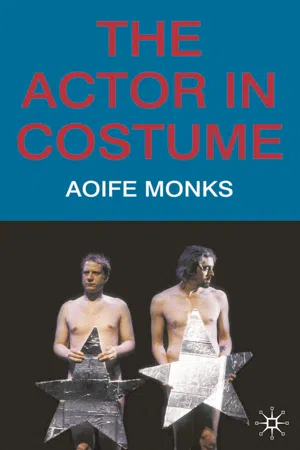
- 224 pages
- English
- ePUB (mobile friendly)
- Available on iOS & Android
eBook - ePub
The Actor in Costume
About this book
Information
1
Dressing Rooms: The Actor’s Body and Costume
In Emile Zola’s 1880 novel Nana, Count Muffat visits the actress and prostitute Nana backstage in her dressing room at a Parisian theatre while a show is in progress. Like Pentheus in the last chapter, Muffat is a morally rigid man, and he feels overwhelmed by the strangeness of the world of the dressing room: ‘Muffat had never been backstage in a theatre and was feeling particularly surprised and uneasy, full of vague repugnance, not unmixed with fear’ (Zola, 1992, p. 120). And, like Pentheus’ double vision after dressing as a woman, Muffat’s repugnance grows into disorientation, due to the strangely erotic experience of being in close proximity to actors, who are hard at work dressing up into their costumes:
Once again, he was feeling overcome by the dizziness [. . .] He could feel the thick dressing-room carpet giving way under his feet, and the flames of the gas-jets on the dressing table and by the cheval-glass were making a hissing noise around his temples. For a second he was scared that this time these women’s smells, aggravated by the heat, would make him faint.
(Zola, 1992, p. 123)
The disorientation the Count feels is put down to the squalor of the dressing rooms, and his infatuation with Nana. But I wonder if this light-headedness is also due to the confusion he feels about being in a third space between the stage and the real world, a space with a life of its own: its own hierarchy, etiquette, smell and sense of time and space? The Count is confused by the stark contrast between the painted brilliance of the auditorium and the ‘sordid, poverty-stricken garret’ (Zola, 1992, p. 140) backstage, and by the tension between the beauty and skill of the performers on the stage, and the ‘pallor and ugliness of actors without their greasepaint’ (Zola, 1992, p. 142). The beauty that had seemed so real to him in performance, is revealed to be nothing but artifice, and he is disconcerted by its loss. But, perhaps Muffat is disoriented most of all by his expectation that the dressing rooms will reveal to him what actors are really like. His hopes are confounded: the work that he sees the actors doing, their act of dressing in preparation for their performance onstage, does not tally with what he sees on the stage or in the street, and he is overwhelmed with dizziness. The dressing room turns out to be an indeterminate place of transition, a place of change, rather than offering any insight into the seams between the illusion and reality.
We might ask why Muffat and Pentheus feel so disoriented by the act of dressing-up: why dressing-up makes the actor and the spectator see double. Muffat and Pentheus’s double-seeing suggests that dressing-up transforms the actor’s body and psyche, and that it does something peculiar to audiences as well. Imagining actors changing into their costumes then, helps us to consider the process of transformation that costumes might produce, and makes visible the strange permeability between actors’ bodies and their clothes. The troubling and disorienting properties of dressing-up begs the question: when we look at an actor in costume onstage, what might we see? Indeed, our theatrical double vision prompts a further question: how many actors and how many costumes do we see in a single figure? Furthermore, given Muffat’s faintness, we could also ask: what forms of double vision are employed by spectators, when looking at the costumed actor? We can think about these questions by making our own visit to the dressing room to consider the strangeness of what we find there. We can also attempt to sketch out the many bodies that costumes produce, and furthermore consider a particular example of how costume has constructed the actor’s body (in this case, the body of the actress Fiona Shaw). All of these approaches will allow us to consider the very strange prospect of the actor in costume.
Dressing-Room Bodies
There is a long history of paintings and photographs of performers in their dressing rooms. It is the disorienting qualities of this third space, between the stage and life, that are central to the allure of these pictures. They undertake the task of displaying the seams between the illusion and reality, of showing us what the actor is “really” like offstage. These portraits seem to answer the plaintive cry: ‘but what do actors do?’ It doesn’t seem right somehow, that acting is just a job; surely, it must be more mysterious than work, must involve some kind of magic trick of transformation and transportation that might explain what we see onstage? Depictions of this space present different versions of what actors “do”, versions of the actor that we can locate in two particular paintings of dressing rooms.

Figure 2 Sir Michael Gambon as Sir John Falstaff at the National Theatre 2005 (Stuart Pearson Wright, oil on linen, 2005, by permission of Stuart Pearson Wright).
In Stuart Pearson Wright’s 2005 portrait of Michael Gambon as Falstaff, Sir Michael Gambon as Sir John Falstaff at the National Theatre, Gambon, a well-known actor of the British stage and screen, sits in his dressing room (see Figure 2). His gaze is averted and his stare is one of introspection or reverie. In the mirror on his right, we see his reflection and on the counter we can see a full ashtray and some scripts. The room is corporate looking and bare. It is unclear if Gambon is in costume, or if he’s about to get dressed. In another portrait, Degas’ 1879 painting Actress in Her Dressing-room, we see an unknown performer with her back to us, adjusting her dress (see Figure 3). We can only see her face in the reflection of the mirror. There is a man on her left, helping her with her costume, looking at her body lasciviously. She is entirely focused on her task, and is unaware of our gaze.

Figure 3 Actress in Her Dressing-Room (Edgar Degas, oil on canvas, c. 1879, by permission of The Norton Simon Foundation).
In anonymous portraits, like the Degas, where we know nothing of who the actress really is, we see performers lost in their rapt attention to the act of dressing-up. Our sense of who they are is determined entirely by their relation to costume. By contrast, in pictures of stars, like this one of Michael Gambon, we see the actor already dressed, or about to dress, but in repose, and in this repose we see the idea of the actor as a “man”. Here, the picture constructs the idea that the actor is a person with an interior life that is distinct from that of the character’s. In the anonymous picture, we see the performer at work – and the actor’s work as the wearing of costume – while in the image of the star, we see the actor before or after work, about to dress up into someone else. Either way, imagining performers putting on (or taking off) their costumes stands in for the secret world behind the illusion of the performance. Access to the dressing room implies that we might somehow discover the seams between actors and their roles. It’s no accident that mirrors are often a central feature of these pictures: they stand in for our desire to see behind the theatrical mask, and suggest that actors too might also be searching for their true selves beneath the greasepaint and tulle.
Portraits of actors in dressing rooms reveal some of the cultural suppositions about the relationship between acting and costume. A common feature of many of these pictures is the actor’s averted gaze. This averted gaze was a central feature of the recent photographic exhibition at the National Theatre in London in 2007, ‘The Half: Photographs of Actors Preparing for the Stage’, by the photographer Simon Annand. It is also at the heart of the portrait of Gambon, his averted gaze giving the sense that he is “not performing”, but is at a distance from his usual connection with the viewer. The gaze suggests that what we see in Gambon is a kind of reverie that comes before change. His stare implies that acting is an inward activity, a psychic transition from the outside world to the illusion of the stage, and that dressing-up is a crucial linchpin for this shift. The painting of Gambon imagines that dressing-up does something to his psyche, suggesting that changes to the exterior of the body have interior effects, that the surface has repercussions for the soul, and that dressing rooms are places of transition from one psychological state to another. The dressing room, this picture wants to tell us, is a place of interior as well as exterior transformation: it is quite literally a changing room.
However, while locating the distinction between actors and their roles is a major trope of dressing-room pictures, there is another important dimension to these paintings, which is the slightly sordid pleasure of peeking backstage unnoticed. In the Degas painting, for instance, we can look at the actress without fear of being confronted. Her absorption in the adjustment of her costume positions us as voyeurs, free to look at her body without her knowledge. Perhaps the man in the painting on her left is our surrogate in this desire to look? The appeal is erotic, but it also hinges on this idea that the painting reveals the secret world of the performer, whose central ingredient is the mundane. Crucially, the actress isn’t doing anything very interesting: her adjustments to her dress point to the repetitive work of performance. Indeed, even as the Gambon portrait might suggest a spiritual dimension to the actor’s identity, accounts of dressing rooms often focus on the mediocrity of the actor’s activities there. What we see in these paintings (and find in representations of dressing rooms in novels, diaries, plays and poems) is the everyday routine labour of being an actor: the graft and repetition that exist beneath the seemingly spontaneous spectacle. The secret of the actor’s work is that there is none: it turns out that the “magic” of the stage is conjured up through dull and hard work. This mundanity is crucial to the allure of the dressing room, and is often used as a metaphor for the work of the actor. The erotic act of looking at an actor dressing-up is tempered – or perhaps heightened – by the fact that dressing-up is an everyday activity that appears dislocated from the fantastical stage-world that the performer inhabits for the audience.
On the other hand, the dressing room can also establish the star persona of the actor. Dressing-up can be an act that asserts the hierarchies of the backstage world. Zola’s description of the communal dressing rooms shared by the minor actors in Nana emphasises the mundane labour of dressing and undressing backstage: ‘the final scramble was taking place, everybody cleaning off all the roughened grease-paint, pulling on their clothes, in a cloud of rice-powder’ (Zola, 1992, p. 138). By contrast, Jennifer Lopez’s demand ‘that her Top of the Pops dressing-room be painted completely white and filled with fresh white flowers’ (Gannon, 2007, p. 24) is situated in a long line of dressing-room demands that have ensured that the identity of the performer as a star is foremost. Muffat’s double vision backstage might be explained, therefore, by the ways that the location and décor of the dressing room, and the sorts of activities that go on there (dressing or thinking) do crucial work in deciding what sort of actor we see onstage. The relations of space, objects, hierarchy and activity in the dressing room show us what a complex and fragile figure the actor is, and how the location where actors get dressed and undressed can exert a formative effect on their public personae.
Of course, the twentieth century was a time when the relationship between dressing-up and the theatrical hierarchy was challenged. Included in Vsevlod Meyerhold’s revolutionary approach to theatre in Russia in the 1920s, was a reconsideration of the role and meaning of dressing rooms, asking:
What link should there be between the actor and the place where he is about to perform? Should he sit in his dressing room, remote from the acting area, and simply arrive in time to speak his part on cue? Or is it better to place him in close proximity to the stage, so that he can easily, naturally, organically merge into the performance at the appropriate moment?
(Meyerhold, 1972, p. 70)
Meyerhold’s (rhetorical) questions imply that to revolutionise performance practices onstage, it is necessary to reconfigure the hierarchies offstage, including those inscribed in the act of dressing-up. Similarly, Ariane Mnouchkine’s company, the Théâtre du Soleil in Paris, make their dressing rooms visible to the audience (see Miller, 2007, p. 90). Again, Mnouchkine’s impulse is to reconfigure the audience/actor relationship. In theory, when actors dress up in full view, the audience are more likely to relate to them as working actors than as characters. The gap between the actor and the role that the Degas and Gambon portraits seek to locate in the dressing room is a gap that has been placed centre stage in the twentieth century by directors such as Meyerhold, Mnouchkine and Bertolt Brecht. It could be argued however, that systematising the act of dressing-up renders the actor’s working body part of the stage’s illusion, becoming another fictional role. Dressing-up onstage offers no further insight into the secrets of the actor’s work.
The Actor’s Body
While we cannot really tell the difference between these performers and their clothes (and in Gambon’s case we are unsure if his clothes are costume or not), these paintings and photographs express the desire to try to locate the difference, to try to establish a distinction between actors and their costumes. In all cases, the attempt fails. We cannot distinguish between the performers and what they wear: their clothes constitute their selves in the paintings. After all, when we look at the portrait of Michael Gambon, it’s not entirely clear whom we see. The real man, Gambon, and the illusion, Falstaff, are not easily distinguished: it’s not clear if we are looking at Gambon in costume. But, even if it were clear that Gambon was dressed for his role, we are not necessarily seeing Gambon as Falstaff. Instead, it’s as if there is a third Michael Gambon, the dressing-room Gambon, who occupies this peculiar space between stage and life. While actors put on the clothes of their character in the dressing room, they may only partly do so, they might wait until the last minute before finishing putting on their costume, they may have only half their make-up done. Within this strange space of dressing-up, the costume is not the character’s clothes, and not the man’s, but is the actor’s work clothes: the uniform, or overalls that they do their job in.
We can see then, in pictures of actors dressing-up, a range of possible figures at work: the star actor, the real actor, the working actor and the transforming actor. These figures can also be found on the stage, operating alongside and within the character in the fictional narrative. When spectators look at a costumed actor on the stage, they see many actors and many costumes. These figures often exist only at the corner of the eye when watching a performance, but are nonetheless essential to how the character may be received by the audience. Sometimes the form of performance indicates that the audience should not look at these figures too directly, while in other forms, like in the work of Mnouchkine and Brecht, or in ballet, circus or celebrity West End appearances, they become central to the spectator’s experience of the performance. The multiple figures in operation in performance are configured in varying relationships of prominence and visibility depending on the contexts, aesthetics and traditions informing the style of acting, and the viewing attitudes of the audience. Portraits of actors in their dressing rooms may function to allow spectators to contemplate the often repressed aspects of the actor’s work, freezing the motion of these many bodies.
So, when spectators look at an actor in this semi-dressed state, or indeed, when they look at an actor in costume on the stage, whom and what do they see? The borders between the actor and the costume are unclear. The costume is the spectator’s means to access the actor’s body, and is also a means for the actor to access the world of the performance. When spectators watch an actor in performance they might imagine they see only one figure, but if they were to relax their eyes slightly, this single figure would blur into multiple ones, all of whom are doing a different job in performance, all of whom are a product of the performance. These blurred and multiple figures might even suggest that the actor’s body is a composite of many bodies. Using the word “body” suggests that we need to approach the actor not as a given, real object, but as a process: a series of practices that are ongoing. When spectators look at actors in costume, they see bodies emerging continuously through the course of the performance. A view of the body as a process may be counterintuitive in a post-Darwinian world, where the body is often assumed to be an object beyond culture, determined only by hereditary and genetic forces. But, even if we accept this version of the body (and many people don’t), we can still take account of the social frameworks through which we approach, or imagine, or experience the body (our own and other people’s). In other words, we can’t leave our context behind when we look at bodies, and actors can’t leave their context behind when playing them. If we work with this notion of a body as a process, we can imagine actors emerging in various forms on the stage, depending on their historical context and aesthetic function within the theatrical event. So far, I have labelled the various figures of the actor as working, real, star and transforming, but I want to suggest that we can break the actor’s body down into even more specific categories. We can examine these bodies more closely in order to understand the complex set of relationships between actors and their costumes. These approaches to the actor have been discussed in detail by Bert States (1985), Michael Quinn (1990) and David Graver (2003), and I’m drawing on their ideas in the following discussion.
We have already seen evidence of the “working body” in the Degas portrait of the actress, in her intent focus on the labour of dressing. This body also emerges on the stage, and as Bert States points out, we can find evidence of its existence in the sweat produced on the brow of the actor while they perform the role (States, 2003, p. 109). This sweat is the working body’s sweat, not the character’s (although sometimes they coincide, as when Falstaff sweats from overeating, and the working figure of Gambon simultaneously sweats from the heat of the lights). Costume makes the working body possible, in facilitating its unnatural state, its: ‘corporeal elasticity and expertise’ (Graver, 2003, p. 160), establishing its particular and peculiar relationship with the stage environment. After all, some costumes are designed to foreground the performers’ work, such as the unitard of the strongman at the circus, while other costumes actually constitute the work, such as clown stilts or the magically transforming costumes of the Kabuki stage. Even modern-dress productions of Shakespeare determine the attitude of the actor’s body onstage, establishing the freedoms and constrictions and contours of a body that appears very like the spectator’s. The appearance, abilities and dimensions of the working body are produced and rendered meaningful through costume.
The “aesthetic body” is made of codes and conventions. Gambon’s costume might look like ordinary dress, but his beige trousers or white pointed shoes and red stripy socks (if indeed they are costume) enter into symbolic realm once included in the space of the stage. His white shoes and socks might become significant of a certain form of dandyism, if every other actor wears sensible brown shoes, for example. His beige trousers would beco...
Table of contents
- Cover
- Title Page
- Copyright
- Dedication
- Contents
- List of Illustrations
- Acknowledgements
- Introduction: The Dress Rehearsal
- 1 Dressing Rooms: The Actor’s Body and Costume
- 2 Dressing the Audience: A History of Fashion at the Theatre
- 3 Re-Dressing the Actor: Modernist Costume
- 4 Cross-Dressing: Authenticity and Identity
- 5 Undressing: The Disappointments of Nudity
- 6 Dressing the Immaterial: Costume and the Problem of Ghosts
- Epilogue: After Effects – Costume and the Memory of Performance
- Bibliography
- Index
Trusted by 375,005 students
Access to over 1.5 million titles for a fair monthly price.
Study more efficiently using our study tools.
Frequently asked questions
Yes, you can cancel anytime from the Subscription tab in your account settings on the Perlego website. Your subscription will stay active until the end of your current billing period. Learn how to cancel your subscription
No, books cannot be downloaded as external files, such as PDFs, for use outside of Perlego. However, you can download books within the Perlego app for offline reading on mobile or tablet. Learn how to download books offline
Perlego offers two plans: Essential and Complete
- Essential is ideal for learners and professionals who enjoy exploring a wide range of subjects. Access the Essential Library with 800,000+ trusted titles and best-sellers across business, personal growth, and the humanities. Includes unlimited reading time and Standard Read Aloud voice.
- Complete: Perfect for advanced learners and researchers needing full, unrestricted access. Unlock 1.5M+ books across hundreds of subjects, including academic and specialized titles. The Complete Plan also includes advanced features like Premium Read Aloud and Research Assistant.
We are an online textbook subscription service, where you can get access to an entire online library for less than the price of a single book per month. With over 1.5 million books across 990+ topics, we’ve got you covered! Learn about our mission
Look out for the read-aloud symbol on your next book to see if you can listen to it. The read-aloud tool reads text aloud for you, highlighting the text as it is being read. You can pause it, speed it up and slow it down. Learn more about Read Aloud
Yes! You can use the Perlego app on both iOS and Android devices to read anytime, anywhere — even offline. Perfect for commutes or when you’re on the go.
Please note we cannot support devices running on iOS 13 and Android 7 or earlier. Learn more about using the app
Please note we cannot support devices running on iOS 13 and Android 7 or earlier. Learn more about using the app
Yes, you can access The Actor in Costume by Aoife Monks in PDF and/or ePUB format, as well as other popular books in Media & Performing Arts & Theatre. We have over 1.5 million books available in our catalogue for you to explore.