- 232 pages
- English
- ePUB (mobile friendly)
- Available on iOS & Android
eBook - ePub
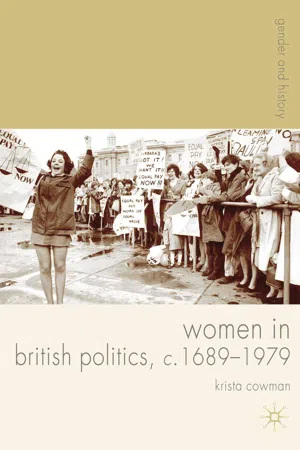
Women in British Politics, c.1689-1979
About this book
This account examines some of the areas of women's political activity in Britain from the Glorious Revolution to the election of the first female Prime Minister in 1979. It shows how women had worked in a variety of arenas and organizations before the suffrage campaign and explores the directions their political activity took afterwards.
Information
Part 1
Forging a Political Presence
1
From Glorious Revolution to Enlightenment: Women’s Political Worlds, 1689–1789
Introduction
This chapter examines aspects of women’s political activity from the Glorious Revolution to the closing years of the eighteenth century. Until recently this approach would have seemed unusual: early modern political history concerned itself with ‘high politics’, the narrow world of court and government where men held sway, with occasional attention paid to groups such as the Levellers.1 Lately this has been challenged by research that has argued the need for a broader definition of the political in an age when few men had access to governmental institutions. Studies such as those by Wrightson have demonstrated alternative sites for political activity in the everyday world of the early modern parish.2 Women’s historians have expanded these approaches to query the gendering of early modern politics. Women, it has been shown, took part in politics at all levels of society.3 Their participation was not always separate. Lower-class women joined with men to voice concerns over religious, economic and social matters in popular demonstrations and riots throughout the seventeenth and eighteenth centuries. Yet, as Mendelson and Crawford have noted, early modern women developed ‘their own objectives in political action,’ which were not always identical to those of men.4 Sometimes these linked directly to their role as wives or mothers. On other occasions religion gave women a public platform. Again this was not unique in a period when state and church were inseparable. Nevertheless, religion ‘authorised women in public political action’, and they often exceeded men in public expression of dissenting beliefs.5 This included direct action; a woman was credited with sparking the rioting against the Scottish Prayer Book which opened the Covenanting Revolution of 1637. Recent research suggests that Jenny Geddes, the servant whose attack on the Dean of Edinburgh initiated the protest, is better understood as a composite of several women, confirming female participation.6 Religious protest was not without risk for women; Covenanting activities led to a number being executed in the 1680s.7
Exceptional events in this period disturbed the gendering of politics. The English Civil War saw women of all classes active in support of both sides. Sometimes their involvement was pragmatic; a besieged town demanded the resistance of all its inhabitants. Elsewhere, women acted less spontaneously as couriers, as spies or as nurses to the wounded, as well as raising considerable funds for the Royalist and Parliamentarian causes. The Civil War prompted an upsurge in women’s petitioning. Such public activities decreased after the Restoration, as society sought ‘a return to normality including the customary gender order’. Dissident voices were repressed but did not vanish; small numbers of women still published political demands throughout the eighteenth century, particularly on religious matters.8
Women were not absent from high politics either. The Glorious Revolution of 1688–9 has been seen as ‘an event of decisive significance in the internal development of the United Kingdom’.9 It settled the issue of royal succession, and furthered a shift in the balance of power from monarch to Parliament. The timing and length of parliamentary meetings and elections were regulated, which in turn encouraged the development of party politics. The Toleration Act of 1689 fostered a more open attitude to religious dissent (but not to Catholicism).10 More recently it has also been read in terms of gender.11 Lois Schwoerer has described women’s participation at several levels as petitioners and publishers, as financial supporters and in the crowds that welcomed William and Mary.12 Women were also involved in the Jacobite movement, which sought a return to the Stuart (and hence Catholic) monarchy. More obviously the presence of Queen Mary as regnant queen put a woman at the heart of political power as head of state. During Mary’s reign and the subsequent regnancy of her sister Anne, British politics were headed (if not dominated) by women. Studying regnant queens has encouraged women’s historians to turn their attention to the world of the royal court, where scholars such as Helen Payne found aristocratic women wielding considerable levels of political power which they exercised for their own ends as well as for those of their families.13
Aristocratic women’s power did not diminish as the importance of the court declined. As Parliament’s power rose, so did party political affiliations. These extended beyond the metropolitan world of Parliament into constituencies; by 1700 O’Gorman found evidence of strong and consistent party feeling amongst the electorate.14 Party loyalty fed into – and was fuelled by – a growing number of contested elections, which in turn assisted the beginnings of party organisation. Women had several roles to play here, as political hostesses, financial supporters and active canvassers. Although she could not stand or vote, the figure of the party woman was as visible as that of the party man at election time.
Alongside considerations of women’s relationship to the institutions and mechanisms of state power, women’s historians have used the concept of political culture to expand understandings of the political. Particular attention has been paid to women’s role in the development of print culture from the mid-seventeenth century onwards.15 Women were involved in all aspects of the printing industry as well as authoring pamphlets, disseminating their ideas to a broader reading public. Published writings by women covered a number of political themes including religion. A small number used print to challenge sexual inequality in ways Crawford and Gowing feel we ‘might label feminist’, although they were not acting within a collective political movement at this stage.16
Approaches from cultural history have also had important implications for historians concerned with women and the Enlightenment. The practitioners of the Enlightenment are now recognised as more diverse than was previously claimed, comprising not only a small group of Parisian philosphes but a host of less familiar figures, ‘novelists, poets, medical men, salon hostesses, utopian thinkers and itinerant lecturers’.17 Collectively they diffused different aspects of Enlightenment through conversation, debate and print, with national and local variations in its emphasis and spread. This wider interpretation has brought greater acknowledgement of women’s role in the dissemination of Enlightenment thought. Assessments of their contribution to Enlightenment philosophy has been further aided, in the British context, by studies which have considered its distinctive Protestant/Anglican dimension in comparison with continental anti-clericalism.18
At the end of the eighteenth century the French Revolution brought fresh impetus to debates concerning political rights. Adjacent to calls for the recognition of a universalising ‘Rights of Man’ came the first tentative calls for women’s political emancipation, which many scholars have taken as the marking the birth of modern feminism.19 These were not yet being made collectively, although they appeared more frequently. Nor were they the only response to considerations of where women might fit in an expanding political world. A more restrictive discourse was simultaneously developed, which argued that woman’s nature made her unsuited for equal participation in a broadening polity. Some women rejected this; others such as Hannah More argued that subordination benefited women through offering them distinctive spheres of activity which complemented those of men. Whether women were equal to or different from men continued to occupy feminist thinkers in the nineteenth and twentieth centuries.
Seventeenth-century antecedents: popular politics and petitioners
Women involved in political protests in early modern Britain often justified their actions in terms of their role as wives or mothers. This can be seen in their constant presence in disturbances connected to the price or availability of food for almost two centuries.20 John Walter has described how women assumed the leadership of the notorious grain riots at Maldon, Essex in 1629, boarding a Flemish ship loaded for the export market and forcing its crew to ‘fill the[ir] aprons and bonnets’ with grain.21 The women put on trial after the riot drew attention to their poverty in court through words which implied their right to obtain food. One, Ann Spearman, explained how she acted ‘because she could not have Corne in the m[ar]kett & [because] certain fflemishe shipps … [lay] at Burrow Hills … there to receiue in Corne to carry beyond the sea’.22
Women were also to be found in disturbances connected with control over aspects of the local environment which fed into the domestic economy. Women mobilised to retain rights over common land which they accessed to graze animals or collect firewood. They protested against the enforced drainage of fenland in the Isle of Axholme in the 1620s and the 1690s.23 Scotswomen resisted the Highland clearances, and were prominent in direct actions against the dykes put up by landowners in Dumfries and Galloway in the 1720s.24 When military spending sparked inflation and protest at the end of the century, women’s participation was so marked that they comprised almost 50 per cent of those accused of felony in London.25
Women had other political concerns too, particularly in urban areas where they acted in defence of their wage-earning potential. In Scotland in the early 1700s, Rosalind Carr has argued that financial concerns provoked women’s part in anti-Union protests when female ‘shopkeepers, traders and consumers’ feared that Union would redistribute wealth to London.26 There were women amongst the crowds of rioting London weavers in 1675, prefiguring their later participation in Luddite protests by calling for the destruction of new engine looms.27 In 1697 between 4000 and 5000 women descended on Parliament demanding a bill to prohibit the wearing of East India silks, as their popularity was damaging the indigenous trade of silk weaving.28 These economically motivated examples show that women did not only legitimise their political activity through referring to their role as wives or mothers. Rather, as Bernard Capp has demonstrated, they were willing to voice their opinions on broader political issues, even when this carried extreme personal risk, as in the case of Mary Cleere, executed in 1577 for ‘pronouncing Elizabeth [I] a bastard and no rightful queen’.29 Nicholas Rogers has shown that such attitudes persisted into the eighteenth century, with women figuring prominently in trials for seditious words, frequently ‘cursing the King in the street’, as in the case of Mary Jones, gaoled for declaring ‘the Prince of Wales is a bastard, his mother’s a Whore’.30
The English Civil War augmented women’s political activity in support of both sides. Some of their action was circumstantial; as Capp commented of women’s part in the defence of Coventry, ‘all hands were needed in a town under siege’.31 At the same time, a distinctive feminine reaction can be traced in women’s opposition to the war. This could be extremely personal; Samuel Priestley’s mother walked the first quarter of a mile of his journey towards Fairfax’s army with him whilst she ‘besought him with tears not to go’.32 Other women petitioned and demonstrated for peace, approaching Parliament in increasing numbers, culminating in a demonstration of over 5000 in August 1643.33 Women justified their actions in terms of their identity as wives, mothers and non-combatants. Their opponents dismissed them in equally sexualised terms, calling them ‘Oyster wives, and other dirty or tattered sluts’, or suggested that they were being manipulated by more experienced political actors to articulate demands they did not understand.34 Critiques of political women as either naive or sexually deviant would reappear throughout the next four centuries.
Women’s petitioning was also a prominent part of the Leveller movement, peaking in 1649. Leveller women too were charged with political ignorance, and advised that as ‘the matter … is of an higher concernement than you understand … you are desired to goe home, and looke after your owne business’.35 Despite such gendered dismissals, Ann Hughes’ study has concluded that the problem lay with what the women were saying rather than the fact that they, not men, were saying it. Warning us to be wary not to ‘take for granted that the Leveller women’s petitioning of 1649 was unprecedented and outrageous’, Hughes claims that petitioning by early modern women was ‘seen as normal in many accounts, irritating or embarrassing, perhaps, but a part of political life’.36 Patricia Higgins, whose pioneering work on women petitioners took a more literal reading of their claims for exceptionalism, perceived an early feminist consciousness amongst women Levellers in their demands for equality and citizenship.37 If this is true, it was short-lived; collective activity such as petitioning had declined by the end of the century. It did not vanish completely. Schwoerer has shown that a small number of women continued to produce strong statements of their religious dissent through pamphlets, and occasionally ventured into other modes of public address, up to the period of the Glorious Revolution and beyond.38 Others such as Margaret Cavendish and Mary Astell began to publish writings that questioned women’s status in society.
Queens and elite networks: Mary II, Anne and models of queenship
From 1689 to 1714 two British women wielded power at the highest level. Unlike other European countries, English (then British) queens could reign if there was no male heir. For the first time in over a century, the Glorious Revolution raised the possibility of the (contested) crown passing to a woman, Princess Mary of Orange, wife of the Dutch Prince William, and elder daughter (and eldest surviving child) of King James II by his first wife, Anne Hyde. Unlike her namesake predecessor Mary I, Queen Mary II was able to draw on historical precedents to define her role as regnant queen, as both Mary Tudor and her half-sister Elizabeth had succeeded in overcoming opposition based on their sex to take the crown and thus establish a model for female sovereignty.39 Their monarchies demonstrated that women could rule, and that they could do so successfully. Furthermore, just as with Mary I and Elizabeth, Mary II and Anne reigned in close proximity, although they developed markedly different concepts of queenship. These showed some of the ways in which individual women could wield significant political power in an age in which this was overwhelmingly gendered as male. Their contrasting styles had wider repercussions for understandings of the relationship between gender and politics in their own time, as within their individual constructions of queenship, very different qualities were equated with femininity. Such different constructions, Rachel Weil has argued, ‘must have unsettled any idea that women had natural roles or characteristics’.40 They also offered markedly different models for how women might negotiate and exercise political power.
Of course, royal women are by their nature exceptional, separated from the majority of society by the privilege of birth which afforded them elite social status with all its attendant benefits. Clarissa Campbell Orr has gone so far as to classify them as ‘an ...
Table of contents
- Cover
- Title
- Copyright
- Dedication
- Contents
- List of Abbreviations
- Acknowledgements
- Introduction: Shaping the Narrative: Waves, Peaks and Troughs
- Part 1 Forging a Political Presence
- Part 2 The Women’s Movement Organises
- Part 3 Women’s Politics after the Vote
- Conclusion
- Notes
- Select Bibliography
- Index
Trusted by 375,005 students
Access to over 1.5 million titles for a fair monthly price.
Study more efficiently using our study tools.
Frequently asked questions
Yes, you can cancel anytime from the Subscription tab in your account settings on the Perlego website. Your subscription will stay active until the end of your current billing period. Learn how to cancel your subscription
No, books cannot be downloaded as external files, such as PDFs, for use outside of Perlego. However, you can download books within the Perlego app for offline reading on mobile or tablet. Learn how to download books offline
Perlego offers two plans: Essential and Complete
- Essential is ideal for learners and professionals who enjoy exploring a wide range of subjects. Access the Essential Library with 800,000+ trusted titles and best-sellers across business, personal growth, and the humanities. Includes unlimited reading time and Standard Read Aloud voice.
- Complete: Perfect for advanced learners and researchers needing full, unrestricted access. Unlock 1.5M+ books across hundreds of subjects, including academic and specialized titles. The Complete Plan also includes advanced features like Premium Read Aloud and Research Assistant.
We are an online textbook subscription service, where you can get access to an entire online library for less than the price of a single book per month. With over 1.5 million books across 990+ topics, we’ve got you covered! Learn about our mission
Look out for the read-aloud symbol on your next book to see if you can listen to it. The read-aloud tool reads text aloud for you, highlighting the text as it is being read. You can pause it, speed it up and slow it down. Learn more about Read Aloud
Yes! You can use the Perlego app on both iOS and Android devices to read anytime, anywhere — even offline. Perfect for commutes or when you’re on the go.
Please note we cannot support devices running on iOS 13 and Android 7 or earlier. Learn more about using the app
Please note we cannot support devices running on iOS 13 and Android 7 or earlier. Learn more about using the app
Yes, you can access Women in British Politics, c.1689-1979 by Krista Cowman in PDF and/or ePUB format, as well as other popular books in Social Sciences & Gender Studies. We have over 1.5 million books available in our catalogue for you to explore.