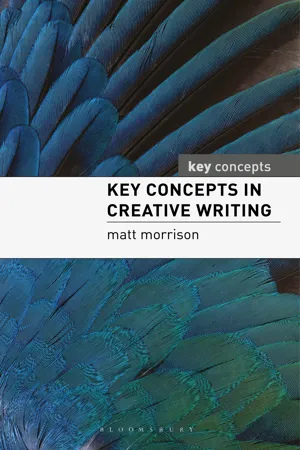
A comprehensive writers' guide to the terminology used across the creative writing industries and in the major literary movements. Packed with practical tips for honing writing skills and identifying opportunities for publication and production, it also explains the workings of publishing houses, literary agencies and producing theatres.
- 192 pages
- English
- ePUB (mobile friendly)
- Available on iOS & Android
eBook - ePub
Key Concepts in Creative Writing
About this book
Information
Aa
Absurd Literature
Absurd (or absurdist) literature provides a slightly ironic first entry to this book since it implies a rejection of much of what is held most sacred by writers.
Although works of fiction such as Franz Kafka’s Metamorphosis (1915) and Joseph Heller’s Catch 22 (1961) are sometimes referred to as absurdist, it is in the field of dramatic writing that the term has become most familiar. In 1961, Martin Esslin published a book called The Theatre of the Absurd in which he identified four leading figures: Samuel Beckett (1906–1989), Arthur Adamov (1908–1970), Eugene Ionesco (1909–1994) and Jean Genet (1910–1986). In later editions he added Nobel Prize-winning playwright Harold Pinter (1930–2008). In much of these writers’ work, the Aristotelian unities of space, time and action are abandoned, the logic of cause and consequence is undermined, and the importance of psychological motivation is rejected. The limits of language are tested through repetition and non sequitur and there are no obvious morals to the story. Characters are not only exposed and bewildered in these nightmare/dream worlds but occasionally completely absent (as is the case in Ionesco’s 1952 play The Chairs). None of which is to say that absurdist plays are depressing. On the contrary, they often delight in ingenious wordplay, self-referential commentary, songs and poetry.
Such an apparently liberated form can be appealing for new writers, who often feel constrained by the ‘rules’ of careful plotting or detailed characterisation. It is worth noting, however, that the flourishing of absurdist drama (and literature more widely) in the second half of the twentieth century was the result of specific historical and cultural conditions.
For many, the Second World War presented a fatal challenge to Enlightenment ideas of progress and reason which seemed to have led, through half a century of war, to the horrors of the Holocaust. As Esslin comments, the late 1940s and 1950s were a time when the ‘unshakeable basic assumptions of former ages had been swept away’ (Esslin, 1980, p. 23). In response, the playwrights of the absurd produced works which resisted attempts by the audience to locate fixed meaning or provide rational answers.
The most famous example of absurdist drama remains Samuel Beckett’s Waiting for Godot which received its British premier in 1955. In the play, two tramp-like figures wait in vain for the mysterious Godot to arrive. Their inconsequential ramblings, which embrace vaudeville, comedy review and clowning, are occasionally interrupted by random acts of violence and occasional kindness. The final implication, however, is that tomorrow will be just like today. Even time cannot give sense or structure to these lives.
Many of the elements that constitute the theatre of the absurd can be traced back to Shakespearian drama with its mix of tragedy and base comedy. Alfred Jarry’s Ubu Roi (1896) is considered a more direct antecedent. Here, the despotic Pere Ubu stands as a metaphor for mankind: insatiable, infantile and insane. Other early twentieth-century movements such as Dadaism and surrealism also helped prepare the ground. The existentialist philosophies of Jean-Paul Sartre and Albert Camus are occasionally conflated with absurdism, partly because Camus introduces the term in his essay The Myth of Sisyphus (1942): ‘This divorce between man and his life, the actor and his setting, truly constitutes the feeling of Absurdity’ (Esslin, 1980, p. 23). The great innovation of Beckett and Ionesco, however, was to match form with content. They, and others like them, were prepared to disorientate their audience with a barrage of apparent nonsense. The plays of Sartre and Camus are curiously traditional in comparison; empathetic characters debate their angst in the relatively staid manner of fourth wall drama.
Many contemporary dramatists continue to exhibit absurdist tendencies in their work. Examples might include Tom Stoppard, Christopher Hampton and Enda Walsh (see Further Reading, below).
Further Reading
Beckett, Samuel, Waiting for Godot (London: Faber & Faber, 1985).
Camus, Albert, The Myth of Sisyphus and Other Essays, trans. Justin O’Brien (London: Penguin, 2000).
Esslin, Martin, The Theatre of the Absurd (Harmondsworth: Penguin, 1980).
Kafka, Franz, Metamorphosis and Other Stories, trans. Michael Hofmann (London: Penguin Classics, 2007).
Hampton, Christopher, Plays 1 (London: Faber & Faber, 1997).
Ionesco, Eugene, Rhinoceros, The Chairs, The Lesson, trans. Donald Watson (London: Penguin, 1962).
Jarry, Alfred, The Ubu Plays, trans. Kenneth McLeish (London: Nick Hern Books, 1997).
Pinter, Harold, Plays: Two (London: Methuen, 1988).
Stoppard, Tom, Rosencrantz and Guildenstern are Dead (London: Faber & Faber, 1967).
Walsh, Enda, The Small Things (London: Nick Hern Books, 2005).
Action
Characters must do things in response to the problems thrown up by the plot. They must make choices, and the more active those choices are, the more an audience or reader will be gripped. Consider Hamlet. His greatest flaw, it is often said, is his propensity for delay. If only he had acted more decisively things would have worked out a lot better. But it can’t be said that Hamlet doesn’t act at all. In fact, he makes bold choices at every stage. Upon seeing a ghost, he bravely (or rashly) follows it to the battlements. On hearing the terrible news about his father’s murder, he resolves to feign madness to disguise his true intentions. Suspecting an intruder behind a curtain, he pulls out his sword and runs Polonius through. It is these actions, rather than his poetic soliloquies, that pull us through the story.
Some might say that Samuel Beckett’s Waiting for Godot (which premiered in France in 1953) provides a better example of literary inaction. In fact, Estragon and Vladimir are continually, restlessly, doing things. Whatever deep reason, or deep irrationality, lies behind their choices, those choices are active. If we weren’t acting, we’d be dead. Other literary works might appear to delight in a lack of action. But when someone says, for example, ‘the wonderful thing about Proust’s In Search of Lost Time is that nothing really happens’, they don’t mean it. What they mean is that nothing ‘big’ happens. There aren’t any earthquakes or asteroids falling out of the sky, but the tiny acts of cruelty, betrayal and indifference of which that book consists are surely as shocking.
With the possible exception of Waiting for Godot and other absurdist works, the vast majority of characters in fiction act in pursuit of specific goals or dramatic agendas. The most active characters will hold us firmly in their grip even when the aims are destructive or psychopathic. On the other hand, a story in which a character simply reacts, weakly, to events, encourages a sense of inertia. Any action or choice undertaken by a character in a story must be believable and well motivated. But taking that as read, the bolder the action the greater the tension and the more we crave to know what will happen next.
As far as dramatic action is concerned, choice is the essential element. We do not choose to breathe, but we may choose to leave our partner, or murder our neighbour. Dramatic action changes the direction the story is going. That change may come in the form of escalation (things were going badly, now they’re going really badly) or it may reverse things (things seemed desperate, but suddenly they’re looking up). Accidental change, which comes about due to entirely external factors (a freak hurricane, for example), should be used sparingly. As soon as such an event occurs, characters must make an active choice in response to it. Stuff happening isn’t that interesting in a story. But characters making decisions in response to stuff happening is compelling.
Writing Exercise
Write a description of a short meeting between two friends who are faced with the same dilemma. Perhaps they need to decide if they should move to another country for work. Or maybe they have to choose whether or not to confess to murder. In any case, they should come to opposite conclusions. Now write a description of another meeting several years later. How will the friends have changed? More importantly, how will the dynamic between them have changed?
Further Reading
Beckett, Samuel, Waiting for Godot (London: Faber & Faber, 1985).
Proust, Marcel, In Search of Lost Time 1: Swan’s Way, trans. C. K. Scott Moncrieff and Terence Kilmartin (London: Vintage, 1996).
Shakespeare, William, Hamlet (London: Penguin, 1996).
Adaptation
Adaptation is the translation of a story from one form to another. Contemporary culture is awash with examples: musicals derived from novels (Les Miserables); films from novels and short stories (The Curious Case of Benjamin Button, No Country for Old Men); plays from films themselves adapted from novels (One Flew Over the Cuckoo’s Nest). Poetry is probably the form most resistant to adaptation, except when there exists a strong narrative thrust. The epic Old English poem Beowulf was brought to the screen in 2007 starring a digitally enhanced Ray Winston.
Even when considering novels, some adaptations work better than others. The books of Charles Dickens, which began life as serialised chapters in magazines, transfer well to TV where their episodic nature can be preserved. Arguably, novels work less well when adapted for the stage. This may be something to do with the different structural requirements of the two forms. Whilst a novel’s length allows for digressions, a play needs to be absorbed in a single sitting, a requirement that usually demands a taut, over-arching structure to bind the whole together. This is not to say that novels cannot, or should not, be adapted for the stage. The theatre company Shared Experience (www.sharedexperience.org.uk) has built a strong reputation through its productions of A Passage to India (2003), Jane Eyre (2006) and War and Peace (2008). But for an adaptation to be successful, changes must be made beyond simply culling the book’s dialogue and compressing and editing the story. Rather, it is necessary to identify the core elements of the story and reimagine them in sympathy with the demands of the new form.
Writing Exercise
Choose a novel you have read recently. What is the first image that springs to mind when you think of it? Now try and fix that image in your mind as if it were a still photograph. What are the separate elements out of which your photograph is composed? Write a list of possible dramatic scenes or moments suggested by those elements. Don’t attempt to write the play or film of the book just yet. This exercise is simply a way of exploring the ‘territory’ by accessing and identifying its essential components.
Further Reading
Rushdie, Salman, ‘A Fine Pickle’, The Guardian, 28 February 2009.
Unknown author, Beowulf: A Glossed Text, ed. Michael Alexander (London: Penguin, 2005).
Adjectives and Adverbs
Adjectives describe nouns (the fizzy beer). Adverbs describe verbs (she burped noisily). From an early age, children are taught that ‘describing words’ are essential to story writing since they make objects and events particular. They should only be used, however, when they add significant detail to the noun or verb described. In most cases it would be unnecessary to write about the four-legged cat or comment that your heroine ran from the monster quickly.
Extraneous adverbs and adjectives add to ‘clutter’ in writing. They prevent us from forming a clear picture of the unfolding scene, especially when they also contribute to cliché. The description of ‘hot’ te...
Table of contents
- Cover
- Halftitle
- Title Page
- Copyright
- Dedication
- Contents
- Acknowledgements
- General Editor’s Preface
- General Introduction
- Key Concepts
- Bibliography
- Index
Trusted by 375,005 students
Access to over 1.5 million titles for a fair monthly price.
Study more efficiently using our study tools.
Frequently asked questions
Yes, you can cancel anytime from the Subscription tab in your account settings on the Perlego website. Your subscription will stay active until the end of your current billing period. Learn how to cancel your subscription
No, books cannot be downloaded as external files, such as PDFs, for use outside of Perlego. However, you can download books within the Perlego app for offline reading on mobile or tablet. Learn how to download books offline
Perlego offers two plans: Essential and Complete
- Essential is ideal for learners and professionals who enjoy exploring a wide range of subjects. Access the Essential Library with 800,000+ trusted titles and best-sellers across business, personal growth, and the humanities. Includes unlimited reading time and Standard Read Aloud voice.
- Complete: Perfect for advanced learners and researchers needing full, unrestricted access. Unlock 1.5M+ books across hundreds of subjects, including academic and specialized titles. The Complete Plan also includes advanced features like Premium Read Aloud and Research Assistant.
We are an online textbook subscription service, where you can get access to an entire online library for less than the price of a single book per month. With over 1.5 million books across 990+ topics, we’ve got you covered! Learn about our mission
Look out for the read-aloud symbol on your next book to see if you can listen to it. The read-aloud tool reads text aloud for you, highlighting the text as it is being read. You can pause it, speed it up and slow it down. Learn more about Read Aloud
Yes! You can use the Perlego app on both iOS and Android devices to read anytime, anywhere — even offline. Perfect for commutes or when you’re on the go.
Please note we cannot support devices running on iOS 13 and Android 7 or earlier. Learn more about using the app
Please note we cannot support devices running on iOS 13 and Android 7 or earlier. Learn more about using the app
Yes, you can access Key Concepts in Creative Writing by Matthew Morrison in PDF and/or ePUB format, as well as other popular books in Study Aids & Study Guides. We have over 1.5 million books available in our catalogue for you to explore.