How English has become a language of the people in India—one that enables the state but also empowers protests against it
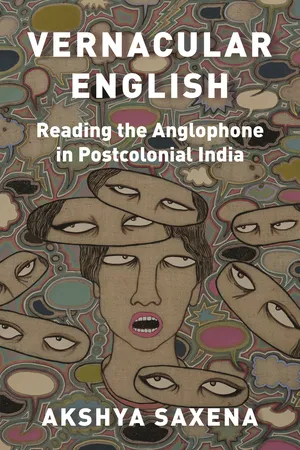
Against a groundswell of critiques of global English, Vernacular English argues that literary studies are yet to confront the true political import of the English language in the world today. A comparative study of three centuries of English literature and media in India, this original and provocative book tells the story of English in India as a tale not of imperial coercion, but of a people’s language in a postcolonial democracy.
Focusing on experiences of hearing, touching, remembering, speaking, and seeing English, Akshya Saxena delves into a previously unexplored body of texts from English and Hindi literature, law, film, visual art, and public protests. She reveals little-known debates and practices that have shaped the meanings of English in India and the Anglophone world, including the overlooked history of the legislation of English in India. She also calls attention to how low castes and minority ethnic groups have routinely used this elite language to protest the Indian state.
Challenging prevailing conceptions of English as a vernacular and global lingua franca, Vernacular English does nothing less than reimagine what a language is and the categories used to analyze it.
- 232 pages
- English
- ePUB (mobile friendly)
- Available on iOS & Android
eBook - ePub
About this book
Information
Publisher
Princeton University PressYear
2022Print ISBN
9780691223131
9780691219981
eBook ISBN
9780691223148
CHAPTER 1
Law
DEMOCRATIC OBJECTS IN POSTCOLONIAL INDIA, OR INDIA DEMANDS ENGLISH
A Language of Paper
My father’s job with the Department of Education of the Government of India filled our house with a unique kind of papery paraphernalia. There were always books, reports, pamphlets, magazines, and paperwork of the unclassified kind that he brought home. Most of these documents were official publications and communiqués of the Department of Education and the larger ministerial office that housed it. Some were plainly cyclostyled, some attractively bound. Meant for wide circulation within the Indian bureaucracy, their function was pedagogical and documentary. Were these publications to find readers, those readers would probably learn about the then Indian government’s educational initiatives for adults or its plans for promoting Hindi in the border states of Northeast India or its self-laudatory prose about India’s diverse culture. Most of these documents were written in an overstuffed bureaucratic English, and many had en face translations in Hindi. None, as I recall, featured other Indian languages.
Not even in high school at the time, I wasn’t their intended reader, of course. But I would often find myself looking through these documents. I specifically remember three red rexine-bound tomes crammed in the diminishing shelf space of our New Delhi apartment. Published by the Commission for Scientific and Technical Terminology, these were English-Hindi dictionaries of technical terms from botany, zoology, chemistry, and physics. Upon flipping through their pages one evening, I found the Hindi definitions were as unpronounceable and unidiomatic as the original English technical terms. There was a pattern: the definitions were either phonetic transliterations of the English word into the devanagari script of Hindi or literal explanations of the processes and objects in Hindi. As I slammed the last of the dictionaries shut, I felt disappointed and confused. After hours of poring over them, I really hadn’t learned any new meanings!
Referencing a dictionary, writes Walter Hakala, is at once an intimate and a collective experience.1 The act of looking up a word—perhaps because you don’t know it or because you want to confirm its meaning—can be embarrassing or exhilarating. But this deeply personal experience is shaped by a far more abstract and social project. More than any other object, a dictionary is also the modern material artifact of a community that shares a common language or wants to share a language. It constructs historical equivalences between languages, staging them as commensurate entities. A dictionary both presumes that one language has equivalences in another and suggests that they are mutually translatable. Thus, it always provides meanings beyond the literal meaning. Indeed, the English-Hindi dictionaries of scientific terms not only offered purchase on the technical terms but also held their meaning between the two languages, as something that belonged to both.
As I learned later, the Commission for Scientific and Technical Terminology was established in October 1961 to develop technical terminology in all Indian languages and “propagate its use and distribute it widely.”2 The primary function of these dictionaries was not really to define a word but rather to mirror English and construct scientific vocabulary in Hindi. Thus, science itself was imbued with a desirable unfamiliarity that was worth knowing and which Hindi, with its grace, was primed to render. As the genre of the dictionary authorized their commensurability, Hindi and English languages were bridged through mutual translatability. If some Indian nationalists were eager to claim Hindi as a representative national language, the technical dictionaries closed the gap between that “national” Hindi and the English of the colonial state. By ensuring that Hindi could also be scientific like English, the dictionaries brought into being the postcolonial state of India in a way that was both a continuation and a break from colonial rule.
Essentially, then, these dictionaries were an example of the bureaucratese that permeates every aspect of Indian civil society. Their bureaucratic status enhanced their truth value as dictionaries, making them a key part of the self-authorizing scriptural economy of bureaucracy in India and the world. For every dust-laden dictionary, one could (and still, can) find all over India all kinds of bilingual or trilingual Hindi-English public signages, public health messaging, governmental forms, and applications. This scriptural economy of bureaucratic documents, as Akhil Gupta writes, not only commemorates the state but also constitutes it.3 Documents exist to document, Lisa Gitelman pithily puts it. As an epistemic practice, the “knowing” from the documents is “all wrapped up with showing, and the showing wrapped with knowing.”4 Often, documents are documents, which is to say they make meaning, merely by dint of their potential to show. This know-show function of documents is tied to the work of no-show, of not, in fact, showing anything that is not obvious. Documents of the bureaucratic kind are “paper truths,” which derive their truth value from their symbolic value as official papers.5 As bureaucratic documents, the technical dictionaries instrumentalized English to claim Hindi as scientific. For someone consulting these, English would perhaps be the unfamiliar language, in need of translation. But it would also be a language that is commensurable with Hindi. The deferral of meanings—from Hindi to English, from English to Hindi—where neither was explained, made English meaningful as a language of science, development, and as related to Hindi which was also all of those things now.
The English language is a vital part of the documentary nature of the postcolonial Indian state as also of several other former British colonies in South Asia, Africa, and the Caribbean that have retained English as their official languages. How does the wide spread of the postcolonial state’s bureaucratese shape English and how does English shape the state? How does this bureaucratese inflect the relation of English with other Indian languages, and how does it offer a practice of reading English in Indian Anglophone literature? This chapter builds upon Rashmi Sadana’s observation in English Heart, Hindi Heartland (2012) that English has become deeply entrenched in postcolonial government bureaucracy and is the official language of higher education. Indeed, English circulates in the bureaucratic scriptural economy as a vernacular. Outside of literary circulation, English becomes a vernacular as an administrative language that promises wider reach and control of the populations. It is a reminder of the state’s colonial formation, as well as an index of its democratic and developmentalist aspirations. And yet, many people who are confronted with English as the language of the state do not know how to read it. As they comprehend it and contest the power of the state within the context of localized linguistic and political environments, their encounters with the language of governmentality, in turn, makes English a language of the people.
Administrative Anxieties of the Postcolonial State
The use of English in bureaucratic documents in India has a simple explanation: it was the continuation of colonial administrative practices. Aijaz Ahmad identified a “genetic cultural link” between the status of English as “the chief cultural and communicational instrument in the centralization of the bourgeois state in the colonial period,” and its continued use after independence.6 But this critical fact is not the whole story. Globally, the postwar ferment of the 1920s had made communication an important political concern both on the Left and the Right. Governance, democracy, and national cohesion all demanded communication, which in John Durham Peters’s words, had the power to “bind a far-flung populace together for good or ill, it had the stuff to make or break political order.”7 This interest in communication demanded a language to communicate in, a language that could reach others and that could be shared and made common.
India’s multilingualism didn’t fit the monolingual pressures of communication. No one language could serve as the communicational bedrock of the modern democratic nation-state. No one language could bear the administrative task of governing this diversity or the representative weight of a complex linguistic landscape. India is home to four language families—the Indo-Aryan, the Dravidian, the Austro-Asiatic, and the Tibeto-Burman, with hundreds and thousands of different languages and dialects. India’s independence movement came with a push to adapt this multilingualism to a monolingual national identity. English offered a solution to the language problem and also secured continuity from colonial administration to the postcolonial state. While scholars tend to examine English in opposition to Indian languages, the life of English is tied to languages like Hindi and Urdu. To understand how and why English emerged as critical to the postcolonial Indian state, we need to cover some well-trodden ground in South Asian studies.
Historically, precolonial and colonial states had preferred the North Indian vernacular for administrative purposes. In continuation of these practices, nationalist leaders like Gandhi touted Hindustani and later Hindi as possible national languages of India after it became independent. For instance, in the twentieth century, Gandhi invoked Hindustani to refer to the North Indian vernacular written either in the devanagari script of Sanskrit or the nastaliq script of Persian calligraphy. Hindustani, thus, came to be understood as a mix of Hindi and Urdu. With two scripts and widespread use, it promised inclusion, syncretism, and historical continuity. As a more unifying language, Hindustani would potentially be more suitable as a national language. But there was another reason for Gandhi’s and others’ affinity to Hindustani. Hindustani was a strategy to erase Urdu, which was typecast as a Muslim language potentially appeasing to Indian Muslims.8 As Aamir Mufti details in Enlightenment in the Colony (2007), no language by the name of Hindustani had really existed in India before it was thus politically appropriated. As part of the colonial history of vernacularization, both Hindi and Urdu were effectively invented—standardized as languages—at Fort William College under British colonialism in the early nineteenth century. The British colonialists standardized these languages from the North Indian vernacular to manage the native population and bring the written and spoken languages into alignment. In the nineteenth century, Hindustani referred to the vernacular written in Persian script. Hindi came to be the vernacular written in devanagari script. Urdu referred to Persian, which was the state language/language of the court.
By May 1947, as the independence of India and the creation of Pakistan as a separate Muslim state seemed imminent, the language question became ever more charged. In addition to the question of independent India’s national identity, the task of governance was also looming. Communication and communicability seemed critical for successful state administration. In the eyes of the nationalist elite, linguistic heterogeneity and plurality posed an insurmountable problem to the idea of a single people and to governing them. While Hindi was still the language of choice for many Indian political leaders, the language did not seem adequate to the task ahead of it.
Amid the Swadeshi movement from 1905–1911, as Indians boycotted and burned British-made goods, Gandhi argued that Indians needed to develop “respect” for their languages in the way that the Boers and the Jews had for their languages, to cultivate the spirit of swadeshi (literally meaning “of one’s own country”).9 On January 30, 1909, Gandhi wrote to the poet Rabindranath Tagore with a political dilemma: “Is Hindi not the only possible national language?”10 Gandhi found it hard to reconcile the continued use of English and the struggle for independence from the British. He conceded that English was essential; Indians could learn it as the language of the British government. “One must learn to use it well, when it has to be used. One must learn to read and write in it with facility.”11 But that was as far as Gandhi was willing to go.
Citing the importance of communicability, he added: “There is no point in writing to another in English when that other person knows as little English as one does. It would only lead to a total misunderstanding, apart from encouraging a bad habit. The right approach would be to use English [only] when the other person does not know our mother tongue. English may be learnt but our mother tongue must not be ignored.”12 Gandhi imagined learning a language to be a zero-sum proposition where learning one language would mean forgetting another. He believed that the unintelligibility of English to most Indians would add to linguistic confusion and political chaos. Gandhi considered English to be foreign and Hindi to be native to India. Indians could not win and maintain independence from the British by embracing English and losing Hindi!
Of course, precisely because of India’s linguistic diversity, were English to be recruited only when Indians did not share a mother tongue, that would still be very often. No one Indian language, certainly not Hindi, could anchor the idea of India as a democratic nation-state. Spoken predominantly in the northern part of the country, Hindi was as (if not more) artificial, divisive, and exclusionary as English. Severed from Urdu in its Sanskritized form, Hindi also upheld religious, class, and caste distinctions. It did not justify the straight line between nation and language that Gandhi was seeking. The romantic expectations of a national language ran up against the practical necessities of reading, writing, and communicating.
Nonetheless, Gandhi’s reasoning that English was unfamiliar to most Indians could not diminish its role in global communication. He acknowledged English as a “world language” to be learned whether one wished to do so or not.13 English, Gandhi claimed, was central to “the acquisition of modern knowledge, for the study of modern literature, for knowledge of the world, [and] for intercourse with the present rulers.”14 In this role, English was needed to amplify the message and power of an independent India, even if the language was not, in Gandhi’s estimation, itself Indian. The knowledge of the world—received via English—would strengthen the image of India’s nationalist assertion. Gandhi mobilized English as a prosthesis that could be attached or detached from its colonial provenance and used it to connect an independent and growing India to the rest of the world. Positioned outwards, English would help Indian leaders to communicate with and hear the leaders of the world. It would provide a stage from where India would become influential. Gandhi’s reluctant acknowledgment of the usefulness of English was both astute and judicious. English was not a part of India’s national identity but the need to assert national identit...
Table of contents
- Cover
- Series Page
- Title Page
- Copyright Page
- Dedication
- Contents
- Acknowledgments
- Preface: On the Grounds
- Introduction. Vernacular English: Reading the Anglophone
- Chapter 1: Law: Democratic Objects in Postcolonial India, or India Demands English
- Chapter 2: Touch: Dalit Anglophone Writers and a Language Shared
- Chapter 3: Text: A Desire Called English in Indian Anglophone Literature
- Chapter 4: Sound: The Mother’s Voice and Anglophonic Soundscapes in Northeast India
- Chapter 5: Sight: Cinematic English and the Pleasures of Not Reading
- Coda: Radical Anglophony, or The Ethics of Attunement
- Notes
- Index
- Series Titles
Trusted by 375,005 students
Access to over 1.5 million titles for a fair monthly price.
Study more efficiently using our study tools.
Frequently asked questions
Yes, you can cancel anytime from the Subscription tab in your account settings on the Perlego website. Your subscription will stay active until the end of your current billing period. Learn how to cancel your subscription
No, books cannot be downloaded as external files, such as PDFs, for use outside of Perlego. However, you can download books within the Perlego app for offline reading on mobile or tablet. Learn how to download books offline
Perlego offers two plans: Essential and Complete
- Essential is ideal for learners and professionals who enjoy exploring a wide range of subjects. Access the Essential Library with 800,000+ trusted titles and best-sellers across business, personal growth, and the humanities. Includes unlimited reading time and Standard Read Aloud voice.
- Complete: Perfect for advanced learners and researchers needing full, unrestricted access. Unlock 1.5M+ books across hundreds of subjects, including academic and specialized titles. The Complete Plan also includes advanced features like Premium Read Aloud and Research Assistant.
We are an online textbook subscription service, where you can get access to an entire online library for less than the price of a single book per month. With over 1.5 million books across 990+ topics, we’ve got you covered! Learn about our mission
Look out for the read-aloud symbol on your next book to see if you can listen to it. The read-aloud tool reads text aloud for you, highlighting the text as it is being read. You can pause it, speed it up and slow it down. Learn more about Read Aloud
Yes! You can use the Perlego app on both iOS and Android devices to read anytime, anywhere — even offline. Perfect for commutes or when you’re on the go.
Please note we cannot support devices running on iOS 13 and Android 7 or earlier. Learn more about using the app
Please note we cannot support devices running on iOS 13 and Android 7 or earlier. Learn more about using the app
Yes, you can access Vernacular English by Akshya Saxena in PDF and/or ePUB format, as well as other popular books in Literature & Asian Literary Criticism. We have over 1.5 million books available in our catalogue for you to explore.