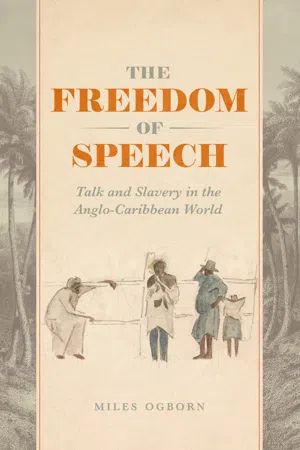
The institution of slavery has always depended on enforcing the boundaries between slaveholders and the enslaved. As historical geographer Miles Ogborn reveals in The Freedom of Speech, across the Anglo-Caribbean world the fundamental distinction between freedom and bondage relied upon the violent policing of the spoken word. Offering a compelling new lens on transatlantic slavery, this book gathers rich historical data from Barbados, Jamaica, and Britain to delve into the complex relationships between voice, slavery, and empire. From the most quotidian encounters to formal rules of what counted as evidence in court, the battleground of slavery lay in who could speak and under what conditions. But, as Ogborn shows through keen attention to both the traces of talk and the silences in the archives, if enslavement as a legal status could be made by words, it could be unmade by them as well. A deft interrogation of the duality of domination, The Freedom of Speech offers a rich interpretation of oral cultures that both supported and constantly threatened to undermine the slave system.
- English
- ePUB (mobile friendly)
- Available on iOS & Android
eBook - ePub
About this book
Information
Publisher
University of Chicago PressYear
2019Print ISBN
9780226657684
9780226655925
eBook ISBN
9780226657714
Notes
Introduction
1. Michel-Rolph Trouillot, Silencing the Past: Power and the Production of History (Boston: Beacon Press, 1995); and Saidiya V. Hartman, “Venus in Two Acts,” Small Axe 26 (2008): 1–14.
2. The National Archives, Kew (hereafter cited as TNA), CO1/53, America and West Indies, Colonial Papers, Extract of a Letter from Barbados, December 18, 1683, f.264v.
3. Trevor Burnard, Mastery, Tyranny, and Desire: Thomas Thistlewood and His Slaves in the Anglo-Jamaican World (Chapel Hill: University of North Carolina Press, 2004).
4. Beinecke Library, Yale University (hereafter cited as BLYU), OSB MSS 176/3, Thistlewood Diary, 1752, p. 250 (December 27, 1752).
5. Thistlewood Diary, 1752, pp. 247–49.
6. Thistlewood Diary, 1752, p. 251; and Thistlewood Diary, 1753, p. 4 (January 5, 1753), OSB MSS 176/4, BLYU. Douglas Hall, In Miserable Slavery: Thomas Thistlewood in Jamaica, 1750–86 (Kingston: University of the West Indies Press,1989), p. 56, argues that Sam was acquitted. However, Thistlewood only records “Sam” being returned to Egypt on January 10, 1753 (Thistlewood Diary, 1753, p. 7).
7. John Lean and Trevor Burnard, “Hearing Slave Voices: The Fiscal’s Reports of Berbice and Demerara-Essequibo,” Archives 27 (2002): 37–50; and Marisa J. Fuentes, Dispossessed Lives: Enslaved Women, Violence, and the Archive (Philadelphia: University of Pennsylvania Press, 2016).
8. Natalie Zacek, “Voices and Silences: The Problem of Slave Testimony in the English West Indian Law Court,” Slavery and Abolition 24, no. 3 (2003): 24–39, at p. 26. See also Trevor Burnard, Hearing Slaves Speak (Caribbean Press, 2010); Dorothy Couchman, “‘Mungo Everywhere’: How Anglophones Heard Chattel Slavery,” Slavery and Abolition 36, no. 4 (2015): 704–20; and Shane White and Graham White, The Sounds of Slavery: Discovering African American History through Songs, Sermons, and Speech (Boston: Beacon Press, 2005).
9. Acts of Assembly, Passed in the Island of Jamaica; From 1681 to 1737 (London, 1738), p. 78.
10. Morgan Godwyn, The Negro’s and Indian’s Advocate (London, 1680), pp. 40, 29–30.
11. The Importance of Jamaica to Great-Britain, Consider’d . . . (London, [late 1730s]), p. 17. On the forms of “Black geographies,” see Katherine McKittrick, Demonic Grounds: Black Women and the Cartographies of Struggle (Minneapolis: University of Minnesota Press, 2006).
12. Robin Blackburn, The Making of New World Slavery: From the Baroque to the Modern, 1492–1800 (London: Verso, 1998), pp. 12–13.
13. Walter Johnson, “To Remake the World: Slavery, Racial Capitalism, and Justice,” Boston Review, October 26, 2016; and Saidiya V. Hartman, Scenes of Subjection: Terror, Slavery, and Self-Making in Nineteenth-Century America (New York: Oxford University Press, 1997), p. 6.
14. Walter Johnson, River of Dark Dreams: Slavery and Empire in the Cotton Kingdom (Cambridge, MA: Belknap Press of Harvard University Press, 2013); and Sowande’ M. Mustakeem, Slavery at Sea: Terror, Sex, and Sickness in the Middle Passage (Urbana: University of Illinois Press, 2016).
15. [Edward Long], The History of Jamaica, 3 vols. (London, 1774), 2:351, 353, 356 (hereafter cited as HJ).
16. Silvia Sebastiani, The Scottish Enlightenment: Race, Gender, and the Limits of Progress (Basingstoke, UK: Palgrave Macmillan, 2013), pp. 66–67.
17. British Library, Additional Manuscripts (hereafter cited as BL Add. MS), 12405, f.294r.
18. BL Add. MS 12405, ff.291r and 293r; and Charles Burney, A General History of Music, from the First Ages to the Present Period, 4 vols. (London, 1776), 1:304.
19. BL Add. MS 12405, f.281r (diagrams at f.285r), quoting Jean-Jacques Rousseau, A Discourse on the Origin and Foundations of Inequality among Men (London, 1761), pp. 229–30, n. 10.
20. For fuller discussions of Long and Monboddo, see Miles Ogborn, “Discriminating Evidence: Closeness and Distance in Natural and Civil Histories of the Caribbean,” Modern Intellectual History, 11, no. 3 (2014): 629–51; and Silvia Sebastiani, “Challenging Boundaries: Apes and Savages in Enlightenment,” in Simianization: Apes, Gender, Class and Race, ed. Wulf D. Hund, Charles W. Mills, and Silvia Sebastiani (Zurich: Lit, 2015), pp. 105–38.
21. [James Burnet, Lord Monboddo], Of the Origin and Progress of Language, 6 vols. (Edinburgh, 1773–92), vol. 1, pp. 1–2, 174–75, 197, 238–39, 272. See also Alan Barnard, “Orang Outang and the Definition of Man: The Legacy of Lord Monboddo,” in Fieldwork and Footnotes: Studies in the History of European Anthropology, ed. Hans F. Vermeulen and Arturo Alvarez Roldan (London: Routledge, 1995), pp. 95–112.
22. HJ, 2:370–71 n. f. Mutum pecus is from Horace.
23. Roxann Wheeler, The Complexion of Race: Categories of Difference in Eighteenth-Century British Culture (Philadelphia: University of Pennsylvania Press, 2000), pp. 209–20; and Suman Seth, “Materialism, Slavery, and The History of Jamaica,” Isis, 105 (2014): 764–72.
24. Sylvia Wynter, “Unsettling the Coloniality of Being/Power/Truth/Freedom: Toward the Human, after Man, Its Overrepresentation—An Argument,” New Centennial Review, 3, no. 3 (2003): 257–337, at p. 266; and Christopher L. Brown, Moral Capital: Foundations of British Abolitionism (Chapel Hill: University of North Carolina Press, 2006), pp. 33–101. For Wynter, the definition of the human through “languaging” remains a crucial political issue as she aims to define humans “as a hybrid-auto-instituting-languaging-storytelling species” (homo narrans) with African origins against other “origin myths”; see Sylvia Wynter and Katherine McKittrick, “Unparalleled Catastrophe for Our Species? Or, to Give Humanness a Different Future: Conversations,” in Sylvia Wynter: On Being Human as Praxis, ed. Katherine McKittrick (Durham, NC: Duke University Press, 2015), pp. 9–89, at p. 25.
25. Godwyn, Negro’s and Indian’s Advocate, p. 12.
26. A Letter from A Merchant at Jamaica to a Member of Parliament in London Touching the African Trade (London, 1709), p. 29. See Jack P. Greene, “‘A Plain and Natural Right to Life and Liberty’: An Early Natural Rights Attack on the Excesses of the Slave System in Colonial British America,” William and Mary Quarterly 62, no. ...
Table of contents
- Cover
- Title Page
- Copyright Page
- Dedication
- Contents
- List of Abbreviations
- introduction / With One Little Blast of Their Mouths: Speech, Humanity, and Slavery
- one / On Our Bare Word: Oath Taking, Evidence Giving, and the Law
- two / The Deliberative Voice: Politics, Speech, and Liberty
- three / Master, I Can Cure You: Talking Plants in the Sugar Islands
- four / They Must Be Talked to One to One: Speaking with the Spirits
- five / They Talk about Free: Abolition, Freedom, and the Politics of Speech
- Last Words
- Acknowledgments
- Notes
- Index
Trusted by 375,005 students
Access to over 1.5 million titles for a fair monthly price.
Study more efficiently using our study tools.
Frequently asked questions
Yes, you can cancel anytime from the Subscription tab in your account settings on the Perlego website. Your subscription will stay active until the end of your current billing period. Learn how to cancel your subscription
No, books cannot be downloaded as external files, such as PDFs, for use outside of Perlego. However, you can download books within the Perlego app for offline reading on mobile or tablet. Learn how to download books offline
Perlego offers two plans: Essential and Complete
- Essential is ideal for learners and professionals who enjoy exploring a wide range of subjects. Access the Essential Library with 800,000+ trusted titles and best-sellers across business, personal growth, and the humanities. Includes unlimited reading time and Standard Read Aloud voice.
- Complete: Perfect for advanced learners and researchers needing full, unrestricted access. Unlock 1.5M+ books across hundreds of subjects, including academic and specialized titles. The Complete Plan also includes advanced features like Premium Read Aloud and Research Assistant.
We are an online textbook subscription service, where you can get access to an entire online library for less than the price of a single book per month. With over 1.5 million books across 990+ topics, we’ve got you covered! Learn about our mission
Look out for the read-aloud symbol on your next book to see if you can listen to it. The read-aloud tool reads text aloud for you, highlighting the text as it is being read. You can pause it, speed it up and slow it down. Learn more about Read Aloud
Yes! You can use the Perlego app on both iOS and Android devices to read anytime, anywhere — even offline. Perfect for commutes or when you’re on the go.
Please note we cannot support devices running on iOS 13 and Android 7 or earlier. Learn more about using the app
Please note we cannot support devices running on iOS 13 and Android 7 or earlier. Learn more about using the app
Yes, you can access The Freedom of Speech by Miles Ogborn in PDF and/or ePUB format, as well as other popular books in History & Early Modern History. We have over 1.5 million books available in our catalogue for you to explore.