A scientist explores the harmony between Christian faith and science
Though some Christians and many skeptics see science and Christianity as locked in a never-ending battle, geologist Gregg Davidson contends that there is tremendous harmony between Scripture and modern science. Many apparent conflicts arise when the Bible is interpreted apart from its literary and historical contexts, but when these are taken into account, most alleged clashes resolve.
Proceeding from a belief that Scripture is inspired and without error and that God's creation should inform how we interpret the Bible, Davidson shows that Scripture and science need not disagree on issues like the age of the earth, Adam and Eve, Noah's flood, the origin and development of life, and numerous related topics. Rather, Christians can rejoice at how God's glory is revealed in both the Bible and the natural world.
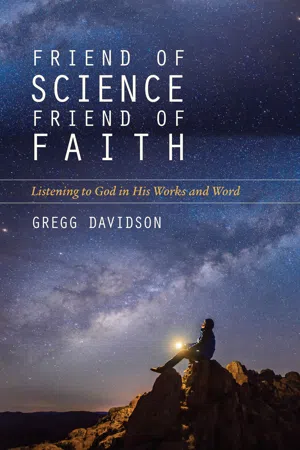
- 304 pages
- English
- ePUB (mobile friendly)
- Available on iOS & Android
eBook - ePub
About this book
Information
Topic
Theology & ReligionSubtopic
Biblical StudiesPART 1
CONFLICTS NEW AND OLD
1
SETTING THE STAGE—CRISIS OF FAITH
Riley sat alone in her dorm room feeling as though her world was getting turned upside down. She had come to college two years earlier, full of dreams and aspirations of a career in the sciences. With a love for the outdoors and uncertain which field of science to pursue, she had tested the waters with introductory classes in both biology and geology. She had known her faith would be tested. Her parents and youth minister had forewarned her about the humanistic worldview pervasive in American universities. Full of the energy and confidence of a young bird launching from the nest, she was ready for the challenge. She believed what the Bible taught and had answers to challenge the flimsy presuppositions employed in support of evolution and millions of years.
But she did not encounter what she expected. She had anticipated arguments based largely on wishful humanistic thinking, with theories built on untestable assumptions that could not even reasonably be called science. As she plunged into her studies, she was increasingly confronted by both the breadth and depth of evidence for views she had previously dismissed. To make matters worse, the evidence was not just being preached by proselytizing atheists. Yes, there had been a few professors and fellow students who mocked all forms of religious belief, especially Christian belief, but the larger number seemed to be normal people honestly striving to understand how nature worked.
At a small group Bible study, she sat in silent upheaval as a fellow student spoke derisively of the supposed absence of transitional fossils to support evolution. Riley kept her mouth shut about the wealth of transitional fossils now known, ranging from feathered dinosaurs to whales with legs. Afterward, she caught up with Doug, a campus-ministry intern who was leading the study. She asked him if being a Christian required belief in a literal six-day creation in the recent past. For Doug, there was a simple answer to this simple question. If God truly inspired the writing of the Scriptures, a literal, or “plain sense” reading of the Genesis account must be true. Any other reading would challenge its veracity and authority.
The next day, Doug called Riley from the lobby of the dorm to tell her he had brought her a book. She was genuinely appreciative of the effort, though less certain about the gift itself. The book was written by a prominent young-earth creationist. Back in her room, Riley opened the book at random to the second chapter, one of several devoted to debunking old-earth science and biological evolution. The chapter was filled with examples of “incontrovertible facts” documenting the impossibility of scientific claims. She read one, squinting and reading again, sure she had misunderstood. She read another and was equally confounded. She read the entire chapter, dumbfounded at the number of misconceptions and false assertions about fossils, scientific laws, and even the definition of terms.
She shook her head at the audacity of one in particular, that uniformitarian geologists assume that the rates of natural processes observed today were always the same in the past. She marveled that the writer could say such a thing, knowing that her “uniformitarian” professors taught that competing views for the demise of the dinosaurs included a giant meteorite impact and massive volcanic eruptions. No professor had ever taught her that rates in the past were constant, nor that they were all slow.
If the veracity of the Bible was linked with the purported truthfulness of the book she had been given, she could not fathom how the Bible could be considered the legitimate Word of God, at least not a God who valued logic, reason, and truth. Her disquiet began to turn to resentment as she contemplated the possibility that her family and church had unwittingly indoctrinated her with fairy tales. Though it would be months before she could bring herself to tell her parents, her Bible found itself that evening sitting in her waste bin, waiting for its new home in the county landfill.

There is a growing population of young adults, raised up in Christian churches, who could read this opening story and reasonably believe I was telling their story. In its general description, it is neither unique to one person’s experience nor infrequent in occurrence. Many tentative seekers could also readily identify with Riley’s experience, differing only in detail. For a time, they considered the possible truth of Christianity, until encountering the stumbling block of a recent creation and finding it insurmountable.
The underlying cause of these spiritual shipwrecks is hotly contested in the church today. For some Christians, it is the inevitable result of clashes between biblical and humanistic worldviews. Their primary sympathies lie with Doug, grateful for his faithful effort to reach out with a defense for the gospel and saddened by hearts hardened against truth. An implicit assumption is made that the stumbling block to faith is not really scientific evidence, but a basic unwillingness to take God at his word. If people would simply believe the Bible, they would see that science actually supports a young earth.
Other Christians argue, with equal conviction, that the battle lines have been drawn not just in the wrong spot, but entirely on the wrong field. Our imperfect interpretation of the Bible has been conflated with the Bible itself, a flawed theological foundation leading to the construction of an equally flawed scientific house of cards. It is the young-earth position that does not take God truly at his word, imposing human ideas on the biblical text. Doug, in this view, has erected a needless barrier in the path to faith—a well-intentioned builder of stumbling blocks!
Which view is correct? There is no shortage of websites, books, articles, blogs, and videos that claim to answer this question. Some are quite good, though very few back up to ask the more basic question of how to approach Scripture and science when they seem to conflict. History should teach us that this is not just a matter of “believing the Bible.” Seventeenth-century believers taking this simplistic approach unjustly condemned Copernicus and Galileo for undermining the “plain meaning” of Scripture that the sun orbits the earth. The Bible was not wrong, but many were too quick to assume that the traditional understanding of what the Bible taught was what the writers intended.
With history in mind, the objectives of this book are twofold. The first is to develop a general approach for addressing apparent conflicts whenever they may arise, in a way that honors Scripture and honestly engages science. It will not start with an assumption that science is right. Science, as the study of God’s natural creation, will simply be allowed to raise questions that will drive us back to Scripture, with the humility to recognize that human understanding of God’s perfect Word is not as equally perfect. While new questions may lead occasionally to new scriptural insights, none will challenge the truth of the Bible nor any core Christian doctrine.1 Rather, where multiple interpretations could be true for a particular passage, new insights may simply serve to dust away never-intended meanings that cloud our view, allowing the true message, one that was there all along, to shine more brightly.
The second objective of the book is to apply the approach to the current discord on origins to see what may be learned. In the pages that follow, we’ll first look to see how believers in the past wrestled with apparent conflicts between science and biblical understanding to help us develop our approach for looking forward. As we apply this method to the subject of origins, science will be permitted to prompt a return to Scripture, looking with fresh eyes for what Scripture can tell us about itself on each question raised. Part of this exercise will require, and benefit from, an assessment of how our own culture influences the way we define terms like truth and inerrancy. Only after a thorough reckoning of the written Word (three chapters worth) will we dive into the strength of evidence offered up by those who study the material world.
My conviction is not only that modern science fails to contradict an accurate understanding of the Bible, but that the simplicity and elegance with which God’s natural revelation illustrates his special revelation is breathtaking. My hope is that this book will not end with the last word of the final chapter, but that Doug will finish the opening story with a more edifying visit to Riley.

1. For example, the doctrines expressed in the Nicene and Apostles’ Creeds.
2
HISTORICAL CONTEXT—HELIOCENTRISM VS. SCRIPTURE
“The sun rises and the sun sets.…” (Eccl. 1:5)
The year was 1633. Galileo Galilei stood before the ecclesiastical court for the final time under the demand that he recant his heresy that the earth was not the center of the universe. It was a confrontation more than 100 years in the making. Heliocentrism, the theory that the sun, rather than the earth, resides at the center of our solar system, was suggested as far back as the early Greeks and Romans, but was not taken seriously again until similar arguments were made by Copernicus in a handwritten book called the Little Commentary in 1514.1 A century later, Galileo had amassed a sizable body of scientific evidence demonstrating that the sun—not the earth—was indeed the center of our local system. The Vatican, and many professing Christians at the time, vigorously opposed the idea on the grounds that it challenged the authority of the Bible. God inspired the words recorded in Ecclesiastes 1:5 and Psalm 19:6 saying that “the sun rises and the sun sets,” and that the sun’s “rising is from one end of the heavens, and its circuit to the other end.” Two additional Psalms proclaim that the earth is “firmly established” and “will not be moved” (Pss. 93:1; 104:5), and the history of Israel’s battles includes an account of a miraculous event when the sun stood still in the sky (Josh. 10:13). Because of these verses, it was strongly believed that Galileo’s measurements and conclusions were not only erroneous, but heretical.
Modern Protestant believers are tempted to dismiss this science-church conflict as a Catholic mistake, but such an assertion is unwarranted. The Catholic Church is the focus of the historical account only because of the legal injunctions eventually levied against Galileo by the Vatican and its political authority to act on its indictments. The possibility that heliocentrism might be inherently in conflict with Scripture was a Christian concern, not just a Catholic one. Following the publication of the Little Commentary, Martin Luther, the father of the Protestant movement, spoke of the foolishness of heliocentric notions and cited Joshua 10:13 as effectively settling the matter.2 John Calvin was another prominent Protestant who took issue with heliocentrism. A little more than a decade after the publication of Revolutions, Calvin wrote,
We will see some who are so deranged, not only in religion but who in all things reveal their monstrous nature, that they will say that the sun does not move, and that it is the earth which shifts and turns. When we see such minds we must indeed confess that the devil possesses them.3
Though it is not possible to know the condition of Galileo’s heart four centuries removed, his writings suggest that he never felt that he was challenging Scripture or the Christian faith. Galileo did not suggest that the Bible was flawed. Rather he argued that the traditional interpretation of these verses was flawed:
The holy scriptures cannot err and the decrees therein contained are absolutely true and inviolable. But…its expounders and interpreters are liable to err in many ways; and one error in particular would be most grave and frequent, if we always stopped short at the literal signification of the words.4
Galileo argued that the interpretation of God’s special revelation (Scripture) should be consistent with and illuminated by God’s natural revelation (science). When faced with excommunication by the church and possible corporal punishment, Galileo signed a written abjuration confessing his sin and promising to cease his heretical teachings. For Galileo, however, the evidence for a sun-centered celestial system was so convincing that a true denial was a denial of reason itself. These sentiments were best recorded in an earlier, now frequently quoted statement,
I do not think it necessary to believe that the same God who gave us our senses, our speech, our intellect, would have put aside the use of these.5
The infallibility and authority of Scripture remain central tenets of Christianity, yet few Christians today hold that the earth is the center of the universe. Somewhere during the last four centuries, the church at large transitioned from a strictly literal interpretation of the verses in Ecclesiastes, Psalms, and Joshua, to an interpretation deemed more accurate even though less literal. It is still believed from Scripture that a miraculous event took place during Joshua’s battle and that it is God who establishes the order of the universe, but Christians no longer a...
Table of contents
- Cover
- Title Page
- Copyright
- Dedication
- Contents
- Acknowledgments
- Preface
- Part 1: Conflicts New and Old
- Part 2: The Meaning of Scripture
- Part 3: Conflict?
- Part 4: The Credibility of Modern Science
- Part 5: War of Words
- Bibliography
Trusted by 375,005 students
Access to over 1.5 million titles for a fair monthly price.
Study more efficiently using our study tools.
Frequently asked questions
Yes, you can cancel anytime from the Subscription tab in your account settings on the Perlego website. Your subscription will stay active until the end of your current billing period. Learn how to cancel your subscription
No, books cannot be downloaded as external files, such as PDFs, for use outside of Perlego. However, you can download books within the Perlego app for offline reading on mobile or tablet. Learn how to download books offline
Perlego offers two plans: Essential and Complete
- Essential is ideal for learners and professionals who enjoy exploring a wide range of subjects. Access the Essential Library with 800,000+ trusted titles and best-sellers across business, personal growth, and the humanities. Includes unlimited reading time and Standard Read Aloud voice.
- Complete: Perfect for advanced learners and researchers needing full, unrestricted access. Unlock 1.5M+ books across hundreds of subjects, including academic and specialized titles. The Complete Plan also includes advanced features like Premium Read Aloud and Research Assistant.
We are an online textbook subscription service, where you can get access to an entire online library for less than the price of a single book per month. With over 1.5 million books across 990+ topics, we’ve got you covered! Learn about our mission
Look out for the read-aloud symbol on your next book to see if you can listen to it. The read-aloud tool reads text aloud for you, highlighting the text as it is being read. You can pause it, speed it up and slow it down. Learn more about Read Aloud
Yes! You can use the Perlego app on both iOS and Android devices to read anytime, anywhere — even offline. Perfect for commutes or when you’re on the go.
Please note we cannot support devices running on iOS 13 and Android 7 or earlier. Learn more about using the app
Please note we cannot support devices running on iOS 13 and Android 7 or earlier. Learn more about using the app
Yes, you can access Friend of Science, Friend of Faith by Gregg Davidson in PDF and/or ePUB format, as well as other popular books in Theology & Religion & Biblical Studies. We have over 1.5 million books available in our catalogue for you to explore.