A veteran pastor answers the questions that today's pastors are asking
In
40 Questions about Pastoral Ministry, veteran pastor Phil Newton provides trustworthy answers to 40 of the most common and pressing questions relating to the life and work of the pastor. Covering five major categories--such as development, practices, and preaching--Newton equips pastors to successfully handle everyday duties and challenges, including:
• Remaining spiritually healthy
• Strengthening your marriage
• Dealing with discouragement
• Avoiding pitfalls
• Leading elders' meetings
• Mentoring future leaders
• Preaching through books of the Bible
• Conducting marriages and funerals
• Practicing church discipline
• Leading change and revitalization, and much more
Basing his answers on Scripture, theological reflection, and personal experience, Newton serves as a mentor and guide for pastors at every stage of ministry. The questions and answers are self-contained, and topics of interest can be easily located. Pastors will want to consult this volume often for authoritative advice on all aspects of pastoral ministry.
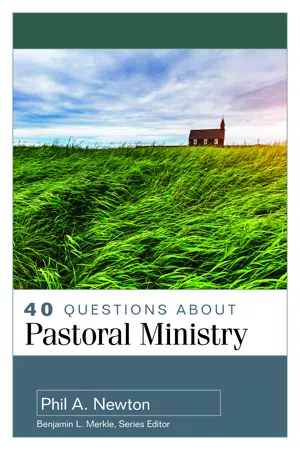
- 320 pages
- English
- ePUB (mobile friendly)
- Available on iOS & Android
eBook - ePub
40 Questions About Pastoral Ministry
About this book
Information
Topic
Theology & ReligionSubtopic
Christian ChurchPART 1
Foundational Considerations
QUESTION 1
What Is a Pastor?
As a college junior, my heart burned to pastor God’s flock. Having sensed his call to ministry five years earlier, this calling began to narrow. At the time, I served on a church staff discipling young adults and teenagers. By doing pastoral work, my calling became clearer. Although seeing only the edges of pastoral ministry, my spirit leaped at the chance to shepherd members of our church toward spiritual health.
Had you pinned me down to ask, “What is a pastor?” I would likely have said, “A shepherd.” Of course, that’s correct since the English term “pastor,” derived from the Old French pastor, and the Latin pastorem, means shepherd.1 When referring to a leadership office in the church, we use the term metaphorically (we do not mean the actual herding of sheep). Through the centuries, governments and religious groups have used shepherd to refer to one ruling, leading, or caring for them. The Bible also uses the term metaphorically. How does it speak to the question, “What is a pastor?”
Shepherd as a Metaphor
The ancient Near Eastern culture and Holy Scripture regularly use shepherd metaphorically.2 When considering shepherd as a metaphor, Timothy Laniak explains, we drag “a collection of inter-related associations from the source domain into the target domain as prospects for comparison.”3 In other words, we take up the original concept of shepherding sheep, mull the various implications involved in that work, and then consider how it is used metaphorically in various biblical contexts. From this process, we begin to derive an understanding of shepherd/pastor. Answering the question, “What is a pastor?” by merely saying, “a shepherd” proves inadequate until we arrive at its meaning in the original metaphor as developed in Scripture.
The noun shepherd (Greek: poimēn) is used eighteen times in the NT, but translated only once as pastor (Eph. 4:11).4 The remaining uses of poimēn shed light on the nominal and verbal meanings when referring to the office of pastor/elder.5 Moisés Silva explains that Greek literature used poimēn literally and figuratively, even for “the divine shepherd.” Metaphorically, it expressed guidance and cherishing. While often describing the actual practice of herding sheep, the biblical term also finds prominent imagery for Yahweh shepherding his people Israel.6 Likewise, we find the NT picking up the shepherding imagery of Yahweh and applying it to the Good Shepherd in John 10. Jesus saw the distressed and dispirited multitudes “like sheep without a shepherd” (Matt. 9:36). Paralleling the OT picture of Yahweh, the Gospels fill out the work of Jesus shepherding, as he sought to draw near, protect, provide, and guide the shepherdless crowds.7 But the Good Shepherd goes one step further: he lays down his life for the sheep (John 10:11–18), as prophesied by Zechariah (Zech. 13:7).8 From the OT use of Shepherd in reference to Yahweh to its NT use in Jesus the Good Shepherd, we begin to see the metaphor’s background for the NT office of pastor/shepherd.
Pastors as Reflections of a Model
Neglecting the OT use of Yahweh as Shepherd when thinking of the church office of pastor/elder/overseer impoverishes the term. As the patriarch Israel blessed Joseph’s sons, he called Yahweh “the God who has been my shepherd all my life to this day” (Gen. 48:15). He expressed Yahweh’s care, guidance, and protection. Similarly, the psalmist describes the Lord’s power in delivering Israel from Egypt: “But He led forth His own people like sheep and guided them in the wilderness like a flock” (Ps. 78:52). Psalm 80:1 sounds the same note on leadership. “Oh, give ear, Shepherd of Israel, You who lead Joseph like a flock.” No wonder there’s great comfort in Psalm 100:3, “We are His people and the sheep of His pasture.” The Lord leads, protects, comforts, and provides for his flock (Ps. 23). This divine leadership occasionally took place through human instruments. “You led Your people like a flock by the hand of Moses and Aaron” (Ps. 77:20), giving hint toward the NT use of shepherd.
The biblical narratives utilize shepherd language to describe David’s kingship. In the ancient Near East, shepherding language “is attached most often to the institution of Kingship (both divine and human).”9 First, David is introduced as a literal shepherd (1 Sam. 16:11; 17:28, 34). Significantly, when David joined the tribes of Israel at Hebron on the occasion of anointing him as king, the leaders identified him as a shepherd/king. “And the Lord said to you, ‘You will shepherd My people Israel, and you will be a ruler over Israel’” (2 Sam. 5:1–2). Here, shepherd “originated with reference to middle-level shepherd contractors,” writes Laniak, showing the connection of the newly appointed king under the Lord God’s authority. “Israel received its desired king, but only on the condition that it understood his [the king’s] role as derivative from and dependent upon the rule of YWHW, the flock’s true Owner.”10 As the true Shepherd, the Lord gave Israel’s king responsibilities as an undershepherd in care, rule, and protection.
Four of the prophets—Isaiah, Jeremiah, Ezekiel, and Zechariah—make extensive use of pastoral language (a) to describe the Lord God (Isa. 40:11; Jer. 31:10; Ezek. 34:11–15; Zech. 9:16); (b) to rebuke unfaithful civil and religious leaders (Jer. 10:21; 23:1–2; Ezek. 34:1–10; Zech. 10:2–3); (c) to anticipate the Good Shepherd (Ezek. 34:23–24; Zech. 13:7–9); and (d) to assure that he would appoint faithful shepherds for his people (Jer. 3:15; 23:3–4). The future pastoral office remained clearly in view throughout the OT.
The emphasis on the Lord God as Shepherd communicates his presence, care, nurture, comfort, protection, guidance, leadership, and provision. Any future use of the shepherding metaphor for those serving his flock must connect these characteristics to pastoral ministry. With the NT pastoral office in view, Yahweh’s appointed “shepherds were not expected simply to tend a flock; they were serving its Owner.”11 Pastors, consequently, must reflect the model of the Lord God as Shepherd over his flock.
Pastors as Promised Servants
Israel grew accustomed to kings who neglected defending the weak, judging impartially, leading in the ways of the Lord, and keeping personal desires in check. Likewise, the priestly religious leaders disregarded those they should have shepherded toward faithful dependence upon the Lord. Consequently, the Lord took action.
First, he proclaimed that he would rescue his flock. He took initiative to deliver his people from bondage, implying future salvific peace in the Lord’s presence (Ezek. 34:11–16). This promise lays groundwork for the NT use of the church as God’s flock (John 10:1–30; Heb. 13:20–21).
Second, he promised to send faithful shepherds to care for, protect, guide, and provide for his flock (Jer. 3:15). “I will also raise up shepherds over them and they will tend them” (Jer. 23:4). In this eschatological passage, Jeremiah points to Jesus, the coming Messianic King, giving assurance that God would “raise up for David a righteous Branch; and He will reign as king and act wisely and do justice and righteousness in the land” (Jer. 23:5). The flock that the future shepherds would tend belongs to the promised Messiah. His promised shepherds find fulfillment in the church’s pastoral office (elder/overseer). Kings and priests failed to shepherd God’s flock. However, the new covenant foresaw a different dimension of shepherds who cared for the flock. Laniak observes, “It illustrates what we will call a ‘divine preference for human agency.’ Appointment by God implies calling, stewardship and accountability.”12 He calls forth the promised shepherds to faithfully tend his flock.
The divine promise of faithful shepherds for God’s flock adds weightiness to pastors serving local congregations. God’s promise of faithful shepherds came in connection with the promised Davidic Messiah (Jer. 23:5–6). No wonder Paul used such striking language to remind the Ephesian elders that they didn’t merely have a job, but were shepherding people purchased at the cost of Jesus’s bloody death: “Be on guard for yourselves and for all the flock, among which the Holy Spirit has made you overseers, to shepherd the church of God which He purchased with His own blood” (Acts 20:28). These men, along with countless pastors through the centuries, answered the prophetic promise to shepherd the blood-bought church of God.
Pastors as Appointed Instruments
“What does the exalted Christ give to the Church?” asks Andrew Lincoln, referring to Ephesians 4:11: “He gives people, these particular people who proclaim the word and lead.”13 The apostolic and prophetic gifts served in the earliest days of the church, but they did not continue in the same manner beyond that period. Apostles and prophets laid the foundation of the church in every age, particularly by the special inspiration through which they gave us God’s Word.14 This seems to have clearly been Paul’s position (Eph. 2:19–22; 3:1–10). Once their work of laying the foundation of the gospel in the church took place, as Thomas Schreiner notes, “such authoritative apostles and prophets are superfluous.”15 Likewise, evangelists served to extend the gospel where the church had not been planted. The remaining gift (or gifts), “teaching shepherds,” continues in the pastoral office of elder/overseer.16 Paul and Peter get at the heart of what it means to shepherd God’s flock. Elders must demonstrate an aptitude to teach in order to exhort in sound doctrine. This explains what it means to be “teaching shepherds” (Acts 20:28; 1 Peter 5:1–2; 1 Tim. 3:2; Titus 1:9). “The functional talk about eldership,” Derek Tidball rightly states, “is cast in the metaphor of shepherding.”17 Shepherds teach the flock.
The phrase “He gave gifts to men” followed by “And He gave some … as pastors and teachers” indicates the pastoral office as the divinely appointed instrument to serve the church throughout the ages (Eph. 4:8, 11). Paul places pastors in the context of God’s gifts to mature and care for the church. He considered the necessity of pastoral leaders when we see him appointing elders in the new churches on his first missionary journey (Acts 14:23). He reconfirmed the responsibility of elders to shepherd the Ephesian church (Acts 20:28). Then he left Titus in Crete to appoint elders in communities where churches had been established (Titus 1:5). Since the Lord of the church appointed pastors to care for the flock, Paul insisted on pastoral care for churches he planted.
Pastors as Undershepherds to the Chief Shepherd
Before the ascension, Jesus called for Simon Peter to care for his flock (John 21:15–17). Jesus asked three times if he loved him. With each probing question, Peter affirmed his love for the Lord Jesus Christ. With each affirmation, Jesus followed with the call to shepherd the church: “Tend My lambs…. Shepherd My sheep…. Tend My sheep.” The first term, tend (boske), was the ...
Table of contents
- Cover
- Title Page
- Copyright
- Dedication
- Contents
- Foreword by Matt McCullough
- Introduction
- Abbreviations
- Part 1: Foundational Considerations
- Part 2: Pastoral Development and Health
- Part 3: Pastoral Practices
- Part 4: Pastoral Preaching
- Part 5: The Church and Pastoral Ministry
- Selected Bibliography
Trusted by 375,005 students
Access to over 1.5 million titles for a fair monthly price.
Study more efficiently using our study tools.
Frequently asked questions
Yes, you can cancel anytime from the Subscription tab in your account settings on the Perlego website. Your subscription will stay active until the end of your current billing period. Learn how to cancel your subscription
No, books cannot be downloaded as external files, such as PDFs, for use outside of Perlego. However, you can download books within the Perlego app for offline reading on mobile or tablet. Learn how to download books offline
Perlego offers two plans: Essential and Complete
- Essential is ideal for learners and professionals who enjoy exploring a wide range of subjects. Access the Essential Library with 800,000+ trusted titles and best-sellers across business, personal growth, and the humanities. Includes unlimited reading time and Standard Read Aloud voice.
- Complete: Perfect for advanced learners and researchers needing full, unrestricted access. Unlock 1.5M+ books across hundreds of subjects, including academic and specialized titles. The Complete Plan also includes advanced features like Premium Read Aloud and Research Assistant.
We are an online textbook subscription service, where you can get access to an entire online library for less than the price of a single book per month. With over 1.5 million books across 990+ topics, we’ve got you covered! Learn about our mission
Look out for the read-aloud symbol on your next book to see if you can listen to it. The read-aloud tool reads text aloud for you, highlighting the text as it is being read. You can pause it, speed it up and slow it down. Learn more about Read Aloud
Yes! You can use the Perlego app on both iOS and Android devices to read anytime, anywhere — even offline. Perfect for commutes or when you’re on the go.
Please note we cannot support devices running on iOS 13 and Android 7 or earlier. Learn more about using the app
Please note we cannot support devices running on iOS 13 and Android 7 or earlier. Learn more about using the app
Yes, you can access 40 Questions About Pastoral Ministry by Phil A. Newton in PDF and/or ePUB format, as well as other popular books in Theology & Religion & Christian Church. We have over 1.5 million books available in our catalogue for you to explore.