eBook - ePub
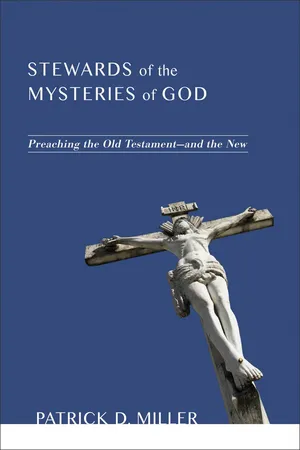
Stewards of the Mysteries of God
Preaching the Old Testament—and the New
- 198 pages
- English
- ePUB (mobile friendly)
- Available on iOS & Android
eBook - ePub
About this book
One of our best known biblical interpreters offers essays and sermons meant to assist preachers in their interpretation and explication of biblical texts. Often neglected in preaching, the Old Testament is a particular focus of attention, but only in the context of the wholeness of Scripture.
Questions addressed in this volume include the following: How does one approach and preach the Old Testament at Easter? What are the contemporary issues or dimensions in preaching the Ten Commandments? And how does the preacher hold the Old Testament and the New Testament in proclaiming God's word to the church?
In this collection, attention is given to preaching about the ministry and on particular occasions, such as funerals, baccalaureates, ordination, and in Advent and Christmas as well as before Holy Communion.
Information
Topic
Theology & ReligionSubtopic
Biblical StudiesEssays
* * *
one
The Old Testament in the Pulpit1
The Old Testament in the Christian Canon
I want to begin our time together by an invitation to you to study and preach and teach the Old Testament in the years ahead in your ministry. It is a genuine invitation in that studying and preaching the Old Testament is not an automatic happening in the Christian pulpit. It is a serious invitation also because it is something I believe you will enjoy doing. The study of the Old Testament may change your life. At least it did mine. Not simply in that it gave me something to do for which someone paid me a decent salary. That is true, and I am grateful. But I am not talking about stumbling onto a way to earn a living. I am talking about stumbling into a world whose central character has taken hold of my life and is taking hold of your life. And the one place where you can make sense of that is in these Scriptures.
I want, then, to lift up four things about the Old Testament that are presuppositions for its serious interpretation and preaching.
- The first is that learning to be a good and faithful interpreter of Scripture means learning to live in the tension between receiving and studying the Bible as an ancient record of the experience and testimony of an ancient people, Israel, and receiving it as the powerful word of God to the present people of God here and now. These Scriptures come from a period literally thousands of years ago, in a foreign language that is not the easiest thing to master. They are often offensive as they speak in explicit detail about sex, murder, rape, abused wives, and other equally unpleasant and disturbing matters. Things happen within the Old Testament that may make little sense in our context. We cannot ignore the distance of the text from us or the demands that distance places upon us to work to try to understand these words from long ago.
With all of that, however, the text is also the word of God that transcends every time and place. It has the capacity to connect with us and who and what we are, to speak from a distant and alien time a word that challenges and comforts us, that speaks truth to power and goodness to evil. Our interest in these books is not finally antiquarian; it is so that we can learn better how to praise God and to live our lives.
- A second thing I want to say is a word about what the Old Testament offers us. It is the record of Israel’s struggle to be the people of God. It deals with family history and family stories, with tribal history, monarchical regimes, and court intrigue, with minority groups and oppressed peoples. The strangeness and distance of these books cannot conceal the way they deal with and in this world in which we live, where nations are at war, where tribalism and ethnic cleansing lead to slaughter and destruction of neighbors, where human beings experience the deepest pain and cry out for help not knowing whether their cry will ever be heard, where the life and death of families and nations are the context in which the providence of God is wrought out, where goodness and blessing are God’s intention for all of life. The Old Testament is rooted deeply in this world, in the terrors and possibilities of human life under God, in the conflicts of peoples and nations. There may be a lot of angels and divine beings around, but there is an earthiness to the Old Testament that always seems to resonate with the earthiness of this dust and clay that compose our beings. If the Old Testament dares to say, as it does over and over again, that God is with us and God will help us, it does so clearly aware of all there is in human life that calls that into question. Indeed all the questions that you could ever think to ask about God or to God, in doubt or in pain, have already come from the lips of ancient Israel.
- The third thing I would have you keep in mind is that the Old Testament belongs with the New and the New Testament belongs with the Old. In its own right the authoritative word of the Lord, the Old Testament is also the deep and rich quarry out of which the New Testament was hewn. The Old Testament books are the Scriptures of Jesus Christ and the best clue we have to who and what he was and what he was about. When the early church sought to understand this one who had come into their midst, claiming them for his discipleship and service in the kingdom of God, they turned to the Scriptures of the Torah, the Prophets, and the Writings, that is, to the Old Testament. There is nothing new that the New Testament tells us about God and God’s ways with us and for us. All is revealed in the Old Testament. What the New Testament does is identify the one in whom God is at work to fulfill those purposes set from the beginning.
As he sat in prison awaiting the possibility of execution, the German pastor and theologian Dietrich Bonhoeffer warned against getting to the New Testament too soon without hearing that full word of the Old Testament. It is that word we want to hear. When we do, it will resonate and point beyond itself to our Lord and to our life. When we understand it well, then we can understand that other Testament better.
So learn to live in that tension between, on the one hand, not going to the New Testament too quickly so that you really do hear the Word of God in the Old Testament, for it is there as clearly as in the New; and, on the other hand, hearing the Old Testament always as a word that has to do with the one who is our Lord. There is never any need to search for Christ in the text of the Old Testament. But you will often encounter him there or know that what you read and hear is the one word of the one God whom we have come to know in Jesus Christ.
- Finally, the Old Testament as part of the canon of Scripture exercises a claim upon us and we want to be open to that. In a sense, I am now talking about its authority, though I am less interested in the grounds of that authority—which I think are fairly clear—than in its effects. The Old Testament takes its place as Scripture for us; that is, the Word of God becomes the word for us when a number of things happen:
- when it calls us into a community that has transcendent dimensions and believes that there is more to this world than our human existence;
- when it calls us into a community that is defined from outside the corruption of history and the failings of human beings, even as it is made up of such folks, just like ourselves;
- when it creates visions and sings songs of impossibilities not yet imagined in this world: visions of a kingdom of righteousness and peace, of a new humanity, of the poor become rich and the lowly lifted up and the barren fertile, of swords into plowshares and guns into tractors;
- when it speaks in a way that transforms lives from being self-centered to being God centered.
I know nothing more demanding, exhilarating, or needed in this world than the effort to hear and proclaim those things from Scripture. I do not think you will find much in your ministry more meaningful or fulfilling than that.
On the Movement from Exegesis to Preaching
- The outcome of your interpretive work is always in mind from the beginning. You do not turn to the text and say, I will find out what this means and then think about preaching from it. You are from the start listening for and looking for the ways the text opens up to communicate a word from the Lord to your congregation. This is why for me, one of the most profitable aspects of the interpretive process is a direct reading of the text in English but with an open interpretive agenda; that is, looking for what I can see about the limits of the text: its structure and shape, what its subject matter is and what is said about it, repetitions that may identify emphases, and the like. I begin making notes about what I discern, starting from the beginning to articulate and imagine what one might say. James L. Mays has properly described exegesis as disciplined meditation on the text.
- The further work of exegesis allows one to test those first forays and to go deeper into the text, but it is still part of an ongoing process that ends up in the preached text. I do not know where the line between exegesis and preaching is drawn, but let me suggest a possible way of keeping the movement going. That is to let your exegetical work culminate in some effort to state what you see as the intention of the text, its basic claim(s), what it is after, what matters about it. There is no single term that is all-sufficient to describe this way of pulling one’s work together. It is not a summary of your work or of the text. It is beginning to say “This is what I think this text is about. This is what it is after and seeks to communicate.”
- As you keep trying to say what that claim or intention is, as you keep articulating and spelling it out, you will find yourself more and more moving toward the preaching of the text. It is not so much that one says, Okay, now how do I preach this text? You have already been wrestling with and working on that all along the way. And you keep on talking about the text, and before you know it, you are into the way the text communicates the word of the Lord to the contemporary community of faith. Now you are going to have to craft the sermon still, of course. But it will be crafted around what you have come to understand and articulate about what matters about the text, the so what? of the text. But you have had that question in your mind all the time.
- At the same time, I want to recognize that the focus of a sermon may be on a particular element in the text, something that your interpretive work has identified as an important aspect of its communication, a particular verse that has something to say. It may be in some sense the key verse of the text, or it may be a separate point or matter within the whole.
- The communication of the text will be most helpful to those to whom you are preaching or teaching if two things happen, and they stand in some tension with one another:
- Do not let go of the text, long or short. Respect it; attend to it; let the congregation be fed by it. Communicate it, illustrate, explain. Do not let your self get in the way of it or lose it. You will be surprised how much your people really do want to be fed by the word of Scripture.
- At the same time, the preaching will be strongest if it is theological and not simply an exposition of the text. Hold those things together. As you have grasped what the text is about, develop its theological character and implications as best you can. The preaching is deeply rooted in the text, but it is also theological and pastoral.
- Do not let yourself get caught in the assumption that you have to end up by taking the text and the sermon into the New Testament. If the text pulls you that way for certain reasons, then by all means go with it. But remember that your congregation is a community of Christians who have the New Testament, who are disciples of Jesus Christ, and so who assume that the text and its preaching belong in that context. Do not get hooked on a single way of relating the Old Testament text to the New, especially on the easy and often misleading and unhelpful schema ...
Table of contents
- Title Page
- Acknowledgments
- Foreword
- Preface
- Part 1: Essays
- Chapter 1: The Old Testament in the Pulpit
- Chapter 2: Preaching and Teaching the Old Testament
- Chapter 3: Preaching the Old Testament at Easter
- Chapter 4: Preaching Repentance in a Narcissistic Age: Psalm 51
- Chapter 5: Preaching the Ten Commandments
- Chapter 6: Preaching the First Commandment in a Pluralistic World
- Part 2: Sermons
- Bibliography
- Scripture Index
Trusted by 375,005 students
Access to over 1.5 million titles for a fair monthly price.
Study more efficiently using our study tools.
Frequently asked questions
Yes, you can cancel anytime from the Subscription tab in your account settings on the Perlego website. Your subscription will stay active until the end of your current billing period. Learn how to cancel your subscription
No, books cannot be downloaded as external files, such as PDFs, for use outside of Perlego. However, you can download books within the Perlego app for offline reading on mobile or tablet. Learn how to download books offline
Perlego offers two plans: Essential and Complete
- Essential is ideal for learners and professionals who enjoy exploring a wide range of subjects. Access the Essential Library with 800,000+ trusted titles and best-sellers across business, personal growth, and the humanities. Includes unlimited reading time and Standard Read Aloud voice.
- Complete: Perfect for advanced learners and researchers needing full, unrestricted access. Unlock 1.5M+ books across hundreds of subjects, including academic and specialized titles. The Complete Plan also includes advanced features like Premium Read Aloud and Research Assistant.
We are an online textbook subscription service, where you can get access to an entire online library for less than the price of a single book per month. With over 1.5 million books across 990+ topics, we’ve got you covered! Learn about our mission
Look out for the read-aloud symbol on your next book to see if you can listen to it. The read-aloud tool reads text aloud for you, highlighting the text as it is being read. You can pause it, speed it up and slow it down. Learn more about Read Aloud
Yes! You can use the Perlego app on both iOS and Android devices to read anytime, anywhere — even offline. Perfect for commutes or when you’re on the go.
Please note we cannot support devices running on iOS 13 and Android 7 or earlier. Learn more about using the app
Please note we cannot support devices running on iOS 13 and Android 7 or earlier. Learn more about using the app
Yes, you can access Stewards of the Mysteries of God by Patrick D. Miller in PDF and/or ePUB format, as well as other popular books in Theology & Religion & Biblical Studies. We have over 1.5 million books available in our catalogue for you to explore.