Gender stereotypes are prevalent in education, as is all spheres of society.
Gender stereotypes squash talent, limit educational experiences and achievement and corrode aspirations - which in turn can limit professional opportunities and prospects.
This book supports you to recognise and challenge gender stereotypes in educational settings and in your own practice. It iincules practical guidance and strategies.
outlines the content and key features of each chapter;
gives tips on how to engage with the content features and apply
ideas from the book in practice.
Purpose of the book
Gender stereotypes are prevalent across all spheres of society, not just
education, but because the formation of gender stereotypes coincides with a
child’s progression through education, and education is a key site for the
perpetuation of gender stereotypes, practitioners at all stages of a child’s
education can help children develop a positive image of their gender and
neutralise negative gender stereotypes and bias.
This book has been written for anyone working with or aspiring to work with
children and young people in education. It is particularly suited to trainee
teachers and education students, but also fills a gap in knowledge, identified in research, for
teachers and education practitioners (e.g. classroom assistants, early years
practitioners). The purpose of the book is to help you develop knowledge of
how and when gender stereotypes form, as well as how they can be perpetuated
in various ways during a child’s education, so that you can help tackle this
problem. This book will support you with research-informed pragmatic
solutions to improve practice and transform the school or learning
environment.
Overview of each chapter
Chapter 2 explores sex-based differences between females and males,
as well as looking at how and when gender identity forms and gender
stereotypes take root. In Chapter 3, we will build on this by
exploring non-binary ideas about gender in more detail. Chapter 4 will
examine the intersection between gender and social background/ethnicity. Chapter 5 examines the impact of gender stereotypes on children’s
subject and career choice, as well as the longer-term economic
implications.
Following that, we will explore how gender stereotypes manifest and may be
perpetuated in specific curriculum and subject areas, beginning with Chapter 6, which looks at early years and children’s play, followed
by Chapter 7 (primary and secondary mathematics learning), Chapter 8 (the national history curriculum for primary and
secondary schools) and Chapter 9 (ICT).
Next, we will turn to contemporary issues in education, beginning with Chapter 10, which examines dyslexia from the perspective of gender
stereotypes. Chapter 11 examines sexism, sexual
harassment and sexual violence in schools.
Chapter 12 advocates a whole-school approach to working with
parents, communities, colleagues and school leaders. Chapter 13
focuses on how to work with mums in disadvantaged communities. Finally, Chapter 14 will consider a future without gender stereotypes, as
well as suggesting further activities to prompt reflection and action
planning.
Content features
Embedded within each chapter of this book are prompts for self-reflection,
practical exercises and activities. You will be given tips on how you can
engage with different types of material embedded in those chapters to help
your reflections and action planning. The reflection questions and
activities in this book have been developed to help link theoretical ideas
and learning with classroom practice. Each chapter in the book includes
activities that you can do to evaluate your practice or activities that you
can do with children in class. There are also suggestions for curriculum and
lesson planning, topic selection, and task selection. We hope that these
activities provide practical ways to transform the learning environment.
Some involve working with parents, colleagues and school leaders.
Activity
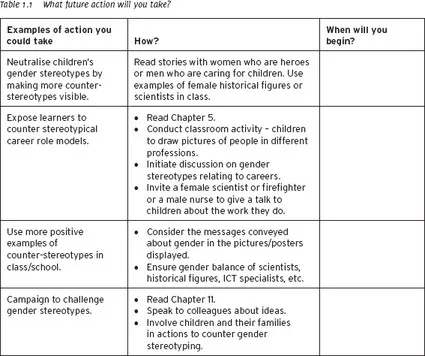
Jot down some bullet-pointed notes on what you would like to learn from
this book and how you hope to use this in practice (you might like to
use Table 1.1). We suggest that you set
yourself some achievable goals to test out ideas from the book in your
practice. For example, you might want to introduce children to more
counter-stereotype role models in storybooks or do more to encourage
children to consider a broader range of careers. This might involve
planning a time when you can explore why girls and boys are steered
towards certain careers. This could include reading Chapter 5
on subject and career choice and setting yourself the goal to complete
an activity with children in class. This might include initiating a
discussion to deconstruct what makes a good nurse, doctor, electrician,
bus driver, care worker, and so on. This could be followed with a
discussion to deconstruct why these roles have traditionally been
dominated by women or men (e.g. why there are more female nurses than
male, more male electricians than female, etc.).
There are many more ideas for classroom-based activities to follow in this
book. As you read each chapter, you can use Table 1.1 to
plan ways that you can challenge gender stereotypes in education. This will
help you to make the best use of this book to transform practice.
Table 1.1
Chapter summary
This book will address a serious issue that is currently highly topical,
which has to date received little attention in education courses, initial
teacher training courses, or published literature. We hope that you find
this book a unique resource for understanding gender stereotypes in
education, whether you are currently working with or aspiring to work with
children and young people. This introductory chapter provided tips on how to
engage with the content features in this book to transform your
practice.
2 The formation of gender identity and gender stereotypes
Karen Jones
Keywords
Sex-Based Differences
Sex
Intersex
Gender
Social Cognitive Theory
Social Learning Theory
Socialisation
Gender Identity
Gender Stereotype Definition
Gender Stereotype Formation
This Chapter
defines and explores terms of reference, including sex, gender and gender stereotypes;
explores key theories that explain the development of a gendered self;
examines when gender stereotypes form and how they shape our experience in life.
Introduction
Men really DO have bigger brains: the amazing image that reveals just how male and female brains are wired differently.
This is the title of an article published in the Daily Mail (Prigg, 2014). There are many more articles like this that illustrate just how much attention is given to differences between the sexes. Think for a moment about how many times you have heard phrases such as ‘battle of the sexes’ or ‘the opposite sex’, or even ‘men are from Mars and women are from Venus’ – a throwback to the relationships book by John Gray (1992). Have you ever commented or heard someone else refer to girls/women as more patient, considerate, empathetic or considerate to the needs of others than boys/men? Or have you heard or joked yourself that women are better at multitasking than men? Or perhaps you have heard someone grumble about ‘women drivers’! You will have seen many examples that relate to children in education and in everyday life (see Table 2.1).
Table 2.1
At the root of ...
Table of contents
Cover
Half Title
Publisher Note
Title Page
Copyright Page
Acknowledgements
Contents
Acknowledgements
About the Authors
1 Introduction
2 The formation of gender identity and
gender stereotypes
3 Challenging the gender binary:
exploring the experiences of transgender children and young people
4 Constructing self: gender, social
background and ethnicity in developing educational identities
5 Subject choice, career decisions and
gender stereotyping
6 Girls and boys: the role of
professionals and play in the early years
7 Gender stereotypes in mathematics
education
8 The history curriculum in primary and
secondary schools and the representation of gender
9 Women in computing
10 Gender and dyslexia
11 Sexism, sexual harassment and sexual
violence in schools
12 A whole-school approach
13 Empowering women from the bottom to
the top: parents, community and partnership
14 What next?
Index
Trusted by 375,005 students
Access to over 1.5 million titles for a fair monthly price.
Study more efficiently using our study tools.
Frequently asked questions
Yes, you can cancel anytime from the Subscription tab in your account settings on the Perlego website. Your subscription will stay active until the end of your current billing period. Learn how to cancel your subscription
No, books cannot be downloaded as external files, such as PDFs, for use outside of Perlego. However, you can download books within the Perlego app for offline reading on mobile or tablet. Learn how to download books offline
Perlego offers two plans: Essential and Complete
Essential is ideal for learners and professionals who enjoy exploring a wide range of subjects. Access the Essential Library with 800,000+ trusted titles and best-sellers across business, personal growth, and the humanities. Includes unlimited reading time and Standard Read Aloud voice.
Complete: Perfect for advanced learners and researchers needing full, unrestricted access. Unlock 1.5M+ books across hundreds of subjects, including academic and specialized titles. The Complete Plan also includes advanced features like Premium Read Aloud and Research Assistant.
Both plans are available with monthly, semester, or annual billing cycles.
We are an online textbook subscription service, where you can get access to an entire online library for less than the price of a single book per month. With over 1.5 million books across 990+ topics, we’ve got you covered! Learn about our mission
Look out for the read-aloud symbol on your next book to see if you can listen to it. The read-aloud tool reads text aloud for you, highlighting the text as it is being read. You can pause it, speed it up and slow it down. Learn more about Read Aloud
Yes! You can use the Perlego app on both iOS and Android devices to read anytime, anywhere — even offline. Perfect for commutes or when you’re on the go. Please note we cannot support devices running on iOS 13 and Android 7 or earlier. Learn more about using the app
Yes, you can access Challenging Gender Stereotypes in Education by Karen Jones in PDF and/or ePUB format, as well as other popular books in Education & Inclusive Education. We have over 1.5 million books available in our catalogue for you to explore.