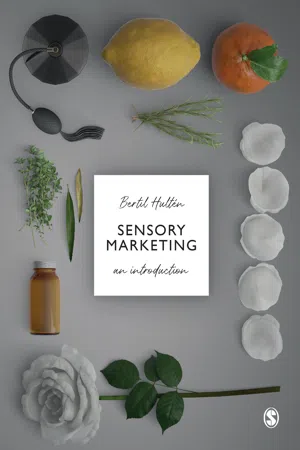
Authored by Bertil Hultén, one of the world?s leading professors of sensory marketing, this text brilliantly explains the techniques through which a sensory experience can be created to surround a consumer. Sensory experiences combine not only to increase the chance of an immediate sale, but to influence perception of a product which then plays into a customer?s chance of return, and brand loyalty for the future.
• Hulten provides definitions, insight boxes, questions and case studies to provide an engaging learning experience.
• The author is one of the most published professors in the field, sharing exclusive expertise and experience.
• The book is thorough yet accessible, dedicating a chapter to each of the 5 senses.
- 240 pages
- English
- ePUB (mobile friendly)
- Available on iOS & Android
eBook - ePub
1 Sensory Marketing Principles
Chapter Contents
- 1.0 Introduction 6
- 1.1 The Human Senses 6
- 1.2 The Global Marketing Environment 7
- The cultural value shift 8
- Digital technology 9
- 1.3 Individualization as Lifestyle 9
- Self-fulfillment 11
- Identity creation 12
- Multi-sensory experiences 12
- 1.4 Theoretical Foundations 13
- Theories and models 13
- Marketing approaches 16
- 1.5 What is Sensory Marketing? 18
- The individual 19
- The firm 21
- Sensory marketing model 27
- 1.6 Chapter Summary 28
- 1.7 The Case of Starbucks 29
- Questions 30
- Further Reading 31
1.0 Introduction
The chapter gives an overview of the main principles of sensory marketing. The global marketing environment and individualization as lifestyle are presented as prerequisites for sensory marketing. Moreover, the theoretical foundations, theories and models, and leading marketing approaches will be analysed and discussed. Finally, the sensory marketing framework with its concepts and terms will be presented and discussed.
After reading the chapter, you should be able to:
- Explain how the global marketing environment and individualization as lifestyle influence sensory marketing in theory and practice.
- Discuss major theoretical models and theories as well as marketing approaches behind sensory marketing.
- Analyse sensory marketing for individuals and firms following the leading concepts.
- Discuss how a company should apply sensory marketing in business practice.
- Analyse the advantages/disadvantages of sensory marketing in relation to individuals and companies.
1.1 The Human Senses
Humans perceive and experience the environment and the outside world through the human senses of vision, hearing, smelling, touching and tasting. For companies and marketers, this means it is important to understand how the senses work in perceiving and experiencing brands, products, services, and physical or digital service environments; especially if the goal for companies is to offer and provide their customers with long-lasting and memorable multi-sensory experiences of their brands, products and services. It is evident that sensory information and input from brands, products and services as well as physical and digital service environments influence an individual’s cognitions, emotions and purchase behaviour (Krishna, 2013; Spence et al., 2014).
Nowadays, consumers should be treated as individuals and not as a homogeneous group of consumers with similar needs. One of the biggest challenges for companies and marketers today is to provide individuals with a deeper satisfaction of their personal desires, wants and needs. Companies can no longer rely on satisfying only an individual’s basic physical needs but must also satisfy emotional, intellectual, sensory and experience-based needs. The notion of sensory marketing should be understood in this marketing context where the multi-sensory experiences of brands, products and services are highlighted.
An iPhone is more than just a telephone – it is a multi-sensory experience to have fun, enjoy images and google for new adventures for every individual.
Just imagine an American, Chinese or French teenager who has bought a new pair of expensive running shoes from Asics to be used in a running tour. How should the multi-sensory experience of the shoes be understood in sensory marketing? It is evident that all the senses are involved: from the information phase when looking at them on the digital website for Asics; during the evaluation and purchase phases in the retailer’s physical store when seeing, hearing, smelling, touching and tasting the aesthetics of shoes; and in the consumption phase when experiencing the running shoes during the running tour and their impact on the whole body through the five senses.

When consuming the shoes during the running tour a conscious body experience, emotional appraisal and a feeling of reward takes place within the individual emanating from the physical feeling of the shoe on the feet as well as the psychological feeling of comfort (or discomfort) of the shoes. It is evident that this bodily experience influences the confidence in the shoes during the running tour as well as the individual’s interest in and motivation for running (Hultén & Pappu, 2018). Altogether, the bodily experience and knowledge are based on the bodily states and the sensory systems through the embodiment of the shoes, which will be further discussed later in the chapter.
Today companies and marketers must understand how an individual’s multi-sensory experience is created and embodied in the human body and mind based on how individuals consciously as well as unconsciously perceive and experience various brands, products and services during purchase and consumption processes.
1.2 The Global Marketing Environment
Two major driving forces in the global marketing environment put new demands on sensory marketing in theory and practice. Brown (1993) suggests that a post-modern view makes it possible to better understand the individual, as a consumer, in contemporary societal culture. This is expressed as ‘the individual’s preference’, ‘different tastes for different people’ and ‘do what you want’, which is what a post-modern view emphasizes (1993: 26). Individual pluralism, diversity or uniqueness is emphasized, laying the ground for the individual’s lifestyle, personal characteristics and social context as key drivers in a sensory marketing context.
The cultural value shift
Based on new personal attitudes and values, the ongoing cultural value shift is one of the most prominent driving forces (Inglehart, 1997). In the global research project World Values Survey (www.worldvaluessurvey.org/wvs.jsp) the Inglehart-Weizel cultural map shows two major dimensions of cross-cultural variation in societies all over the world following traditional values versus secular-rational values and survival values versus self-expression values. Countries like Benelux, Germany, France, the Nordic countries, Switzerland and Japan have high scores on secular-rational and self-expressions values. On the other hand, countries like most of Latin America and the US have high scores on traditional and self-expression values. Also, the emergence of the ‘I-society’ promoting individual independence and self-fulfillment has been evident during the last two decades (Howard & Mason, 2001). How should sensory marketing contribute to this development?
In 2013 the Swedish consulting firm Kairos Future published a study with the title Global Youth 2013 reporting the dreams and values of 6,500 young people in 11 countries. The respondents came from countries like Australia, China, India, Russia, Sweden and the UK. Two out of three respondents considered that society was too individualistic and that their future was dim. But despite this a lot of the respondents had dreams about a job, a good home and a family.
All brands are global in the sense that all individuals in different societal cultures have access to them through newspapers, television, smartphones, websites and online platforms like Amazon or Alibaba. The top 10 most valued global brands for 2017 ranked by Interbrand are Apple, Google, Microsoft, Coca-Cola, Amazon, Samsung, Toyota, Facebook, Mercedes-Benz and IBM. These brands and products give possibilities for an increased individualization with respect to individual desires, wants and needs in relation to what different brands and products might offer.
The global marketing environment becomes more and more fragmented based upon the multiplicity of knowledge among individuals that belong to ‘the objective real world’ and ‘the subjective symbolic world’. For many individuals it means establishing a coherent identity and lifestyle to be a subject – not an object – with contradictory, fragmented and multiple identities at the same time. All global brands have in each cultural and societal context a deeper symbolic meaning for individuals related to the five human senses, which will be discussed later.
Digital technology
The individualistic approach has been strongly related to the access of information and knowledge through the growth of digital technology as another prominent driving force. Digital technology through, for example, the Internet, smartphones and social media has opened up new channels of communication and information exchange (Castells, 2010). It is no longer possible for companies and marketers to promote their brands and products solely through traditional advertising and promotion in the clutter of the global digital marketplace.
Instead the Internet and social media like Google, Facebook, Twitter and Instagram offer authenticity and transparency among networks of individuals about brands, objects, products, places, retail spaces and services, changing the balance in the power relationship from companies to individuals. Think of all the positive or negative comments given every day about brands, products and services on the Internet.
Generations X, Y and Z demonstrate the most prominent change in attitudes, behaviours and values following the cultural value shift. The most common characteristics are their physical and social mobility and ambition to experience the world beyond their local and private boundaries. This mobility has also resulted in a more international and multi-cultural character of the societal culture than before. Its impact on the consumption of, for example, food, clothing and services of various kinds, such as entertainment, travel and education, is obvious among these generations.
Nowadays digital technology is the most important communication tool for most individuals in Africa, Asia, Australia, Europe, the Middle East, North and South America. Blogs, websites and social media such as Facebook, Instagram and Twitter are used for personal and private exchange of information and communication. As soon as digital technology is used with these purposes it is regarded as consumption of multi-sensory experiences.
In particular, for generation Z digital technology is a part of their lives already from birth. The technology influences attitudes and values as well shopping and purchase behaviour in both physical and digital retail environments (Petit et al., 2019). There is no doubt that blogs, communities, social media and social networks involve many individuals sharing information about brands, companies, friends and social movements. The most distinctive feature of this type of communication and information exchange is that it allows many individuals to experience both emotional and rational arguments in an open dialogue.
1.3 Individualization as Lifestyle
In sensory marketing the individual is sovereign and unique when it comes to attitudes, values and behaviours. During the last decade the transition from a collectivistic society to a more individualistic society has led to an emphasis for many individuals on individualization as lifestyle. This lifestyle is a result of the cultural value shift as well as the growth in digital technology where the individual is focused. Especially for generations X, Y and Z, the consumption of brands, products and services is connected to emotional, intellectual, sensory and physical needs related to a quest for quality of life and self-realization.

The current lifestyle is a part of a global consumption culture of brands, products and services with the main purpose for many individuals being to create new identities and self-images. It concerns brands such as Apple, BMW, Gap, H&M, Huawei, Samsung, Zara, Victoria’s Secret and other global premium consumer brands. Also, luxury brands like Alfa Romeo, DKNY, Dior, Gucci, Ferrari, Hennessy, Lamborghini, Louis Vuitton, Sephora, TAG Heuer and many others belong to those brands creating prestige and social status. Altogether, this development illustrates the importance of individual consumption as a carrier of personal values in satisfying one’s own ego and quest for self-fulfillment, happiness and personal joy.
This lifestyle is based on individuals’ attitudes, values an...
Table of contents
- Cover
- Half Title
- Publisher Note
- Title Page
- Copyright Page
- Contents
- Acknowledgements
- Introduction
- 1 Sensory Marketing Principles
- 2 The Sensory Brain
- 3 Sensory Principles for Vision
- 4 Sensory Principles for Sound
- 5 Sensory Principles for Smell
- 6 Sensory Principles for Touch
- 7 Sensory Principles for Taste
- 8 Multi-Sensory Principles
- References
- Index
Trusted by 375,005 students
Access to over 1.5 million titles for a fair monthly price.
Study more efficiently using our study tools.
Frequently asked questions
Yes, you can cancel anytime from the Subscription tab in your account settings on the Perlego website. Your subscription will stay active until the end of your current billing period. Learn how to cancel your subscription
No, books cannot be downloaded as external files, such as PDFs, for use outside of Perlego. However, you can download books within the Perlego app for offline reading on mobile or tablet. Learn how to download books offline
Perlego offers two plans: Essential and Complete
- Essential is ideal for learners and professionals who enjoy exploring a wide range of subjects. Access the Essential Library with 800,000+ trusted titles and best-sellers across business, personal growth, and the humanities. Includes unlimited reading time and Standard Read Aloud voice.
- Complete: Perfect for advanced learners and researchers needing full, unrestricted access. Unlock 1.5M+ books across hundreds of subjects, including academic and specialized titles. The Complete Plan also includes advanced features like Premium Read Aloud and Research Assistant.
We are an online textbook subscription service, where you can get access to an entire online library for less than the price of a single book per month. With over 1.5 million books across 990+ topics, we’ve got you covered! Learn about our mission
Look out for the read-aloud symbol on your next book to see if you can listen to it. The read-aloud tool reads text aloud for you, highlighting the text as it is being read. You can pause it, speed it up and slow it down. Learn more about Read Aloud
Yes! You can use the Perlego app on both iOS and Android devices to read anytime, anywhere — even offline. Perfect for commutes or when you’re on the go.
Please note we cannot support devices running on iOS 13 and Android 7 or earlier. Learn more about using the app
Please note we cannot support devices running on iOS 13 and Android 7 or earlier. Learn more about using the app
Yes, you can access Sensory Marketing by Bertil Hultén in PDF and/or ePUB format, as well as other popular books in Business & Marketing. We have over 1.5 million books available in our catalogue for you to explore.