- 280 pages
- English
- ePUB (mobile friendly)
- Available on iOS & Android
eBook - ePub
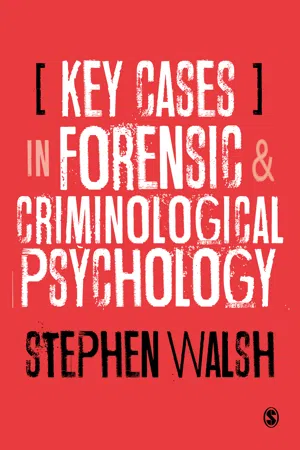
Key Cases in Forensic and Criminological Psychology
About this book
By presenting current psychological theories alongside individual case studies, this book will guide you to understand the theory as it applies to specific instances of each crime. Covering a wide range of cases, from economic crimes, to terrorism and sexual and violent crimes, this book provides a comprehensive and engaging resource to develop an understanding of forensic psychology.
Information
Publisher
SAGE Publications LtdYear
2021Print ISBN
9781526494849
9781526494856
Edition
1eBook ISBN
9781529757415
Part I Theft, Fraud and Economic Crime
Chapter 1 Psychology of theft, burglary, robbery and fraud: An Overview
Introduction
Theft and economic crime, including fraud, are acquisitive crimes, meaning they centre on taking other people's belongings. More formally, acquisitive crimes are those that have as their central process the appropriation of money or goods. Interestingly, there are aspects to these crimes, for example enhancing one's power of reputation, that go beyond the obvious desire to acquire something of value (Canter & Youngs, 2009). Acquisitive crime ranges from filching the toiletries or the bible from your hotel room, to the armed robbery of cash in transit, to the multi-million-dollar Ponzi scheme perpetrated by Bernie Madoff. For as long as there have been human beings, there has been crime rooted in covetousness. Indeed, the crime of theft is ‘probably concomitant with the possession of property’ (Brown, 1930, p. 405). For as long as people have owned things there has been someone intent on stealing them. Part 1 of this book will explore these crimes in depth, using standout cases to illustrate the different themes in closer detail. In each case-chapter throughout the book you will find learning objectives to help guide your learning throughout the chapter, a synopsis of the case before we delve into the psychology behind it, reflective questions to help you to understand the details discussed, and further reading to take your learning beyond these pages.
Kleptomania
When thinking of the psychology of acquisitive crimes, in particular crimes of theft, the first thing that comes to many people's minds is kleptomania. The Diagnostic and Statistical Manual of Mental Disorders (DSM-5) (American Psychiatric Association, 2013) classifies kleptomania as an impulse control disorder that is marked by an inability to resist the impulse to steal. In many instances, the goods stolen by those with kleptomania have little monetary value and they are not needed for personal use.
Having an occasional impulse to steal is considered normal, as is thinking about the consequences that would follow if one were to steal. What marks those suffering from kleptomania apart is that they have these thoughts incessantly, and that they consistently lack the capacity to resist the urge to steal.
People afflicted with kleptomania will experience a build-up of tension before they steal, followed by an intense feeling of relief in the aftermath of stealing (American Psychiatric Association, 2013). Kleptomania is an ego dystonic disorder, meaning that the stealing behaviour is experienced by the kleptomaniac as repugnant, unacceptable, inconsistent with their self-concept and distressing (Gavin, 2014). The severity of kleptomania has been associated with disorders of compulsivity (Grant & Chamberlain, 2018). However, Kleptomania is a very uncommon disorder with a reported prevalence of 0.38% – occurring in fewer than four out of every 1,000 people (Odlaug & Grant, 2010). The vast majority of people who commit crimes associated with theft are not kleptomaniacs.
Theft
‘Thou shalt not steal.’ Despite the admonishments of every world religion, and culture, against stealing and coveting, theft is extraordinarily common. Stealing always involves intent, and to steal is to violate, in some fundamental way, another's right of ownership. It is worth noting that this is different from saying that stealing is simply a violation of some particular set of property laws (Green, 2007). This distinction is important to note because, while it is very easy to conflate legal and psychological categories, it is not at all useful to do so.
Theft is taking property without the owner's consent, with the proviso that the person doing the taking knows that the property does not belong to them (Gavin, 2014). Taking someone else's dessert in error is a mistake, but it is not theft. However, most, probably all, of us have behaved in a way that results in something that might be legitimately called theft. A recent survey conducted by pen makers Papermate, and reported by the BBC (2018), found that 100% of 1,000 office workers sampled admitted stealing a pen from a colleague.
There are cases in which a person is technically subject to the laws of theft even though many would hold the view that nothing has been stolen. This raises a question as to whether the fit between our understanding of theft from a descriptive perspective sits as well as it might with our view of theft from a moral, or normative, sense. The gap between law and norms with regard to widely accepted manifestations of theft (e.g. taking a towel home from a hotel break) is also useful because it facilitates a consideration of how groups, other than the ones that we ourselves belong to, regard theft. For example, few consider illegal downloading as theft, although that is precisely what it is. Thieving has been part of human behaviour for millennia and the roots of stealing behaviour are deeply embedded in the evolutionary past of our species. We even celebrate thievery in our culture. Almost everyone loves Robin Hood, and many regard the pirates of old with more than a little fondness.
The capacity to thieve is predicated on a functioning theory of mind. One must know that another perceives themselves as owners of a given object and that to take their property without consent is wrong (Green, 2007). A sense of morality is also necessary.
Theft is one of the most common crimes and it is found across all cultures (Gavin, 2014). The concept of theft seems to be in some way pre-legal. Small children understand what it is to steal (Green, 2007) as, it seems, do non-human primates, including rhesus monkeys (Flombaum & Santos, 2005). Because theft is omnipresent, it is highly unlikely that there is a specific psychology of theft.
As with all behaviour that is learned, knowledge about stealing is something that evolves and reacts to the environment (Gavin, 2014). In addition to conceiving them as acquisitive crimes, property thefts can be usefully understood as interpersonal transactions, even when the victim is not physically present. Our focus, in this section, is on one of the parties to this transaction, those perpetrating the thieving. With this focus, in considering individual crimes, it is useful to us that all thieves bring their store of ‘professional’ and life experiences to each ‘transaction', to every offence that they commit.
Burglary
Burglary is one of the most common crimes and one that we find in the criminal histories of most offenders (Canter & Youngs, 2009). The Crime Survey for England and Wales (CSEW), covering the period to the year ending June 2018 (Office for National Statistics, 2018), indicated a rate of 27 burglaries per 1,000 population with 432,267 offences in total. In the United States, in their most recently published figures, the Bureau of Justice Statistics (BJS) reported 20.6 victimisations of burglaries per 1,000 households in 2017 (Bureau of Justice Statistics, 2018).
Burglary is categorised as a property crime and is a specific type of theft that requires unlawful entry onto premises in order to steal (Anderson & Kavanaugh, 2009). From a psychological point of view, there is much to consider with this crime. Detection rates for burglary are shockingly low. Hockey (2016) reports that for the years 2009–2012 roughly 87% of reported burglaries in England and Wales did not lead to a conviction, and he attributes this low detection rate to a range of factors: there is often no pre-existing relationship between perpetrator and victim, offences tend to be reported many hours after their commission, and there are generally no witnesses.
These facts, which feed into the low detection rates, render burglary a fascinating subject to those with an interest in crime because the 13% or so of burglaries that result in a conviction are a small subset of the total burglary committed. In extrapolating from this 13%, we are focusing on cases that are atypical and, in the process, learning much about unsuccessful criminals but little about those who ‘get away with it'.
Canter and Youngs (2009) offer a useful take on burglary. From their perspective, burglary constitutes the crossing of a psychologically significant physical barrier in order to achieve material gain from the resources located on the other side of that boundary. They suggest that burglary differs in psychologically important ways from other acquisitive crimes, not least because burglary is an open-ended, exploratory and non-violent approach to illicit material gain. Compared to crimes involving fraud and threat, burglary can seem positively risky and adventurous, focusing as it often does on a battle of wits with security measures and staff. On the silver screen, there are few people not won over by the charm of movies like the Thomas Crown Affair, or George Clooney's character, Danny, in Ocean's Eleven (2001).
Building on the dramaturgical aspect, understanding burglary in terms of the stories that perpetrators weave about themselves opens up a path which facilitates a useful consideration of what burglary represents, psychologically, to the offender. This in turn facilitates a consideration of what the differences might be in the ways that individual offenders tackle their offences. It may well be that the stories that burglars tell themselves about their crimes is key to a psychological understanding of these crimes (Canter & Alison, 2000). This approach will be developed in a consideration of the Hatton Garden raid, presented in the next chapter.
Robbery
Robin Hood, Butch and Sundance, Bonnie and Clyde, Billy the Kid and Buster Douglas. From a cultural perspective, their crimes are perceived with admiration by many. Perhaps, in an abstract sense, robbery is seen as a way in which grievances with the powerful and wealthy can be redressed. However, the reality of this crime is decidedly less wholesome.
Robbery is distinct from burglary because violence is fundamental to the crime. Robbery, by definition, involves either the threat or use of violence. Robberies can be usefully classified based on whether they are commercial (e.g. from banks, post offices, shops, etc.) or personal (e.g. muggings, snatch thefts and/or street robbery) (Porter, 2010). In commercial robberies, the victim is often asked to surrender somebody else's money. This is a significant factor in the interaction between robber and victim as less force is likely to be needed when someone is being coerced into surrendering money or goods that are not their own.
In the United States, the Federal Bureau of Investigation (FBI) defines robbery as ‘the taking or attempting to take anything of value from the care, custody, or control of a person or persons by force or threat of force or violence and/or by putting the victim in fear’ (Federal Bureau of Investigation, 2014). In England and Wales, the Theft Act 1968, section 8(1), states that ‘a person is guilty of robbery if he/she steals and immediately before or at the time of doing so, and in order to do so he/she uses force on any person or puts or seeks to put any person in fear of being and then subjected to force'. This legalese is somewhat verbose but the point is clear. As in the United States, threat, force and violence are also fundamental to the legal definition of robbery in the UK.
Robbery is a relatively low-volume crime in England and Wales with police recording 79,117 offences for the year ending June 2018. This amounts to a rate of four robberies per 1,000 in the population. The instances of recorded robbery in London are disproportionately high with 42% of all robberies taking place in the capital (Office for National Statistics, 2018). In the United States, the official rate is even lower. There were an estimated 319,356 robberies in the US during 2017, amounting to a rate of 0.98 per 1,000 in the population (Bureau of Justice Statistics, 2018). However, it is worth noting that the official police data from which these figures are compiled, appears to suffer from significant under-reporting (McCluskey, 2009).
As indicated at the outset, because of the nature of the crime, robbery is associated with a likelihood of physical injury and, in some cases, homicide. In the USA, data collected by the National Crime Victimization Survey (NCVS) in 2006 shows that about one-third of robbery victims were injured (McCluskey, 2009). Taking a more fine-grained look, research also shows that about half of those robbed by offenders armed with blunt objects or other weapons were hurt. Thirty-six per cent of victims of unarmed offenders and 31% of victims of criminals armed with knives were harmed during their victimisation. Victims of robbery where the perpetrator(s) were armed with blunt objects or weapons other than firearms were more likely to be attacked without prior threat (Perkins, 2003).
Consistent with the statistics presented above, robbers choose weapons to establish credible threats (McCluskey, 2009). Weapons and the use (or threat of) violence are all about the perpetrator establishing control. The victim–offender encounter is at the very heart of this. According to McCluskey (2009), this interaction is likely to be best understood in terms of a contest of coercive power. Injury, resistance and ‘successful’ completion of the robbery are all potential outcomes in the robbery transaction.
Paradoxically, using a gun to threaten a victim means that the actual use of force is less likely. On the other hand, unarmed robbers are unlikely to be perceived to have overwhelming coercive power and will need to demonstrate, through the actual use of violence, that they can force victims into compliance.
Wright, Brookman and Bennett (2006) found that it is sometimes the ‘buzz’ and excitement of robbery that provided the main motivation for UK offenders. One of the participants in the Wright et al. study reports that, in their view, the perfect robbery is one where the victim fights back – ‘the point of street robbery is to get them to fight back, innit. I'd give him a couple of slaps and tell him to fight back, yeah. If he won't fight back, we just give him a kick and go’ (Wright et al., 2006, p. 9).
The word ‘we’ is perhaps key in the previous sentence. It is noteworthy that robbery tends to be a group phenomenon, and across the whole spectrum of crimes that fall under the heading of robbery, group processes and patterns tend to be evident. Other important motivating factors in robbery include having money for both everyday items and drugs, status, fun and excitement, and generating reputation.
Economic Crime
‘Crime in the street and crime in the suite is an offence rather than an offender distinction’ (Gottfredson & Hirschi, 1990, p. 200). Economic crime, also referred to as financial crime, and colloquially known as ‘white-collar crime', is a term that covers illegal acts perpetrated in order to achieve financial or professional advantage. Sociologist Edwin Sutherland first conceived of ‘white-collar crime’ in 1939. Sutherland's interest was in ‘respectable’ people of high social status who committed crime and he used the concept to challenge conventional stereotypes in the 1930s and 1940s about criminals and criminality.
The word ‘criminal’ conjures up images of people who are a danger to society. Deviants. Dangerous. This is perhaps not the most useful way of approaching criminality. Consideration of economic crimes can aid our understanding of criminality, and challenge this ‘deviant’ view, by refocusing our attention on the situation. In many instances, understanding crime is best served by attending to the context of crime rather than harking back to long-distant childhoods and the complexities of human development (Weisburd, Waring, & Leeper Piquero, 2008). It is somewhat amusing to think that most ‘white-collar’ criminals see themselves as upstanding and respectable citizens.
The (shockingly) small number of senior banking executives whose convictions followed the 2008 financial crisis offer a good, recent example of one type of criminal who might be considered under the heading of ‘economic crime'. The United Nations Office on Drugs and Crime gives a broad definition of the term ‘economic and financial crime’ as any non-violent crime that results in a financial loss (United Nations, 2005).
While the category is, at present, somewhat loosely defined, the term ‘economic crimes’ covers bribery, tax evasion, fraud, embezzlement and money laundering (Kryvoi, 2018).
Cybercrime is another area where there is currently a flourishing of economic crime. ‘Cyber’ refers to things digital, from Bluetooth to driverless cars, and an important focus of things cyber is the internet (Aiken, 2016). In the UK, cybercrime has been defined as ‘entailing conduct proscribed by legislation and/or common law as developed in the courts, that involves the use of digital technologies in the commission of the offence, or is directed at computing and communications technologies themselves, or is incidental to the commission of other crimes. Computers may be incidental to the offences or indeed instrumental to criminal offences’ (Ridley & Harrison, 2017, p. 8). Despite the relentless increase in cybercrime, and in common with crime generally, most cybercriminals remain unprosecuted.
Adding to the complexity of bringing cybercriminals to trial, there is often a cross border component to this category of offences which makes them difficult to prosecute.
One especially concerning aspect of cybercrime is banking confidentiality. According to Ridley and Harrison (2017), the banking industry has been withholding billions in losses caused by hackers stealing from their electronic systems. The reason given for this reticence on the part of bankers is that reporting these crimes would negatively impact the share prices of these publicly listed companies, thereby causing even further losses. In itself, this raises issues about full disclosure to investors of companies floated on stock markets.
Taken as a whole, economic crimes cause a plethora of woes to national economies and individuals, including damaged credibility for businesses and institutions, bankruptcy, job losses, pension losses and home evictions. These effects are often experienced especially sharply in the developing world where sustainable development can be curtailed because of limited government capacity and weak regulatory frameworks. In the first world, over recent decades, economic crimes, and the almost unimaginably large losses associated with high-level financial criminality, have undermined social security systems and put entire economies at risk.
Economic crimes generally span a significant period of time, and law enforcement and regulatory officials often only take action in the wake of financial disasters. Moreover, these financial disasters tend to be ‘quintessentially organizational offences, requiring collective cooperation and mutual reinforcement – what might be called cultures of non-compliance’ (Snider, 2008, pp. 47–48). Social and organisational psychology should therefore be part of any attempt to understand these crimes.
Of particular interest from a social psychological point of view are the machinations which facilitate, for example, ‘aggressive tax planning', the over-valuing of assets, the hiding of debts, and the reporting of inflated profits. There is considerable esteem associated with such criminal chicanery. Bankers and executives can benefit from massive bonuses because of criminal behaviour. It is worth pausing for a moment to contrast this treatment with the opprobrium heaped on ‘welfare cheats’ and ‘blue-collar’ criminals who can lose liberty, housing and income as a consequence of crimes that come with a ...
Table of contents
- Cover
- Half Title
- Title Page
- Copyright Page
- Contents
- About the author
- Copyright acknowledgement
- Part I Theft, Fraud and Economic Crime
- Chapter 1 Psychology of theft, burglary, robbery and fraud: An Overview
- Chapter 2 The Hatton Garden burglary
- Chapter 3 The Securitas raid
- Chapter 4 Nick Leeson and Barings Bank
- Chapter 5 Bernie Madoff
- Part II Terrorism
- Chapter 6 Terrorism: An overview
- Chapter 7 The Hindawi Affair
- Chapter 8 Michael Stone, the Milltown massacre and the corporals’ murders
- Chapter 9 The Manchester Arena bombing
- Chapter 10 The Unabomber
- Part III Sexual Crimes
- Chapter 11 Paraphilia and sex crimes: An overview
- Chapter 12 Prams and handbags: A case of fetishism
- Chapter 13 Kirk Anderson
- Chapter 14 Kitty Genovese
- Part IV Firesetting and Homicide
- Chapter 15 Firesetting and homicide: An overview
- Chapter 16 Peter Dinsdale aka Bruce Lee
- Chapter 17 The Motorcycle Murder
- Chapter 18 Reserve Police Battalion 101
- Chapter 19 Charles Whitman: Mass killing
- Chapter 20 Stephen Griffiths: The Bradford murders
- Chapter 21 Alan Hawe: Murder-suicide
- References
- Index
Trusted by 375,005 students
Access to over 1.5 million titles for a fair monthly price.
Study more efficiently using our study tools.
Frequently asked questions
Yes, you can cancel anytime from the Subscription tab in your account settings on the Perlego website. Your subscription will stay active until the end of your current billing period. Learn how to cancel your subscription
No, books cannot be downloaded as external files, such as PDFs, for use outside of Perlego. However, you can download books within the Perlego app for offline reading on mobile or tablet. Learn how to download books offline
Perlego offers two plans: Essential and Complete
- Essential is ideal for learners and professionals who enjoy exploring a wide range of subjects. Access the Essential Library with 800,000+ trusted titles and best-sellers across business, personal growth, and the humanities. Includes unlimited reading time and Standard Read Aloud voice.
- Complete: Perfect for advanced learners and researchers needing full, unrestricted access. Unlock 1.5M+ books across hundreds of subjects, including academic and specialized titles. The Complete Plan also includes advanced features like Premium Read Aloud and Research Assistant.
We are an online textbook subscription service, where you can get access to an entire online library for less than the price of a single book per month. With over 1.5 million books across 990+ topics, we’ve got you covered! Learn about our mission
Look out for the read-aloud symbol on your next book to see if you can listen to it. The read-aloud tool reads text aloud for you, highlighting the text as it is being read. You can pause it, speed it up and slow it down. Learn more about Read Aloud
Yes! You can use the Perlego app on both iOS and Android devices to read anytime, anywhere — even offline. Perfect for commutes or when you’re on the go.
Please note we cannot support devices running on iOS 13 and Android 7 or earlier. Learn more about using the app
Please note we cannot support devices running on iOS 13 and Android 7 or earlier. Learn more about using the app
Yes, you can access Key Cases in Forensic and Criminological Psychology by R. Stephen Walsh in PDF and/or ePUB format, as well as other popular books in Psychology & Forensic Psychology. We have over 1.5 million books available in our catalogue for you to explore.