eBook - ePub
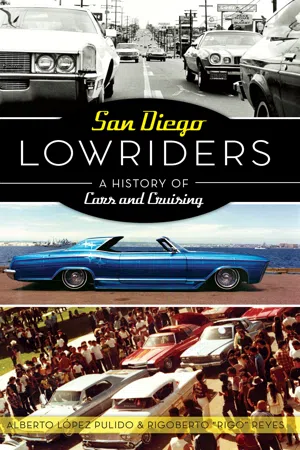
San Diego Lowriders
A History of Cars and Cruising
- 144 pages
- English
- ePUB (mobile friendly)
- Available on iOS & Android
eBook - ePub
About this book
San Diego's unique lowrider culture and community has a long history of "low and slow." Cruising the streets from 1950 to 1985, twenty-eight lowrider car clubs made their marks in the San Diego neighborhoods of Logan Heights, Sherman Heights, National City, Old Town, San Ysidro and the adjoining border community of Tijuana, Mexico. Foundational clubs, including the Latin Lowriders, Brown Image and Chicano Brothers, helped transform marginalized youth into lowriders who modified their cars into elegant, stylized lowered vehicles with a strong Chicano influence. Despite being targeted by the police in the 1980s, club members defended their passion and succeeded in building a thriving scene of competitions and shows with a tradition of customization, close community and Chicano pride. Authors Alberto López Pulido and Rigoberto "Rigo" Reyes follow the birth of lowrider culture to the present day.
Information
Subtopic
North American HistoryIndex
History1
LAS RAÍCES
The Early Roots of Lowriding in San Diego, 1950–68
MATHIAS PONCE AND THE ART OF LOWRIDING
Serra Car Club of Old Town and Bean Bandits of San Diego
The early raíces of lowriding in San Diego, California, began in the 1950s, with people having a desire to come together to acquire vehicles and share ideas on how best to modify vehicles in creative and unique ways. A sizeable portion of these activities were motivated by “hanging out,” working on cars, cruising and racing cars and simply socializing with a desire to build community and to establish close and long-lasting friendships. These activities were at the core of the early car cultures that have persisted into the present period. We begin our journey with one of the most influential individuals in the lowrider movement. Mathias Ponce came onto the car scene in the 1940s in the community of Old Town in San Diego, California. He was a car enthusiast, speed and drag racer and, most significant for our project, a lowrider. As a young man, Mathias began lowering and cruising cars as early as the late 1940s throughout San Diego. He was a proud member of the Serra Car Club, considered to be the very first car club that welcomed and supported lowriders and lowriding in San Diego and anywhere else for that matter. Based in Old Town, the car club held its meetings at the Old Town Recreational Center in the shadows of Presidio Park. The club chose its name from the Catholic missionary Father Junipero Serra and had up to fifteen members. One of the favorite activities of the Serra Car Club was cruising the streets of Linda Vista and Mission Beach with limited contact with the communities of southern San Diego.
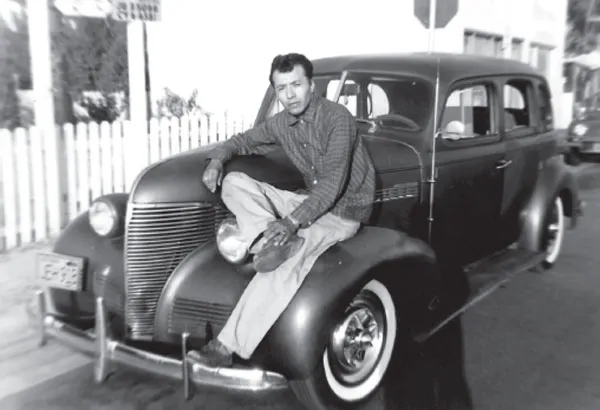
Mathias Ponce poses on top of his customized 1939 Chevy four door in Bay Park. The vehicle has hubcaps that came from a 1956 Chrysler. Courtesy of Mathias Ponce.
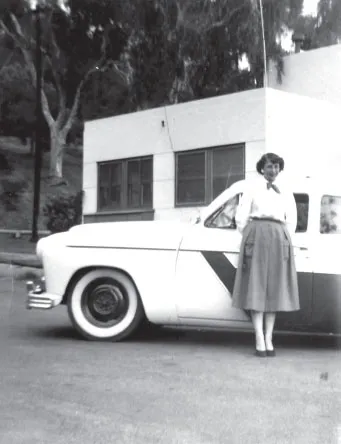
A woman poses in front of the Old Town Recreation Hall, where the Serra Car Club gathers. Courtesy of Mathias Ponce.
A good part of Mathias’s car and cruising activities included his younger brother David. They would imagine new ways to customize their cars and share them when they hung out with friends and other club members. The Ponce brothers—Mathias, David and Ernie—were well known in the San Diego region for their cars and their friendship. In the community, they were known as “good guys.”
One of their most popular hangouts was at Presidio Park, where they proudly displayed their vehicles on the lawn in front of the Presidio in the 1950s.
Mathias’s lowriding journey began when he was a young man in the early 1940s and was obligated to help his brother with collecting and selling “junk”—what he refers to as “junking.” It was during one of these episodes of going through piles of unwanted materials that he discovered a square metal box. As he thought about this little box, he came up with an idea: to place it between the back springs and rear end of his car. (This will lower the rear end of the car.) Mathias was self-taught on the mechanics of suspension systems on cars because he had to fix his brother’s car, whose rear end had broken, and discovered how rear ends of cars worked. Later, he would discover aluminum blocks that could be used to create the same effect. This Mexican ingenuity served him well; the lowering block concept was taught to many young lowriders and became a common practice until well into the 1970s. Another lowering method that was not always preferred was heating up the back springs that bolted to the back of the car. The heat compresses the springs, lowering the car.
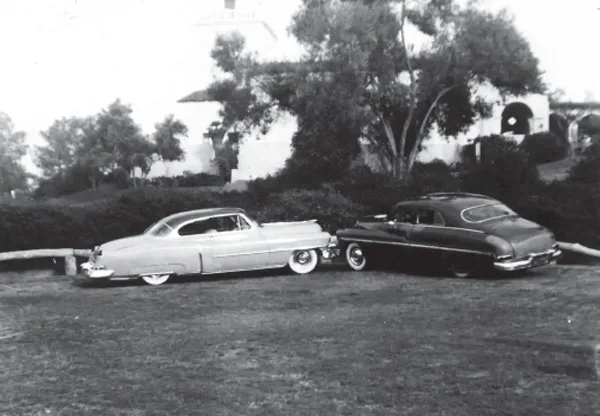
David Ponce’s 1953 Coupe de Ville facing Mathias Ponce’s 1950 Mercury at Presidio Park in San Diego. Courtesy of Mathias Ponce.
The desire to lower his vehicles was based on performance—they simply rode better that way. American cars built during the 1940s and ’50s were very large, and the car rode very high off the ground. Mathias noticed that lots of air would get underneath the cars and they would not handle very well. So he figured that by lowering the car, you could eliminate the air, allowing for a much smoother and more gentle ride. Mathias became very well known in the region for lowering cars, and before you knew it, he was in high demand throughout Southern California, where numerous car enthusiasts would hire him to lower their cars.
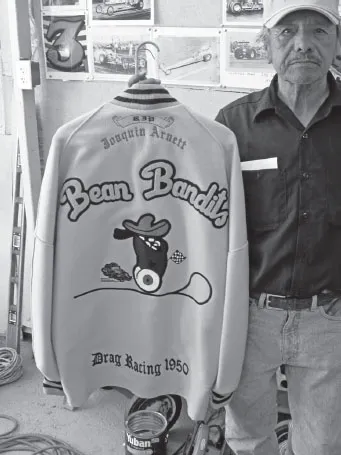
Mathias Ponce poses with his Bean Bandits Racing Team jacket. Courtesy of Alberto Pulido.
By 1965, Mathias had begun to drag race and became known as el Águila, or “the Eagle,” in the drag racing world. He would own a total of three different dragsters—created and customized by him—throughout his career. Mathias’s involvement in the drag racing scene led him to get involved with the Bean Bandits, a resourceful and amazing racing team founded in 1949. Joaquin Arnett Jr., described by many as a mechanical genius, guided this predominantly Mexican American racing team to win nearly four hundred trophies at the height of its presence in the racing world. In addition to Ponce and Arnett, other members, such as Robert Martinez, were recognized for their brilliance and skill in customizing vehicles.
Throughout all their visionary work, the Bean Bandits’ modification and lowering of cars drew much attention and gave them much notoriety that would influence the next generation of lowrider customizers. Their unique vehicles and bright yellow jackets were popular and respected in the Mexican barrio of Logan Heights in San Diego.
Street Vistas
LOWRIDING CULTURE AND MUSIC
An integral part of the lowrider movement is cultural pride. We identify it as one of the eight qualities of lowriding in the introduction. In addition to lifestyle and dress, music is central to the lowrider experience. Numerous styles, including rhythm and blues, soul, traditional Mexican music and “oldies but goodies,” have been central to lowrider culture and community. A common activity of all the lowrider car clubs featured here are dances. Dances were always being organized by numerous car clubs, and some car clubs became extremely popular for the dances they organized and bands they featured. Clubs usually designed their own tickets and posters to publicize the event, and these became part of the art of the lowrider movement. The practice of organizing dances for the community began in the 1950s with social clubs during the early roots of lowriding. A good example of a social club is represented by Los Lobos, which is discussed in this chapter.
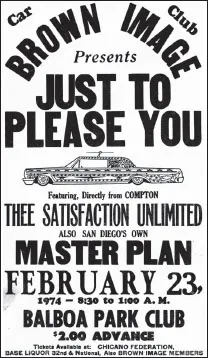
A poster for a dance sponsored and organized by Brown Image Car Club. Courtesy of Rachael Ortiz.
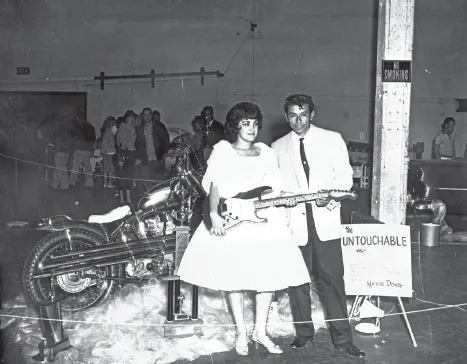
David Ponce and Rosie Hamlin of Rosie and the Originals at a car show in Balboa Park featuring Mathias Ponce’s motorcycle, the “Untouchable.” Courtesy of Mathias Ponce.
The “oldies but goodies” scene cannot be more clearly accented than by the song “Angel Baby” by Rosie and the Originals. Rosie Hamlin spent part of her youth in National City, where she wrote the lyrics to the song that featured Mathias Ponce’s brother David as one of the guitarists of the group.
THE ORIGINAL LOS LOBOS JACKET CLUB OF LOGAN HEIGHTS
Social clubs, known as jacket clubs, were an important part of youth culture during the 1950s in the community of Logan Heights and surrounding communities in San Diego. They instilled great pride and provided leadership skills for Mexican American men from this era. Several of the jackets clubs came out of the local neighborhood house. The neighborhood house had been in existence since the 1920s and provided key social services, cultural activities and community-building opportunities for Logan Heights. Among the many clubs that emerged during this era were Los Gallos, Los Chicanos and Los Lobos. The majority of these clubs had some incredible mentorship from community leaders such as Al Pelón Johnson, and Coaches Merlin Pinkerton and Frank Galindo worked incessantly with the youth of Logan Heights. One of the most important contributions of the jacket clubs was their social function in the community. They were organized to build community and practice the value of reciprocity. Here we find the roots of lowrider qualities and expressions as outlined in the introduction. It is important to note that key, active women’s social clubs, such as the Blue Velvets and the Shebas, also represent a part of this history, but unfortunately, they have not received the same amount of notoriety as their all-male counterparts. Like with other jackets clubs from this era, a major activity organized by Los Lobos were dances. As noted in this chapter, music was an integral part of the Chicano and Mexican American experience through organized dances with live bands. They were fun times for people to gather, socialize, date and dance to the rhythm of the live music.
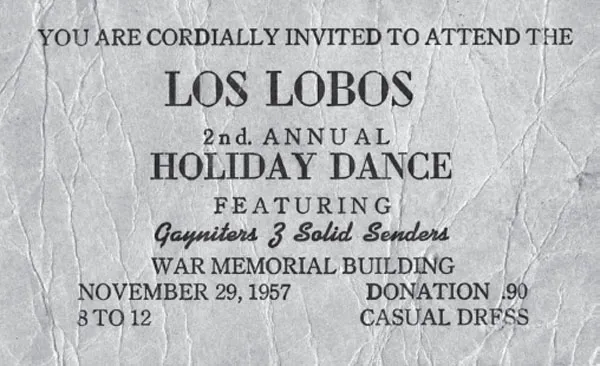
A dance ticket sponsored by Los Lobos Jacket Club. Courtesy of Gilbert Reyes.
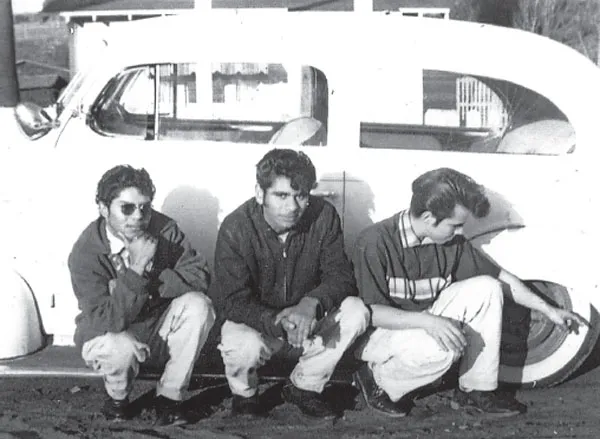
In 1954, (left to right) Joe Ortega, David Ayala and Raymond Herrera of Los Lobos Jacket Club pose in front of a 1937–38 Chevy. Courtesy of Gilbert Reyes.
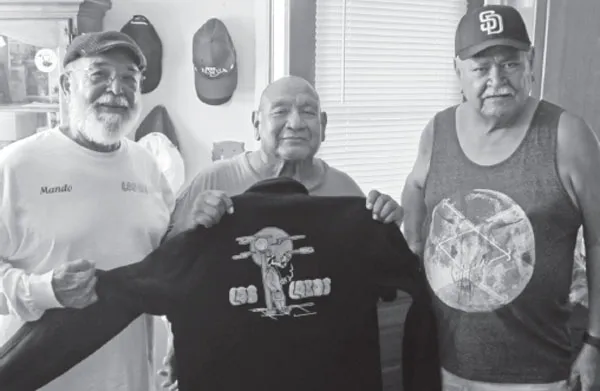
Lobos Jacket Club members (left to right) Roumaldo “Mando” Romero, Gilbert Reyes and Chayo Colmenero pose with the original Los Lobos fingertip jacket. Courtesy of Alberto Pulido.
The jacket clubs are critical for lowrider history because they were how the emerging lowrider scene and aesthetic began to proliferate. The style and type of vehicles that were designed during this era were similar to those customized by car enthusiasts such as Mathias Ponce. In fact, some of Los Lobos friends and members who owned vehicles remember they acquired their first car from Mathias. As Louie Ayala recalled, “Mathias was the guy with the ’39 Chevy coupes.” Dress and fashion, in particular the jackets adorned by members of these social clubs, became the pattern adopted and worn by the lowrider car clubs up to the present day. The type and style of jacket, along with the lettering on both the front and back of the jacket, have become a signature lowrider trait. With the importance of style and representation, looking sharp and taking great pride in one’s appearance was of great importance to Los Lobos. As Gilbert Reyes, a cofounder of Los Lobos Jacket Club, looked around and saw that all the other clubs had what are known as stadium jackets, with the ribbed collar and waist, he sought to do something very different. The jacket he designed was long and stylish and gave the club members a unique quality. Friends and family were very impressed with the jackets. The founding members of Los Lobos were Gilbert Reyes, Phillip Usquiano, Rudy Gomez, Louie Boreno, David Fuentes and Robert Delgado, who began the club in 1953 as students at Memorial Junior High in someone’s garage. By 1954, Los Lobos had moved to the neighborhood house, where they remained throughout their history.
LOS VILLANOS OF SAN YSIDRO
Guided and inspired by his father, Gilbert Ochoa learned a great deal about car customizing in his father’s garage, supplied with plenty of tools and cutting torches. He became very popular with his friends in the small community of San Ysidro on the U.S.-Mexico border, about fourteen miles south of Logan Heights in the area popularly known as south San Diego or the South Bay. By sharing tools and becoming skilled with his father’s cutting torch, Ochoa and several of his friends began to gather and hang out in his father’s garage in the late 1950s. By 1958, they had become known as Los Villanos of San Ysidro, California. Members included Harvey Acosta, Armando Garcia, Art Palacios, Frank Parra, Rafael Armas, Robert Montoya, Phil Reyes and Gilbert Ochoa. They represented one of the first documented custom car clubs in the South Bay region. The lowering method used by this Mexican car club w...
Table of contents
- Front Cover
- Half Title
- Title Page
- Copyright
- Dedication
- Contents
- Acknowledgements
- Introduction. Overview and Characteristics of the Lowrider Movement
- 1. Las Raíces: The Early Roots of Lowriding in San Diego, 1950–68
- 2. Clicas: Foundational Lowrider Car Clubs, 1969–71
- 3. The Affirming of Lowrider Identity in San Diego and Tijuana, 1972–74
- 4. The Old and the New: Car-Hopping, Blessings and the Legacy of Lowriding, 1975–77
- 5. Made in the USA and Women Lowrider Car Clubs, 1978–79
- 6. From the Streets to the Car Show: The End of the Foundational Lowrider Era, 1980–85
- Conclusion. The Future of Lowriding: Taking to the Streets in a Global World
- Glossary
- Bibliography
- About the Authors
Trusted by 375,005 students
Access to over 1.5 million titles for a fair monthly price.
Study more efficiently using our study tools.
Frequently asked questions
Yes, you can cancel anytime from the Subscription tab in your account settings on the Perlego website. Your subscription will stay active until the end of your current billing period. Learn how to cancel your subscription
No, books cannot be downloaded as external files, such as PDFs, for use outside of Perlego. However, you can download books within the Perlego app for offline reading on mobile or tablet. Learn how to download books offline
Perlego offers two plans: Essential and Complete
- Essential is ideal for learners and professionals who enjoy exploring a wide range of subjects. Access the Essential Library with 800,000+ trusted titles and best-sellers across business, personal growth, and the humanities. Includes unlimited reading time and Standard Read Aloud voice.
- Complete: Perfect for advanced learners and researchers needing full, unrestricted access. Unlock 1.5M+ books across hundreds of subjects, including academic and specialized titles. The Complete Plan also includes advanced features like Premium Read Aloud and Research Assistant.
We are an online textbook subscription service, where you can get access to an entire online library for less than the price of a single book per month. With over 1.5 million books across 990+ topics, we’ve got you covered! Learn about our mission
Look out for the read-aloud symbol on your next book to see if you can listen to it. The read-aloud tool reads text aloud for you, highlighting the text as it is being read. You can pause it, speed it up and slow it down. Learn more about Read Aloud
Yes! You can use the Perlego app on both iOS and Android devices to read anytime, anywhere — even offline. Perfect for commutes or when you’re on the go.
Please note we cannot support devices running on iOS 13 and Android 7 or earlier. Learn more about using the app
Please note we cannot support devices running on iOS 13 and Android 7 or earlier. Learn more about using the app
Yes, you can access San Diego Lowriders by Alberto López Pulido & Rigoberto "Rigo" Reyes in PDF and/or ePUB format, as well as other popular books in History & North American History. We have over 1.5 million books available in our catalogue for you to explore.