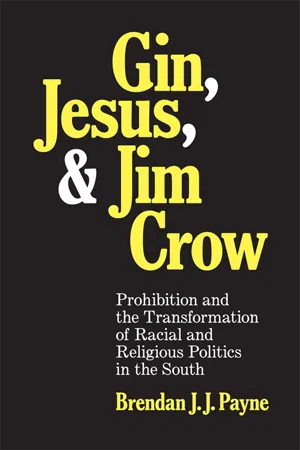
In Gin, Jesus, and Jim Crow, Brendan J. J. Payne reveals how prohibition helped realign the racial and religious order in the South by linking restrictions on alcohol with political preaching and the disfranchisement of Black voters. While both sides invoked Christianity, prohibitionists redefined churches' doctrines, practices, and political engagement. White prohibitionists initially courted Black voters in the 1880s but soon dismissed them as hopelessly wet and sought to disfranchise them, stoking fears of drunken Black men defiling white women in their efforts to reframe alcohol restriction as a means of racial control. Later, as the alcohol industry grew desperate, it turned to Black voters, many of whom joined the brewers to preserve their voting rights and maintain personal liberties. Tracking southern debates about alcohol from the 1880s through the 1930s, Payne shows that prohibition only retreated from the region once the racial and religious order it helped enshrine had been secured.
eBook - ePub
Gin, Jesus, and Jim Crow
Prohibition and the Transformation of Racial and Religious Politics in the South
- 304 pages
- English
- ePUB (mobile friendly)
- Available on iOS & Android
eBook - ePub
Gin, Jesus, and Jim Crow
Prohibition and the Transformation of Racial and Religious Politics in the South
About this book
Information
Subtopic
African American HistoryIndex
HistoryII
Gin Crow
PROHIBITION IN THE JIM CROW SOUTH
AS BOURBON RULE FELL in the early twentieth-century South, so did the old wet consensus to a new dry order that might justly be called “Gin Crow.” Chronologically, statewide prohibition existed in the US South only during Jim Crow. More importantly, though, southern white drys endorsed Jim Crow laws in the 1890s in part because they believed it was the only reliable path to prohibition’s success. The attempted interracial prohibition coalitions in the 1880s failed, leading white drys to blame Black voters for their failures. White drys increasingly sought to advance white supremacy through the punitive legal measures of Jim Crow, particularly voter suppression. Concern with suppressing Black votes permeated the publications of white drys. Many whites worried aloud that the prohibition issue could divide the white vote and so give a decisive role to African American voters in elections.
Because of the hardening of racial views among most white drys, African American participation in local and statewide prohibition elections during the early Jim Crow period was effectively a form of resistance to Jim Crow. White supremacists had effectively used Jim Crow laws to disfranchise the majority of African Americans by the first decade of the twentieth century, and white Democrats exercised a stranglehold on statewide offices and state legislatures throughout the region. Black men found in the wet movement at least one issue on which to ally with a powerful, white-dominated industry—brewers and distillers—to wield real political influence and protect Black suffrage. Even white supremacists in the wet coalition unwittingly helped to prop up interracial politics by protecting the alcohol lobby, which fought more to mobilize Black voters and to subvert Jim Crow poll taxes than any other white industry at the time. To oppose Gin Crow (southern prohibition) was to oppose Jim Crow, and that opposition was stronger and went longer than scholars have previously thought possible. Still, Black turnout eventually succumbed to voter-suppression tactics, dooming the region to Gin Crow.
Once statewide and national prohibition took effect, not only did law enforcement disproportionately target Black Americans for violations of dry laws, but white Protestant attacks against traditionally wet Catholics increased, particularly in the presidential election of 1928. The “Solid South” broke, with half of the formerly Confederate states joining with the GOP. The Democratic Party in the South had switched from “Rebels, Rum, and Romanism” to rebels against rum and Romanism.
While Black men lost suffrage, white women gained it. The Eighteenth and Nineteenth Amendments, for prohibition and women’s suffrage, had gone hand in hand, and many dry men granted women the vote mostly because they hoped women would never permit alcohol’s return by the ballot box. However, the failure of prohibition to bring a promised utopia, particularly during the Great Depression, prompted respectable women to organize against prohibition. From the first woman elected governor, Texan Miriam “Ma” Ferguson, to the Alabama organizer Pattie Ruffner Jacobs, southern women played leading roles in challenging assumptions that white women would always embrace prohibition.
Unlike the contests over prohibition’s enactment, repeal in the South came with little discussion of race and virtually no major Black involvement. Even the Republican Party in the South, once a staunch defender of Black rights, had turned from a multiracial “black-and-tan” coalition to a lily-white institution. Gin Crow finally fell in part because it was no longer needed: Jim Crow laws had effectively disfranchised African Americans and imposed white supremacy. Before then, however, white drys had indelibly linked prohibition in the South with Jim Crow.
3
Gin Crow Begins
WHITE DRYS AND JIM CROW
ON MARCH 27, 1908, James Thomas “Cotton Tom” Heflin shot a Black man who had just drunk alcohol in front of a white woman. The day before, Heflin, who represented Alabama in the US House, had introduced a bill to extend Jim Crow segregation to the District of Columbia’s streetcars. Just before the shooting, Heflin was on a streetcar in the nation’s capital on his way to give a lecture at a Methodist church on “Temperance”—which in that context meant prohibition—when two Black men boarded the car. One of those men, Louis (or Lewis) Lundy, produced a flask, at which point Heflin berated him for drinking in front of a white lady. Lundy “replied that he’d take a drink if he felt like it.” Everyone left the car at the next stop except Heflin, the unnamed white woman, Lundy, and an unnamed Black man. When Lundy rose to take a drink, Heflin engaged him, and Lundy grabbed him by the lapel. Heflin drew a pistol, hit Lundy on the head with the butt, shoved and kicked Lundy off the car, and fired two shots at him. One of the shots hit Lundy in the neck, and another ricocheted into a white bystander, Thomas McCreary.1 While Heflin was briefly arrested, he was soon bailed out and charges against him were soon dropped.
In one sense, this behavior fit with Heflin’s lifelong advocacy of white supremacism. As a delegate to the convention for the 1901 Alabama Constitution, Heflin successfully pushed for measures to disfranchise Black voters, stating: “God Almighty intended the negro to be the servant of the white man.”2 While serving as secretary of state for Alabama in 1903, he publicly supported white men who had Black men fraudulently arrested and then forced them to perform slave labor through convict leasing, arguing that such efforts helped maintain white supremacy. As he represented his state in the US House from 1904 to 1920, he routinely spouted racist vitriol.3
More broadly, Heflin’s vigilante action weaves together southern prohibition and Jim Crow in several ways. First, the incident highlights how prominent white southern drys used their power to promote white supremacism and Jim Crow laws, such as the streetcar law Heflin had introduced the day before the shooting. While Heflin, like many other “states’ rights” southerners, later opposed federal prohibition, speaking on “Temperance” at a Methodist church implied his dry stance at the local and state levels. Other prominent white drys across the South likewise linked prohibition to white supremacism. Tennessee’s prohibition “martyr” Edward Ward Carmack, Alabama’s “Father of American Prohibition” Richmond Pearson Hobson, and Virginia’s Southern Methodist Bishop James Cannon also numbered among white drys who advocated both prohibition and strict racial hierarchy.
Second, the shooting suggested how fears connecting racial disorder and gender, which inspired Jim Crow laws, also helped the cause of prohibition. Heflin attributed the incident to a Black man drinking alcohol in the same streetcar as a white woman, an allusion to fears of drunk Black men assaulting white women and to Black criminality generally. White drys had openly argued that legal segregation and banning alcohol would keep Black men docile and so protect the virtue of white women, thus preventing the need for lynchings. The notion of protecting white women’s honor from inebriated Black men was a key component of prohibition advocacy in the South.
The shooting also reflected how white churches supported the values of Jim Crow and prohibition. While Heflin did not explicitly connect his white-supremacist violence to his faith, he was a white Christian on his way to a Methodist church to lecture on temperance when it happened. Instead of leading him to turn the other cheek or at least stay his hand, Heflin’s convictions whipped him into a nearly lethal rage at the sight of a Black man who violated his racial, gender, and alcohol taboos. While it might be tempting for believers to claim Heflin’s behavior was out of step with “true” Christian faith, religious and racial convictions are strands of a contingent and experiential fabric and are demonstrated by their fruits. Far more important than what Heflin himself did is how white Christians around the South responded. The lack of a serious rebuke from his peers indicated their tacit consent—if not nodding approval—for his near-murder of a Black man who had the temerity to sip alcohol in front of a white woman on a streetcar. White churches in the South and around the nation thus showed more support for a white champion of Jim Crow and prohibition than the Black man he nearly shot to death.
Support for Heflin was not limited to churches. Regardless of party or home region, Heflin’s white colleagues in the US House heaped praise and sympathy on him. Southern white members excused his “impetuous temperament” and “his views on the race question.” Within minutes of Heflin’s arrest, offers to pay his $5,000 bond came from House members representing parts of Georgia, Louisiana, Mississippi, North and South Carolina, Tennessee, Texas, and most of the Alabama districts.4 Other Democrats offering to pay Heflin’s bail came from beyond the former Confederacy, including Charles Ferris Booher of Missouri and John Geiser McHenry of Pennsylvania. Sympathy for Heflin and regret for the incident came “from all quarters,” including the Republican Speaker of the House, Joseph Gurney Cannon of Illinois.5 Even the white man Heflin accidentally shot shared his white supremacism. When an ambulance took Lundy, the also-wounded McCreary ordered a separate carriage, since he refused to ride with a Black man to the hospital.6 McCreary also dropped charges when Heflin offered to pay his hospital bills.7 Whites regardless of party or region saw little need to punish Heflin for nearly killing a Black man who defied the racial order.
The ties between prohibition and Jim Crow were not limited to extraordinary incidents like this but extended to changing laws around the South. On New Year’s Day, 1908, the first statewide prohibition law in the South went into effect. Georgia’s state legislature voted overwhelmingly for the measure in July 1907. The Georgia House voted 139 to 39 in favor on July 30; then the Senate approved the amended bill 34 to 7, and the governor promptly signed it.8 It seemed fitting that the state whose capital, Atlanta, was the first major city in the South to opt for prohibition in 1885 would also be the first southern state to go dry.
As far as Black voters were concerned, however, the 1885 and 1907 measures could not have been more different. While white drys and white wets competed for African American votes in the 1880s, Jim Crow laws in the 1890s and 1900s had marginalized Black voters in nearly all major political contests. Prohibitionist whites were particularly insistent on suppressing Black votes, which they blamed for their failures in decades past. As statewide prohibition laws spread throughout the South in the 1900s and 1910s, the dry movement became increasingly white and ever more entwined with Jim Crow. This sharp turn to Jim Crow—and prohibitionist “Gin Crow”—in the South can best be properly understood by way of a brief detour into the greatest interracial political movement across the region between the 1870s and the 1960s: populism. While not directly bearing on prohibition, populism reveals how interracial politics rose, nearly triumphed, and crashed dramatically, providing the immediate context for the white-supremacist alliance between drys and advocates of Jim Crow.
Political Prelude: Populists
After the failure of interracial cooperation in the prohibition contests of the 1880s, the next major effort at multiracial political coalitions in the South was the Populist Party or People’s Party. According to Gerald H. Gaither, historians have generally fallen into three schools of thought on how Black men interacted with the populist movement. The progressive school of the 1920s and 1930s treated Black voters as tools of whites, more inclined to sell their votes than engage in the political process to achieve their own interests. The consensus school of the 1950s, however, emphasized the class solidarity of Black and white farmers and optimistically posited that interracial politics could have succeeded if events had only gone differently. A more pessimistic recent school since the 1990s has emphasized institutional racism over class and concluded that interracial politics between relatively marginalized Blacks and relatively more secure whites was doomed to failure. While surveying these three perspectives, Gaither argues that southern populism is “a many-faceted crystal that does not fit easily into ...
Table of contents
- Cover
- Title Page
- Copyright Page
- Dedication
- Contents
- Preface
- Acknowledgments
- Introduction
- I. Bourbon Rule: The South before Prohibition
- II. Gin Crow: Prohibition in the Jim Crow South
- Epilogue
- Notes
- Bibliography
- Index
- Illustrations
Trusted by 375,005 students
Access to over 1.5 million titles for a fair monthly price.
Study more efficiently using our study tools.
Frequently asked questions
Yes, you can cancel anytime from the Subscription tab in your account settings on the Perlego website. Your subscription will stay active until the end of your current billing period. Learn how to cancel your subscription
No, books cannot be downloaded as external files, such as PDFs, for use outside of Perlego. However, you can download books within the Perlego app for offline reading on mobile or tablet. Learn how to download books offline
Perlego offers two plans: Essential and Complete
- Essential is ideal for learners and professionals who enjoy exploring a wide range of subjects. Access the Essential Library with 800,000+ trusted titles and best-sellers across business, personal growth, and the humanities. Includes unlimited reading time and Standard Read Aloud voice.
- Complete: Perfect for advanced learners and researchers needing full, unrestricted access. Unlock 1.5M+ books across hundreds of subjects, including academic and specialized titles. The Complete Plan also includes advanced features like Premium Read Aloud and Research Assistant.
We are an online textbook subscription service, where you can get access to an entire online library for less than the price of a single book per month. With over 1.5 million books across 990+ topics, we’ve got you covered! Learn about our mission
Look out for the read-aloud symbol on your next book to see if you can listen to it. The read-aloud tool reads text aloud for you, highlighting the text as it is being read. You can pause it, speed it up and slow it down. Learn more about Read Aloud
Yes! You can use the Perlego app on both iOS and Android devices to read anytime, anywhere — even offline. Perfect for commutes or when you’re on the go.
Please note we cannot support devices running on iOS 13 and Android 7 or earlier. Learn more about using the app
Please note we cannot support devices running on iOS 13 and Android 7 or earlier. Learn more about using the app
Yes, you can access Gin, Jesus, and Jim Crow by Brendan J. J. Payne in PDF and/or ePUB format, as well as other popular books in History & African American History. We have over 1.5 million books available in our catalogue for you to explore.