As the Vietnam War divided the nation, a network of antiwar coffeehouses appeared in the towns and cities outside American military bases. Owned and operated by civilian activists, GI coffeehouses served as off-base refuges for the growing number of active-duty soldiers resisting the war. In the first history of this network, David L. Parsons shows how antiwar GIs and civilians united to battle local authorities, vigilante groups, and the military establishment itself by building a dynamic peace movement within the armed forces.
Peopled with lively characters and set in the tense environs of base towns around the country, this book complicates the often misunderstood relationship between the civilian antiwar movement, U.S. soldiers, and military officials during the Vietnam era. Using a broad set of primary and secondary sources, Parsons shows us a critical moment in the history of the Vietnam-era antiwar movement, when a chain of counterculture coffeehouses brought the war’s turbulent politics directly to the American military’s doorstep.
eBook - ePub
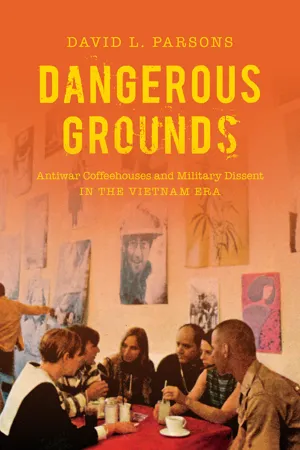
Dangerous Grounds
Antiwar Coffeehouses and Military Dissent in the Vietnam Era
- 176 pages
- English
- ePUB (mobile friendly)
- Available on iOS & Android
eBook - ePub
About this book
Information
1: Setting Up Shop
Coffeehouses Land in America’s Army Towns
It’s unprecedented in American history that we have a movement within the military that is opposing a war which the United States government is waging. That’s unprecedented. And it seems to me that the Army and Navy and the Marines have something to do with power; and there is the possibility that the peace movement can have that power on their side. Therefore, the peace movement ought to be supporting the GI movement.
Dr. Howard Levy, Los Angeles Free Press, May 1970
FRED GARDNER’S COFFEEHOUSE CONCEPT
In the summer of 1963, Fred Gardner’s path seemed set. He had just graduated from Harvard, where he had been a star undergraduate reporter and editor at the Harvard Crimson, writing articles on arts, culture, and politics during the height of the Kennedy years. Among the newspaper’s young staff, rumor had it that the Kennedy administration regularly read only three newspapers: the New York Times, the Washington Post, and the Harvard Crimson. Gardner later recalled, “For a brief time, I felt like I had a pipeline directly to the White House.”1 After graduation, he immediately landed a job as an editor at Scientific American. As he strode into the magazine’s slick Madison Avenue offices that summer, he imagined himself at the beginning of a promising career as a New York City writer.
Despite these personal achievements, Gardner was troubled by the headlines throughout the year, concerned that America’s involvement in South Vietnam might lead to a wider war. He was especially worried that he hadn’t yet fulfilled his obligation for military service. Since he was no longer enrolled in college, being drafted was suddenly a real possibility. In an effort to minimize the disruption to his life and career, as well as to avoid being shipped overseas, in November 1963 Gardner enlisted as an army reservist. He spent the next six months training at Fort Polk in Leesville, Louisiana, before returning to his writing career. Just as he had hoped, by the summer of 1964 he had gotten his military service “out of the way” and moved on with his life. Over the next few years, he got married, had children, and watched with mounting horror as the Vietnam War spun out of control. “The war drove me completely crazy,” he later explained.2 In 1967 his marriage disintegrated.
After his divorce, at twenty-five years old, Gardner moved to San Francisco for a fresh start. He found himself drawn to the city that stood at the center of a burgeoning cultural and political revolution and eager to become more involved in the growing movement against the war. He was particularly interested in the radical political potential of American soldiers and was frustrated that major New Left organizations did not pay them more attention. By ignoring American soldiers, Gardner thought, the Left was missing an opportunity to connect with a massive number of disaffected young men, particularly in the U.S. Army, where the majority of draftees were serving. He imagined an army of young soldiers who were not particularly excited about serving in the Vietnam-era armed forces: “By 1967 the Army was filling up with people who would rather be making love to the music of Jimi Hendrix than war to the lies of Lyndon Johnson. People were serving because they’d been drafted. Or they ‘volunteered’ because they’d gotten in trouble with the law, or been told they needed an honorable discharge in order to get a job. Almost everybody went in ambivalent about whether the war was worth it—the risk, the interruption to their lives.”3 If you want to stop the war, Gardner thought, one way might be to reach out to those soldiers, to help build an antiwar movement within the army.
Gardner had reason to hope for an uprising among the ranks. As the war in Vietnam escalated in 1965 and 1966, instances of rebellion, insubordination, and other forms of antiwar resistance were on the rise. By 1967, at army posts across the country, individual and group demonstrations were drawing national attention and became known as the GI movement. These acts of resistance took infinite forms throughout the war’s duration, ultimately creating a significant crisis for military and government officials.4 Vietnam veterans were also increasingly speaking out against the war. On April 15, 1967, a group of six veterans participated in the Spring Mobilization, a massive New York City peace demonstration, marching behind a handmade placard carrying a simple, searing slogan: “Vietnam Veterans Against the War.” After the march, other veterans joined the original group and formed an official organization bearing the same attention-grabbing name.5 By the following summer, Vietnam Veterans Against the War chapters were springing up around the country. This organization, along with other instances of GI resistance, captured the imagination of civilian antiwar activists like Fred Gardner, who saw great power in an alliance of soldiers and civilians. The energy and authority that soldiers and veterans were bringing to the antiwar movement was undeniably compelling. But could civilians find a way to help harness that energy?
In Gardner’s mind, one key to bridging the gap between the organized Left and American GIs lay in the rise of youth counterculture. In San Francisco, he spent much of his time hanging out at the various counterculture establishments that then lined the streets of the city’s North Beach neighborhood, an area teeming with revolutionary cultural and political energy. He drew particular inspiration from the radical coffeehouses that offered something more than the requisite folk music and cappuccinos—the places that had tables full of radical literature, that often hosted political speeches and meetings, and that served as de facto bases of operation for a range of local political organizations. Using the common language of sex, drugs, and rock and roll, these coffeehouses were attempting to build a real countercultural politics.
As Gardner sat in these North Beach coffeehouses throughout the summer of 1967, an idea struck him. He recalled his service at Fort Polk in Leesville, Louisiana, a few years earlier. While spending his off time in dingy dive bars and pool halls, he lamented that there were no local hangouts that reflected the vibrant youth culture embraced by so many soldiers of the era. In 1960s Leesville (which many soldiers referred to as “Diseaseville”), “the only places to hang out . . . were seedy, segregated bars serving watered-down drinks for a dollar a shot, a rip-off.”6 Gardner thought the same was probably true of most army towns around the country. He was sure that a great number of GIs would appreciate a hip place to spend time near their post and wagered that a significant portion of those soldiers might also be opposed to the Vietnam War. As he saw it, a hip antiwar coffeehouse, designed for GIs, might be an effective way of starting conversations between antiwar soldiers and civilians. At the very least, he reasoned, it would provide GIs with a comfortable environment to spend time off-post. In late 1967, he resolved to open such a coffeehouse outside one of the most active army training posts in the country.
Fort Jackson, located outside Columbia, South Carolina, was the site of some of the most significant and visible events of the growing GI movement. One of the U.S. Army’s largest training posts, Fort Jackson was home to a great number of the military’s youngest recruits. During the Vietnam War, the post had a transient population of roughly 20,000 young men, the majority of whom were either recent draftees or “draft-motivated volunteers” who had joined the army under some duress.7 As the war became more unpopular, particularly among young people like the thousands stationed at Fort Jackson, the post experienced a sharp increase in cases of dissent and insubordination.
In 1967, the post made national headlines with the trial of Howard Levy, an army doctor who refused his assignment to provide medical training for Special Forces troops headed to Vietnam.8 Dr. Levy was convicted of disobedience and making disloyal statements about U.S. policy in Vietnam. He was dishonorably discharged and incarcerated in military prison for three years. In antiwar circles, Levy was widely admired for his principled stand against the war.9 Fred Gardner was one such admirer. As he sat in his San Francisco apartment clipping newspaper articles about Levy’s trial, he became convinced that Columbia, South Carolina, would be a perfect site for the first GI coffeehouse.10
In the mid-1960s, Columbia was regarded as one of the most military-friendly cities in the country. Over the course of several decades, the presence of military camps and other installations had come to be seen as critical to Columbia’s economic health, and the city itself became much more directly concerned with fostering a pro-military culture to encourage further military development in the area.11 “Camp Jackson,” as it was first called, had been established in 1917 as the First World War demanded a dramatic expansion of troop levels and training posts. After the war, however, the population of military personnel who had turned Columbia into a bustling military town (with an attendant explosion of local businesses catering to military needs) declined rapidly, and city leaders began to actively lobby the federal government for a more permanent military presence in Columbia. As World War II accelerated, Fort Jackson was finally converted into a permanent army installation, and in 1968 local officials successfully persuaded the Pentagon to officially annex Fort Jackson into the city proper. It was during the height of the Vietnam War, then, that Columbia’s leaders explicitly worked to reinforce the city’s total alignment with military goals and values; in both an operational and ideological sense, Columbia and Fort Jackson became a single entity.12
A permanent military presence provided the Columbia community with a stable and prosperous economy. Local businesses were booming through the 1940s and 1950s, when hundreds of thousands of military men and women moved to the area, creating a ready-made consumer base. At midcentury, “soldiers, civilians, wives, and sweethearts (real, potential, and alleged) poured into the Midlands. Rents soared, restaurants and beer joints boomed, and, for all practical purposes, the Great Depression became a distant memory.”13 While there was some controversy among city leaders about the influx of bars, nightclubs, and pool halls bringing a certain brand of moral decline to the area (prostitution increased exponentially, for example), for the most part Columbia’s business and political community embraced the city’s conversion to one of the nation’s largest military towns.
Most military-oriented towns, Columbia included, invariably featured downtown districts lined with small businesses offering cheap thrills to lonely and homesick GIs. To Gardner, these places created a “violent, venal atmosphere . . . ringed by strips of bars, whorehouses, jewelry emporiums, and pawnshops,” making for a complacent, demoralized group of soldiers.14 Of course, Gardner had more in mind than just cultural alternatives: he thought that a counterculture coffeehouse, staffed by young civilian radicals, could provide a gateway to a more concentrated antiwar activism on the part of soldiers themselves: “I figured that people working at the coffeehouses, just by listening to GIs’ gripes, taking them seriously and maybe distributing them in leaflet form, would help soldiers see that their problems weren’t ‘merely’ personal but widespread and historical. In time, there would develop a network of organizers in the towns and in the Army itself whom soldiers would consider politically trustworthy—because they had a record of telling the truth about conditions.”15
Reluctant to proselytize directly to active-duty soldiers, Gardner envisioned the role of coffeehouse staff as essentially supporting and nurturing antiwar sentiment among GIs, offering them a safe environment and organizational skills to foster the development of their own political activities. Gardner felt that GIs were under enough pressure as it was and would be unlikely to appreciate a hard sales pitch from an overeager activist. Civilian staff should thus take the lead from GIs, rather than vice versa. The coffeehouses would serve mainly as support institutions for empowering disaffected soldiers to channel their energy into political action.16
Gardner spent the summer of 1967 sharing his coffeehouse idea with just about anyone who would listen. He found a business partner, a friend named Donna Mickleson, and the two pitched the idea to a few of the more prominent countercultural figures around the Bay Area. One early supporter was Alan Myerson, owner and operator of the Committee, a left-wing improv troupe made up of actors from Second City in Chicago. The Committee’s cabaret theater in North Beach had become a center for all kinds of radical performances since opening in an abandoned indoor bocce ball court in 1963. In addition to offering business advice, Myerson shared Gardner’s coffeehouse idea with local concert promoter Bill Graham, owner of the Fillmore Theater, who donated dozens of rock and roll posters from his infamous San Francisco venue in support of the project.17 After failing to convince anyone to take on the responsibility of funding and operating the first GI coffeehouse, Gardner and Mickleson finally decided to open it themselves. Leaving San Francisco and driving to Columbia in the fall of 1967, they thought about the uneasy task that lay before them: to open an explicitly antiwar coffeehouse outside one of the army’s most active training centers.
“A SORE SPOT IN OUR CRAW”: THE UFO LANDS IN COLUMBIA
Gardner and Mickleson arrived in Columbia in September 1967, aware that they were entering hostile territory. Gardner hid his intentions of turning their rental house into a crash pad for “soldiers and organizers, smoking grass and listening to Sgt. Pepper’s Lonely Hearts Club Band,” by fabricating a cover story that he and Mickleson were a married couple whose children would be arriving soon.18 The pair then went in search of a venue for their coffeehouse, eventually renting a space at 1732 Main Street, in the center of downtown Columbia. They immediately went to work transforming what had been a tropical-themed “Hawaiian” bar into a counterculture coffeehouse, replacing tiki torches and plastic flamingos with photos of Bob Dylan and Janis Joplin, along with the Bill Graham–donated rock posters.
Mickleson hung a psychedelic hand-painted sign reading “UFO” on the outside of the building, officially opening the coffeehouse for business in January 1968. From a cultural standpoint, the owners made no effort to conceal their hip, sardonic orientation, with the aforementioned posters including one of a cannabis plant and another of President Lyndon Johnson awkwardly holding his pet beagle by its ears.19 The interior of the UFO was “modestly furnished with wooden tables and folding chairs, an area for a band, and displays of reading material featuring alternative newspapers from around the country, such as the Berkeley Barb, The Village Voice (New York), The Great Speckled Bird (Atlanta), and numerous pamphlets, as well as mainstream newspapers and periodicals.”20 The coffeehouse’s location, on Main Street in the heart of downtown Columbia, made it highly visible to the city’s leaders. It was directly across the street from Columbia’s city hall and, perhaps more important, next door to the Elite Epicurean Restaurant, the city’s popular gatherin...
Table of contents
- Cover Page
- Title Page
- Copyright Page
- Dedication
- Contents
- Acknowledgments
- GI Coffeehouse Locations, 1968–1974
- Introduction
- 1: Setting Up Shop
- 2: Getting Together
- 3: Repression, Harassment, Intimidation
- 4: Moving On
- Epilogue
- Notes
- Bibliography
- Index
Trusted by 375,005 students
Access to over 1.5 million titles for a fair monthly price.
Study more efficiently using our study tools.
Frequently asked questions
Yes, you can cancel anytime from the Subscription tab in your account settings on the Perlego website. Your subscription will stay active until the end of your current billing period. Learn how to cancel your subscription
No, books cannot be downloaded as external files, such as PDFs, for use outside of Perlego. However, you can download books within the Perlego app for offline reading on mobile or tablet. Learn how to download books offline
Perlego offers two plans: Essential and Complete
- Essential is ideal for learners and professionals who enjoy exploring a wide range of subjects. Access the Essential Library with 800,000+ trusted titles and best-sellers across business, personal growth, and the humanities. Includes unlimited reading time and Standard Read Aloud voice.
- Complete: Perfect for advanced learners and researchers needing full, unrestricted access. Unlock 1.5M+ books across hundreds of subjects, including academic and specialized titles. The Complete Plan also includes advanced features like Premium Read Aloud and Research Assistant.
We are an online textbook subscription service, where you can get access to an entire online library for less than the price of a single book per month. With over 1.5 million books across 990+ topics, we’ve got you covered! Learn about our mission
Look out for the read-aloud symbol on your next book to see if you can listen to it. The read-aloud tool reads text aloud for you, highlighting the text as it is being read. You can pause it, speed it up and slow it down. Learn more about Read Aloud
Yes! You can use the Perlego app on both iOS and Android devices to read anytime, anywhere — even offline. Perfect for commutes or when you’re on the go.
Please note we cannot support devices running on iOS 13 and Android 7 or earlier. Learn more about using the app
Please note we cannot support devices running on iOS 13 and Android 7 or earlier. Learn more about using the app
Yes, you can access Dangerous Grounds by David L. Parsons in PDF and/or ePUB format, as well as other popular books in History & North American History. We have over 1.5 million books available in our catalogue for you to explore.