- 224 pages
- English
- ePUB (mobile friendly)
- Available on iOS & Android
eBook - ePub
About this book
The Tall Corn State's agricultural history influences countless aspects of modern life. To truly understand Iowa, you have to understand the culture of agriculture--the stories of the people of the land. In many ways, these are untold stories, especially as more generations of families are further removed from living or working on Iowa farms. Visitors from around the globe travel to Iowa annually for major events like the Farm Progress Show, the World Pork Expo and the World Food Prize. Agriculture has shaped Iowa's landscape from the location of towns and the evolution of the world-famous Iowa State Fair to Iowa's beloved culinary traditions like breaded pork tenderloins, sweet corn and more. Join fifth-generation Iowa farmer Darcy Dougherty Maulsby as she details the fascinating history of agriculture in Iowa.
Information
Chapter 1
LANDSCAPES THAT SHAPE US
The story of Iowa agriculture begins with the soil. It’s one of the most basic resources on which all life depends, it’s right beneath our feet and it’s one of the most valuable resources we have. Soil is also a silent witness to Iowa’s dramatic natural history, influenced through ancient times by shallow seas, violent explosions and huge glaciers. These powerful forces shaped what has become one of the most productive agricultural regions on Earth, yet clues to this land before time endure, recorded in rocks and fossils.
Modern Iowans, both rural and urban, don’t have to look far to discover the legacy of Iowa’s distant past, which is intertwined with modern life and modern agriculture. In 2017, visitors to the University of Iowa’s Mobile Museum got a glimpse of Iowa history that might look like something from a horror movie—a six-foot giant sea scorpion that called Iowa home hundreds of millions of years ago.
Iowa Geological Survey research specialist Paul Liu and his team discovered that a meteorite struck Earth 465 million years ago in the area that is now Decorah in northeast Iowa. In the resulting crater, researchers found an astonishing collection of exceptionally well-preserved fossils. The site represents one of only a few such lagerstätten (the scientific term for a fossil deposit of this magnitude) from the Middle Ordovician period, a geologic measure of time when a rich variety of marine life flourished in the vast seas and the first primitive plants began to appear on land.
At that time, a shallow saltwater sea covered much of what is now Iowa and the Midwest. The area around Decorah was near the coast, where the water was less salty. Distinctive organisms evolved to exist in the special conditions there. When the meteorite struck Earth, the water near the crater’s seafloor became very still, brackish (slightly salty) and low in oxygen. Organisms in the water died and fell to the seabed, where they were preserved and laid undisturbed until Liu and his colleagues found them. “This opens a new window to tell us what Ordovician life was like,” Liu said.
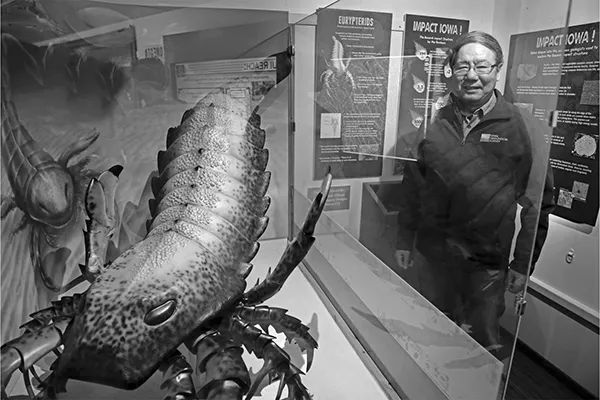
Iowa’s fossil record reveals that this six-foot sea scorpion lived in the Decorah area millions of years ago, noted Paul Liu, Iowa Geological Survey researcher. Courtesy Iowa Geological Survey/University of Iowa.
One of the most dramatic finds was the sea scorpion, the earliest and largest such animal of that period, with a long head shield, a narrow curving body and huge, claw-like limbs that could easily trap the creature’s unfortunate prey. The sea scorpion’s modern relatives include spiders, lobsters and ticks. Imagine a six-foot tick!
FOSSILS PRESERVE IOWA’S ANCIENT HISTORY
As those ancient sea creatures died, their bodies became part of the landscape that would become Iowa. Some became fossils in places like the Devonian Fossil Gorge, which has become a tourist attraction in Iowa City.
This gorge was created by the massive floods of 1993 and was expanded by the flood of 2008, when water topped the emergency spillway. The overflow washed away tons of soil, huge trees and part of the road. When the waters receded, the 375-million-year-old fossilized Devonian ocean floor was revealed.
A similar adventure awaits at the Floyd County Fossil & Prairie Park in northern Iowa, where you can descend 375 million years into what once was a shallow Iowa sea filled with squid, coral and fish-like creatures.
Naturalist Barb McKinstry, who was quoted in the May/June 2007 issue of Iowa Outdoors magazine, noted how Iowa’s shallow seas millions of years ago were teeming with life, similar to the subtropical islands below the Gulf of Mexico. The ancient fossils that remain today put people’s place on Earth into context. “We like people to feel a connection between what is here now, and what this land once was,” she said.
GLACIERS’ LEGACY LIVES ON
While shallow seas and massive meteorites affected Iowa, the icy grip of continental glaciers thousands of years ago remains one of the most significant geologic processes to affect Iowa’s agricultural heritage.
Most of the deposits underlying today’s land surface are composed of materials known as drift that were moved here by glaciers. The arrival of these glaciers in the state began more than 2 million years ago, and numerous reappearances are recorded in the deposits they left behind.
Among the most famous landforms in Iowa created during the glacial periods are the Loess Hills, a geologic wonder in western Iowa. The Loess Hills are a product of the Illinoian and Wisconsonian glacial periods, when huge quantities of wind-blown silt, or loess (rhymes with “fuss”), accumulated to heights of more than two hundred feet. Although deposits of loess are found in various locations around the world, nowhere else but the Yellow River Valley in China are those deposits higher than they are in Iowa, according to the Loess Hills National Scenic Byway.
Most of the loess deposits occurred between 18,000 and 150,000 years ago, according to historical markers located near the tiny town of Turin along the Loess Hills Scenic Byway. The silt particles that form the Loess Hills were produced by the grinding movement of glaciers on rock underneath. Glacial meltwater carried silt downriver in the summer. In winter, water flowed slowly, and the silt was deposited on the floodplain. Winds picked up soils that had been ground as fine as flour and formed dunes along the ancient waterway that became today’s Missouri River.
The process repeated itself during the thousands of years the ice age took to end, enlarging the dunes. Because the prevailing winds were from the northwest, the dunes on the Iowa side of the river were higher than those west of the Missouri. Erosion of the loess soil during thousands of years has helped form the unique landscape that exist today.
To the east of the Loess Hills, landscapes of north-central and west-central Iowa still display the actual shapes that resulted directly from glacial action. This region, known as the Des Moines Lobe, runs from the Minnesota border to Des Moines. It includes the part of the state last touched by the huge sheets of frozen water (the Wisconsin glacier) that invaded Iowa twelve to fourteen thousand years ago.
Archaeologists tell us that this massive glacier was five thousand feet tall—about a mile. It pushed its way south across the Des Moines Lobe from northern Iowa to the area where the state capitol stands in Des Moines at about 0.8 mile per year—a blistering-fast pace for a glacier. Once the glacier got to central Iowa, however, warmer temperatures caused it to melt about twelve thousand years ago.
Landforms of the Des Moines Lobe still retain the distinct imprints of recent glacial occupation, according to Landforms of Iowa by Jean C. Prior. As it plowed across the land, pushing rocks and soil with it, the glacier established the present course of the Raccoon River, according to the City of Storm Lake, Iowa. Today, the Iowa portion of the Des Moines Lobe is further outlined by the cities of Clear Lake, Eldora, Carroll, Storm Lake and West Okoboji.
Nearly all of Iowa’s natural lakes occur on the Des Moines Lobe. Also, Storm Lake, Lake Okoboji, Spirit Lake, Clear Lake and numerous smaller ponds, sloughs and bogs are characteristic of postglacial landscapes and their sluggish, inefficient drainage networks. When the first settlers came to this part of Iowa, it was said they could travel by boat from Rockwell City to west of Pomeroy in Calhoun County without even taking their boat out of the water.
These wetlands were known for attracting great flocks of nesting and migrating waterfowl, as reflected in the names given to the Des Moines Lobe towns of Mallard and Curlew in Palo Alto County and Plover in Pocahontas County.
Although good for wetland habitat, incomplete surface drainage is a serious impediment to agricultural productivity, Prior noted. Many of the region’s native wetlands were drained as agriculture became more important. Glacial erratics, those travel-worn rocks and boulders from regions north of Iowa, are other impediments to agriculture in this area. They generally aren’t an issue in the rolling terrain of southern Iowa.
Farmers who must deal with these rocks typically gather them over the years into piles in the corners of fields and on farmsteads, with some ending up as unique garden décor. Clearing fields of rocks and laying drainage tile lines beneath poorly drained areas have turned the Des Moines Lobe into highly productive farmland, Prior noted.
CULTIVATING A DEEPER UNDERSTANDING OF IOWA’S SOILS
All these factors help explain why Iowa has some of the richest, most productive soil in the world. Most soils in Iowa formed ten to fourteen thousand years ago, after the last glacier in the region melted. Those soils supported the prairies that covered much of Iowa in centuries past. “Understanding the geology of Iowa is important so we can better manage the soils we have today,” said Dr. Lee Burras, a professor of agronomy at Iowa State University (ISU) who taught the short course “The Soils of Iowa” during the 2018 Practical Farmers of Iowa’s annual meeting in Ames.
Any good farmer knows there’s a big distinction between soil and dirt. Soil is one of the most diverse habitats and complex ecosystems on the planet. It’s a precious, magnificent resource that holds the secrets to sustainable farming.
Iowa’s fertile, black, prairie-derived soils are referred to as mollisols, and they make up more than two-thirds of the state’s land base, Burras said. Midwestern mollisols are among the most productive soils in the world, making Iowa a perfect place to grow crops. “One of the reasons that 90 percent of Iowa is farmed is because we have incredible natural soils,” Burras said.
Soil is a mixture of sand, silt, clay and an array of microorganisms. Loam is rich soil with roughly equal proportions of sand, silt and clay. “To grow crops, you must start with a loam or silt loam,” Burras said. In terms of particle size, sand is the biggest of the three. Silt particles are smaller than flour particles, although the texture of silt feels like flour. Clay particles are the smallest of all and require a microscope to be seen.
Iowa has at least 11,000 different soils and 507 different soil series. “Series” is the local name of soils, such as Clarion, Marshall or Fayette. These series differ based on various soil-forming factors like parent material, time (how long the soil has been forming), climate and biota (the animal and plant life of a particular region, habitat or geological period).
Soil series information stems from soil survey programs that started in the late 1890s in the United States. The first soil survey in Iowa took place in the Dubuque County area, according to ISU Extension. Field work was completed in 1902, and the report was published in 1903.
Beginning in the mid-1960s, Iowa launched an accelerated effort to map soil in all counties in a short time. The agencies involved included the USDA Soil Conservation Service (now the USDA Natural Resources Conservation Service), Iowa Department of Soil Conservation (now Division of Soil Conservation in the Iowa Department of Agriculture and Land Stewardship) and ISU through the Experiment Station and Cooperative Extension Service. Today, all ninety-nine Iowa counties have had multiple soil surveys.
The soil surveys reflect the diverse terrain that has defined Iowa’s landscape, from prairies to wetlands to forests to savannahs (a combination of forest and prairie). Soil series determine what grows well in certain areas. Cattails, for example, grown in Harp and Okoboji soils, while big blue stem grass thrives in Clarion and Nicollet soils.
Iowa soils are also defined by the Corn Suitability Rating (CSR) system, which was developed by Iowa State University in 1971 as a way to measure potential soil productivity based on soil profile, slope characteristics and weather conditions. It is an index ranging from 0 to 100, with CSR values of 100 reflecting the most productive soil.
Advances in soil science necessitated an update of the CSR. In 2015, the Corn Suitability Rating 2 (CSR2) was introduced to provide a current index to the inherent productivity of each kind of soil for row-crop production.
Soil productivity is intertwined with soil health. “Soil is the fundamental resource on which human civilization depends,” said Dr. David Montgomery, a professor of earth and space sciences at the University of Washington who spoke at the 2019 Iowa Water Conference in Ames. “If you study history, there’s a clear connection between degraded soils and impoverished human societies.”
It’s time to change the way you think about the soil, added Montgomery, the author of Growing a Revolution: Bringing Our Soil Back to Life. “How people today treat the land influences how the land will treat future generations.”
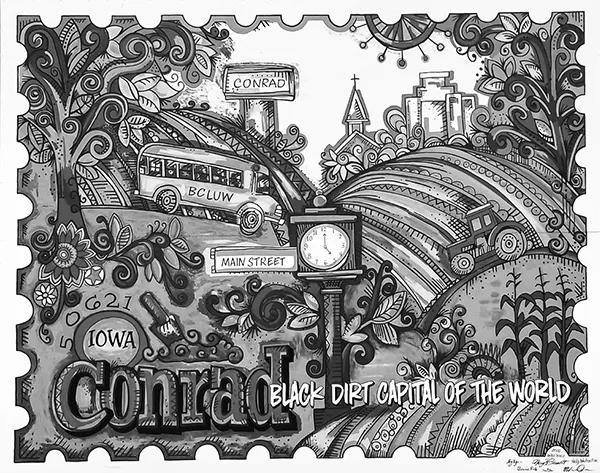
This public artwork near downtown Conrad in Grundy County celebrates the rich black soil that makes the region’s farms so productive. Author’s collection.
Improved knowledge of the complex relationship between soil and plant roots could bring changes to Iowa agriculture in the next fifteen years that are as vast as the difference between the landline phone and the smartphone, Burras said. Soil links Iowa’s past, present and future, he added. “Iowa is a beautiful place with a fascinating history. Once you understand basic geology and its connection to the soil, you can better understand the Iowa we see today.”
Chapter 2
IOWA’S FIRST FARMERS
Just as Iowa’s soils reveal the history of the state’s landscapes, there’s evidence of human activity throughout Iowa long before recorded history. I think about my experience at Whiterock Conservancy near Coon Rapids during an archaeological dig that was open to the public in 2018.
Archaeologist Joe Arts passed around a brown stone you could easily hold in your hand. When he started telling the story behind this sandstone, I was hooked. “We’ve carbon dated a cooking hearth from the area where we found this rock and found that it was about 2,400 years old,” said Arts of Iowa City, explaining that the stone we were passing around was fire-cracked rock, which would have been heated to cook food in a pit.
I was stunned by this insight. I became even more excited that I’d chosen to spend my Saturday assisting a team of archaeologists working along the banks of the Middle Raccoon River near Coon Rapids. About ten of us, including professional archaeologists and rank amateurs like me, gathered on a warm, sunny Saturday morning on September 15 to dig into history, literally, at Whiterock Conservancy. This 5,500-acre, nonprofit land trust along seven miles of the Middle Raccoon River Valley balances sustainable agriculture, natural resource protection and public recreation on the landscape.
Whiterock Conservancy began inviting archaeologists to conduct research in the conservanc...
Table of contents
- Front Cover
- Half Page
- Title Page
- Copyright
- Contents
- Foreword, by Senator Chuck Grassley
- Acknowledgements
- Introduction
- 1. Landscapes that Shape Us
- 2. Iowa’s First Farmers
- 3. Pioneer Settlement and the Making of a Farm State
- 4. Growing Iowa’s Farms and Towns
- 5. Bonanza Farming, Iowa-Style
- 6. Rural Iowa Enters the Twentieth Century
- 7. The Culture of Iowa Agriculture
- 8. Hard Times and Farm Rebels
- 9. Iowa Women Blaze New Trails in Agriculture
- 10. Iowa’s Ag Innovators
- 11. Livestock Production Thrives in Iowa
- 12. Crop Production and Iowa’s Ever-Changing Weather
- 13. Remembering the 1980s Farm Crisis
- 14. Conserving Iowa’s Natural Resources
- 15. Making the Farm-to-Fork Connection
- 16. The Future of Iowa Agriculture
- Bibliography
- About the Author
Trusted by 375,005 students
Access to over 1.5 million titles for a fair monthly price.
Study more efficiently using our study tools.
Frequently asked questions
Yes, you can cancel anytime from the Subscription tab in your account settings on the Perlego website. Your subscription will stay active until the end of your current billing period. Learn how to cancel your subscription
No, books cannot be downloaded as external files, such as PDFs, for use outside of Perlego. However, you can download books within the Perlego app for offline reading on mobile or tablet. Learn how to download books offline
Perlego offers two plans: Essential and Complete
- Essential is ideal for learners and professionals who enjoy exploring a wide range of subjects. Access the Essential Library with 800,000+ trusted titles and best-sellers across business, personal growth, and the humanities. Includes unlimited reading time and Standard Read Aloud voice.
- Complete: Perfect for advanced learners and researchers needing full, unrestricted access. Unlock 1.5M+ books across hundreds of subjects, including academic and specialized titles. The Complete Plan also includes advanced features like Premium Read Aloud and Research Assistant.
We are an online textbook subscription service, where you can get access to an entire online library for less than the price of a single book per month. With over 1.5 million books across 990+ topics, we’ve got you covered! Learn about our mission
Look out for the read-aloud symbol on your next book to see if you can listen to it. The read-aloud tool reads text aloud for you, highlighting the text as it is being read. You can pause it, speed it up and slow it down. Learn more about Read Aloud
Yes! You can use the Perlego app on both iOS and Android devices to read anytime, anywhere — even offline. Perfect for commutes or when you’re on the go.
Please note we cannot support devices running on iOS 13 and Android 7 or earlier. Learn more about using the app
Please note we cannot support devices running on iOS 13 and Android 7 or earlier. Learn more about using the app
Yes, you can access Iowa Agriculture by Darcy Dougherty Maulsby in PDF and/or ePUB format, as well as other popular books in Politics & International Relations & Agricultural Public Policy. We have over 1.5 million books available in our catalogue for you to explore.