The Everything Nut Allergy Cookbook
eBook - ePub

The Everything Nut Allergy Cookbook

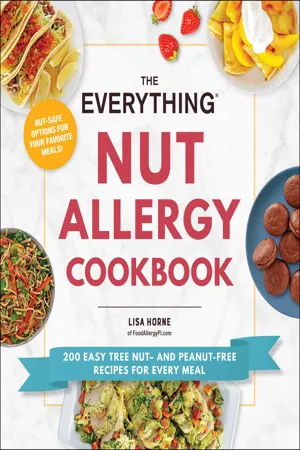
200 Easy Tree Nut– and Peanut-Free Recipes for Every Meal

  1. 272 pages
  2. English
  3. ePUB (mobile friendly)
  4. Available on iOS & Android
eBook - ePub

The Everything Nut Allergy Cookbook

200 Easy Tree Nut– and Peanut-Free Recipes for Every Meal

About this book

Go completely nut-free with 200 accessible, beginner-friendly recipes designed to keep anyone with nut allergies safe—while still enjoying delicious foods.

Dealing with a peanut or tree nut allergy can often make mealtimes challenging—lots of recipes require nuts, and it can be hard to share a meal with others who might not understand the severity of your allergy. However, you can avoid all these issues with nut-free solutions that allow you to safely—and quickly—create delicious dishes that even your friends without allergies will love!

In The Everything Nut Allergy Cookbook, you’ll learn all the tips and tricks for creating nut-safe meals, including cooking tips to avoid contamination and safe substitutions for common ingredients. Enjoy hundreds of allergy-friendly recipes (including recreations of favorites) like:
-Two Cheese Baked Pesto Chicken
-Thai Chicken Salad
-Sunflower Pumpkin Seed Trail Mix
-French Macarons
-Seed Butter Chocolate Cups
-And many more!

Whether you’re looking for new recipes to build out your nut-free repertoire or are new to the nut-free lifestyle, this helpful, reliable resource provides easy, tasty dishes that will become allergy-safe for years to come.
Frequently asked questions

Yes, you can cancel anytime from the Subscription tab in your account settings on the Perlego website. Your subscription will stay active until the end of your current billing period. Learn how to cancel your subscription.
No, books cannot be downloaded as external files, such as PDFs, for use outside of Perlego. However, you can download books within the Perlego app for offline reading on mobile or tablet. Learn more here.
Perlego offers two plans: Essential and Complete
  • Essential is ideal for learners and professionals who enjoy exploring a wide range of subjects. Access the Essential Library with 800,000+ trusted titles and best-sellers across business, personal growth, and the humanities. Includes unlimited reading time and Standard Read Aloud voice.
  • Complete: Perfect for advanced learners and researchers needing full, unrestricted access. Unlock 1.4M+ books across hundreds of subjects, including academic and specialized titles. The Complete Plan also includes advanced features like Premium Read Aloud and Research Assistant.
Both plans are available with monthly, semester, or annual billing cycles.
We are an online textbook subscription service, where you can get access to an entire online library for less than the price of a single book per month. With over 1 million books across 1000+ topics, we’ve got you covered! Learn more here.
Look out for the read-aloud symbol on your next book to see if you can listen to it. The read-aloud tool reads text aloud for you, highlighting the text as it is being read. You can pause it, speed it up and slow it down. Learn more here.
Yes! You can use the Perlego app on both iOS or Android devices to read anytime, anywhere — even offline. Perfect for commutes or when you’re on the go.
Please note we cannot support devices running on iOS 13 and Android 7 or earlier. Learn more about using the app.
Yes, you can access The Everything Nut Allergy Cookbook by Lisa Horne in PDF and/or ePUB format, as well as other popular books in Art & Culinary Arts. We have over one million books available in our catalogue for you to explore.

Information

Publisher
Everything
Year
2022
Print ISBN
9781507218266
eBook ISBN
9781507218273
Topic
Art

CHAPTER 1 Living with a Food Allergy

If you or a loved one has been diagnosed with a food allergy, please know you are not alone. This chapter will give you a fundamental understanding of what a food allergy is, how to recognize a reaction, and what to do if you have to deal with a reaction. You’ll also learn tips on how to keep your kitchen allergy friendly, along with how to find delicious and easy ingredient substitutions for your allergens.

Intolerance versus Food Allergy

Oftentimes individuals will use the terms “intolerance” and “food allergy” interchangeably, but they are very different. Intolerances can wreak havoc on a person’s body, causing bloating, fullness, stomach pain, gas, diarrhea, headaches, fatigue, and brain fog, as well as lead to other autoimmune issues. While food intolerances are not a walk in the park—they are very uncomfortable and can potentially lead to other health problems, as the body is not processing or digesting food properly—they are not immediately life-threatening.
A food allergy is a serious medical condition that can be potentially life-threatening. Food allergies are a body’s reaction to something that the body has identified as bad. The function of the immune system is to identify and destroy things that would bring the body harm. With a food allergy, the immune system overreacts and misidentifies what should ordinarily be a harmless protein as something that is bad instead. This sends the body into attack mode, resulting in any or all of the following symptoms:
  • Itching or tingling in the mouth or wherever the protein has come in contact
  • Hives, eczema, or itching on the skin
  • Feelings of dizziness or light-headedness, or even fainting
  • Stomach pain
  • Diarrhea
  • Nausea
  • Vomiting
  • Swelling of lips, face, tongue, throat, or other areas of the body
Food intolerances are typically tested using what is known as an IgG blood test, and many allergists will also advise a food diary is kept for review and discernment. A true food allergy is tested typically by skin prick testing and IgE blood tests, coupled with actual ingestion of the offending allergen whether by mistake, introduction of new foods, or an in-office oral food challenge. IgG tests are looking for delayed response reactions, versus the IgE tests that are looking for immediate response antibodies. Always consult with a board certified allergist for the best ways to navigate testing, diagnosing, and deciphering between intolerances and food allergies.

The Top Nine Allergens

For many years, the phrase “the top eight major allergens” has been the common way to refer to the top eight allergens that account for approximately 90 percent of all food allergies. In 2021, the United States Congress passed the Food Allergy Safety, Treatment, Education, and Research (FASTER) Act. This act states that by January 1, 2023, food manufacturers in the United States will be mandated to include what will now become known as the “top nine” to accommodate the addition of sesame.
The top nine allergens referenced in this book are:
  • Peanuts
  • Tree nuts
  • Dairy
  • Eggs
  • Finfish
  • Shellfish
  • Wheat
  • Soy
  • Sesame

Anaphylactic Allergic Reaction

While there are some symptoms that are common to food allergies, some individuals’ reaction triggers a life-threatening reaction known as anaphylaxis in which two or more body systems are affected. They can include all of the typical symptoms previously listed, in addition to:
  • Constriction of airways
  • The feeling of a lump in the airway making it difficult to breathe
  • Anaphylactic shock along with a drastic drop in blood pressure. Anaphylactic shock causes the immune system to send a flood of chemicals that then essentially drop your blood pressure so low that your cells and organs don’t get enough oxygen.
  • Rapid pulse
  • In the event of anaphylaxis, treatment is needed immediately. Untreated, anaphylaxis may result in a coma or ultimately death.

What to Do in the Event of a Reaction

The earlier you give epinephrine, the better. The longer an individual waits to administer epinephrine, the likelier it is that the reaction will progress, which could result in multiple doses of the drug being required. Additionally, the longer one waits, the more damage the reaction may cause, leading to a greater possibility of turning serious or even leading to death. When in doubt, administer epinephrine first and quickly, and then call 911 immediately. Administering epinephrine in the event it wasn’t needed cannot hurt the person; however, delaying or not administering epinephrine could result in loss of life.
fact
Exposure to allergens can occur several ways, including direct contact, cross-contact, and inhalation. Allergens enter the body through the eyes, nose, ears, or mouth.
While antihistamines are usually listed in a care plan from your doctor, in the event of an allergic reaction, always administer epinephrine first. Follow the protocol given by your board-certified allergist in allergy and immunology, through the American Board of Allergy and Immunology. Always carry at least two epinephrine auto-injectors. Though your auto-injectors come in a set of two and it can be tempting to separate them, don’t. It is necessary to carry two in the event that one misfires or that one dose is not enough to inhibit the reaction until 911 arrives.
alert
Individuals who have been diagnosed with a food allergy should follow up with their board-certified allergist for a personalized protocol. Whether an allergy is diagnosed as mild, severe, or anywhere elsewhere on the spectrum, it is vital to note that the severity of any previous reactions do not indicate the severity of future reactions. An allergic reaction may be experienced as mild one day and anaphylactic the next. This is why it is very important to treat all food allergies with a serious approach and care.

Label Reading and Food Allergy Safety

By law, manufacturers that sell products in the United States are required to provide a label for all products that are food for consumption or products that contain protein from the top allergens as ingredients, and that label must list ingredients that are high risk for causing allergic reactions. This law is known as the Food Allergen Labeling and Consumer Protection Act of 2004 (FALCPA), and went into effect in 2006.
When reading a label, keep in mind both FALCPA and the FASTER Acts do exist to aid in the prevention of allergic reactions; however, it is dually important to know that you must still read the ingredients in their entirety as the system is not perfect nor is it streamlined. The best way is to take the time to read each and every individual ingredient every time. Do not rely on a “may contain” or “contains” statement at the end of the ingredients list, or for top allergens to always be included in bold font. Oftentimes, those are incorrect, have errors, or are incomplete.
fact
While manufacturers are required to declare the allergen in the ingredients, they are not required to put the allergen in bold. They are also not required to put “may contain” or “manufactured in a shared facility” information on their labels.
Additionally, recipes, processes, and ingredients change due to sourcing, holidays, manufacturing processes...

Table of contents

  1. Cover
  2. Title Page
  3. Dedication
  4. Introduction
  5. Chapter 1: Living with a Food Allergy
  6. Chapter 2: Breakfast
  7. Chapter 3: Lunch
  8. Chapter 4: Dinner
  9. Chapter 5: Side Dishes
  10. Chapter 6: Breads, Rolls, and Muffins
  11. Chapter 7: Appetizers
  12. Chapter 8: Dips, Dressings, Seasonings, and Sauces
  13. Chapter 9: Snacks and Energy Boosts
  14. Chapter 10: Baked Goods and Candy
  15. Chapter 11: Frozen Treats
  16. Standard US/Metric Measurement Conversions
  17. About the Author
  18. Index
  19. Copyright