A look at how ideas of translation, migration, and displacement are embedded in the works of prominent artists, from Ovid to Tacita Dean
On Belonging and Not Belonging provides a sophisticated exploration of how themes of translation, migration, and displacement shape an astonishing range of artistic works. From the possibilities and limitations of translation addressed by Jhumpa Lahiri and David Malouf to the effects of shifting borders in the writings of Eugenio Montale, W. G. Sebald, Colm Tóibín, and many others, esteemed literary critic Mary Jacobus looks at the ways novelists, poets, photographers, and filmmakers revise narratives of language, identity, and exile. Jacobus's attentive readings of texts and images seek to answer the question: What does it mean to identify as—or with—an outsider?
Walls and border-crossings, nomadic wanderings and Alpine walking, the urge to travel and the yearning for home—Jacobus braids together such threads in disparate times and geographies. She plumbs the experiences of Ovid in exile, Frankenstein's outcast Being, Elizabeth Bishop in Nova Scotia and Brazil, Walter Benjamin's Berlin childhood, and Sophocles's Antigone in the wilderness. Throughout, Jacobus trains her eye on issues of transformation and translocation; the traumas of partings, journeys, and returns; and confrontations with memory and the past.
Focusing on human conditions both modern and timeless, On Belonging and Not Belonging offers a unique consideration of inclusion and exclusion in our world.
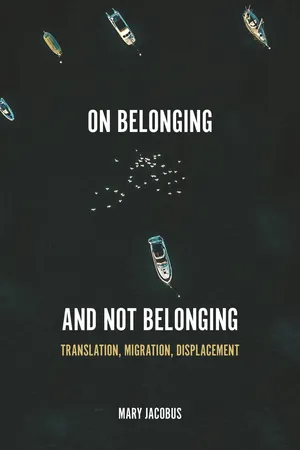
- 248 pages
- English
- ePUB (mobile friendly)
- Available on iOS & Android
eBook - ePub
About this book
Information
Publisher
Princeton University PressYear
2022Print ISBN
9780691231679
9780691212388
eBook ISBN
9780691231662
1
Identity Poetics
IDENTITY POLITICS, with its implied essentialism, has long been a suspect category, if also at times strategically necessary. Substituting “identity poetics” offers an alternative that emphasizes the literary and linguistic construction of identity. Translation is one of the many ways in which belonging (or not-belonging) can play out. In each of the texts considered in this chapter, translation unsettles the linguistic foundation of identity, whether conceived as divided and conflicted or as rooted in native soil. The Indian American novelist Jhumpa Lahiri’s In altre parole (In Other Words, 2016) and the Australian novelist David Malouf’s novel An Imaginary Life (1978) intersect with Ovid’s late poem of exile, the Tristia, in the problematic area of language. In each case, the subject’s tenacious hold on identity gives way in translation to something that may be unfamiliar, frustrating, or even freeing. These three texts belong to a long history of transformation and translocation that spans empire and exile, stretching from metropole to margin and back again. Such histories in any case disturb fixed ideas about cultural and national boundaries. On one hand, they can be understood as inalienable forms of belonging, and their attenuation as something to be resisted. On the other hand, an identity rooted in language is capable of transformation. Alongside their explorations of identity, each of these writers inscribes a theory of making (poesis) as well as a theory of translation. Hence, “the poetics” of identity—identity constructed and discovered in another language, rather than inherited or given.
Lahiri’s In altre parole struggles to disentangle the losses and gains of learning another language. However imperfect, Lahiri suggests, her reading and writing acquire new strength through an act of translation that she compares to Daphne’s flight in Ovid’s Metamorphosis, in a reading that sidesteps both pathos and artifice. Ovid’s first-century Tristia, written during his banishment to the farthest edge of the Roman Empire, resonates with the pains of literary and linguistic as well as geographical banishment. His unreconstructed imperial subjectivity emphasizes the loss of community, sociality—and Latin, his native and literary language. David Malouf’s An Imaginary Life reimagines Ovid’s exile as the poet’s gradual crossing into the nonhuman world that lies beyond the borders of sociality and language, on the other side of the river Ister (the modern Danube)—the symbolic boundary that marks the farthest reach of the Roman Empire. For Malouf’s Ovid, death is a gradual process of becoming. As an Australian postcolonial and immigrant subject, Malouf is sensitive to the tension between appropriation and interchange, both with the natural world and with unknown forms of otherness. Ahistorical dream-time pushes the envelope of language and consciousness toward the silent poetry of metamorphosis glimpsed at the end of Malouf’s novel.
Exchange, metamorphosis, interchange; translation, transformation, process: these terms emerge indirectly from authorial journeys that span India, America, and modern Rome; Ancient Rome, its Black Sea outpost, and the barbarian lands beyond the Ister. Journeying, as Heidegger argues in his war-strained reading of Hölderlin’s river poem, “Der Ister,” is also location, and location implies journeying, just as the familiar includes foreignness. Translation occupies a central place in what Heidegger calls “poeticizing,” the philosophic work of poetry that tries to think beyond the constraints of abstract concepts and symbolic equivalences. In its encounter with the foreign, language has the potential to question boundaries and undo national and imperial versions of belonging—including Heidegger’s own wishful nativizing of Hellenic culture and his questionable appropriation of Hellenism for Germanic culture.
It goes without saying that the crossing over from one language to another is constitutive of both identity and translation. In exposing the nonequivalence of words, translation (along with untranslatability) inevitably puts “identity politics” in question. Reading across these three fictions of individual, collective, or national identity shows how writerly subjectivity is constantly being undone by the vicissitudes of language. In place of identity politics, “identity poetics” is here conceived as piecemeal, malleable, mobile, and potentially transformative—in other words, as a theory of translation, or rather, untranslatability. Translation’s departure from an “original” offers a way to discover alternative linguistic (even nonlinguistic) versions of a necessarily fictive self, at once disorienting and freeing.
i. Writing on the Margins
Scrivo ai margini, così come vivo da sempre ai margini dei Paesi, delle culture.… L’unica zona a cui credo, in qualche modo, di appartenere. (I write on the margins, just as I’ve always lived on the margins of countries, of cultures.… The only zone where I think that, in some way, I belong.)—JHUMPA LAHIRI1
What Lahiri calls the writer’s “zone” of belonging—writing on the margins—is also the place of non-belonging. At the core of Jhumpa Lahiri’s account of her twenty-year struggle to learn, speak, and write the Italian language are questions that complicate the relation between translation and identity. Is language merely the dress of meaning that overlays cultural identity, or is language itself a tenacious bearer of cultural identity?2 Is translation only skin-deep? Or do profound and disconcerting changes underlie the shift into another language? Lahiri’s previous novels and short stories have explored the experience of first- and second-generation South Asian immigrants into America; but she has chosen to write her most recent novel, Dove mi trovo (2018), in Italian, extending her exploration of linguistic and geographical disorientation.3 Lahiri’s first published venture into Italian, In altre parole, includes a short story that she says came to her suddenly as she worked in a library in Rome; later, she confesses that it is autobiographical: “la protagonista, appena modificata, sono io.… Ho visto e osservato tutto quello che descrivo” (“the protagonist, slightly changed, is me.… I saw and observed everything that I describe”) (IAP, 218–19). In Lahiri’s story, the protagonist becomes a stranger about whom we know little. The story is called “Lo Scambio” (“The Exchange”)—a title that spans the colloquialism of “swap” or “mix-up” along with “trade” or “confusion” (as opposed to il cambio, substitution). The “s” in the Italian title has the negative force of “un-” in English, as if signaling a latent differential; the tension between “exchange” and “change” is more than the shift from first-person protagonist to third-person narrative. The story’s exchange becomes fantastical and dream-like, as if its unmoored central character—a translator by profession—has stumbled into another world.
For reasons mysterious to the translator herself, she has decided to quit her former comfortable life: “C’era una donna, una traduttrice, che voleva essere un’altra persona. Non c’era un motivo chiaro. Era sempre stato così.” (“There was a woman, a translator, who wanted to be another person. There was no precise reason. It had always been that way.”) (IAP, 66–67). Wanting to be another person provides the enigmatic rationale for the story. Perhaps the translator of texts is trying to produce a better draft of herself: “Si considerava imperfetta, come la prima stesura di un libro.” (“She considered herself imperfect, like the first draft of a book.”) (IAP, 66–67). Taking with her only the barest essentials—a black dress, shoes, and a black sweater—she moves to an unfamiliar city, seemingly without friends or occupation. One rainy day she follows a group of women entering a private apartment where elegant garments are discreetly for sale; their designer too is indefinably foreign. Here the protagonist tries on black clothes that are modern, versatile, and ideal for travel (so their designer tells her). Yet she finds she has no wish to buy anything. When the time comes to leave, she is unable to find her own sweater. After a while, a sweater that resembles hers is found, but she does not recognize it: “Era un altro, sconosciuto. La lana era più ruvida, il nero meno intenso, ed era di una misura diversa.” (“It was another one, unfamiliar. The wool was coarser, the black less intense, and it was a different size.”) (IAP, 76–77). The translator feels only revulsion for this unfamiliar sweater. Perhaps someone has taken hers by mistake. Her hostess obligingly telephones the departed guests, but with no result. The translator leaves with the sweater, feeling emptied and defeated. The next day, her sweater is once more familiar, and she puts it on.
Lahiri’s story suggests that the project of exchanging oneself for another may stall as the familiar becomes uncomfortably strange, even off-putting. The translator understands that she had come to this unknown city in search of freedom from her previous identity, only to find its hold unexpectedly tenacious: “Era venuta in questa città cercando un’altra versione di sé, una trasfigurazione. Ma aveva capito che la sua identità era insidiosa, una radice che lei non sarebbe mai riuscita a estirpare, un carcere in cui si sarebbe incastrata.” (“She had come to that city looking for another version of herself, a transfiguration. But she understood that her identity was insidious, a root that she would never be able to pull up, a prison in which she would be trapped.”) (IAP, 78–79). Yet, when she puts on her sweater again, both it and she seem changed: “Quando lo vide, non provava più nessun ribrezzo. Anzi, quando lo indossò, lo preferì. Non voleva ritrovare quello perso, non le mancava. Ora, quando lo indossava, era un’altra anche lei.” (“When she saw it, she no longer felt revulsion. In fact, when she put it on, she preferred it. She didn’t want to find the one she had lost, she didn’t miss it. Now, when she put it on, she, too, was another.”) (IAP, 80–81). What is the nature of this fantastic metamorphosis?—this exchange that is no-change; not another version of the translator, but the emergence of a previously undiscovered preference for—what?
The riddle posed by Lahiri’s story concerns the relation of identity not only to language but also to imperfection. In a later chapter of In altre parole titled “L’Imperfetto” (“The Imperfect”), Lahiri describes her lifelong quest for perfection and her shame at her imperfectly spoken and written Italian. She singles out her struggle to master the distinctive Italian usage of the imperfect tense (a continuous or unchanged state of affairs in the past). Yet her story implies something else. Although her recovered sweater appears rough, ill fitting, its color lacking intensity, it has become different, as if seen through new eyes—and she with it. Just as she declines the elegant clothing she has tried on in the apartment, she realizes that the imperfection of her sweater is ineradicable and habitual, almost a habitus. When she reassumes her familiar identity, the translator doesn’t miss what she had thought lost: “Non voleva ritrovare quello perso, non le mancava.” (“She didn’t want to find the one she had lost, she didn’t miss it.”) (IAP, 80–81). A sense of imperfection becomes the previously unacknowledged, lifelong root of her identity: “Mi identifico con l’imperfetto, perché un senso d’imperfezione ha segnato la mia vita.” (“I identify with the imperfect because a sense of imperfection has marked my life.”) (IAP, 110–11). The imperfect tense is her. She inhabits (or is inhabited by) a continuous past tense, a state of being that is both intensely familiar and disturbingly strange.
Lahiri’s is the classic immigrant’s dilemma: whether to assimilate, or to resist change; whether to write from the margins, or to assume a new identity, however conflicted and divided. Although In altre parole ostensibly concerns the difficulty of learning to read and write in another language, it is also a writer’s odyssey that emphasizes Lahiri’s discovery of a more robust authorial voice for her writing: “Una nuova voce, grezza ma viva, da migliorare, da approfondire” (“A new voice, crude but alive, to improve, to elaborate”) (IAP, 62–63). The author feels as if she has gone back to childhood, discarding the language of choice and distinction that shapes her anglophone writing for a more direct and immediate voice—rough, like the sweater (“grezza”), lacking in depth or color, yet living (viva); a voice with unknown depths to plumb (“approfondire”): “Il verbo sondare vuol dire esplorare, esaminare. Vuol dire, letteralmente, misurare la profondità di qualcosa.” (“The verb sondare means ‘to explore, to examine.’ It means, literally, to measure the depths of something.”) (IAP, 182–83). The author tells us that she doesn’t know how to think about this short story that seemed to come unbidden and from an unknown source: “Benché sia venuto da me, non sembra completamente mio.” (“Although it came from me, it doesn’t seem completely mine.”) (IAP, 64–65). In this, it resembles her refound sweater. Later, the meaning of the story reveals itself to her: “il golfino è la lingua” (“the sweater is language”) (IAP, 64–65). Not any language, but the language in which she recovers an imperfect self. Confronted by her missing sweater, she initially feels “ribrezzo” (revulsion). But by the end of the story, “non provava più nessun ribrezzo” (“she no longer felt revulsion”). She has become used to it. It fits.
The term ribrezzo carries visceral implications, an element of physical repugnance that rhymes with grezza, the coarse texture of the recovered sweater—the double “z” catching like rough wool on dry skin. The pared-down language of Lahiri’s story lacks the ease and transparency ...
Table of contents
- Cover Page
- Title Page
- Copyright Page
- Dedication
- Contents
- List of Illustrations
- Acknowledgments
- Introduction: Unbelonging
- 1. Identity Poetics
- 2. Of Birds and Men
- Color Plates
- 3. The Coastal Paradox
- 4. Displaced Persons
- 5. Border Crossing
- 6. Rewilding Antigone
- Notes
- Index
Trusted by 375,005 students
Access to over 1.5 million titles for a fair monthly price.
Study more efficiently using our study tools.
Frequently asked questions
Yes, you can cancel anytime from the Subscription tab in your account settings on the Perlego website. Your subscription will stay active until the end of your current billing period. Learn how to cancel your subscription
No, books cannot be downloaded as external files, such as PDFs, for use outside of Perlego. However, you can download books within the Perlego app for offline reading on mobile or tablet. Learn how to download books offline
Perlego offers two plans: Essential and Complete
- Essential is ideal for learners and professionals who enjoy exploring a wide range of subjects. Access the Essential Library with 800,000+ trusted titles and best-sellers across business, personal growth, and the humanities. Includes unlimited reading time and Standard Read Aloud voice.
- Complete: Perfect for advanced learners and researchers needing full, unrestricted access. Unlock 1.5M+ books across hundreds of subjects, including academic and specialized titles. The Complete Plan also includes advanced features like Premium Read Aloud and Research Assistant.
We are an online textbook subscription service, where you can get access to an entire online library for less than the price of a single book per month. With over 1.5 million books across 990+ topics, we’ve got you covered! Learn about our mission
Look out for the read-aloud symbol on your next book to see if you can listen to it. The read-aloud tool reads text aloud for you, highlighting the text as it is being read. You can pause it, speed it up and slow it down. Learn more about Read Aloud
Yes! You can use the Perlego app on both iOS and Android devices to read anytime, anywhere — even offline. Perfect for commutes or when you’re on the go.
Please note we cannot support devices running on iOS 13 and Android 7 or earlier. Learn more about using the app
Please note we cannot support devices running on iOS 13 and Android 7 or earlier. Learn more about using the app
Yes, you can access On Belonging and Not Belonging by Mary Jacobus in PDF and/or ePUB format, as well as other popular books in Literature & Translating & Interpreting. We have over 1.5 million books available in our catalogue for you to explore.