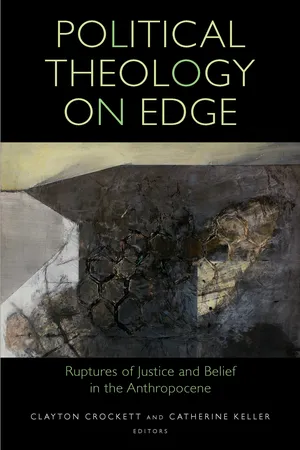
In Political Theology on Edge, the discourse of political theology is seen as situated on an edge—that is, on the edge of a world that is grappling with global warming, a brutal form of neoliberal capitalism, protests against racism and police brutality, and the COVID-19 pandemic. This edge is also a form of eschatology that forces us to imagine new ways of being religious and political in our cohabitation of a fragile and shared planet. Each of the essays in this volume attends to how climate change and our ecological crises intersect and interact with more traditional themes of political theology.
While the tradition of political theology is often associated with philosophical responses to the work of Carl Schmitt—and the critical attempts to disengage religion from his rightwing politics—the contributors to this volume are informed by Schmitt but not limited to his perspectives. They engage and transform political theology from the standpoint of climate change, the politics of race, and non-Christian political theologies including Islam and Sikhism. Important themes include the Anthropocene, ecology, capitalism, sovereignty, Black Lives Matter, affect theory, continental philosophy, destruction, and suicide. This book features world renowned scholars and emerging voices that together open up the tradition of political theology to new ideas and new ways of thinking.
Contributors: Gil Anidjar, Balbinder Singh Bhogal, J. Kameron Carter, William E. Connolly, Kelly Brown Douglas, Seth Gaiters, Lisa Gasson-Gardner, Winfred Goodwin, Lawrence Hillis, Mehmet Karabela, Michael Northcott, Austin Roberts, Noëlle Vahanian, Larry L. Welborn
To inhabit the geological era recently known as the Anthropocene is not to live during a time when—as if flouting millions of years of long, slow change in oceans, species evolution, climate, glaciers, monsoons, and deserts—humanity writ large suddenly became a geological force. Such a statement asserts two mistakes: the assumption of planetary gradualism with which it starts and the charge of generic human responsibility with which it closes. First, geology, paleontology, oceanography, glaciology, and other earth sciences—starting as late as the 1980s—finally exploded the story of planetary gradualism that had informed the nineteenth-century geologist Lyell and the evolutionary theorist Darwin. It is an interesting question: What kind of metaphysical and cosmological assumptions in Christian providentialism and its remainders in secular thought made such sciences take so long? Especially when some predecessors, such as Kropotkin, Cuvier, Mary Shelley, and Nietzsche had already challenged gradualism? And why did the humanities, social scientists, and citizen activists even take longer?
Second assumption: “Humanity” did not become a geological force in the modern era. Rather, state capitalism, socialism, and communism, organized around internally differentiated priorities of fossil extraction, productivism, and consumption abundance, became major geological forces by dint of their institutional demands and spiritual priorities. They imposed new, rapidly accelerating burdens and injuries on racially defined constituencies, the lower classes inside the old capitalist states, and several regions outside those centers. So much, so obvious, though the corrections do require adjustments in geological definitions of the “Anthropocene.”
If you interrogated the five great mass extinction events that occurred before these modern systems of political economy triumphed, it would also become clear how capitalism and others are not THE sole geological forces of rapid, deep change today either. These modern political economies, rather, spawn climate triggers that can be inflated or dampened by planetary forcings and self-organizing amplifiers. We thus need concepts of cascading causality to explore multiple, intersecting planetary trajectories populated with varying degrees of agency. Not all planetary forces are agents, in the sense of exuding at least some capacity to strive, feel, and help to bring something new into the world. But blind forces and purposive agents of different sorts do interact in the Anthropocene—as they did during slow and bumpy periods long before it emerged.
Gilles Deleuze and Félix Guattari did not examine the Anthropocene in relation to capitalist and communist practices of productivism. D&G, however, did open a door to such examinations through a series of concepts that underline the ways diverse human cultural practices are profoundly entangled with a host of nonhuman forces and agencies. These concepts together challenge the sufficiency of human exceptionalism, sociocentrism, cultural internalism, and planetary gradualism that had heretofore graced much of Euro-American philosophy, the humanities, and social sciences.
Several D&G concepts are pertinent to the inquiry in question. One pair—smooth and striated space—is exemplary. A few paradigms of smooth space are oceans, deserts, glaciers, mountain ranges, the atmosphere, mist, creative thinking, the stratosphere, steppes, and prairies. Several smooth spaces expand or contract over time, making huge differences to possibilities of life in and around them. Certainly, each is also susceptible to new practices of striation that would organize it more sharply. The introduction of longitude and latitude onto ocean maps is a modest example of striation. So is the division of prairie land into territories marked by moats, river borders, passport controls, county divisions, racial divisions, state bureaucracies, surveillance systems, class hierarchies, highway systems, and/or territorial walls.
The D&G interventions compel social thinkers to address the shifting densities and intensities of drought zones, monsoons, ocean currents, desertification, rates of glacier flow, hurricanes, atmospheric composition, and so forth. D&G thus introduced several categories that cut off sociocentrism at the pass—the latter being the quaint idea still lingering in some quarters that key social processes can be explained almost solely by reference to more basic social processes.
When you think of how various planetary processes themselves slide and bump into shifting mixtures of social life, other D&G concepts present themselves as candidates too. Assemblage, rhizome, multiplicity, body without organs, plane of composition, and abstract machine pop up for consideration.
But I suspect the idea of an abstract machine may do even more work to rethink the bumpy trajectories of the Anthropocene, partly because of its emphasis on fecund processes that both involve and exceed human powers and partly because of its focus on imbrications between elements of diverse types in processes of formation, consolidation, and deconsolidation. A couple of things D&G say are relevant. Abstract machines “are defined by the fourth aspect of assemblages, in other words, the cutting edges of decoding and deterritorialization…. Therefore they make the territorial assemblage open onto something else, assemblages of another type, the molecular, the cosmic: they constitute becomings.” And “each abstract machine can be considered a ‘plateau’ of variation.”1 An abstract machine thus composes and links heterogeneous temporalities that are self-organizing to various degrees. The earth itself is an abstract machine: It “asserts its own powers of deterritorialization, its lines of flight, its smooth spaces that live and blaze their way for a new earth.”2 Here the idea of “machine”—with bumpy, evolutionary, self-organizing capacities—challenges both Eurocentric life/nonlife dualities and reductionist philosophies of materialism that sought to overtake them. Both.
An abstract machine, in the sense deployed here, includes moving, morphing planetary complexes that exceed the power of the ensemble of forces and agencies that constitute it. A planetary machine is machinic (rather than mechanistic, cybernetic, or organic) in that it evolves new speeds and capacities as it draws energy from earthquakes, capitalist emissions, ocean currents, deforestation, volcanoes, methane bursts, microbes, and the sun to cut into prior stabilizations; planetary (in this instance) in that it imposes asymmetrical regional, racial, class, and species consequences on the face of the earth; abstract in that it is irreducible to an aggregation of the forcings and agencies that compose it, such as, say, capitalism, white evangelicalism, technoscientific formations, imperial patterns of trade and finance, tectonic plates, cultural ressentiment, species evolution, viral and bacterial flows, desert advances, ocean currents, acidification, and glacier flows; and it is complex (or nonlinear) in that the heterogeneous forces that compose it impinge on each other, periodically infuse one another, and respond to these intrusions in ways that exceed the power of the triggers. Doing so will endow the self-organizing machine with evolving shapes, speeds, and trajectories.
CAPITALISM AND THE ANTHROPOCENE
I understand, with D&G, capitalism to be imperfectly contained by a shifting “axiomatic” that exceeds both a determinate mode of production and the rationality of impersonal market processes. The axiomatic, as it morphs, enables some activities, constrains others, and captures yet others. Such an image of capitalism outstrips any mode of economism, partly because it includes shifting spiritualities that infuse the institutions of production, investment, governance, class struggle, and consumption, partly because it secretes atmospheric emissions that change climate, and partly because it faces planetary forces with powers of self-amplification that jostle it in multifarious ways.3 The bumpy relations between an axiomatic and the outside often compel a regime to search and grope in the dark as new events unfold or erupt.
A capitalist axiomatic of enablement and constraint might consist, for instance, of private ownership and pursuit of profit, a focus on fossil fuel extraction, a commodity form of consumption, labor pushed kicking and screaming toward the commodity form, states organized as servants and/ or regulators of the axiomatic, and banks with varying degrees of independence. These axioms can then be augmented or contracted to foster diversities within capitalism writ large. Some variations take the form of democratic capitalism in which competing parties shuffle between enthusiastically subordinating themselves to the vicissitudes of the axiomatic and regulating it to protect workers, consumers, public goods, and nonhuman species; fascist capitalism in which a dictatorial party mobilizes a few intense factions to guide private capital and to exercise terror, surveillance, and racist control over others; Keynesian capitalism in which unions acquire increased institutional power and a social net for workers, the poor, the old, and the infirm is established; and neoliberal capitalism in which democracy becomes hollowed out, corporate regulations are stripped, state subsidies for capital flourish, and a myth (or “overcoding”) of market rationality is invoked to vindicate those practices.
Under conditions of stress neoliberal capitalism can morph toward fascist capitalism, as occurred after the Great Depression in several states and as a host of new social movements drive to accomplish today in the United States, Poland, Hungary, Austria, Turkey, Brazil, and Italy. The racial dog whistles and thinly denied white triumphalism that marked neoliberalism now become bullhorns. Big Lies, aggressive racial and religious nationalism, voter suppression, corruption of courts, intelligence agencies and judicial policies, harsh policing of territorial borders, market testing of new modes of cruelty, and media intimidation now attain new heights of intensity. The Big Lie Scenario plays an outsize role in such regimes, in which leaders both dramatize false accusations against others to mobilize a base and disclose tells about themselves in doing so.
The key connections between extractive capitalism, the galloping Anthropocene, and new fascist movements in old democratic states today and tomorrow are perhaps these. First, climate warming, drought, stuttering monsoons, glacier melts, wildfires, extreme storms and so on press upon vulnerable and exploited regions outside old capitalist states, increasing pressure to civil wars and forced migrations within the latter. The resulting racialized refugee pressures upon old capitalist states create happy hunting grounds for the purveyors of aspirational fascism in those regimes. Second, as those flames are fanned by aspirational fascists—with Donald Trump leading the way in America—white workers and the lower middle class in deindustrialized zones are told that only by returning to the old days of fossil fuel extraction, steel and automobile production, and white triumphalism can they regain the levels of entitlement acquired precariously in the 1950s and early 1960s. This combination pulls some to embrace climate denialism and support an authoritarian leader; it encourages others (particularly in white upper middle and donor classes) to fund such expressions of public belief to fend off challenges from the Left.4 White triumphalism and climate denialism thus support each other today, in part because it would indeed take radical reform of dominant practices over a single decade to respond to the perils of the Anthropocene.
“Accelerationism”—in its left-wing expressions—is the contemporary claim that the only way to respond to neoliberal capitalism today is to accelerate its own tendencies to self-destruction and austerity until it collapses from its own contradictions.5 The frustrations pushing critics into accelerationism are understandable. But I note that left-wing proponents of accelerationism tend to underplay the acceleration of the Anthropocene itself that is well under way. If they did attend to it, it is doubtful that they would be able to pretend that a new, just society would emerge out of wreckage of the old. Accelerationism, indeed, may incite the fascist responses its proponents decry.
That is why I support a series of rapid, positive interim policies and practices to start current capitalist states, first, beyond extractive capitalism and, second, beyond the class organization of acquisitive desires joined to the differential ability of people in different subject positions to fulfill them. Today, given the urgency of time and the resentments of several neglected constituencies, it assumes the character of an improbable necessity, improbable because so many powerful forces resist it, necessary because it will take a series of rapid changes on multiple fronts to slow down the Anthropocene.
Capitalism—with its endemic pressures to expand growth, exploit nature, workers, and consumers, extend income and wealth hierarchies, generate crises, and deploy fossil...
Table of contents
Cover Page
Title Page
Copyright
Contents
Introduction: Political Theology on Edge
Part I: Political Theology and the Anthropocene
Part II: Destruction and Suicide
Part III: Affective and Axiomatic Interventions
Part IV: Global Political Theologies
Part V: From Genocide Toward a Sacred Politics
Acknowledgments
List of Contributors
Trusted by 375,005 students
Access to over 1.5 million titles for a fair monthly price.
Study more efficiently using our study tools.
Frequently asked questions
Yes, you can cancel anytime from the Subscription tab in your account settings on the Perlego website. Your subscription will stay active until the end of your current billing period. Learn how to cancel your subscription
No, books cannot be downloaded as external files, such as PDFs, for use outside of Perlego. However, you can download books within the Perlego app for offline reading on mobile or tablet. Learn how to download books offline
Perlego offers two plans: Essential and Complete
Essential is ideal for learners and professionals who enjoy exploring a wide range of subjects. Access the Essential Library with 800,000+ trusted titles and best-sellers across business, personal growth, and the humanities. Includes unlimited reading time and Standard Read Aloud voice.
Complete: Perfect for advanced learners and researchers needing full, unrestricted access. Unlock 1.5M+ books across hundreds of subjects, including academic and specialized titles. The Complete Plan also includes advanced features like Premium Read Aloud and Research Assistant.
Both plans are available with monthly, semester, or annual billing cycles.
We are an online textbook subscription service, where you can get access to an entire online library for less than the price of a single book per month. With over 1.5 million books across 990+ topics, we’ve got you covered! Learn about our mission
Look out for the read-aloud symbol on your next book to see if you can listen to it. The read-aloud tool reads text aloud for you, highlighting the text as it is being read. You can pause it, speed it up and slow it down. Learn more about Read Aloud
Yes! You can use the Perlego app on both iOS and Android devices to read anytime, anywhere — even offline. Perfect for commutes or when you’re on the go. Please note we cannot support devices running on iOS 13 and Android 7 or earlier. Learn more about using the app
Yes, you can access Political Theology on Edge by Clayton Crockett, Catherine Keller, Clayton Crockett,Catherine Keller in PDF and/or ePUB format, as well as other popular books in Theology & Religion & Political Philosophy. We have over 1.5 million books available in our catalogue for you to explore.