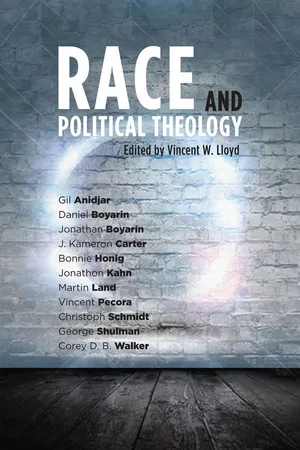
In this volume, senior scholars come together to explore how Jewish and African American experiences can make us think differently about the nexus of religion and politics, or political theology. Some wrestle with historical figures, such as William Shakespeare, W. E. B. Du Bois, Nazi journalist Wilhelm Stapel, and Austrian historian Otto Brunner. Others ponder what political theology can contribute to contemporary politics, particularly relating to Israel's complicated religious/racial/national identity and to the religious currents in African American politics. Race and Political Theology opens novel avenues for research in intellectual history, religious studies, political theory, and cultural studies, showing how timely questions about religion and politics must be reframed when race is taken into account.
- 264 pages
- English
- ePUB (mobile friendly)
- Available on iOS & Android
eBook - ePub
Race and Political Theology
About this book
Information
Publisher
Stanford University PressYear
2012Print ISBN
9780804773157
9780804773140
eBook ISBN
9780804781831
CHAPTER 1
POLITICAL THEOLOGY AND THE CASE OF OTTO BRUNNER
VINCENT P. PECORA
Otto Brunner’s Land und Herrschaft: Grundfragen der territorialen Verfassungsgeschichte Südostdeutschlands im Mittelalter (1939) blended Carl Schmitt’s ideas (especially the friend-foe opposition as the basis of the political) with W. H. Riehl’s nineteenth-century account of the medieval Germanic family, tribe, and nation.1 Brunner posits the unique nature of the premodern Germanic Volksgemeinschaft (people’s community), from which he imagined a distinctly postmodern political order arising under Hitler. Medieval Austria’s Land (territory), Volk (people), and Herrschaft (lordship or sovereignty) constituted for Brunner a necessary template for the Third Reich, which supplanted the contractual authority of the Rechtstaat (modern liberal state). The putatively recoverable deep structure of familial, clan, and regional relationships stands in for the idea of race. What I have elsewhere called a “household of the soul” that shapes much political resistance and nostalgia in the nineteenth and early twentieth centuries—a fundamentally Aristotelian, aristocratic, and anticapitalist image of proper (noble) familial relationships and gens-based symbolic economies—is at the same time a racial household, for it rests on the assumption that authentic political life arises from the family writ large, either in the Hobbesian, top-down, monarchist “throne and altar” fashion of Joseph de Maistre, or in the pre-Hobbesian, bottom-up, völkisch populism of Brunner (who focuses directly on Hausherrschaft, or household lordship, as the basis of the German Volk).2 Schmitt insists on the force of secularized religious (Roman Catholic) structures of thought as the intractable bases of the sovereign decision that implicitly founds and explicitly preserves the law. Such a decision is an echo of divine authority, without which neither monarchic nor republican sovereignty can survive crises. By contrast, Brunner radically collapses the secularizing distinction between religious moral background and rationalized civil politics that the modern state requires by returning to notions of land and lordship—of Landrecht, a sense of law and right welling up from the land—that predate the Rechtstaat and through which modern racial politics becomes far more salient.
BRUNNER’S Land und Herrschaft, published in 1939, 1942, and 1943 (revised), and newly revised in 1959 minus the conclusion, is an example of Blut und Boden thought, and there was no shortage of such texts before and during the Third Reich. Blut und Boden—blood and soil, race and rural community, an Aryan body returning to the land for corporal rejuvenation and reaffirmation of sacred bonds—was a significant element of Nazi propaganda early in Hitler’s reign and a crucial part of the apotheosis under the Reich of the Germanic Volk. The term Volk had at least two, usually reinforcing but at times distinct, meanings: a people as a cultural community with long-standing traditions of custom and law—what sociologists call an ethnie today, equivalent in ways to premodern usages of the term “nation”—and a people defined by a biologically measurable racial composition.3 Whereas the first meaning of Volk had widespread appeal well before the rise of Nazism and during the Third Reich, the second meaning attracted a narrower but more politically aggressive group of writers and theorists. The latter, racial meaning became dominant once Hitler consolidated power. Blut und Boden obviously refers to the racial definition of the Volk but also to the rural, agricultural basis of that definition. Hence, the expression Blut und Boden, however effective as propaganda, raised certain problems once the Reich began intensive rearmament and war preparations in 1934. The cities, with their heavy industry and ready work forces, were a crucial part of National Socialism’s drive for lebensraum and the irredentist project of reuniting all Germanic peoples. Urban energy, advanced technology, and centrally organized bureaucratic state apparatus were fundamental elements of Hitler’s war machine.4 By 1938, Hitler was actively denouncing the mystical and occult elements that had defined much Blut und Boden and völkisch thought.5 What he needed instead were public representations of Volksgemeinschaft that could be materially and ideologically controlled, as in the spectacular state-sponsored party rallies at Nuremberg after 1933.
Walther Darré, appointed Reich minister for nutrition and agriculture in 1933, melded the cultural and political projects of Blut und Boden. Darré’s Das Bauerntum als Lebensquell der nordischen Rasse (The Peasantry as the Life Source of the Nordic Race, 1929) and Neuadel aus Blut und Boden (New Nobility out of Blood and Soil, 1935) made him the perfect mix of rural idealist, practical bureaucrat, and anti-Semite. Darré’s thinking had roots in that of Karl Haushofer, a WWI general and geographer often named as a source for the idea that the putatively high population density of German cities could be relieved by colonial expansion (an idea that may have had credibility for Haushofer because of the Monroe Doctrine and “manifest destiny”); and in that of Friedrich Ratzel, whose essay “Lebensraum” (1901) popularized the term as part of his science of “biogeography” following upon the Darwinian Ernst Heinrich Haekel (for whom ontogeny famously recapitulated phylogeny). Further back, one finds nineteenth-century geographer Karl Ritter, whose Die Erdkunde im Verhältniss zur Natur und zur Geschichte des Menschen (The Science of the Earth in Relation to Nature and the History of Mankind, 1817–1859), was a grand elaboration (nineteen volumes, unfinished) of theories found in Montesquieu and Alexander von Humboldt about how the physical environment shapes human communities. Darré’s thinking was racist and anti-Semitic. But Haushofer, whose wife was Jewish and whose son played a role in the plot to assassinate Hitler, was likely not. Ratzel was an imperialist, and his notion of lebensraum depended on a Darwinian process by which healthier populations reinvigorated weaker nations on their borders. And Ritter was a cosmopolitan preevolutionist philosopher, opposed to the slave trade of his time, whose work could suggest a colonizing, racist mentality only via distortion.
The literary expressions of Blut und Boden, which perhaps had greater popularity than the scholarly work and were tinged with romantic mysticism, may actually begin with a Norwegian. Knut Hamsun, whose Markens Grøde (Growth of the Soil, 1917), translated quickly into German as Segen der Erde (The Blessing, or Abundance, of the Earth) and into Yiddish, emerges in Viennese writer Jean Améry’s account as the model for subsequent German “peasant” novels.6 Growth of the Soil was largely responsible for Hamsun’s Nobel Prize in Literature in 1920. Hamsun became a staunch promoter of the Nazi cause, as did other völkisch novelists of the Weimar years, such as Hanns Johst and Hans Grimm. But Friedrich Griese, whose novels Feuer (Fire, 1921), Winter (1927), and Das letzte Gesicht (The Final Vision, 1934) meditate on sacred connections to one’s ancestors and to eternal processes of death and regeneration rather than on modern racial politics, traded in nostalgia for a time predating industrial capitalism, with its crowded, multiethnic cities, horrific machine-driven wars, and crushing economic depressions. Griese celebrated a time when unsophisticated rural populations did not feel manipulated by educated elites, when families functioned as extended households, and when relative independence and self-help were (at least imaginatively) the order of the day. The Nazi use of the term Volksgemeinschaft was adopted, one might add, from Weimar’s Social Democrats, “who, after World War I, had tried unsuccessfully to link it to the new democracy.”7
This recovery of an ancestrally rooted, rural, and robust yeomanry should not be understood as a specifically German phenomenon in earlier decades. It is trans-European, with deep roots in the nineteenth-century British Empire. Adventure novelists such as Frederick Marryat, Charles Kingsley, Robert Ballantyne, George Henty, and H. Rider Haggard championed a seaborne empire built around a völkisch resistance to multiethnic urban decay and a völkisch embrace of traditional rural values, of kinship and soil.8 Haggard, barrister by training, produced a parliamentary “blue book” on Salvation Army colonies in North America and England (The Poor and the Land, 1905) as well as a study arguing that Britain could relieve urban overcrowding, unemployment, poverty, and the threat of anarchy, and arrest the decline and depopulation of its countryside, by repatriating people from the cities to the country (Rural Denmark and Its Lessons, 1911). (Chairman Mao later had the same idea—with disastrous results.) Joseph Conrad, the great chronicler of deracinated adventurers and maritime empire in decay, periodically sang hymns to the primacy of the Land. “Each blade of grass has its spot on earth whence it draws its life, its strength; and so is man rooted to the land from which he draws his faith together with his life.”9 Despite the divergent uses to which sociology and fiction about the value of blood and soil were put in different national settings, we need to be disabused of the idea—an idea promoted by Nazi ideologues themselves—that there was anything uniquely German about such sentiments.
Brunner’s Land und Herrschaft should be read today, despite its claims to Germanic specificity, less as an example of Blut und Boden thinking than as a remarkably complex and detailed elaboration of how a family of ideas—including land, household, extended kinship, local sovereignty, and an individual’s right to violent self-help in the redress of wrongs—was interwoven in a broadly European, politically complex reaction to an increasingly secular, urban, technologically driven, and socially administered modernity. Moreover, we should understand Brunner’s contribution in the context of modern political theology, that is, as an attempt to mend the supposed aporias in the nineteenth-century liberal nation-state between disavowed religious background and democratic secular foreground, between what Schmitt called “the omnipotent God” and the “omnipotent lawgiver,” or between “theology” and “the theory of the state,” by returning to a singular, integrated, and organic whole. It is a version of—or perhaps a response to—political theology that has uncanny resonances with the political theology of the present day.
The excellent existing translation of Land und Herrschaft into English in 1992 is based unfortunately, for my purposes, on the fourth edition of 1959. As the translators point out, Brunner’s alterations in 1959 were a response to the embarrassing resonances after 1945 of his earlier formulations. Brunner omitted his conclusion, which makes a direct connection between his account of medieval Austria and the German Third Reich. He deleted references then current among other völkisch thinkers (Ernst Huber, Hans Freyer, Ernst Jünger) to the idea that what Schmitt called the “total” or “welfare” state of the early twentieth century, in which private interests became politically organized in and by the state, had already dissolved the nineteenth-century distinction between laissez-faire state (law and administration) and society (Marx’s bürgerliche gesellschaft, ruled by economic interests, religious beliefs, and class “ideologies”), thus ushering in the Third Reich’s specifically Germa...
Table of contents
- Cover
- Copyright
- Title Page
- Contents
- List of Contributors
- Introduction
- 1. Political Theology and the Case of Otto Brunner
- 2. “The Politicization of Heaven”: Wilhelm Stapel’s Political Theology of Nationalist Sovereignty
- 3. Between W. E. B. Du Bois and Karl Barth: The Problem of Modern Political Theology
- 4. There Are No Clean Souls: The Promise and Perils of Political Theology in The Souls of Black Folk
- 5. The Race for Theology: Toward a Critical Political Theology of Freedom
- 6. The Enemy’s Two Bodies (Political Theology Too)
- 7. The Double Mark of the Male Muslim: Eracing Othello
- 8. Between Sacred and Secular? Michael Walzer’s Exodus Story
- 9. The State between Race and Religion: A Conversation
- 10. From Political Theology to Vernacular Prophecy: Rethinking Redemption
- Index
Trusted by 375,005 students
Access to over 1.5 million titles for a fair monthly price.
Study more efficiently using our study tools.
Frequently asked questions
Yes, you can cancel anytime from the Subscription tab in your account settings on the Perlego website. Your subscription will stay active until the end of your current billing period. Learn how to cancel your subscription
No, books cannot be downloaded as external files, such as PDFs, for use outside of Perlego. However, you can download books within the Perlego app for offline reading on mobile or tablet. Learn how to download books offline
Perlego offers two plans: Essential and Complete
- Essential is ideal for learners and professionals who enjoy exploring a wide range of subjects. Access the Essential Library with 800,000+ trusted titles and best-sellers across business, personal growth, and the humanities. Includes unlimited reading time and Standard Read Aloud voice.
- Complete: Perfect for advanced learners and researchers needing full, unrestricted access. Unlock 1.5M+ books across hundreds of subjects, including academic and specialized titles. The Complete Plan also includes advanced features like Premium Read Aloud and Research Assistant.
We are an online textbook subscription service, where you can get access to an entire online library for less than the price of a single book per month. With over 1.5 million books across 990+ topics, we’ve got you covered! Learn about our mission
Look out for the read-aloud symbol on your next book to see if you can listen to it. The read-aloud tool reads text aloud for you, highlighting the text as it is being read. You can pause it, speed it up and slow it down. Learn more about Read Aloud
Yes! You can use the Perlego app on both iOS and Android devices to read anytime, anywhere — even offline. Perfect for commutes or when you’re on the go.
Please note we cannot support devices running on iOS 13 and Android 7 or earlier. Learn more about using the app
Please note we cannot support devices running on iOS 13 and Android 7 or earlier. Learn more about using the app
Yes, you can access Race and Political Theology by Vincent Lloyd in PDF and/or ePUB format, as well as other popular books in Theology & Religion & Political Philosophy. We have over 1.5 million books available in our catalogue for you to explore.