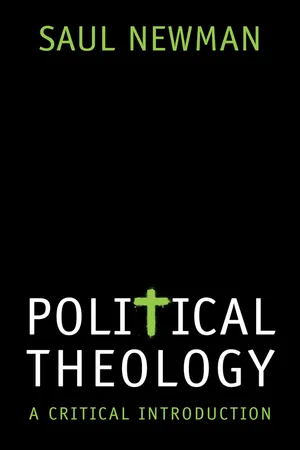
God is dead, but his presence lives on in politics. This is the problem of political theology: the way that theological ideas find their way into secular political institutions, particularly the sovereign state.
In this intellectual tour-de-force, leading political theorist Saul Newman shows how political theology arose alongside secularism, and relates to the problem of legitimising power and authority in modernity. It is not about the power of religion so much as about the religion of power. Examining the current crisis of the liberal order, he argues that recent phenomena such as the rise of populism, the renewed demand for strong national sovereignty and the return of religious fundamentalism may be understood through this paradigm. He illustrates his argument through an exploration of themes such as sovereignty, democracy, economics, technology, ecological catastrophe, messianism and the future of radical politics, engaging with thinkers ranging from Schmitt and Hobbes to Stirner, Foucault, and Agamben.
This book will be a crucial text for all students, scholars and general readers interested in the meaning and significance of political theology for political theory.
- English
- ePUB (mobile friendly)
- Available on iOS & Android
eBook - ePub
About this book
Information
1
The Politico-Theological Problem
In the hope – a vain one perhaps – of stealing a march on political theology and routing it from the outset, I propose to begin the discussion of this topic from an unexpected place. While it is customary to start with Schmitt and his now famous 1922 work Politische Theologie (Schmitt, 2005), I want to take as my point of departure an earlier figure, whose political commitments could not be more different from the German jurist's. It is not often recognised that the term ‘political theology’, commonly attributed to Schmitt, actually comes, at least in its modern variation, from the nineteenth-century Russian anarchist Mikhail Bakunin. In a polemical essay from 1871 titled ‘La théologie politique de Mazzini et l’Internationale’, Bakunin reproaches the great Italian politician and republican Guiseppe Mazzini for illegitimately mixing religion and politics. Mazzini's revolutionary role in the formation of the Italian state was marred, for Bakunin, by his Christianity and religious idealism – a theological abstraction that led him to turn against the cause of human emancipation and progress. Mazzini was the ‘last high priest of religious, metaphysical, and political idealism which is disappearing’ (Bakunin, 1871).
The idealist, whether of the religious, philosophical or political kind – it is all the same to Bakunin – is one who abstracts moral principles from the materiality of life, suspending them above the living forces of society, as if from heaven over earth, and turning them against humanity. That is why, according to Bakunin, religion has usually been on the side of the state, why the theologian is also a political absolutist, and why sovereignty has cloaked itself in religious ideology. Just as God transcends the world and nature, the state transcends and stands above society; the same principle of absolute sovereignty is at work in both. Moreover, the reason why religious idealists and political absolutists reach the same conclusions is that both proceed from the doctrine of original sin, which leads them to the same ‘melancholy destiny’: man is not to be trusted, and therefore needs the moral authority of religion and the political authority which can only come from a strong state. Schmitt, as we shall see, reasons in exactly this way. This metaphysical abstraction from the real world is intolerable to Bakunin, and it was his outrage at this that led him to declare himself on the side of Satan in his rebellion against God's authority. Satan was the first real humanist and anarchist. Modern revolutions – exemplified by the Paris Commune of 1871 – were thus ‘the audacious realization of the Satanic myth, a revolt against God; and today as always the two opposing parties are ranged, the one under the standard of Satan or of liberty, the other under the divine banner of authority’ (Bakunin, 1971). For Bakunin, we are confronted with a great conflict between the forces of idealism and political reaction (the church, state and capital, shrouded in phantasms, with their assorted array of ideologues, metaphysicians and political theologians such as Mazzini – but there are worse) and the progressive forces of materialism, atheism, internationalism and revolutionary socialism, which in the end will prevail.
Bakunin's implacable critique of political theology1 is of major concern to Schmitt. Indeed, Bakunin is revealed in Political Theology and elsewhere as one of Schmitt's chief antagonists, one who best represents modernity's assault on the sanctity of the state. In fact I would go as far as to suggest that Schmitt's whole politico-theological apparatus and his theory of the sovereign state of exception are mobilised precisely against the threat posed by the kind of atheistic and materialist revolutionary politics that Bakunin represents. If there is a relationship of enmity at work in Schmitt's political theology, Bakunin and the anti-politico-theological gesture of revolutionary anarchism emerge as the real enemy.
I will return to this question later. However, it will be the aim of this chapter to explore Schmitt's particular and highly influential interpretation of political theology and to understand the kinds of questions and problems he was responding to. Schmitt's at times enigmatic account of political theology will be clarified by exploring a number of debates – not only with anarchism (with which there could be no ‘debate’ as such, only outright war, something akin to a religious war), but also with key interlocutors such as Leo Strauss, the theologian Erik Peterson, and the Jewish philosopher Jacob Taubes. Here I will illustrate my central thesis that the problem of political theology is really the problem of power itself.
Political Theology
Schmitt wrote his Political Theology at a time of political crisis – in some ways like our own time. His work can be seen as a response to the lack of legitimacy of the Weimar Republic, a political order weakened and destabilised not only by economic dislocation and hyperinflation, but also by the forces of political radicalism. However, for the conservative Weimar jurist, this instability was indicative of the deeper crisis of liberal modernity, in which atheism, capitalism and technology worked to neutralise the dimension of the political and to deny modern societies a place of transcendence that was once provided by religion.2 Indeed, the constitutional liberal state was itself an embodiment of this nihilism and loss of political meaning – it had become, or was in danger of becoming, a mere administrative machine without genuine political substance and without a transcendent or sacred dimension that would act as a point of legitimacy for public order. What was missing in the Weimar state was the ‘spirit’ of sovereignty, which was essential to any genuine political order. Schmitt is concerned above all with the need for a stable order in society, something that could only be achieved through a coherent political form or ‘idea’. It was this that led Schmitt to affirm an authoritarian and decisionist account of sovereignty and that explains, at least in part, his attraction to Nazism some years later. Schmitt's decision to republish Political Theology in 1934 may be seen in the context of his political support for the Nazi regime, which had recently come to power, and his seeing the Nazi (counter)revolution as the redemption and salvation of the German state.3
Schmitt's return to the theme of political theology many years later shows that the connection between religion and politics was a question that preoccupied him throughout his life. As a political theologian, his concern is to understand the conditions of secularism and the threat it poses to politics, as well as to find new sources of political authority and legitimacy. In other words, modern secularism makes the politico-theological problem – the loss of transcendence in society – particularly acute. Influenced by Max Weber, Schmitt accepted the secularisation hypothesis although he rejected its liberal conclusions. In other words, he accepted the idea that modernity is founded on a progressive secularisation of religious concepts and categories resulting in an experience of ‘disenchantment’ – a loss of a sacred, transcendent dimension in society. Schmitt's (2005: 36) own version of the secularisation thesis is summarised in the following oft-quoted passage in Political Theology:
All significant concepts of the modern theory of the state are secularized theological concepts not only because of their historical development – in which they were transferred from theology to the theory of the state, whereby, for example, the omnipotent God became the omnipotent lawgiver – but also because of their systematic structure, the recognition of which is necessary for a sociological consideration of these concepts. The exception in jurisprudence is analogous to the miracle in theology.
Schmitt proposes a ‘sociology’ of political and juristic concepts based on a series of analogies with theological categories. Just as Bakunin perceived in his anti-political theology, there was, for Schmitt, a clear structural parallel between the absolute authority of God and the absolute authority of the sovereign; similarly, the state of exception – in which the legal constitution is suspended by the sovereign's decision – is similar to God's miracle that suspends the laws of nature.
By highlighting these structural analogies, Schmitt is not so much reflecting on the persistence of religion in politics, but rather pointing to the place of transcendence left vacant by the collapse of the theological world in the sixteenth century and to the way in which secular political concepts of the state have subsequently struggled to fill this void. Once again, religion and theology are present in modernity precisely in the form of their absence – an absence that leaves an indelible trace on our political experience. As theological authority diminishes, there are a series of displacements and substitutions of its conceptual categories, which find their way into the historical understanding of sovereignty and create a place of transcendence that allows a political order to be instituted: ‘To the conception of God in the seventeenth and eighteenth centuries belongs the idea of his transcendence vis-à-vis the world, just as to that period's philosophy of state belongs the notion of the transcendence of the sovereign vis-à-vis the state’ (Schmitt, 2005: 49). Thus, in the seventeenth century – in the age of deism, in which natural law supplanted the miracle – it was still possible to think of God as the sovereign architect of the world; Leviathan was still a ‘mortal god’. And even in the eighteenth century, the age of Enlightenment rationalism, one finds theological ideas creeping, for instance, into Rousseau's divine-like legislator. There is a politicisation of theological concepts as a way of speaking about sovereignty.
However, this way of thinking becomes increasingly impossible in the nineteenth century, which Schmitt characterises as the age of immanence. Here, under the influence of liberal economics, atheistic materialism and new scientific modes of investigation, the world comes to coincide entirely with itself and there is no longer space for transcendence, in either a theological or a political sense. Thus, in the modern concept of democracy, in which the division between ruler and ruled is eclipsed, as well as in modern liberal concepts of the state, in which the sovereign coincides absolutely with the state and the state ...
Table of contents
- Cover
- Table of Contents
- Title page
- Copyright page
- Acknowledgements
- Introduction
- 1: The Politico-Theological Problem
- 2: Max Stirner and the Ghosts of the Secular Modern
- 3: God Is Unconscious
- 4: Auctoritas non veritas
- 5: Pastoral Power and Political Spirituality
- 6: Economic Theology
- 7: Conclusion
- References
- Index
- End User License Agreement
Trusted by 375,005 students
Access to over 1.5 million titles for a fair monthly price.
Study more efficiently using our study tools.
Frequently asked questions
Yes, you can cancel anytime from the Subscription tab in your account settings on the Perlego website. Your subscription will stay active until the end of your current billing period. Learn how to cancel your subscription
No, books cannot be downloaded as external files, such as PDFs, for use outside of Perlego. However, you can download books within the Perlego app for offline reading on mobile or tablet. Learn how to download books offline
Perlego offers two plans: Essential and Complete
- Essential is ideal for learners and professionals who enjoy exploring a wide range of subjects. Access the Essential Library with 800,000+ trusted titles and best-sellers across business, personal growth, and the humanities. Includes unlimited reading time and Standard Read Aloud voice.
- Complete: Perfect for advanced learners and researchers needing full, unrestricted access. Unlock 1.5M+ books across hundreds of subjects, including academic and specialized titles. The Complete Plan also includes advanced features like Premium Read Aloud and Research Assistant.
We are an online textbook subscription service, where you can get access to an entire online library for less than the price of a single book per month. With over 1.5 million books across 990+ topics, we’ve got you covered! Learn about our mission
Look out for the read-aloud symbol on your next book to see if you can listen to it. The read-aloud tool reads text aloud for you, highlighting the text as it is being read. You can pause it, speed it up and slow it down. Learn more about Read Aloud
Yes! You can use the Perlego app on both iOS and Android devices to read anytime, anywhere — even offline. Perfect for commutes or when you’re on the go.
Please note we cannot support devices running on iOS 13 and Android 7 or earlier. Learn more about using the app
Please note we cannot support devices running on iOS 13 and Android 7 or earlier. Learn more about using the app
Yes, you can access Political Theology by Saul Newman in PDF and/or ePUB format, as well as other popular books in Philosophy & Political Philosophy. We have over 1.5 million books available in our catalogue for you to explore.