“An essential guide to the engine that drives the early adoption of disruptive innovations.”
--Geoffrey Moore, Author, Crossing the Chasm and Zone to Win
HOW COMPANIES CAN VAULT AHEAD
BY DEVELOPING, MARKETING,
AND DELIVERING SUPERIOR EXPERTISE
“Thought leadership” is now a core part of the business lexicon. Numerous corporate websites devote whole sections to it. Entire conferences are built around it (TED and the World Economic Forum as the most exclusive ones). It’s at the center of sophisticated, high-ticket PR campaigns. Thousands of people are making careers of it. And companies from Fidelity Investments, Adobe and Cigna to PwC, Accenture and Spotify have people in charge of it.
Interest in the field of thought leadership is white hot -- just like the buzz created by illustrious thought leaders when they bring groundbreaking ideas to market. So it’s about time the topic of thought leadership itself got a substantive treatment.
In Competing on Thought Leadership, Robert Buday boldly delivers it. He defines thought leadership concretely: as the acclaim that a firm or a person earns for developing, marketing and delivering superior expertise in solving complex customer problems. And he defines it broadly -- as a business strategy, not just a marketing strategy.
Buday also brings to bear his client work and research since the 1980s in helping companies and individuals inside them become known worldwide as leading experts in their field, which in turn has increased their revenue and profit multifold.
This book focuses on how businesses that sell services and products to other businesses can thrive on thought leadership. It takes the lessons learned at some of the best firms in the world at selling expertise – consulting, accounting, law, financial services and technology firms – and makes them practical for every B2B firm.
Yet the principles of Competing on Thought Leadership apply to all organizations – for-profit and non-profit alike -- that must demonstrate superior expertise in solving complex problems. Consumer companies, charitable foundations and other organizations, too, can benefit greatly from adopting these best practices in thought leadership.
Trusted by 375,005 students
Access to over 1.5 million titles for a fair monthly price.
THE FORCES THAT HAVE BROUGHT THOUGHT LEADERSHIP TO THE FORE
CHAPTER 1
A MORE ENCOMPASSING DEFINITION OF THOUGHT LEADERSHIP
THE WORDS “THOUGHT LEADERSHIP” have become part of the corporate lexicon. They seem to appear in just about every business-to-business company website (e.g., “Insights” sections that dispense organizational wisdom). They pop up in numerous job postings (e.g., “Global Head of Thought Leadership”). They can be found in many PR plans (e.g., “Make the CEO a recognized thought leader on XYZ”). And they are slapped as a label on seemingly every white paper, conference presentation and other documents to make their ideas appear more novel and substantive than they perhaps are.
It seems every B2B company these days, and especially the ones that sell expertise by the hour, wants to be viewed as a “thought leader.” And so do many software, financial services and other companies that want to demonstrate the expertise of the people who produce and deliver those offerings. In fact, fortunes have been made by professional services firms that turned their expertise into world-recognized concepts.
Yet the chances for a B2B company’s “thoughts” to become block-buster ideas are slim. The competition for executive mindshare is ferocious. Google and social media make it easy for executives to find content on just about every topic, and for companies to spread their ideas.
Moreover, the easy availability of digital tools for spreading ideas and building your brand has created a deafening marketplace of ideas, where it’s easy for fast-buck peddlers to pretend to be something that they’re not. The sheer number of authoritative-sounding websites that include “thought leadership” make it difficult for B2B companies that need real solutions to identify those that are truly proven and effective. And perhaps the most troubling aspect of the thought leadership profession today is that even when a firm can offer proven ideas, it may not have the capacity to deliver when potential clients find them.
So let’s cut through the clutter by defining what thought leadership really is:
Thought leadership is the acclaim that an organization or individual achieves by becoming known for providing superior expertise that solves a complex problem.
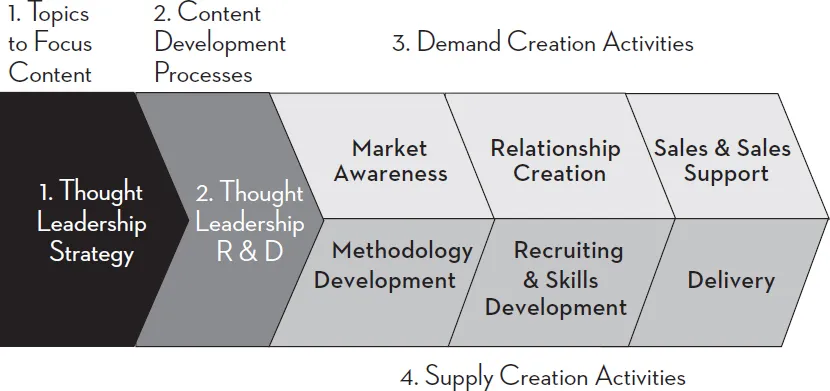
Thought leaders are people and the organizations they work for that develop, deliver, market and sell solutions (advice, training, software and other offerings) that are better at solving certain problems of people, organizations and the greater society. Firms that gain substantial and sustainable market advantages with thought leadership excel in four areas:
1. They focus their thought leadership resources on building deep and superior expertise on a small number of client problems. Of course, the bigger the firm, the greater the number of client problems it can focus on; the smaller the firm, the fewer. Deciding which client problems to focus on is at the core of an effective thought leadership strategy.
2. They create groundbreaking ideas about how to solve the client problems they’ve decided to “own.” A key way they create such ideas is by conducting primary research and collecting key lessons from their client projects. They create content that codifies the superior ways they solve client problems, based on this research and client experience. These activities are, in effect, their thought leadership research and development engine.
3. They turn their thought leadership R&D content into material that becomes a wellspring for marketing and sales campaigns: books, research reports, op-ed submissions, conference presentations, etc.
4. They also turn their thought leadership content into methodologies and internal training curricula. By doing so, they increase the number of people in their firms who can deliver this expertise to clients at a high level of quality.
THE 4 PILLARS OF THOUGHT LEADERSHIP
As you can see, marketing and sales (i.e., demand creation) are just one of the four pillars — albeit an important one. But if you’ve read the more than 30 books on thought leadership over the last 20 years, you’d think it was the only one. It isn’t, and it can’t be — not if your firm wants to outpace competitors by providing expertise that is superior at solving your customers’ problems.
This is a broader definition of thought leadership. Companies that adopt it recognize that they are competing on the basis of thought leadership — not just marketing on that basis.
Defined this way, CSC Index was squarely competing on the basis of thought leadership. But it didn’t take the supply-creation piece nearly as seriously as the demand-generation piece.
Since the turn of the 21st century, many other firms have begun to take notice of how consulting firms used thought leadership to expand their businesses. The practice of thought leadership has been adopted and embraced by companies in the software, wealth management, law, architecture and accounting industries, among others.
The race to be recognized as a preeminent expert has been in full swing. And like business reengineering, a number of blockbuster concepts have had their moments: Clayton Christensen’s concept of “disruptive innovation” (followed by Silicon Valley startups and their financiers, which have transformed the media, retail, transportation, advertising and other sectors); Bain & Company’s customer loyalty and Net Promoter Score consulting services (forcing companies to root out poor service); various quality improvement methods (Six Sigma, TQM, etc.); and the lean startup, to name just a few.
Each concept helped organizations that adopted them improve their businesses, often substantially. And, of course, they have enabled the producers of the concepts to grow their own businesses.
What is of little doubt is that the concept behind these concepts — of competing on the basis of thought leadership — has gained substantial traction since the 1990s. How do I know this? I see five telltale signs:
• The explosion of books that use the phrase “thought leadership.”
• The ascension of conferences designed purely to feature thought leaders, and only thought leaders.
• The deluge of blog posts by both accomplished people and dilettantes opining on seemingly every topic under the sun.
• The rise of B2B companies that aren’t in the publishing business to publish thought leadership periodicals.
• The hundreds of thousands of people around the world with thought leadership in their job titles or job descriptions.
Let’s explore each one.
THE 21ST CENTURY THOUGHT LEADERSHIP GOLD RUSH
There’s nothing magical about the year 2000. The 20-year uptake of thought leadership practices outside the management consulting industry began before then. But it gained steam after the turn of the century. A number of indicators, the first ...
Table of contents
Cover
Praise for Competing on Thought Leadership
Title Page
Copyright Page
Dedication
Contents
Prologue: Life at the Epicenter of a Blockbuster Concept
Part I: The Forces That Have Brought Thought Leadership to the Fore
Part II: Organizing and Steering Thought Leadership
Part III: Creating Breakthrough Ideas
Part IV: Attracting the Right Audience to Your Content
Part V: Scaling Expertise
Part VI: Turbocharging Thought Leadership
Epilogue
Acknowledgments
Endnotes
Index
Frequently asked questions
Yes, you can cancel anytime from the Subscription tab in your account settings on the Perlego website. Your subscription will stay active until the end of your current billing period. Learn how to cancel your subscription
No, books cannot be downloaded as external files, such as PDFs, for use outside of Perlego. However, you can download books within the Perlego app for offline reading on mobile or tablet. Learn how to download books offline
Perlego offers two plans: Essential and Complete
Essential is ideal for learners and professionals who enjoy exploring a wide range of subjects. Access the Essential Library with 800,000+ trusted titles and best-sellers across business, personal growth, and the humanities. Includes unlimited reading time and Standard Read Aloud voice.
Complete: Perfect for advanced learners and researchers needing full, unrestricted access. Unlock 1.5M+ books across hundreds of subjects, including academic and specialized titles. The Complete Plan also includes advanced features like Premium Read Aloud and Research Assistant.
Both plans are available with monthly, semester, or annual billing cycles.
We are an online textbook subscription service, where you can get access to an entire online library for less than the price of a single book per month. With over 1.5 million books across 990+ topics, we’ve got you covered! Learn about our mission
Look out for the read-aloud symbol on your next book to see if you can listen to it. The read-aloud tool reads text aloud for you, highlighting the text as it is being read. You can pause it, speed it up and slow it down. Learn more about Read Aloud
Yes! You can use the Perlego app on both iOS and Android devices to read anytime, anywhere — even offline. Perfect for commutes or when you’re on the go. Please note we cannot support devices running on iOS 13 and Android 7 or earlier. Learn more about using the app
Yes, you can access Competing on Thought Leadership by Robert Buday in PDF and/or ePUB format, as well as other popular books in Business & Marketing. We have over 1.5 million books available in our catalogue for you to explore.