How Christian Communities Can Better Engage Disability Justice
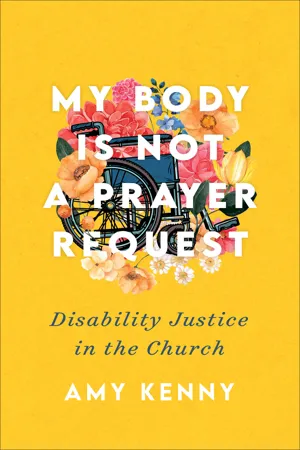
Much of the church has forgotten that we worship a disabled God whose wounds survived resurrection, says Amy Kenny. It is time for the church to start treating disabled people as full members of the body of Christ who have much more to offer than a miraculous cure narrative and to learn from their embodied experiences.
Written by a disabled Christian, this book shows that the church is missing out on the prophetic witness and blessing of disability. Kenny reflects on her experiences inside the church to expose unintentional ableism and cast a new vision for Christian communities to engage disability justice.
Offering a unique blend of personal storytelling, fresh and compelling writing, biblical exegesis, and practical application, this book invites readers to participate in disability justice and create a more inclusive community in church and parachurch spaces. Engaging content such as reflection questions and top-ten lists are included.
"A convincing case for all Christians to do more to meet access needs and embrace disabilities as part of God's kingdom. . . . Inclusivity-minded Christians will cheer the lessons laid out here."--Publishers Weekly
"A book the church desperately needs."--Sojourners
- 208 pages
- English
- ePUB (mobile friendly)
- Available on iOS & Android
eBook - ePub
About this book
Information
Topic
Theology & ReligionSubtopic
Christian Ministry1
Disability Curatives
God told me to pray for you,” she says. Her words linger like cloying perfume in a claustrophobic space. “God wants to heal you!” She is undoubtedly thrilled with this opportunity.
I’ve been here before. It never ends well.
This woman does not know me. She doesn’t have the intimacy that prayer or accountability or sarcasm require. She simply interprets my cane as something that requires “fixing” and ropes God into her ableism, the belief that disabled people are less valuable or less human than our nondisabled counterparts.1 Internally, I make a swift calculation: endure the prayer to avoid squabble, or call her out on her benevolent eugenics and be branded a heretic again.
I used to play the game. Eavesdropping as they prayed for my broken body, trying to conceal my spasms lest they be confused for demonic convulsions. I thought if I could just assume a veneer of piety, it would inoculate me against their patronizing prayers and invasive interrogations. I believed that I could perfect my way out of people demeaning disability, that somehow my patience would endow me with enough worth in their minds to be considered fully human. All it did was put me on a carousel of dehumanization that made me feel complicit in their toxic theology.
So I choose door B. “I don’t need prayer for healing. My body has already been sanctified and redeemed,” I choke out. I know it won’t be enough, but my dignity is not up for debate, particularly here, in God’s house. Only a second has passed, but there is a lifetime between us.
Bewildered, she blocks my path, grabbing my forearm so I can’t leave until I suffer her pontification. “You need to hear that God wants to heal you. If you stopped resisting, you would be free already.” Free. All I want to be free from is her. All I need to be liberated from is the notion that disability is inherently deviant and in need of eradication.
I am the embodiment of her worst-case scenario because I don’t need her to rescue me. I am what every athlete fears and what pregnant parents dread. I am the catalyst for losing faith and questioning God. Theodicy runs through my veins. I am every villain in every superhero movie ever made. People call my murderers “merciful” because I am a burden and a drain and a waste. I am disabled.
This woman is an echo of every prayerful perpetrator before her. They have many faces, but they always approach me with the same paternalistic confidence, eager to rid me of my wheelchair or cane. On repeat, they applaud the stories where Jesus healed a disabled outcast like me, without stopping to consider that curing bodies and healing lives are not the same thing. They are too hyped up on their divine intervention to realize they are not the savior in my story. A poor, brown-skinned refugee named Jesus is.
Flummoxed, the woman snaps that I have given up, that God wants more for me than life in a wheelchair. That Jesus’s divine touch is waiting whenever I am willing to receive. The mark of her nails dissipates long before her words do.
They think they are being faithful; that much I want to believe. But some days it is hard to convince myself of their pure intentions because I am the only one who emerges singed by these encounters. This woman uses the prayer card to justify imposing her prejudice on a stranger she assumes despises being disabled. I am not confined to my wheelchair. I have not lost a battle to a disease. I am many things, but a tragic defeat is not one of them.
Afterward I replay the encounter in my mind, wondering what I should have said differently, knowing there will be a next time. I wish I was whole in their minds—enough to exist without needing a prayerful remedy to cast out my “demons,” a full human who has something to offer other than a miraculous narrative. I wish I could be more than my diagnosis, more than a problem in need of fixing, as if my disability is only valuable if converted into a cure. I wish prayerful perpetrators were free from the lie that I am worth less simply because my body works differently. In each of these encounters, I come away feeling like my stomach has just dropped out on a roller coaster. I am confused by the way people interpret my disability as in need of “fixing” without knowing anything else about me. I am troubled that my body becomes public property they feel they have the right to control. I am indignant that this takes place under the veil of Jesus-following, as though they are the bouncers to God’s table. I am hurt that I must justify my own existence at church. Belonging shouldn’t have the admission price of assimilation.
My story is not unique. Most of my disabled friends have their own stories of strangers approaching them to pray away their disabilities, sometimes at church, other times on public transport or at the grocery store. No place is safe from prayerful perpetrators. It’s draining to endure, especially because the people who do this don’t intend to cause us harm. They just haven’t considered how the assumption that disability needs “fixing” is dehumanizing.
Some of the irony is that my life isn’t disastrous or deficient at all. Most days, my disability isn’t the worst part of my day, or even what I need prayer for. To assume that my disability needs to be erased in order for me to live an abundant life is disturbing not only because of what it says about me but also because of what it reveals about people’s notions of God. I bear the image of the Alpha and the Omega. My disabled body is a temple for the Holy Spirit. I have the mind of Christ. There’s no caveat to those promises. I don’t have a junior holy spirit because I am disabled. To suggest that I am anything less than sanctified and redeemed is to suppress the image of God in my disabled body and to limit how God is already at work through my life. Maybe we need to be freed not from disability but from the notion that it limits my ability to showcase God’s radiance to the church. What we need to be freed from is ableism.

“If your hand causes you to sin, cut it off. It is better for you to enter life crippled than with two hands to go to hell, to the unquenchable fire. And if your foot causes you to sin, cut it off. It is better for you to enter life lame than with two feet to be thrown into hell. And if your eye causes you to sin, tear it out” (Mark 9:43–47 ESV). We get it, Jesus. It’s better to be lame, blind, and crippled than go to hell. It feels a little extreme to perform voluntary amputations to avoid sin. We’d have a lot more folks with amputations in our midst if we took this literally. Yet Jesus still claims that disability becomes a way to encounter God or a preventative remedy for sin, suggesting that being nondisabled might enhance temptation. I am not trying to initiate a #CutItOff movement, but I wish the church could interpret my disabled body in this way: as a mark of holy living, an antidote to sin, and a way to reveal God to the surrounding community. Churchgoers have been too hasty to dismiss passages of Scripture where disability is celebrated as a blessing or a prophetic witness, because it doesn’t fit their neat cultural narrative of disability making people uncomfortable. Imagine if prayerful perpetrators #CutItOff instead of trying to pray me away.
This isn’t the only time Jesus talks about disability as a teacher and a way to reveal God to nondisabled people. When Jesus encountered a man born blind in Jerusalem, “his disciples asked him, ‘Rabbi, who sinned, this man or his parents, that he was born blind?’ Jesus answered, ‘Neither this man nor his parents sinned; he was born blind so that God’s works might be revealed in him’” (John 9:2–3). Just like the prayerful perpetrators who approach my wheelchair with head tilts and side-glances, the disciples interpret this man solely as his disability. They are so caught up in prescribing the cause of his disability that we don’t even learn his name. Do they even know it, I wonder? He’s known as the man formerly known as blind, which sounds like a dad joke about Prince. I hate that he is not given a name, as though he is unknown and forgotten, not important enough to name. I know what it’s like to be reduced to a diagnosis, and I want this man to be given more humanity and dignity than that. So let’s call him Zechariah, which means “God remembers.” Zach is so much more than his blindness. “I am the man,” he confidently enlightens his neighbors, wanting them to know who he really is, in addition to his disability (v. 9). We also get a sense of his personality throughout the chapter: he’s not afraid to challenge authority figures, and he’s feisty. He seems like someone who would use the eye-roll and face-palm emojis with regularity. (Who doesn’t?) Zach advocates for himself when confronted by his neighbors because he knows who he really is. Perhaps the disciples never initiated a conversation with him because in their minds, Zach’s identity is his blindness—a blindness that they incorrectly conflate with sin.
It’s easy to dismiss the disciples as the villains here, but they surely think they are being faithful to common theology inherited from Leviticus. They aren’t excluding Zach for the sake of excluding, like Mean Girls, but want to remain faithful to their notions of who is in and who is out. In their minds, it’s much simpler if there’s a neat conflation of sin and disability. Much like prayerful perpetrators, the disciples understand the disabled body as public property they can control, interpret, and reject. No disabled person can sit with them.
Before you judge the disciples, you should know that a 2018 poll found that 67 percent of people feel “uncomfortable” talking to a disabled person.2 Disabled people make up about 25 percent of the US population, and 15 percent of the global population, yet we still make the majority of our neighbors uncomfortable, simply by existing.3 Any body who doesn’t fit in a tidy box of cured or “normal” makes other people feel out of place. It is no wonder the disciples don’t know anything about Zach other than his blindness. They don’t bother to get involved in his life because they think they are better than him.
Jesus is having none of it. Jesus inverts their idea of blindness by showing the disciples that disability becomes a place of encounter with the glory of God. Jesus interacts with Zach directly, talking not just about him, but to him and with him. According to Jesus, Zach’s blindness didn’t result from his or his parents’ sin, but instead his blindness displays God. What a powerful, subversive statement: disability helps reveal the Light of the World to people who think of themselves as holier than disabled people. Disability is no longer a symbol of sin but one of being open to revelation. Disability unveils God’s work to the community, if only people are willing to receive it.
Jesus returns to this messaging later, claiming that he’s come to the world “so that those who do not see may see, and those who do see may become blind” (John 9:39). While this is directed at Jesus’s audience, it offers a lesson for modern Jesus followers. If our primary perception of ourselves is as people who can see, hear, or walk—over those who can’t do those things—the sin of stereotyping and excluding remains prevalent. According to Jesus, those who think of themselves as “able-bodied” may be in more need of healing than those who are disabled. “But that’s figurative,” you’re tempted to clap back. Paul, blinded on the road to Damascus, begs to differ. Figurative or not, the fact that a disabled person makes two-thirds of us uncomfortable exposes the need for deeper healing. Instead of dismissing these statements as merely figurative, we should consider how to embrace disability as a mark of greater understanding about God. Disability acts as a method for revealing the living God to the community, not something that always needs to be prayed away to showcase God’s power. Imagine if the prayerful perpetrator approached my wheelchair with reverence and awe instead of condemnation and accusation. Maybe then they would be able to witness the glory of God revealed through my disabled body.
Perhaps the biggest surprise in this passage is that receiving sight doesn’t magically improve everything (or anything?) for Zach. Quite the opposite, in fact. It amplifies the way he is ostracized by people who think they understand Scripture better than him. His neighbors fancy themselves detectives on Law & Order: Jerusalem, interrogating everyone to get to the truth of how and why and when he was first able to see. “They reviled him, saying, ‘You are his disciple, but we are disciples of Moses. We know that God has spoken to Moses, but as for this man, we do not know where he comes from. . . . You were born entirely in sins, and are you trying to teach us?’ And they drove him out” (John 9:28–29, 34). The neighbors are so suspicious of Zach’s miraculous story that they expel him, baptizing their actions in spiritual language to make them seem holy. Zach receives his sight on the Sabba...
Table of contents
- Cover
- Endorsements
- Title Page
- Copyright Page
- Dedication
- Contents
- A Note on Language
- Preface
- 1. Disability Curatives
- 2. Disability Discrimination
- 3. Disability Doubters
- 4. Disability Justice
- 5. Disability Blessings
- 6. Disability Mosquitos
- 7. Disability Lessons
- 8. Disabled Foundations
- 9. Disabled God
- 10. Disabled Church
- Benecription for Nondisabled People
- Benecription for Disabled People
- Acknowledgments
- Further Reading
- Back Ad
- Back Cover
Trusted by 375,005 students
Access to over 1.5 million titles for a fair monthly price.
Study more efficiently using our study tools.
Frequently asked questions
Yes, you can cancel anytime from the Subscription tab in your account settings on the Perlego website. Your subscription will stay active until the end of your current billing period. Learn how to cancel your subscription
No, books cannot be downloaded as external files, such as PDFs, for use outside of Perlego. However, you can download books within the Perlego app for offline reading on mobile or tablet. Learn how to download books offline
Perlego offers two plans: Essential and Complete
- Essential is ideal for learners and professionals who enjoy exploring a wide range of subjects. Access the Essential Library with 800,000+ trusted titles and best-sellers across business, personal growth, and the humanities. Includes unlimited reading time and Standard Read Aloud voice.
- Complete: Perfect for advanced learners and researchers needing full, unrestricted access. Unlock 1.5M+ books across hundreds of subjects, including academic and specialized titles. The Complete Plan also includes advanced features like Premium Read Aloud and Research Assistant.
We are an online textbook subscription service, where you can get access to an entire online library for less than the price of a single book per month. With over 1.5 million books across 990+ topics, we’ve got you covered! Learn about our mission
Look out for the read-aloud symbol on your next book to see if you can listen to it. The read-aloud tool reads text aloud for you, highlighting the text as it is being read. You can pause it, speed it up and slow it down. Learn more about Read Aloud
Yes! You can use the Perlego app on both iOS and Android devices to read anytime, anywhere — even offline. Perfect for commutes or when you’re on the go.
Please note we cannot support devices running on iOS 13 and Android 7 or earlier. Learn more about using the app
Please note we cannot support devices running on iOS 13 and Android 7 or earlier. Learn more about using the app
Yes, you can access My Body Is Not a Prayer Request by Amy Kenny in PDF and/or ePUB format, as well as other popular books in Theology & Religion & Christian Ministry. We have over 1.5 million books available in our catalogue for you to explore.