The Meeting of the Waters identifies seven trends having a major impact on the Church around the world—and on every Christian at home in every country. The global community of Christians is stunning in its scope and spiritual impact. But what is happening to the Church as new technology, marketing, and generational shifts make their unavoidable mark? And what difference does it make for Christians in day-to-day life? Equal parts travelogue, character study, and global documentary, The Meeting of the Waters interlaces stories and instruction in the tradition of Freakonomics, The World Is Flat, and The Tipping Point. This breakthrough book is for any Christian eager to make a difference in a changing world.
eBook - ePub
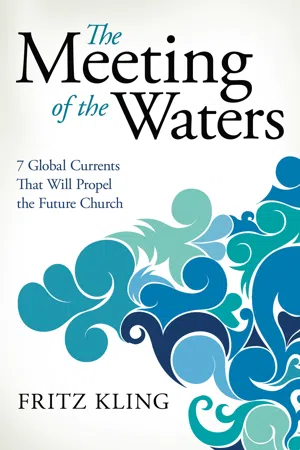
The Meeting of the Waters
7 Global Currents That Will Propel the Future Church
- 240 pages
- English
- ePUB (mobile friendly)
- Available on iOS & Android
eBook - ePub
About this book
Information
Topic
Theology & ReligionSubtopic
Christian ChurchCHAPTER 1
The 7 Global Currents
All Bets Are Off
“The expectations are unreasonable! I am but one small pastor in a tiny church in Africa, but the challenges are getting greater and greater!” the Kenyan pastor vented during a tea break at a leadership conference in East Africa.
As a pastor’s kid, I thought I recognized those post-sermon insecurities and doubts. They had been my father’s constant carp. Today, friends of mine who are pastors admit to being tormented by the very same gremlins. But this was not a case of my father’s sermon angst.
“You see,” the pastor continued, “what has happened is that quite a few of my parishioners have told me that they prefer the sermons of the televangelist whom they watch on TV before church every Sunday. Perhaps you have heard of the fellow, he’s an American … T. D. Jakes?”
“Oh my,” I said. Of course I knew of Jakes, who graced the cover of Time magazine in 2001 with the title “Is This Man the Next Billy Graham?” Jakes is a Dallas-based, African-American pastor who draws 30,000 worshipers to his church, has written several best-seller books, is pastor to the Dallas Cowboys and other celebrities, and runs anti-poverty programs in both Dallas and Kenya. He preached at a private church service for President-elect Obama on the morning of his inauguration and has prayed with the President on numerous phone calls.
That Kenyan pastor, who lacked formal training, a library, an assistant, or compensation, had pushed himself to work harder and harder to deliver sermons that were biblically truthful and culturally relevant. Suddenly, though, he found himself in a classic twenty-first-century bind. He was a Kenyan ministering to Kenyans in Kenya, but he had been unwittingly thrust into a global, cross-cultural dilemma. He had not gone to another country as a missionary. Rather, another country (America, in this case) had come into his church—and his church would never be the same. America was not the problem: His parishioners could just as easily tune in to televised preachers from South Korea, Australia, or Germany.
The challenge facing the pastor was that global media seamlessly and invisibly infiltrated his Kenyan culture. Further, I believe that this “cultural creep” is not the exception, but rather the rule in most countries around the world.1
As I met more leaders like my Kenyan friend, I grew increasingly curious to know just which trends were on the loose, in which countries, and what changes they were causing. The answers were important to me as a foundation executive, as I directed grants around the world, but I felt that something much bigger was also at stake: whether the global church could unlearn old irrelevancies and learn new realities as it steered into the next era.
A mission scholar said, “If you really want to understand the future of Christianity, go and see what is happening in Asia, Africa, Latin America … that’s where the action is.”2 So, my colleagues and I decided to do just that. Between June 2006 and June 2007, we conducted 151 one-hour interviews with church leaders in nineteen countries. We called it the Global Church Listening Tour.
We interviewed indigenous seminarians, pastors, missionaries, and laypeople. We met them in churches, offices, schools, restaurants, tea shops, hotel rooms, trains, planes, cars, and boats throughout Asia, Africa, and Latin America. We asked all interviewees the following fifteen questions and transcribed their answers—about the state of the indigenous church in their country; the impact and effectiveness of Western missionaries and aid workers in their country; and the ways in which globalization is affecting local ministry in their country.
• With which denomination or church are you most closely affiliated?
• What are the three most urgent needs of the church in your country?
• What is the state of the church in your country?
• What are your dreams for the church in your country?
• What are the greatest strengths and weaknesses of people in your country, not just Christians?
• Which of the following are appropriate ways for the Western church to support the church in your country: short-term missions? Money? Evangelism? Church planting? Leadership development? Humanitarian aid?
• Describe the good and bad effects of missionaries in your country.
• Which country has sent the most missionaries to your country?
• What would you wish for foreign missionaries to know about your culture and society?
• As an American, I am curious to know what you think are the best and worst personal characteristics of American missionaries.
• Has the nature of relationships between foreign missionaries and local Christians changed in the past ten years?
• How are younger Christians different than their parents, and do they practice their faith differently?
• How has your country changed, for better or worse, in terms of culture, economics, politics, and religion because of other countries’ influence?
• Are there ministry approaches that are no longer as effective as they used to be because of changing times?
• Which countries have affected your country the most?
In conducting the Listening Tour, my colleagues and I consistently met with a telling response—surprise that Americans would travel to poorer countries, ask questions, and listen. An American foundation with large amounts of money seeking the insights of indigenous church leaders in the developing world? At first, this caused suspicion, but ultimately it spread profound encouragement.
Deeply appreciative of being asked, the survey participants were remarkably forthcoming and thoughtful. I felt honored as they shared with me their indigenous perspectives, reminding me of long-simmering issues and also opening my eyes to new on-the-ground realities.
As the Listening Tour data came in, seven prevalent trends began to emerge. These 7 Global Currents flow invisibly and powerfully, under and around the global church. As identified in the Listening Tour, they are:
1. Mercy: Social justice has become a global imperative, especially among youth and young adults. For Christians, this will lead to an increasing emphasis on meeting physical needs in addition to continuing the long-standing emphasis on evangelism.
2. Mutuality: Leaders from traditionally poor countries increasingly have education, access, technology, and growing economies … and they will demand to be heard. Global church leaders from traditionally powerful countries will need to account for these new perspectives and voices.
3. Migration: Relocation among nations and regions is on the rise and will be rampant—especially to cities—whether for jobs, war, schooling, tourism, or politics. All future Christian outreaches will need to adapt their message for radically diverse audiences.
4. Monoculture: The cultures of all countries will become more and more similar, thanks to the spread of worldwide images, ideals, celebrities, and ad campaigns. Christians seeking to communicate with global neighbors will need to be aware that marketing from outside their borders now shapes many of their deepest values.
5. Machines: Cell phones, GPS, television, and the Internet are transforming lifestyles worldwide. The future global church must recognize how newfound abilities to communicate, travel, and consume are changing individuals’ lives and values, too.
6. Mediation: While there is much talk of the world’s flattening, partisan rifts are actually proliferating. Splinter groups now have more communication avenues for inciting discord and attracting sympathizers than ever, and the global church must find a mediating role amid increasing polarization of all kinds.
7. Memory: Even as globalization reshapes the world, every nation and region has distinct histories that have profoundly shaped their society. Visitors must understand how yesterday affects today, in ways potentially undermining because they are invisible and unstated.
These Currents do not respect national or ethnic boundaries. Their invisibility makes them doubly potent, because they are relentless and dominant—but often overlooked. These Currents will powerfully alter the global church’s future direction—for good or evil—depending on how quickly and wisely the church reacts.

My job as executive director of a private foundation has afforded me an enviable string of private tutoring sessions from great leaders in the global church. One day I might meet with a publisher from Moscow, the next day a politician from Sierra Leone, and then a substance-abuse counselor from Mexico, a summer camp director from Romania, a seminary president from Egypt, a researcher from China, and a church planter from Ghana. I have also met American ministry greats: the urban ministry leader from Pasadena, the megachurch pastor from Manhattan, the substance-abuse counselor from Richmond, and the missions expert from Berkeley. It has all been part of the job.
My tutors come from more than one hundred nations, and not just the powerful ones. Although incredibly diverse, these men and women are consistent in how they describe their societies back home as modernizing and changing, rendering old stereotypes counterproductive. They do not characterize any single Global Current as totally negative or positive, but recognize that each of them could be harnessed for good or ill. The Currents are reliable tools for those who would help lead the global church into a bold and relevant future—to skate to where the puck is going to be.
I have been asked why today’s followers of Christ—in New Delhi or Lima or Sydney—should care about the 7 Global Currents. My best answer is that the Currents will help people to reconcile their faith with their world—to connect Sundays with the rest of the week and provide a perspective on religion’s centrality in the world today. The church’s mission is to represent Jesus Christ to the people of the world, and I believe that the Currents will help the church understand what those people are like and how they are changing.
The practice of watching the changing world and constantly adjusting approaches accordingly is second nature in so many fields, but not in the worldwide Christian church.3 Mission practitioners and scholars have traditionally focused on specific people, cultures, or countries—a noble undertaking as missionarie...
Table of contents
- Cover
- Endorsements
- Meeting of the Waters Photo
- Title
- Copyright
- Dedication
- Contents
- Foreword
- Introduction
- 1-The 7 Global Currents
- 2-Mercy
- 3-Mutuality
- 4-Migration
- 5-Monoculture
- 6-Machines
- 7-Mediation
- 8-Memory
- Conclusion
- Acknowledgments
- Notes
- Extras
Trusted by 375,005 students
Access to over 1.5 million titles for a fair monthly price.
Study more efficiently using our study tools.
Frequently asked questions
Yes, you can cancel anytime from the Subscription tab in your account settings on the Perlego website. Your subscription will stay active until the end of your current billing period. Learn how to cancel your subscription
No, books cannot be downloaded as external files, such as PDFs, for use outside of Perlego. However, you can download books within the Perlego app for offline reading on mobile or tablet. Learn how to download books offline
Perlego offers two plans: Essential and Complete
- Essential is ideal for learners and professionals who enjoy exploring a wide range of subjects. Access the Essential Library with 800,000+ trusted titles and best-sellers across business, personal growth, and the humanities. Includes unlimited reading time and Standard Read Aloud voice.
- Complete: Perfect for advanced learners and researchers needing full, unrestricted access. Unlock 1.5M+ books across hundreds of subjects, including academic and specialized titles. The Complete Plan also includes advanced features like Premium Read Aloud and Research Assistant.
We are an online textbook subscription service, where you can get access to an entire online library for less than the price of a single book per month. With over 1.5 million books across 990+ topics, we’ve got you covered! Learn about our mission
Look out for the read-aloud symbol on your next book to see if you can listen to it. The read-aloud tool reads text aloud for you, highlighting the text as it is being read. You can pause it, speed it up and slow it down. Learn more about Read Aloud
Yes! You can use the Perlego app on both iOS and Android devices to read anytime, anywhere — even offline. Perfect for commutes or when you’re on the go.
Please note we cannot support devices running on iOS 13 and Android 7 or earlier. Learn more about using the app
Please note we cannot support devices running on iOS 13 and Android 7 or earlier. Learn more about using the app
Yes, you can access The Meeting of the Waters by Fritz Kling in PDF and/or ePUB format, as well as other popular books in Theology & Religion & Christian Church. We have over 1.5 million books available in our catalogue for you to explore.