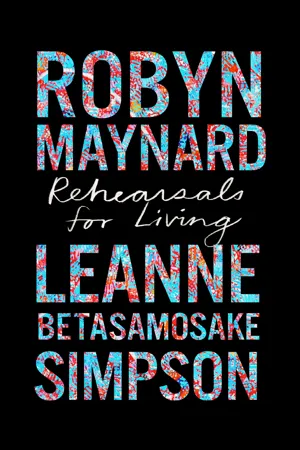
Amid the overlapping crises of a pandemic, ecological disaster, and global capitalism, two leading Black and Indigenous feminist theorists ask one another: what do liberated lands, minds, and bodies look like? These letters are part debate, part dialogue, and part lively and detailed familial correspondence between two razor-sharp thinkers, sending notes to each other during a stormy present. Featuring a foreword by Ruth Wilson Gilmore and an afterword by Robin D.G. Kelley.
- 250 pages
- English
- ePUB (mobile friendly)
- Available on iOS & Android
eBook - ePub
Rehearsals for Living
About this book
Information
Subtopic
Colonialism & Post-ColonialismIndex
Social SciencesPART ONE

On Letter Writing, Commune,
and the End of (This) World
and the End of (This) World
Dear Leanne,
About five years ago now, I sat down with a copy of your book, As We Have Always Done. I’d planned to flip through the first few pages over my morning coffee. In the end, though, I stayed put, reading almost the whole text in one go, and was suddenly overcome with a strong feeling that I wanted to know you. Your words beckoned me to join you in what you called “constellations of co-resistance”: constellations that affirmed life and world-making in a time of acute racial violence. We spoke on the phone shortly after. I remember that I was in a Subway restaurant in downtown Montreal, squatting the free Wi-Fi to do a final fact-check of some op-ed I’d written. I could barely make out your voice over the very loud—and very bad—music. I don’t recall the details of what we talked about, but I know that I have wanted to chart old and new constellations with you ever since.
I’ve been meaning to write you for a long time, and yet it’s hard to know where to begin. So I guess I will start where I’m at: I can’t stop doom-scrolling the multiple crises of our time.
At this moment, I’m preoccupied and filled with dread by the reports of rising temperatures, the just-about-last chances regularly announced by climate scientists, the continually shelved fact that things must be drastically and immediately shifted if we are to avoid “untold suffering.” I’m preoccupied with what goes unwritten in so many reports, but what I know in my bones: some communities’ “untold suffering” will vastly exceed that experienced by others. Some communities have been facing “untold suffering” for multiple generations.
I don’t want to live in this preoccupation, in this dread that sometimes comes to visit me and threatens to immobilize. So I suppose this is me reaching out, simply, for a levelling of the grounds beneath my feet. For communion. To help transform the source of this dread into a place from which we can, instead, plot, conspire, dream, and attend to life, otherwise. To attend to the celebration, the preservation of life, without eliding our own communities’ intimate proximity to death and loss. Talking and thinking with you has always helped me focus on the vitality, the livingness of the traditions that our work emerges from, regardless of what the last several centuries of European atrocities have wreaked on our peoples. Our conversations are a salve against the sharp edges of everyday life. But I don’t see you as much as I would like, and the phone is not my medium. So I’ve decided to write you this letter. I’m writing you a letter even though it feels cringey because I’m shy. I’m writing you a letter even though I may never send it, even though you may never write me back.
I am writing to you a letter at the end of (this) world.
From Cyclone Idai in Malawi, Mozambique and Zimbabwe to Hurricane Dorian in the Bahamas, the devastating forest fires displacing Indigenous communities from the Amazon rainforest through to the Mishkeegogamang Ojibway Nation in Northwest Ontario, our respective communities—that is, Black and Indigenous communities—are collectively positioned on the very forefront of the unfolding catastrophe.
It would require a deliberate obfuscation to view the racially uneven distribution of harms that the climate collapse engenders as accidental. Even if we didn’t take into account the melting of Arctic ice caps, rising sea waters, and eroded shorelines, desertification, and species extinction that are now nearly, if not totally, inevitable, the reality is that not only are an array of world-endings already before us: they have already arrived. Our respective communities have borne, already, multiple apocalypses that were inflicted upon us, if un-identically, from the “barbarity time” of genocide/slavery/settler colonialism. The apocalypse is imagined, after all, in most classic Euro-Western settler tropes, in terms of the lack of clean drinking water, the destruction of the places “we” (they) live, the poisoning of the earth, inhumane and restrictive responses to people left hungry, displaced, in desperation: this is a condition that is already deeply familiar to our kin across Turtle Island and globally. You wrote about this in Dancing On Our Turtle’s Back: “By 1822—when many Nishnaabeg in the north and the west were still living as they always had—we were facing the complete political, cultural, and social collapse of everything we had ever known. My ancestors resisted and survived what must have seemed like an apocalyptic reality of occupation and subjugation in a context where they had few choices.” To remix Public Enemy, “Armageddon-been-in-effect”: it is the apocalypses of slavery and settler colonialism that bind our collective pasts and presents together in the calamity at hand.
Today, the racially uneven environmental catastrophes of the present are inextricably connected to the unfinished catastrophes of 1492—the two genocides at the heart of the Americas, to paraphrase M. NourbeSe Philip, when a death-making commitment to extraction and dispossession took hold on a global scale. In this burgeoning global logic and political economy, our ancestors became, through distinct but interrelated processes, what Cedric J. Robinson once described as “a collection of things of convenience for use and/or eradication.” The factory of post-apocalyptic life that has unfolded its dramas over the last half millennium means that our collective histories are mapped out, too, onto the racially and geographically differentiated vulnerabilities amidst the present-future disaster.
As we are confronted with the crisis of the earth’s viability, then, amidst so many crises, I am writing you so we can think together about what it means for us to build livable lives together in the wreckage.

AS I WRITE YOU FROM THE end of this world, I’m also very aware both of our respective, if unidentical, subject positions as domestic enemies of and inside the settler-state, and of our presence within one of the main arteries of Western empire. I am writing to you from the belly of the beast. Despite its pretensions of being a “benevolent” nation-state, Canada plays an important role in the massive carbon unloading, and the ecological and human devastation wrought by extractive industries. These industries produce over 50 percent of the world’s carbon emissions, not to mention the cataclysmic environmental devastation of the tar sands pipelines that run through more than 350 Indigenous nations in so-called Canada alone. Much of the unmaking of Black and Indigenous lives and the ecosystems that have historically sustained our lives, spanning Turtle Island, the Caribbean, Africa, and South and Central America, can be traced right back here.
In fact, while I am haunted by the spectre of the pending crises, there is something about our sheer physical proximity to the authors of these monstrosities that is weighing heavily on me. Out of a mix of curiosity and compulsion, I created a Google Maps itinerary to figure out how long it would take me to travel from my house to some of the places where our collective apocalypses are being drawn up. A kind of a walking tour that maps out some of the contemporary architects of the warfare against human and non-human life. As it turns out, it would take one hour and twelve minutes to walk (twenty-eight minutes on the TTC) from my home to the main office of James Bay Resources Limited. While this is not a household name, James Bay is a Canadian company that is based in the Niger Delta region that is the homelands of the Ogoni people. In the Delta and across the region, gas flares resulting from oil extraction burn off CO2 emissions comparable to the annual output of Sweden. It is a site of both racial and ecological destruction: mutated food crops, toxic drinking water, rainwater that melts through the tin roofs of people’s homes, and a wide assortment of permanent human and non-human health crises. Of course, even as this site of transnational anti-Black violence produces flares that are visible from space, there is no discernable trace of this at its company headquarters in Toronto (that would be “uncivilized”). Enabling Google Street View, it is clear that little evidence links the decisions made in this metropolitan office to the crimes enacted “over there”: we see a medium-rise grey building, flanked by two Starbucks cafés and underground parking.
Anyways. Leaving this office on foot, it would only take me eight minutes to walk to the headquarters of Barrick Gold, another Toronto-based company. The headquarters lack grandeur, at least from the outside—the building is a sprawling high-rise with a face of green-tinted glass windows—but Barrick is a Big Deal for the Canadian economy. In 2018, they made a profit of $7.24 billion, and were prepared to pay their new CEO $18-million US in 2019. They are also a Big Deal as the bringers of premature death, a Big Deal in the thieffing of Black lives, their executives’ annual bonuses siphoned from the poisoned bodies and lands of those globally marked as surplus. While in the headlines less than in the past, Barrick Gold, of course, is the majority owner of Acacia Mining, its sites marked by an array of environmental and human atrocities against the local Tanzanian population, largely of the Indigenous Kuria community, where human rights organizations have attested to an array of sexual and physical abuses by company-run security, as well as a body count that continues to rise, reaching, according to state officials, several hundred extrajudicial murders since the late 1990s. The heavy metals and toxins produced at the site seep into the river, soil, and nearby air of the 70,000 people who live nearby. Yet the transnational links between this Toronto office and the world-endings, the unceasing onslaught of Black dispossession, elsewhere, escape my field of vision.
Nine minutes after leaving this office- front, where I would see nothing and feel everything, I would arrive at the headquarters of Belo Sun Mining Corporation. Here my Street View seems to glitch, only showing me the front of a seemingly closed dollar store called “Rainbow Jade” inside of what appears to be a mini-mall. But honestly, this does not matter, I know that I am not likely missing much, even as this company is set to build Brazil’s largest open-pit gold mine, the Volta Grande mine, in the heart of the still-burning Amazon rainforest (you can see these fires, too, from NASA cameras in space). This mine, this future abomination that is orchestrated from somewhere probably close to “Rainbow Jade,” will leach toxins into the lands and waters of the Indigenous Juruna and Arara peoples, who have opposed the mine and are labouring for the ongoing survival of their peoples. But bad news for Indigenous peoples is good news for colonizers everywhere: following the election of white-supremacist president Jair Bolsonaro, a CBC News tweet declared that “Critics have lambasted the former paratrooper for his homophobic, racist and misogynist statements, but his government could open new investment opportunities” for Canadian investors.
(colonizer meet colonizer.)
It does not take great imagination to say that if I can’t, virtually, see this building, it is probably either grey or brownish or whiteish, probably tall, and it wouldn’t take much time to take it in. And only one (!) minute after leaving this building—whatever it really looks like—even as I’ve crossed a hemisphere in terms of impact, I will find myself at the last stop: the headquarters of Copper One (yet another high-rise). Currently undertaking a legal battle against the Algonquins of Barrière Lake to mine the resources on their traditional hunting grounds, Copper One is not yet dissuaded, despite years of community resistance in the form of blockades and legal challenges. Anyways.
You might note that this tour starts and ends somewhat arbitrarily. It could go on all day, what with more than one thousand mining companies based in Canada (with more than 50 percent of the world’s mining companies traded through the Toronto Stock Exchange, to be precise). This tour of invisible carnage shows us that Toronto really is the global hub that it is so widely celebrated to be. It is on and around Bay Street that we find the direct lines between capitalist accumulation and those racial subjects whose lands and labours are being accumulated and poisoned. It also shows us that the climate crisis is not “coming”—for some, its arrival began long ago.
All of this in ninety minutes—likely less, because I am a fast walker. I am drawn to this walk that links Toronto and the settler nation-state to the global flows of capital accumulation emerging from racial and ecological assaults, largely— but not exclusively—on Black and Indigenous lives, both here and a multitude of elsewheres. Maybe we will walk this route together, sometime. I think I would like to. But I am not sure why I keep refreshing the browser expecting for something more to reveal itself to me, as I look for some trace or hint of the barbarism behind the veneer. Of course this is fruitless: Toronto, like the Canadian society it encapsulates, keeps the violence on which it relies firmly out of view, a perfectly modern society that tidily keeps its atrocities out of plain sight. This absent and absented violence is what it is to look upon the house of “the modern barbarian,” walking in and amongst their streets, while, to use the words of Aimé Césaire, “the hour of the barbarian is at hand.” Even if I were to enter these unremarkable buildings, they would probably just be filled with the dead-eyed graduates of schools like the U of T Peter Munk School of Global Affairs (named after Barrick Gold’s former CEO), who likely spend their lunch breaks stalking their ex-girlfriends’ Instagram accounts, posting on 4chan, and sending unsolicited dick pics: the modern technocrats of empire. I know that I will make this pilgrimage on my own at some point, possibly before I send you this letter. I also know that I will be disappointed, and then irritated with myself for being disappointed, and then devastated at the state of the world that white supremacy built.
I suppose that part of my frustration, and why I continue to return to these (e-)locations looking for something, fucking anything, is that it is hard to believe that this— THIS—is what is to show for the accumulated catastrophes of our past-presents, our ancestors’ lives and bodies and dreams of otherwise being funnelled—accumulated— toward these undifferentiated grey masses of rock, brick, steel and glass filled with undifferentiated living (just barely) pink-grey masses of human-shaped greed. It is difficult to let it sink in—that it is for this that so many of us are dead and are dying. That should we make it through this, our great-grandkids will have to look at pictures of this unremarkable landscape, these boring and unimaginative tributes to stolen wealth and stolen lives, to make sense of the who, why, and where of it all.
I am acutely aware that it is our collective destruction as Black subjects, as Indigenous subjects, along with the rest of the global wretched of the earth, that is being drawn up in these boardrooms of global finance (and theirs and their grandchildren’s too, though they are too arrogant to see this).
The IPCC reports bring to light what is to come: previously unknown levels of fires, floods, droughts, famines, and shortages of all kinds. A planetary crisis on multiple frequencies, the state and corporate ruling classes working together to commit and recommit the planet, anew, to death or near-death.
And for some this has long been clear. In the words of Nigerian activist and scholar Oladosu Adenike, “the crisis is already here”: in Nigeria, on the continent. The major famine that struck Somalia in 2011 was in part a result, climate scientists suggest, of global warming. Several African island nations—Mauritius, Cape Verde, and Seychelles— are slated to face flooding, to eventually disappear entirely underwater, as sea levels rise a result of climate change. Audre Lorde wrote several decades ago, now, that “[w]e are Black people living in a time when the consciousness of our intended slaughter is all around us.” To be aware of the ongoing possibility of imminent world-endings is part of what constitutes and has constituted Black (and Indigenous) life globally for five centuries. Her words take on a renewed urgency in the calamity at hand.
And yet even as the final assault on the viability of the earth is being authored on the many Bay Streets of the global north, this is being called the Anthropocene: a crisis caused by human activity that puts human life at risk. This is an affront! Because it is not “humans,” is it? The Human has never been a politically neutral category. In this anthropocentric framing of the climate crisis it is important to ask: Who, exactly, is imagined as a human?
I’m not immune from this slippage, of course. I sometimes bring my son L. to the Leslie Spit, a beach, ish, in Toronto. I don’t know if you’ve been there; I visit it semi-frequently because it’s not too far and I’m afraid of driving, but I like to spend as much time outdoors as I can. While he and I meander near the water collecting “treasure” (rocks) for him to bring home, I often muse that perhaps this is what this city would look like after humans, that this is how the earth might begin to recover itself. The brown-grey sand is lined with rebar, large chunks of concrete. I have let L. go barefoot here, but warily, me carefully scrutinizing the ground beneath his feet as his lean brown legs propel him freely in and out of the shallow water. The beach pebbles are mixed in with ground-up bricks and chunks of glass, most but not all of their hard edges softened over time. Broken tiles mixed throughout the sand and rocks have re-emerged to look, almost but not quite, like the stones that they were forged from. It’s beautiful somehow, despite feeling somewhat post-apocalyptic: like the ghost of an abandoned city that the environment is slowly taki...
Table of contents
- Cover
- Copyright
- Contents
- Foreword by Ruth Wilson Gilmore
- Part One: On Letter Writing, Commune, and the End of (This) World
- Part Two: Making Freedom in Forgotten Places
- Part Three: A Summer of Revolt
- Part Four: One Hundred Forms of Homespace
- Part Five: “We Are Peoples of the Lands, of More Lands Than Could Ever Be Counted”
- Part Six: Rehearsals for Living / areyousurethatyoureallywanttobewell
- An Afterwor(L)D by Robin D.G. Kelley
- Acknowledgments
- Notes
- Index
- Back Cover
Trusted by 375,005 students
Access to over 1.5 million titles for a fair monthly price.
Study more efficiently using our study tools.
Frequently asked questions
Yes, you can cancel anytime from the Subscription tab in your account settings on the Perlego website. Your subscription will stay active until the end of your current billing period. Learn how to cancel your subscription
No, books cannot be downloaded as external files, such as PDFs, for use outside of Perlego. However, you can download books within the Perlego app for offline reading on mobile or tablet. Learn how to download books offline
Perlego offers two plans: Essential and Complete
- Essential is ideal for learners and professionals who enjoy exploring a wide range of subjects. Access the Essential Library with 800,000+ trusted titles and best-sellers across business, personal growth, and the humanities. Includes unlimited reading time and Standard Read Aloud voice.
- Complete: Perfect for advanced learners and researchers needing full, unrestricted access. Unlock 1.5M+ books across hundreds of subjects, including academic and specialized titles. The Complete Plan also includes advanced features like Premium Read Aloud and Research Assistant.
We are an online textbook subscription service, where you can get access to an entire online library for less than the price of a single book per month. With over 1.5 million books across 990+ topics, we’ve got you covered! Learn about our mission
Look out for the read-aloud symbol on your next book to see if you can listen to it. The read-aloud tool reads text aloud for you, highlighting the text as it is being read. You can pause it, speed it up and slow it down. Learn more about Read Aloud
Yes! You can use the Perlego app on both iOS and Android devices to read anytime, anywhere — even offline. Perfect for commutes or when you’re on the go.
Please note we cannot support devices running on iOS 13 and Android 7 or earlier. Learn more about using the app
Please note we cannot support devices running on iOS 13 and Android 7 or earlier. Learn more about using the app
Yes, you can access Rehearsals for Living by Robyn Maynard,Leanne Betasamosake Simpson in PDF and/or ePUB format, as well as other popular books in Social Sciences & Colonialism & Post-Colonialism. We have over 1.5 million books available in our catalogue for you to explore.