A compelling account of South Africa's post-Apartheid democracy
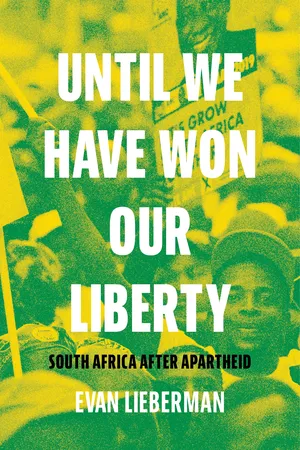
At a time when many democracies are under strain around the world, Until We Have Won Our Liberty shines new light on the signal achievements of one of the contemporary era's most closely watched transitions away from minority rule. South Africa's democratic development has been messy, fiercely contested, and sometimes violent. But as Evan Lieberman argues, it has also offered a voice to the voiceless, unprecedented levels of government accountability, and tangible improvements in quality of life.
Lieberman opens with a first-hand account of the hard-fought 2019 national election, and how it played out in Mogale City, a post-Apartheid municipality created from Black African townships and White Afrikaner suburbs. From this launching point, he examines the complexities of South Africa's multiracial society and the unprecedented democratic experiment that began with the election of Nelson Mandela in 1994. While acknowledging the enormous challenges many South Africans continue to face—including unemployment, inequality, and discrimination—Lieberman draws on the country's history and the experience of comparable countries to demonstrate that elected Black-led governments have, without resorting to political extremism, improved the lives of millions. In the context of open and competitive politics, citizens have gained access to housing, basic services, and dignified treatment to a greater extent than during any prior period.
Countering much of the conventional wisdom about contemporary South Africa, Until We Have Won Our Liberty offers hope for the enduring impact of democratic ideals.
- 344 pages
- English
- ePUB (mobile friendly)
- Available on iOS & Android
eBook - ePub
About this book
Information
Publisher
Princeton University PressYear
2022Print ISBN
9780691203218
9780691203003
eBook ISBN
9780691203010
1
The Campaign
COMMUNICATING FRUSTRATION
I HAD JUST SAT down and taken out my notebook when I heard a loud thud. It was a few minutes after 9 a.m. on the last Friday of January 2019. I had come to meet a prospective research assistant at the Chicken Licken in downtown Krugersdorp, about an hour’s drive from Johannesburg. A modest-but-modern fast food restaurant, clean and sparsely furnished, it was one of the most popular spots in a neighborhood that was otherwise filled with unremarkable storefronts, including several tire stores, low-price clothing boutiques, and pawn shops. Signs for quick and easy abortions adorned many of the adjacent buildings.
I noticed that the restaurant manager was hurrying around the exterior of the building, slamming shut each of the heavy exterior gates used for security after-hours. The pair of police officers who had been sitting and chatting at the table next to me had disappeared. Most of the other customers eating and drinking there that morning had also left their tables in order to gather close to the exit, huddling under the threshold as they looked out cautiously onto the street.
I stood up and joined the small crowd. We all peered out toward the action to our left and could see a loud throng of people toyi-toying. The toyi-toyi is a protest march that became popular in Black townships beginning in the late 1970s in the wake of the growing campaign against White rule in South Africa.1 On that day in January, thousands of people were hopping, dancing, singing, and yelling all along the multiple lanes of Commissioner Street. They held hand-printed placards in their hands proclaiming, “No service, no vote” and “2019 no vote.” It was still morning, but it was already getting hot in the summer sun. Sweat streamed down the protesters’ faces.
The manager was closing the metal gates because the previous week, a different protest had turned violent and rubber bullets had broken windows. She wanted to protect the new windows, the restaurant, and, presumably, any customers who remained.
Krugersdorp has long been a site of confrontation and conflict. Within a few years of its founding in 1887, it developed rapidly into a hard-drinking, hard-gambling, transient mining town and was frequently likened to the American “Wild West.”2 It was established to serve the booming gold mining industry a year after rich deposits were found in nearby Johannesburg. The allure of quick profits attracted thousands of foreigners, mostly from Britain but also from Australia, Ireland, and America, other parts of Africa, and other corners of the world. Over many generations individual explorers, groups, and sometimes even warring parties came through this town to try to carve out a better life.
For most of its history and up until the 1990s, Krugersdorp was designated for Whites only. Black people were permitted to work here only if they carried a special permit, and mostly they were relegated to the neighboring Black townships of Munsieville and Kagiso (pronounced Kah-hee-so). As early as the first few years of the twentieth century, the Krugersdorp Town Council deliberately regulated the movement of Black Africans into and out of well-demarcated areas on the outskirts of town.3 Indeed this distinction between “towns” and “townships” was fundamental to the racial ordering built up throughout South Africa during most of the twentieth century. Today, downtown Krugersdorp is filled with people from all race groups and a wide range of nationalities. By contrast, Kagiso (about seven miles south) and Munsieville (less than four miles north) remain almost all Black, though the latter also hosts Pango Camp, a small informal settlement of poor Whites.
On this day in 2019, the approximately two thousand Munsieville residents were marching to see Patrick Lipudi, mayor of Mogale City Local Municipality, which now incorporates all of these areas under a single local government. Lipudi is himself Black. In the 1970s and 1980s, he had served as a union leader, political activist, and protester; and he danced the toyi-toyi during the struggle for Black liberation. Like so many others who once led protest movements and were now serving as government officials, he had become the target of anger and frustration. The protesters were making demands for better water and electricity. It was the last weekend of voter registration for the upcoming national elections, and when interviewed later that day, the protest’s organizer said the people of Munsieville were prepared to boycott further registrations.4 For Lipudi and other government leaders, such boycotts could cost the ruling party precious votes in a close election, and they would be forced to negotiate.

FIGURE 1.1. Site of protest outside Chicken Licken, Krugersdorp.
Democracy Up Close
I had traveled to Krugersdorp, the seat of Mogale City government, to observe the campaign for this national election. I wanted to learn more about how multiracial democracy was faring after twenty-five years.
The country’s first multiracial election, in 1994, had marked an important milestone in a highly improbable political transformation. It produced a shift in power away from an economically dominant White minority in favor of universal adult suffrage, resulting in a Black-led government. In terms of population and economic development, ending Apartheid and creating an integrated South Africa was like fusing together the relatively poor African country of Kenya and the much smaller and wealthier European country of Denmark into a single polity in just a few years’ time. Between 1989 and 1994, the size of the electorate increased by a factor of eight, from over 2.5 million to close to 20 million voters.5 During that period, the country transitioned away from civil war—a fact which itself did not bode well for democratic development if one considered the trajectories of other postconflict countries.6
And now it was time to ask: What can students of democracy and social justice the world over learn from this ambitious political endeavor?
That a large protest swept right in front of me on my first day—in fact, in the first fifteen minutes of my time in Krugersdorp—was an important reminder of the mood of many of the country’s citizens: they were frustrated, angry, and losing patience. In this chapter and in the next, I share what I observed about contemporary South African politics from the perspective of the 2019 national election as it played out in Mogale City—first the campaign, and then election day itself. This will provide an introduction to the diverse actors and concerns driving the heated political competition in the country.
I set my gaze on the midsized South African municipality of Mogale City because, at least from afar, it appeared to be a place that could serve as something of a microcosm for learning more about South Africa. It is racially diverse, prior elections tracked national trends toward greater competitiveness, and it straddles the country’s very different urban and rural areas. On the one hand, the municipality abuts South Africa’s megalopolis—the corridor between “Joburg” and Pretoria, home to over 8 million residents. Yet, even the most urbanized section of Mogale—Krugersdorp, with a population of about 140,000—is still just a town. Streets can get busy during trading hours, but there are no high-rise buildings. Just a few miles away, still very much within Mogale’s borders, lie thousands of acres of farmland. Black and White, rich and poor, urban and rural, and support for different political parties represent the most important sources of diversity in South Africa; and all are contained within Mogale.
The municipality is located in Gauteng Province, specifically in an area known as the West Rand—a reference to the Witwatersrand, an approximately thirty-five-mile rock escarpment that elevates its residents over a mile above sea level. The Rand is also quite literally the source of continental divide, as runoff from the plateau feeds the Crocodile, Limpopo, Vaal, and Orange rivers, which in turn drain into the Indian and Atlantic oceans. Wanderers and explorers came here even before the transformative discovery of great mineral wealth in the ground below. No part of Southern Africa has drawn more people into such a concentrated area. And on my drive in from Johannesburg that January day in 2019, I noticed the immodest welcome sign, “Mogale City: Cradle of Humankind,” a reference to rich archaeological discoveries within the municipal boundaries. Mogale’s northern border is drawn by the Magaliesberg mountains, the site of millions of years of human occupation, and at least hundreds of years of known trading and conflict between groups of people moving into and out of the area.
Although I never spent any significant amount of time in Krugersdorp or Mogale prior to 2019, I have been studying South African politics for my entire career and adult life. And I wanted to take stock of what had and had not been accomplished since the time of the democratic transition, especially as democracy seemed to be in peril around the world, including in my own country, the United States. Populist leaders and parties have been on the rise around the globe—in Hungary, the United States, Brazil, the Philippines, India, and elsewhere—and they have been characterized by increasingly authoritarian tendencies. South Africa was plausibly fertile ground for such appeals. Anti-immigrant and anti-elite sentiment was already strong in many pockets—and very strong in Mogale City. It would not take much imagination to organize highly racist campaigns; and any of a number of well-worn strategies to identify a culpable elite and/or additional scapegoats had the potential to win votes.

FIGURE 1.2. Map of Mogale City Local Municipality in South Africa.
Even beyond the seemingly fragile nature of liberal democracy around the globe, South Africa’s 2019 contest appeared pivotal in so many ways: the electoral choices were stark, as the competing parties offered very different candidates and visions; and more than any national election since 1994, this one appeared to be quite competitive. Democracy is about a lot more than just elections, but elections are both necessary and crucial, and I wanted to watch this one up close. I would start by simply observing the process, particularly as it unfolded in this one municipality, asking: What were the leading political parties offering as interpretations of the past and proposals for the future? How were citizens responding to those campaigns? And then I would consider the historical record, look comparatively at other countries, and try to make sense of what I observed with respect to the efforts to forge a new government and to deliver. Ultimately, my goal was to assess the strength and value of South Africa’s still young democracy.
When I arrived in Mogale City, the municipality and the nation were just three months from marking the twenty-fifth anniversary of Nelson Mandela’s historic electoral victory in the first-ever truly multiracial election, one that was celebrated as a credible promise to redress the types of indignities that befell Black township dwellers like the people of Munsieville.
It was also a quarter century, more or less, since the end of Apartheid—literally translated as apartness—a style of government launched in 1948 with the express goal of keeping people from different race groups apart from one another. Institutionalized White supremacy, including in the form of slavery, had been practiced to varying degrees throughout southern Africa almost immediately after the arrival of Dutch settlers in 1652. When Krugersdorp was formed, it was contained within the South African Republic, a landmass representing approximately one-quarter of modern South Africa. Many of that government’s harsh rules and practices, including issuing passes to control the movement of Black people, would become the foundation for sustained racial oppression.
Of course, southern Africa was not alone in its institutionalization of racial hierarchies. Most of the African continent was at some point colonized by White Europeans; and the African slave trade was built on ideas of racial supremacy. The United States and Brazil both imported massive numbers of slaves, and the lasting results of race-based inequalities are starkly evident in these countries even today. What made South Africa both truly unique and infamous was the degree to which its White government doubled down on segregation and a panoply of racially exclusionary policies during the second half of the twentieth century. When the National Party gained power in a surprising electoral victory just three years after the end of World War II, Apartheid-style government came to define South Africa as a White minority persisted in developing a vision of government and citizenship for Whites only. Apartheid planners tried to market their project to the world as one promoting national self-determination, a language that was more acceptable to postwar sensibilities as the age of empire had come to an end. And yet, there was no mistaking the fact that the Apartheid project sought to forcibly segregate and separate people of color into the least desirable territories in the region and to control them as sources of cheap labor.
All of the Apartheid laws and practices were felled in the early 1990s. And yet, the end of Apartheid was not the end of South Africa’s difficult history. Deep Apartheid and pre-Apartheid legacies remained, and while various negotiating parties agreed to adopt a multiracial democracy, its success was hardly preordained. Moreover, a quarter of a century is clearly not sufficient to redress three and a half centuries of racial hierarchy. Nonetheless, the silver anniversary of the first multiracial election presented a fitting opportunity to take stock of what had been accomplished relative to expectations, to the past, and to other countries.
In the pages that follow, I show that South Africa’s first twenty-five years of democratic government were extremely successful. Many problems remain and citizens are understandably frustrated that more was not accomplished during this period. However, we cannot lose sight of the fact that democratic practice has moderated the tensions inherent in governing South Africa’s diverse society. Successive democratic administrations have helped to improve the lives of millions across the country, in terms of housing, basic services, social security, access to education, and more, and they have done so without resorting ...
Table of contents
- Cover
- Title Page
- Copyright Page
- Contents
- Preface
- On South African Racial Categories
- List of Abbreviations
- 1. The Campaign: Communicating Frustration
- 2. Citizens Choose: Election Day in Mogale City
- 3. The Value of Democracy
- 4. Before Democracy: Shaky Foundations
- 5. The Bold Experiment: Institutions for a Divided Society
- 6. Democracy after Mandela: A Stress Test
- 7. Prosperity: There Shall Be Houses, Security, and Comfort
- 8. Respect, Belonging, and Recognition
- 9. The Final Tallies
- Epilogue
- Acknowledgments
- Author’s Note on Primary Data and Analysis
- Notes
- Bibliography
- Index
Trusted by 375,005 students
Access to over 1.5 million titles for a fair monthly price.
Study more efficiently using our study tools.
Frequently asked questions
Yes, you can cancel anytime from the Subscription tab in your account settings on the Perlego website. Your subscription will stay active until the end of your current billing period. Learn how to cancel your subscription
No, books cannot be downloaded as external files, such as PDFs, for use outside of Perlego. However, you can download books within the Perlego app for offline reading on mobile or tablet. Learn how to download books offline
Perlego offers two plans: Essential and Complete
- Essential is ideal for learners and professionals who enjoy exploring a wide range of subjects. Access the Essential Library with 800,000+ trusted titles and best-sellers across business, personal growth, and the humanities. Includes unlimited reading time and Standard Read Aloud voice.
- Complete: Perfect for advanced learners and researchers needing full, unrestricted access. Unlock 1.5M+ books across hundreds of subjects, including academic and specialized titles. The Complete Plan also includes advanced features like Premium Read Aloud and Research Assistant.
We are an online textbook subscription service, where you can get access to an entire online library for less than the price of a single book per month. With over 1.5 million books across 990+ topics, we’ve got you covered! Learn about our mission
Look out for the read-aloud symbol on your next book to see if you can listen to it. The read-aloud tool reads text aloud for you, highlighting the text as it is being read. You can pause it, speed it up and slow it down. Learn more about Read Aloud
Yes! You can use the Perlego app on both iOS and Android devices to read anytime, anywhere — even offline. Perfect for commutes or when you’re on the go.
Please note we cannot support devices running on iOS 13 and Android 7 or earlier. Learn more about using the app
Please note we cannot support devices running on iOS 13 and Android 7 or earlier. Learn more about using the app
Yes, you can access Until We Have Won Our Liberty by Evan Lieberman in PDF and/or ePUB format, as well as other popular books in Politics & International Relations & African History. We have over 1.5 million books available in our catalogue for you to explore.