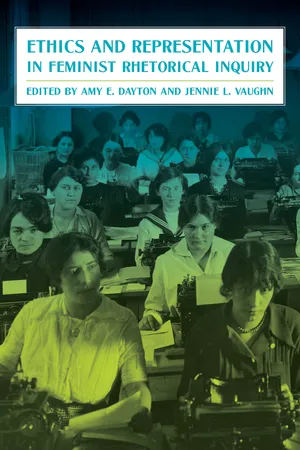
eBook - ePub
Ethics and Representation in Feminist Rhetorical Inquiry
- English
- ePUB (mobile friendly)
- Available on iOS & Android
eBook - ePub
Ethics and Representation in Feminist Rhetorical Inquiry
About this book
The historiography of feminist rhetorical research raises ethical questions about whose stories are told and how. Women and other marginalized people have been excluded historically from many formal institutions, and researchers in this field often turn to alternative archives to explore how women have used writing and rhetoric to participate in civic life, share their lived experiences, and effect change. Such methods may lead to innovation in documenting practices that took place in local, grassroots settings. The chapters in this volume present a frank conversation about the ways in which feminist scholars engage in the work of recovering hidden rhetorics, and grapple with the ethical challenges raised by this recovery work.
Information
Subtopic
RhetoricChapter 1
SEARCHING FOR MYRTILLA MINER’S SCHOOL FOR COLORED GIRLS
Afrafeminist Strivings, Ethical Representations, and Nineteenth-Century Archives
Only the BLACK WOMAN can say “when and where I enter, in the quiet, undisputed dignity of my womanhood, without violence and without suing or special patronage, then and there the whole Negro race enters with me.”
—Anna Julia Cooper (A Voice from the South, 1892, p. 12)
WHY I ARCHIVE
Today, researchers, scholars, teachers, and intellectuals have the opportunity to read the rhetorical discourses and historical accounts of nineteenth-century African American women, such as Maria W. Stewart, Ida B. Wells, Mary Ann Shadd Cary, Frances Ellen Watkins Harper, Sojourner Truth, Mary Church Terrell, Harriet Tubman, and others, who put their voices and bodies on the line for cultural, social, and political justice and freedom. Looking back, across, and through time and space, I marvel at the rhetorical agency of nineteenth-century African American women who are represented in, and who now speak from, the histories of rhetoric, composition, and literacy studies scholarship. The above epigraph reflects the determination and spirit of the Black experience, and is but one example of the voice and presence of prominent African American women as presented in collections such as Shirley Wilson Logan’s With Pen and Voice: A Critical Anthology of Nineteenth-Century African American Women and We Are Coming: The Persuasive Discourse of Nineteenth-Century Black Women, Carla L. Peterson’s “Doers of the Word”: African American Women Speakers & Writers in the North (1830–1880), and Jacqueline Jones Royster’s Traces of a Stream: Literacy and Social Change Among African American Women, to name a few.
These contemporary collections recognize the importance and inclusion of African American women within the rhetorical tradition, even as the collections also illuminate the fact that current “trends and practices in feminist rhetorical studies have broken habitual expectations for rhetorical studies to be overwhelmingly about men and male-dominated arenas” (Royster and Kirsch 17). But what of the many nameless nineteenth-century African American women who are still waiting to speak? More importantly, I asked myself: What is my commitment to nineteenth-century African American women? And what of the promise that I made to Pearlia Mae, my grandmother, when I was eleven?
One of my favorite memories of my grandmother was of her buying 3x5 and 5x7 spiral notebooks, as she allowed me to push the grocery cart in the store. For as long as I can remember, she kept the daily newspaper, her Bible, church bulletins, postage stamps, and spiral notebooks in a neat pile at the end of the dining room table. She read and discarded the newspaper each day, she read her Bible each day, and she actively used the spiral notebooks to record information that she wanted to remember. Each notebook had a purpose: (1) recipes; (2) printed obituaries, stories, and cultural memories from Jet, Ebony, and the Crisis magazines; (3) addresses and phone numbers; and (4) family members’ names, birthdays, weddings, baby dedications, baptisms, and deaths.
Annually, my grandmother traveled to our family reunions and to other family gatherings, and on occasion, she brought the family notebook along in her purse. She taught me about cultural memory and remembering, as we visited family gravestones and barely visible markers that listed births and deaths as far back as 1866. Through the act of enculturation, she taught me about family, faith, and the obligation of remembering, and she modeled for me specific duties and other-knowings as a Black woman in my family. Unfortunately, upon my grandmother Pearlia Mae’s death, the notebooks did not remain together as a collection, as they were passed on to family members, who have their own memories of Mamaw’s notebooks. Many of my grandmother’s notebooks hold traces of bygone voices and events, and reflect the hopes, dreams, successes, and hardships of people of the African diaspora in America. When I was eleven, I promised to remember and to tell our people’s stories. That is why I am drawn to archival research and feminist rhetorical historiographic writing.
In light of my promise, in this chapter I recall my academic journey to find nineteenth-century primary evidence of Myrtilla Miner’s School for Colored Girls, to shed more light on antebellum women of African descent who are absent in the larger rhetorical tradition. Even as I endeavored to learn best practices related to feminist rhetorical studies and archival studies as a doctoral student and tried to keep my promise, I could not prove that more nineteenth-century cultural and pedagogical evidence survived. But I was hopeful that to find tangible artifacts from the School for Colored Girls would illuminate the discourses of African American women in the public sphere of antebellum society and within the “higher branches of learning,” which were systematically and pervasively kept from free and enslaved people of African descent. The daughters of colored freemen, who were enrolled at the School for Colored Girls, were not as distinguished as the African American women rhetoricians who are presented in the aforementioned collections. But recovered nineteenth-century artifacts have the ability to represent these women’s rhetorical agency and voices. Nineteenth-century artifacts from the School for Colored Girls may contribute to what we already know of an antebellum counternarrative for social, cultural, and political change for free and enslaved African people in America.
Like Sara Hillin, “I explore the responsibility to represent and discuss more ‘hidden’ rhetorics of less privileged” women <45>. In chapter 2, Hillin recognizes that “it is enticing to pin the label of feminist on all the women” <49>. But such an inference using contemporary labels may be incorrect and less than informative when identifying and attributing actions, motives, and lives of nineteenth-century African American women. Even though contemporary labels may facilitate our limited understanding of historical events and artifacts, they may not accurately or ethically represent the lives of earlier women who are under investigation. Still, it is important for scholars and researchers to ask how nineteenth-century women’s discourses and rhetorical voices were viewed in the public and private spheres. It is equally important to “ask how these women viewed their own work” <49>. On the other hand, without a clear declaration of feminist activism in archival artifacts and records, I hesitate to attach such a finding to all nineteenth-century African American women. But I highlight discourses, literacy, and pedagogical practices from Myrtilla Miner’s School for Colored Girls that speak to Afrafeminist strivings and foreshadow tenets of womanist ethics and rhetoric as means for the production of feminist rhetorical historiography.
PLAYING IN THE ARCHIVES
Ethical representations of peoples, pivotal moments, activisms, and discourses as reflected through cultural and literacy artifacts that speak from carefully designed archives and collections and from forgotten places, misplaced boxes, and dusty folders are at the forefront of primary research and the recovery of archival source materials: “Archives, according to rhetoric and composition researchers, can be anything: a well-funded ‘top ten’ University Special Collections Archive, papers stored in the basement of the town hall, a box of papers found in an attic or basement, the content of an office, or an actively used filing cabinet for a writing program” (L’Eplattenier and Mastraengelo 211). Though they have always been a part of our disciplinary narrative, the “archival turn” and historiographic writing have increased, since the late 1980s, along with the establishment of rhetoric and composition programs, and they are celebrated in the field through published discourses, journal articles, anthologies, and monographic scholarship. Most noteworthy, conference proposals and panels that highlight archival studies are reflected and presented at annual meetings, such as the Rhetoric Society of America (RSA), the Conference on College Composition and Communication (CCCC), the Feminisms and Rhetoric Conference (FemRhet), and the Modern Language Association (MLA), and have shown a marked increase and attention to ongoing archival research and the continued recovery and analysis of primary artifacts.
Still, I am mindful of the assertion, “If the fields of writing studies are to sustain an ‘archival turn’ across varied contexts of research, teaching, and administration, then scholars need to consider why and how they might engage the archives on their own and with their students” (Buehl, Chute, and Fields 297). Extending the thought to magnify the intersections of African American women’s rhetorics, literacy practices, and the emotional attachments, participant selection, and motivations of a feminist researcher, I recognize and appreciate the purpose (“why and how”) of archival research and production of feminist rhetorical historiography. Even as scholars acknowledge the hegemonic design of historical collections and repositories, as well as recognize the marginality and omissions of people of color and include many gender identities, “feminist rhetorical historiography requires us to become research agents who bring transformations to dominate research practices and interpretive frameworks. It must not only emphasize women as an additional historical subject but also pose methodological challenges to predominant theoretical models” (Wu 85–86). In this chapter, I draw attention to Afrafeminism and womanist ethics as a methodology for archival inquiry and feminist rhetorical historiography in relation to both my search for nineteenth-century Black women rhetors in general and my search for Myrtilla Miner’s School for Colored Girls more specifically. As a female African American researcher, I found that, as Wu suggests, this methodological approach facilitates the study of and writing for, with, and about the lived experiences and rhetorical presence of Black women.
I celebrate the contributions of scholars, researchers, and teachers such as Logan, Peterson, and Royster, who strive to make visible the voices of nineteenth-century women of color. Based on my reading of their scholarship when I began my doctoral studies, I was convinced that more primary artifacts could be found, and I was hopeful that I could find instances of unrepresented and underrepresented eighteenth- and nineteenth-century African American women in some hidden box in an archive. My position was bolstered by a past visit to the Bizzell Library at the University of Oklahoma, when I was an undergraduate, where I watched as a white-gloved history of science archivist retrieved valuable fifteenth-century portfolios and other priceless publications from a massive vault to show each one of them to the class. I figured that if the history of science artifacts survived and are representative of many people, there could be other artifacts yet to be found that relate to the eighteenth- and nineteenth-century Black experience in America. I agree with Linda Ferreira-Buckley when she argues that “most rhetoric and composition graduate programs require students to be conversant with histories of rhetoric and even theories about historical writing, but few require that students be experts at standard research methodologies” (“Archivist with an Attitude” 577). With Ferreira-Buckley’s point in mind, I enrolled in Eileen Schell’s Social History of Rhetoric class during my first semester in the Composition and Cultural Rhetoric (CCR) program at Syracuse University to gain further insight on primary artifact recovery. Even back in 2007, Schell argued that “feminist rhetorical research is alive and well, multifaceted and in motion, reaching into continuing and new branches of inquiry, places, and spaces” (Schell and Rawson 20).1
Still, Jacqueline Jones Royster and Gesa E. Kirsch explain “that feminist rhetorical scholarship is now moving far beyond the rescue, recovery, and (re)inscription of a diversity of women participants and on to the establishing of new watermarks of regard and worthiness in rhetorical studies more generally for the methodologies that we have been using and the types of insights that such methodologies have the capacity to yield” (31). Many scholars agree with Royster and Kirsch’s assessment of the “tectonic shifts” and “metacognitive awareness” in feminist rhetorical studies as a whole. The tectonic shifts signal the decentralization of normative hegemony and privilege of white, elite men and Western rhetoric. This shift opens spaces in the rhetorical tradition for other paradigms, such as women’s rhetoric, ethnic and cultural rhetorics, non-Western rhetorics, queer rhetorics, and transnational rhetorics. Within this understanding, I offer my story of the search for Myrtilla Miner’s School for Colored Girls not as a narrative of exemplary research methods and methodologies for the recovery of primary artifacts, but I make the case that attention to feminist studies in rhetoric, womanist ethics, and an Afrafeminist approach suggest continued growth in the area of feminist rhetorical historiography, which I like to think—from a most simple explanation—is a merger of subfields in rhetoric and composition: feminist rhetorical studies and archival studies.
I make a distinction between the writing of feminist histories and the writing of feminist rhetorical historiographies, where historiographies are historical accounts, but not all historical accounts are historiographies. While a feminist history may account for historical facts, discourses, and the retelling of women’s lived experiences, a historiography may also include the researcher’s point of view and purposeful reflection of research efforts and designs. This may include the recognition of cultural/ethnic position, motivations, and biases; identification of research methods and methodologies; recollection of primary artifact searches, selections, and omissions; and the ethical representation and re-storying of women’s lives and voices within a larger diaspora.
Rhetoric and composition scholarship demonstrates the values of archival research practices. Our academic discourses benefit from publications such as In the Archives of Composition (Ostergaard and Wood), Landmark Essays on Archival Research (Gaillet et al.), Working in the Archives (Ramsey et al.), Beyond the Archives (Kirsch and Rohan), and Local Histories (Donahue and Moon). Current scholarship challenges researchers and scholars to value doing research, to celebrate primary artifacts and serendipitous finds, and to produce historiographic analyses and writing. Further, Buehl, Chute, and Fields argue that rhetoric and composition publications give little attention to guidelines on how to train archival researchers. With an eye on sustainable research practices, Buehl, Chute, and Fields explain, “Although the growing body of scholarship on archival methods offers a plethora of practical resources, inspirational anecdotes, productive exemplars, and reflections on methods, no essay or chapter offers a sustainable method for training new scholars to work with archives, though Linda Ferreira-Buckley (582), Thomas P. Miller and Melody Bowden (585), and Barbara L’Eplattenier (71) have called for one. There are anecdotal accounts of ad hoc archival education of graduate students and established researchers in rhetoric and composition scholarship” (“Training in the Archives” 278). There is no denying that if the field of rhetoric and composition wants to sustain our archival research efforts, more curricular development should focus on “good and replicable methods for teaching archival methods” (278). Training the next generation of archival researchers, scholars, and graduate students is important and is in the best interest of rhetoric and composition. Moreover, I acknowledge unpublished, rigorous, and theoretically sound curricular efforts that are currently taking place in rhetoric and composition, such as in the CCR program at Syracuse University. While best and good archival research practices should be taught, I caution against any push for standardized archival research practices, which may push the field of rhetoric and composition into intended and unintended polemic debates on archival research validity.
According to Robert Connors, “The archive is where storage meets dreams, and the result is history” (16). There is no doubt that the search for primary artifacts can be a rewarding and enjoyable experience, but I am reminded of the words of scholars in the field, such as Linda Ferreira-Buckley, Richard Enos, Jessica Enoch, and Michelle Ballif, who signal the challenges and the import of knowledge production in historiographic research and writing. For example, Linda Ferreira-Buckley argues, “We must make archives our starting point, for failing to do so weakens both our historical accounts and our theorizing” (“Octalog II” 28). She points out that historical scholarship in the field has shifted from being “undertheorized” to being “under researched” (28). Richard Enos’s sentiments strike a similar chord. In “Recovering the Lost Art of Researching the History of Rhetoric,” he states that “a great deal of emphasis is spent not on the actual activity of doing history but abstract discussion about the notion and presuppositions about doing history” (14). Enos makes the following case: “This process, however, is inextricably bound with the activity of research in the history of rhetoric; the epistemology of writing history is a process done during the a...
Table of contents
- Cover Page
- Title Page
- Copyright Page
- Contents
- Acknowledgments
- Introduction
- Chapter 1: Searching for Myrtilla Miner’s School for Colored Girls: Afrafeminist Strivings, Ethical Representations, and Nineteenth-Century Archives
- Chapter 2: “For Their Day and for Our Own”: Navigating the Use of Diverse Sources in Feminist Rhetorical Analysis
- Chapter 3: Invitational Anger: Naming Forbidden Emotion in Native American Women’s Autobiographical Writing of the Nineteenth Century
- Chapter 4: Historiographic Disappointment: Archival Listening and the Recovery of Politically Complex Figures
- Chapter 5: (Re)presenting Lila: The Ethics of Sharing Stories from a 1920s–Era Training School for Girls
- Chapter 6: Ethics and Access in Mental Health Archives
- Chapter 7: Representation, Relationships and Research: Building a Living Archive through Feminist Inquiry
- Chapter 8: On Pins and Needles: Multi-Sited Ethnography and the Archives
- Chapter 9: Contexts and Communities: Valuing Collectivity in Feminist Rhetorical Inquiry
- Chapter 10: Stabilizing Stories: Personal Narrative and Public Memory in Recent Activist Histories
- Chapter 11: The Rhetorics of Translation: A Feminist Method for Inquiry, Recovery, and Theoretical Application
- Chapter 12: Venues and Voices: Welcoming Greater Participation in Feminist Rhetorical History and Inquiry
- List of Contributors
- Index
Trusted by 375,005 students
Access to over 1.5 million titles for a fair monthly price.
Study more efficiently using our study tools.
Frequently asked questions
Yes, you can cancel anytime from the Subscription tab in your account settings on the Perlego website. Your subscription will stay active until the end of your current billing period. Learn how to cancel your subscription
No, books cannot be downloaded as external files, such as PDFs, for use outside of Perlego. However, you can download books within the Perlego app for offline reading on mobile or tablet. Learn how to download books offline
Perlego offers two plans: Essential and Complete
- Essential is ideal for learners and professionals who enjoy exploring a wide range of subjects. Access the Essential Library with 800,000+ trusted titles and best-sellers across business, personal growth, and the humanities. Includes unlimited reading time and Standard Read Aloud voice.
- Complete: Perfect for advanced learners and researchers needing full, unrestricted access. Unlock 1.5M+ books across hundreds of subjects, including academic and specialized titles. The Complete Plan also includes advanced features like Premium Read Aloud and Research Assistant.
We are an online textbook subscription service, where you can get access to an entire online library for less than the price of a single book per month. With over 1.5 million books across 990+ topics, we’ve got you covered! Learn about our mission
Look out for the read-aloud symbol on your next book to see if you can listen to it. The read-aloud tool reads text aloud for you, highlighting the text as it is being read. You can pause it, speed it up and slow it down. Learn more about Read Aloud
Yes! You can use the Perlego app on both iOS and Android devices to read anytime, anywhere — even offline. Perfect for commutes or when you’re on the go.
Please note we cannot support devices running on iOS 13 and Android 7 or earlier. Learn more about using the app
Please note we cannot support devices running on iOS 13 and Android 7 or earlier. Learn more about using the app
Yes, you can access Ethics and Representation in Feminist Rhetorical Inquiry by Amy Dayton, Jennie Vaughn, Amy Dayton,Jennie Vaughn in PDF and/or ePUB format, as well as other popular books in Languages & Linguistics & Rhetoric. We have over 1.5 million books available in our catalogue for you to explore.