A sharecropper, a warrior, and a truth-telling prophet, Fannie Lou Hamer (1917–1977) stands as a powerful symbol not only of the 1960s black freedom movement, but also of the enduring human struggle against oppression. A Voice That Could Stir an Army is a rhetorical biography that tells the story of Hamer's life by focusing on how she employed symbols—images, words, and even material objects such as the ballot, food, and clothing—to construct persuasive public personae, to influence audiences, and to effect social change.
Drawing upon dozens of newly recovered Hamer texts and recent interviews with Hamer's friends, family, and fellow activists, Maegan Parker Brooks moves chronologically through Hamer's life. Brooks recounts Hamer's early influences, her intersection with the black freedom movement, and her rise to prominence at the 1964 Democratic National Convention. Brooks also considers Hamer's lesser-known contributions to the fight against poverty and to feminist politics before analyzing how Hamer is remembered posthumously. The book concludes by emphasizing what remains rhetorical about Hamer's biography, using the 2012 statue and museum dedication in Hamer's hometown of Ruleville, Mississippi, to examine the larger social, political, and historiographical implications of her legacy.
The sustained consideration of Hamer's wide-ranging use of symbols and the reconstruction of her legacy provided within the pages of A Voice That Could Stir an Army enrich understanding of this key historical figure. This book also demonstrates how rhetorical analysis complements historical reconstruction to explain the dynamics of how social movements actually operate.
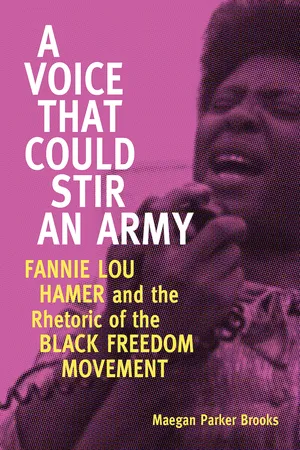
eBook - ePub
A Voice That Could Stir an Army
Fannie Lou Hamer and the Rhetoric of the Black Freedom Movement
- 240 pages
- English
- ePUB (mobile friendly)
- Available on iOS & Android
eBook - ePub
A Voice That Could Stir an Army
Fannie Lou Hamer and the Rhetoric of the Black Freedom Movement
About this book
Information
Subtopic
RhetoricIndex
Social SciencesCHAPTER 1
A Rhetorical Education, 1917–1962
The people are our teachers. People who have struggled to support themselves and large families, people who have survived in Georgia and Alabama and Mississippi, have learned some things we need to know. There is a fantastic poetry in the lives of the people who have survived with strength and nobility. I am convinced of how desperately America needs the blood transfusion that comes from the Delta of Mississippi.
—PRATHIA HALL
Over fifty years after prathia hall expressed this conviction, America still has much to learn from people who not only carved out an existence in the Mississippi Delta, but who also left an indelible mark on this nation.1 I traveled to the Delta in search of one particular source of this wisdom. On a humid June morning in 2007, I first made the two-and-a-half-hour trek from Jackson. That day, I brought flowers to set upon Fannie Lou Hamer’s grave—a small cement headstone with a marble placard echoing her now famous words of determination—“I’m sick and tired of being sick and tired.” That same day, several other people braved the heat and humidity to beautify her memorial site. Hattie Robinson Jordan, a Ruleville alderwoman, and Mary Moore, a relative of Hamer’s who proudly donned a t-shirt embossed with a black and white image of Hamer speaking at the 1964 DNC, greeted me as I approached. Not long after I told the two women about my project, I was settled comfortably in the backseat of Jordan’s black Buick Lucerne witnessing all the Hamer-related landmarks their town had to offer. And there was no shortage of these. It would be impossible to drive through Ruleville and not realize that this was where Hamer lived and worked, that she played a pivotal role in redefining race relations in this small Delta town, and that she is sorely missed. The post office, local day care center, and a side street are named after her. The memorial site where she and her husband are buried sits on forty acres of land, adjacent to the town’s recreational center. And many of the hundreds of houses for low-income residents that Hamer worked tirelessly to fund still provide shelter to Ruleville residents.
Although Hamer emerged as Ruleville’s most famous and beloved inhabitant, the road to that status was often blocked by retaliation, fear, and resentment: like the time Hamer’s home was firebombed by white supremacists, or when few of Ruleville’s black citizens would provide her a safe harbor, or even as her Freedom Farm food cooperative for the Delta poor—black and white alike—failed to take root. When Hamer’s parents, James Lee Townsend and Lou Ella (Bramlett) Townsend, moved their twenty children to Ruleville in 1919, it would have been difficult for them to predict that their youngest daughter would fundamentally challenge the segregated structure of this city. In fact, when Fannie Lou Hamer was born Fannie Lou Townsend on October 6, 1917, in the city of Tomnolen, Mississippi, the Townsends were grateful for another healthy child and the fifty dollars landowners typically paid sharecropping families to swell their workforce. The Townsends, like so many other poor black families in Mississippi, desperately needed the money and welcomed the additional labor this child would provide.
Fannie Lou was only two years old when her parents packed up their six girls and fourteen boys and moved from Montgomery to Sunflower County. Sunflower County attracted a large number of displaced sharecroppers, who came seeking work and higher wages after being pushed off farms that had been devastated by the boll weevil. A small beetle that feeds on cotton, the boll weevil migrated to the United States from Mexico and infested cotton crops across the South. Sunflower County was largely spared from its infestation and, as a result, the county experienced a population explosion during the 1910s—“growing by more than 60 percent to exceed 46,000 inhabitants,” and becoming the state’s fourth largest county.2 Once the Townsends arrived, the family found work and lodging at E. W. Brandon’s plantation along the Quiver River a few miles east of Ruleville. The city was named after the Rule brothers, who built the town’s first cotton gin in 1886, some forty years after the Choctaw Indians had been forced from the land. The dwellings for black families on these plantations were typically two- or three-room wood huts, built from old boards nailed to rickety frames or held up by logs. The sole source of heat and light within these huts usually came from an open fireplace in the center of the makeshift structure. The children’s “beds” consisted of no more than old cotton sacks filled with grass or cornhusks.
Spared from the boll weevil’s destruction and with the influx of new labor, Sunflower County quickly became “the most productive cotton-growing area in the most productive cotton-growing state in the most productive cotton-growing country in the world.”3 This distinction connected Delta planters to a global economy that yielded considerable profits for them—these profits were not, however, passed down to the sharecroppers who labored in the hot, humid, mosquito-ridden, and snake-infested fields. In fact, sharecroppers were often kept in the landowners’ debt through an exploitative credit-based system, against which blacks had no recourse.
The Townsends arrived in Sunflower County during a particularly tumultuous period with regard to race relations. Black veterans who returned from fighting the Great War abroad joined blacks who were generations removed from slavery and who began to grow more outwardly resentful of their miserable living conditions, exploited labor, and lack of opportunity. Some blacks left the state for northern cities as part of the Great Migration; those who stayed created pockets of resistance across the Delta. Anthropologist Hortense Powdermaker observed in her 1930 study of the region that the children born two generations removed from slavery—the generation to which Hamer belonged—“exhibited a great deal more resentment at their station in life. They considered themselves entitled to equal treatment and were much less comfortable than their parents had been with the elaborate codes of ritual deference.”4 Dissenting views about the imbalance of power between the races grew alongside traditional lessons of pride and perseverance, which were passed down through generations of black sharecropping families. Knowledge of the white supremacist ideology and skills of interracial communication also developed as a necessity for blacks who lived and worked in the homes and on the fields of whites. Sharecropping communities, moreover, were sustained through sermons and spirituals delivered in small plantation sanctuaries throughout the South.
In light of all that was withheld from black sharecropping families, therefore, it is still possible to discern the lessons, skills, and strength that members of this Delta community shared with one another. To do so, however, requires looking outside formal institutions of learning and to consider, instead, spaces like the home, the plantation, and the black Baptist church. As Afrocentric scholars Molefi Asante and Maulana Karenga emphasize, in the Ancient Egyptian rhetorical tradition, “eloquent and effective speech” is a “practice carried out with skill, artistry and precision,” but it is not the sole possession of the formally learned person. Good speech “can also be found among the women at the grindstone,” because they too “are hearers and participants in the rhetorical and political project of creating and sustaining a just and good society.”5 Revisiting the spaces Hamer traversed, with a focus on the rhetoric she heard and the lessons she learned within them, reveals where she derived the substance of her appeals and honed her widely celebrated delivery. A look back at Hamer’s early years before she became involved in SNCC’s voting-rights campaign suggests that long before she received civic training from leaders within the struggle, she was developing rhetorical skills from her family, her life on the plantation, and her church. When Hamer’s path eventually intersected with SNCC’s, she needed only the empowerment and citizenship training that the organization provided to local people to become an asset to their voter-registration, community-organizing, and fundraising efforts.
LESSONS FROM FAMILY AND FIELD
The region of Mississippi known as the Delta sits between the Yazoo and Mississippi Rivers. In this area of the state, where the well-nourished soil yields cotton, corn, rice, and soybeans, and where the black population outnumbered whites—constituting 75 percent of Sunflower County’s population in 1920—the exploitative system of sharecropping thrived during Hamer’s formative years. Sharecropping or “halving,” as it was often called, replaced slavery after the Civil War as a means of controlling the black population and securing cheap labor. On the fields in and around Ruleville, plantation owners fostered dependency by encouraging black families to live on their land and by loaning them small amounts of money for living expenses throughout the year, to be paid back at harvest. When that time came, the plantation owner ostensibly split the proceeds from the season’s yield with the sharecroppers. The main catch, however, was that the seed and fertilizer for planting, in addition to the family’s medical expenses, food costs, cash advances, and whatever else the plantation owner reckoned to be fair, was paid out of the cropper’s half. The sharecropping system was thereby maintained in such a way that the workers remained indebted to the landowners and, on a good year when a large and industrious family like the Townsends could pick fifty or sixty bales of cotton, they still were not likely to turn a profit.
“Sharecroppers were strictly prohibited from taking any part whatsoever” in the profit calculations, notes historian J. Todd Moye in Let the People Decide, wherein he offers the extended example of how L. C. Dorsey’s family was manipulated by the sharecropping system.6 Dorsey grew up in a sharecropping family in the town of Drew, seven miles outside of Ruleville. One year, Dorsey defied this prohibition and took it upon herself to meticulously track the family’s shares. From the initial loan amount to the harvest, Dorsey documented all the family’s expenses and listened to the radio during harvest to learn what cotton was selling for in their area. According to her math, the family’s haul minus their legitimate expenses should have earned them $4,000; at settlement time, however, the plantation owner gave her father $200 for an entire year of labor. With no recourse for the injustice, Dorsey realized first-hand how blacks “were locked into this system, and the fear and lack of control made them take” what they could get.7
As patently unfair as the system was, it had to be continuously reinforced and defended by its beneficiaries. The most ubiquitous line of defense was rooted in the popular Social Darwinist ideology, which combined ostensible laws of nature with the historical advances of the Anglo-Saxon race to suggest that the white race was the most fit for survival and, thus, whites’ social dominance was warranted. White supremacists ignored advances made by the African race and held fast to the consequent of their natural dominance argument, declaring that blacks were biologically inferior to whites. Stretching back to the days of slavery, white slave-owners-turned-landowners propagated similar beliefs, most commonly that “the Negro is congenitally lazy and must be kept in debt in order to be made to work.”8 Landowners typically provided housing, healthcare, and food—substandard as it was—in return for the sharecroppers’ hard labor and deference to the system. In some cases, this relationship engendered for blacks a “plantation mentality,” defined by historian Chris Meyers Asch as “an outlook on life that encouraged immediate gratification and deference while discouraging individual responsibility and collective protest. Because black workers were not allowed to make decisions or wield any power on the plantation,” he reasons, “over time they were conditioned to defer to authority and accept (and sometimes even prefer) powerlessness.”9
Although the absence of any incentive to effort and the perceived futility of protest did lead to a plantation mentality among many black sharecroppers, there were certainly exceptions. Though rural and remote, Sunflower County was not immune to the national trends in rising black consciousness that occurred following WWI. Black servicemen returned from war embodying the spirit of the “New Negro,” no longer deferent to exploitation and eager to advocate for the same rights they had fought to secure for others in Europe. Marcus Garvey’s United Negro Improvement Association (UNIA) was also formed in 1917, the year of Hamer’s birth, and a local chapter of the UNIA cropped up in Sunflower County in 1921, just two years after the Townsends moved their family there.
To quell resistance, white beneficiaries of the sharecropping system would make horrid examples of those blacks who threatened racism’s stronghold on the region. Lynching was the most barbaric method white supremacists deployed to maintain the region’s racial hierarchy and to ensure cheap labor. Though extreme in nature, lynchings were not all that uncommon—in 1919 alone there were eighty-nine reported lynching victims across the South. Between 1882 and 1951, furthermore, there were nearly five thousand reported lynchings in the United States. And nearly every state in the union was home to at least one race-based lynching, with 90 percent occurring in the South and the largest percentage taking place in Mississippi, Georgia, Alabama, Louisiana, and Texas. In the state of Mississippi, in particular, at least six hundred blacks were lynched between 1880 and 1940.10
One such instance of white-inflicted terrorism on the Delta’s black sharecropping community remained with Hamer throughout her life. When she was just eight years old, a black sharecropper named Joe Pulliam was murdered in a violent confrontation with a lynch mob. The mob descended upon Pulliam, who managed to kill several of his assailants with a Winchester rifle, before the group murdered him. Pulliam was lynched over a dispute with his landowner involving no more than $150; the mob drug his corpse behind a truck for all the town’s black inhabitants to see. After the beastly parade, the killers went a step further in intimidating the black community by cutting off Pul...
Table of contents
- Cover
- Title
- Copyright
- Contents
- Introduction: “I Don’t Mind My Light Shining”
- Chapter: 1: A Rhetorical Education, 1917–1962
- Chapter: 2: Through the Shadows of Death, 1962–1964
- Chapter 3: “Is This America?,” 1964
- Chapter: 4: “The Country’s Number One Freedom Fighting Woman,” 1964–1968
- Chapter: 5: “To Tell It Like It Is,” 1968–1972
- Chapter: 6: The Problems and the Progress
- Afterword: “We Ain’t Free Yet. The Kids Need to Know Their Mission,” 2012
- Acknowledgments
- Coda: Listen to the “Voice That Could Stir an Army”
- Notes
- Bibliography
- Index
Trusted by 375,005 students
Access to over 1.5 million titles for a fair monthly price.
Study more efficiently using our study tools.
Frequently asked questions
Yes, you can cancel anytime from the Subscription tab in your account settings on the Perlego website. Your subscription will stay active until the end of your current billing period. Learn how to cancel your subscription
No, books cannot be downloaded as external files, such as PDFs, for use outside of Perlego. However, you can download books within the Perlego app for offline reading on mobile or tablet. Learn how to download books offline
Perlego offers two plans: Essential and Complete
- Essential is ideal for learners and professionals who enjoy exploring a wide range of subjects. Access the Essential Library with 800,000+ trusted titles and best-sellers across business, personal growth, and the humanities. Includes unlimited reading time and Standard Read Aloud voice.
- Complete: Perfect for advanced learners and researchers needing full, unrestricted access. Unlock 1.5M+ books across hundreds of subjects, including academic and specialized titles. The Complete Plan also includes advanced features like Premium Read Aloud and Research Assistant.
We are an online textbook subscription service, where you can get access to an entire online library for less than the price of a single book per month. With over 1.5 million books across 990+ topics, we’ve got you covered! Learn about our mission
Look out for the read-aloud symbol on your next book to see if you can listen to it. The read-aloud tool reads text aloud for you, highlighting the text as it is being read. You can pause it, speed it up and slow it down. Learn more about Read Aloud
Yes! You can use the Perlego app on both iOS and Android devices to read anytime, anywhere — even offline. Perfect for commutes or when you’re on the go.
Please note we cannot support devices running on iOS 13 and Android 7 or earlier. Learn more about using the app
Please note we cannot support devices running on iOS 13 and Android 7 or earlier. Learn more about using the app
Yes, you can access A Voice That Could Stir an Army by Maegan Parker Brooks in PDF and/or ePUB format, as well as other popular books in Social Sciences & Rhetoric. We have over 1.5 million books available in our catalogue for you to explore.