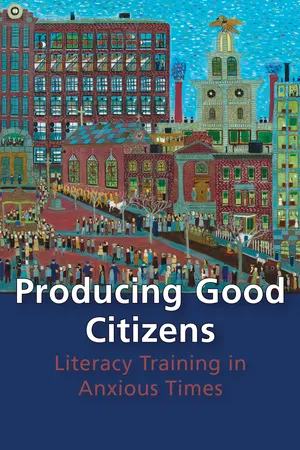
Recent global security threats, economic instability, and political uncertainty have placed great scrutiny on the requirements for U.S. citizenship. The stipulation of literacy has long been one of these criteria. In Producing Good Citizens, Amy J. Wan examines the historic roots of this phenomenon, looking specifically to the period just before World War I, up until the Great Depression. During this time, the United States witnessed a similar anxiety over the influx of immigrants, economic uncertainty, and global political tensions.
Early on, educators bore the brunt of literacy training, while also being charged with producing the right kind of citizens by imparting civic responsibility and a moral code for the workplace and society. Literacy quickly became the credential to gain legal, economic, and cultural status. In her study, Wan defines three distinct pedagogical spaces for literacy training during the 1910s and 1920s: Americanization and citizenship programs sponsored by the federal government, union-sponsored programs, and first year university writing programs. Wan also demonstrates how each literacy program had its own motivation: the federal government desired productive citizens, unions needed educated members to fight for labor reform, and university educators looked to aid social mobility.
Citing numerous literacy theorists, Wan analyzes the correlation of reading and writing skills to larger currents within American society. She shows how early literacy training coincided with the demand for laborers during the rise of mass manufacturing, while also providing an avenue to economic opportunity for immigrants. This fostered a rhetorical link between citizenship, productivity, and patriotism. Wan supplements her analysis with an examination of citizen training books, labor newspapers, factory manuals, policy documents, public deliberations on citizenship and literacy, and other materials from the period to reveal the goal and rationale behind each program.
Wan relates the enduring bond of literacy and citizenship to current times, by demonstrating the use of literacy to mitigate economic inequality, and its lasting value to a productivity-based society. Today, as in the past, educators continue to serve as an integral part of the literacy training and citizen-making process.
- English
- ePUB (mobile friendly)
- Available on iOS & Android
eBook - ePub
About this book
Information
Topic
Lingue e linguisticaSubtopic
Scrittura creativa1
IN THE NAME OF CITIZENSHIP
Citizens should know what their status implies; and they should understand when politicians abuse the term by according the whole concept only a partial range of attributes. It is, moreover, important to understand the complexity of the role of citizen and to appreciate that much needs to be learned if civic rights are to be exercised, civic duties are to be performed and a life of civic virtue is to be pursued. The citizen, in short, must be educated; and no teacher can properly construct the necessary learning objectives if semantic confusion surrounds the very subject to be studied.
—Derek Heater, Citizenship, vii
The charge of producing citizens has long been an integral part of the mission of education in the United States. From Thomas Jefferson's linking of an “educated citizenry” to “our survival as a free people” to educational reformer Horace Mann's common school movement through John Dewey and other Progressive era pragmatists, from the New Left–era education movements of the 1960s (e.g., Students for a Democratic Society) to the rhetoric of the 2006 Spellings Commission report, education in the name of citizenship endures. Yet as educational historian Derek Heater explains, citizenship—what it means, what kind of behavior it describes, what resources are afforded through it—often suffers under “semantic confusion” in which a “partial range of attributes” stands in for the whole. While Heater tasks the teacher with sorting out the confusion, the realm of education often perpetuates this confusion by labeling so many educational aims as citizenship. Encompassing civic, intellectual, cultural, and vocational goals, the production of the citizen remains an uncontroversial leitmotif in the rhetoric surrounding educational objectives.
Citizenship—not just the legal status, but the cultural certification—takes on heightened importance in moments of anxiety, whether economic, social, or national. And often education is used as a way to alleviate these anxieties, playing a role in shaping individuals based on a model deserving of that cultural certification. While citizenship has always been produced in multiple spaces (e.g., federal government, adult education, community groups), the increase in mass formal education, first in K–12 and more recently in higher education,1 has been justified, in part, by its crucial role in the fulfillment of citizenship. Higher Education for Democracy, a report from the President's Commission on Higher Education2 published in 1947, drove a national education policy around the production of citizens and advocated “increased access to college” (Hutcheson, “Truman Commission” 107) as a way of addressing societal concerns during the post–World War II era and at the beginning of the Cold War. By increasing the number of college-educated Americans and through a more fully articulated general education, institutions of higher education would guide “the transmission of a common cultural heritage toward a common citizenship” (United States, Higher Education 88). Along with the G.I. Bill of 1944, the Truman report “marked the beginning of a substantial shift in the nation's expectations about who should attend college” (Hutcheson, “Truman Commission” 107), thus connecting increasing higher education rates with generating citizenship. While educative spaces have always been positioned as crucial elements of citizenship production, the continued increasing importance of formal education means these institutions now have more of an influence on how citizenship is being produced and defined and, to some degree, has resulted in a definition of good citizenship that is disproportionally focused on success in education.
A definition of citizenship in the context of rising standards for literacy and education challenges the seemingly central importance of citizenship to education in general, and, for writing teachers, the influence of citizenship in literacy learning. To this end, I must ask two crucial questions: First, why is citizenship a faithful goal of literacy instruction? In turn, why is literacy so often used to cultivate citizenship? Literacy is supposed to yield a more democratic and participatory citizenship, a more educated citizenship, a more active citizenship—all familiar refrains in the field of rhetoric and composition and beyond. Yet despite assuming that successful writing instruction plays a key role in making good citizens and that the classroom space can reinvigorate democratic and participatory citizenship, the terms and boundaries used to define citizenship are vague at best and often go uninterrogated. Although citizenship has become a superterm that can encompass many definitions, the resultant lack of specificity that often accompanies it allows us to elide crucial concerns about the access to, impact, and exercise of citizenship.
For instance, scholarship in the contemporary field of rhetoric and composition often promotes the idea that successful writing instruction plays a key role in the preparation of good citizens, situating the classroom as a space that can reinvigorate democratic and participatory citizenship (see Campbell; Eberly; Ervin; Flower; Gilyard; Simmons and Grabill; and Weisser, to name just a few). Writing teachers often see citizenship-building as an integral part of the classroom mission, and scholarly investigations about writing classrooms take up the compelling concept of citizenship in a variety of ways, offering some familiar configurations: a potential antidote for students' impoverished citizenship through the transfer of skills to engage critically (as with critical pedagogy), a space to encourage participation in the outside world (such as service learning and ethnography), or a way to cultivate the use of writing skills to participate in citizen discussions (e.g., public writing, letter to the editor assignments, and blogs). What goes unarticulated in these configurations is how writing skills and other literate practices actually make citizens—that is, what kinds of citizens are cultivated in relation to literacy.
In this way, the “semantic confusion” around citizenship that Heater describes in this chapter's epigraph is actually productive because the confusion is masked by educational skills and other signs of improvement such as literacy. Citizenship theory as a body of work can help articulate literacy's role (and thus the role of literacy teachers) in citizenship production, such as the will to make citizenship central in literacy learning spaces and the “ideological freight” (Brandt 20) accompanying the widespread attainment of literacy. Doing so locates the pervasive use of citizenship in its malleability and its capacity to carry a broad set of potential values and beliefs. This capacity is further amplified alongside a societal imperative that education is necessary to becoming a full citizen and that one must collect as much education as possible. The persistence of education as a means of acquisition, which exists outside of all legal definitions of citizenship, is evident in the contemporary setting of the writing classroom, a familiar (but not the only) space through which to begin to understand both how literacy is used to produce citizens and which theoretical questions about citizenship endure in our current landscape.
In scholarship about the goals of the college writing classroom and policy documents (such as Kathleen Yancey's “Writing in the Twenty-First Century” for the NCTE), college-level literacy and citizenship are intertwined. Citizenship, namely its flexibility as a term, can imbue the work of higher education—and more specifically, the writing classroom—with a sense of its larger societal impact while at the same time its ambiguity allows for unspoken and sometimes conflicting beliefs about what citizenship is. In order to counteract what I call the ambient nature of the use of the term “citizenship,” I analyze three key factors that have helped to establish “citizenship” as a superterm and underlie its unspoken assumptions in literacy learning spaces: the infinite flexibility that comes from shifting definitions of citizenship; the belief that citizenship is an achievable status by individuals who have the will for it; and the implicit understanding that equality and social mobility are synonymous with and can be achieved through citizenship.
These three influences on our thinking about citizenship have allowed citizenship to serve as shorthand for a variety of objectives such as productivity, usefulness, or transformation in literacy learning, whether in the contemporary writing classroom or in spaces such as federal Americanization programs and union education classes of the early twentieth century, which are discussed in later chapters. Unspoken assumptions about how citizenship is being defined and produced through literacy are not endemic to contemporary writing classrooms, as the historical inquiry in the following chapters examines through literacy learning inside and outside of formal schooling during the late Progressive era around World War I. The contemporary uses of citizenship and the role of education as an embedded element of citizenship production demonstrate the continuing influence of factors—such as a changing economy and shifting immigration patterns—on citizenship expectations, both now and in the early twentieth century.
Literacy is often implicated in the work of citizenship production. Despite extensive scholarly research that historicizes and problematizes the connection between literacy and citizenship (e.g., H. Graff, Street, Young), engaging citizenship as an educational goal remains a murky undertaking with the potential to undermine aspirations for the democratizing aspects of literacy. The capacious nature of the term “citizenship” contributes to a lack of attention to concrete civic goals and allows for the term's too-infinite flexibility, allowing the public good of citizenship to stand in for any number of values that are more economically than critically motivated. A citizenship premised on equality—economic, legal, social, cultural—must incorporate the multiplicity of its definitions, and uncovering such assumptions in its production can help to clarify literacy's role in the production of citizenship and the impact of citizenship as a commonplace term in literacy learning spaces.
The Cultivation of Ambient Citizenship in Writing Classrooms
While American education has been steeped in the job of creating citizens, citizenship is often relegated to an unspecific rhetorical flourish in policy and practical discussions with regard to how one achieves citizenship through classroom practices. Especially when civic behavior is in the foreground, as in classes focused on service learning and public writing, the assumptions, implications, and consequences of cultivating civic behavior in the classroom setting go largely unexamined. Citizenship becomes an easy trope because of its immediate associations with positive civic activities such as voting. Pervasive and nonthreatening, citizenship provides a convenient and agreeable greater goal for literacy instruction, intimately connecting it with democracy. Perhaps citizenship plays such a central role because it facilitates political activity in the classroom without an overtly political charge. Or perhaps its prominence can be explained via Joseph Harris's critique of the term “community”—without a negatively charged opposite, “citizenship” becomes completely and unquestionably acceptable (“Idea”; “Beyond Community”). In his landmark 1976 book, English in America, Richard Ohmann succinctly explains the reasons why democratic citizenship, education, and literacy are often viewed together: “Democracy can't work unless citizens are literate and informed” (124). Who would disagree? Yet while citizenship or a more robust enactment of the citizen is a worthwhile goal for writing instruction and other educative endeavors, a closer investigation of the term can help writing teachers and scholars better understand the concept's limitations and even obfuscations.
Although a handful of contemporary writing textbooks (see Berndt and Muse's Composing a Civic Life, Delli Carpini's Composing a Life's Work, Ford and Ford's Citizenship Now) address the issue of citizenship directly, more often than not the term is left largely underexamined. Two general approaches to engaging citizenship are common in scholarly conversations about writing instruction—one is a reference to citizenship in a general list of student goals in syllabi or pedagogical studies (and on a larger scale, departmental and institutional goals and outcomes). Such casual references to citizenship often pepper pedagogical discussions. This move should be quite familiar; by briefly invoking citizenship or the citizen in service of a particular research or teaching agenda, the work becomes connected to an external motive and broader significance.
For example, Yancey focuses on using twenty-first-century “composings” to “foster a new kind of citizenship” (7) and refers to the “citizen writers of our country, of our world, and the writers of the future” (1) in order to encourage a more engaged, informed, and literate citizen through the teaching of writing. The citizen writer is expected to use writing skills toward action, particularly in a “Web 2.0 world” in which technology enables all writers to share, dialogue, and participate (5). Yet while Yancey does much to advance new technologically inflected models of literacy, she also depends on an assumed connection between producing writers and producing a particularly participatory brand of citizenship. By doing so, Yancey yokes citizenship to a kind of political action, suggesting that “through writing, citizens might exercise their own control” (2) over their lives and produce a sense of empowerment. While Yancey's report is meant as more of public document designed to effect changes in policy and public opinion rather than in scholarship, the uses of citizenship here are implicit but powerful because they are used to underscore a primary motivation for writing and teaching writing in the twenty-first century. For Yancey, the trope of the citizen writer works to demonstrate the urgency of this task.
The second approach takes on this same association but is more focused in its attention to citizenship and the production of participatory action through writing. In this configuration, scholars give more explicit attention to how the classroom can serve as a “protopublic” space for public discourse and participation, which Rosa Eberly describes as a “means of reinvigorating public life and citizenship” (168),3 where citizenship's impoverished state can be nourished through a cultivation of public sphere participation. Similarly, Christian Weisser expresses wanting to “help my students become active citizens who are capable of using language to defend themselves, voice their opinions, and take part in the public debates” (94). Other scholars such as Kermit Campbell, Ellen Cushman, Elizabeth Ervin, and Michele Simmons and Jeffrey T. Grabill, among many others, have also written about the writing classroom as a training ground for active and participatory citizenship. Calls for increased public discourse and public engagement are seen as a way to cultivate a richer sense of citizenship, seemingly in the face of a dearth of civic activity. This deficit model of citizenship, drawing from Susan Wells's critique of the deficit model of public discourse, imagines the student subject as “needing more.”4 The writing classroom with its transfer of advanced literacy skills is situated as a space that can reinvigorate democratic and participatory citizenship through writing that relates to the public. Underlying this approach is a belief in using the classroom as a space to cultivate the ability and desire to “read the world” critically (Freire), to participate in the public sphere as a marker of good citizenship, and to build the community necessary for a strong citizenry. This training engages the public with varying levels of directness, from positioning the writing classroom as a space where students hone their writing and therefore, citizenship skills (e.g., Eberly; Gilyard; Weisser) to putting students into situations in which they are involved with a particular nonschool community (e.g., Cushman; Flower; Goldblatt).
Important work has been done in the areas of public writing, participatory writing, citizen journalism, citizen rhetoric, and service learning. But using “citizenship” as shorthand to describe all of these different goals obscures the distinctions among them because it assumes citizenship is synonymous with the most overt of these civic activities. Instead of letting, for example, “deep democracy” (Gilyard) or “community literacy” (Flower) stand in for the kind of citizenship cultivated in the writing classroom, different shades of meaning need to be articulated. By overlooking these distinctions, the casual reference to citizenship and the more specific attention to participation work together to create an “ambient awareness” of citizenship in writing instruction that obfuscates the range of a citizen's rights, obligations, and privileges. This phrase was originally used to describe the casual awareness of another person's life through electronic media (Thompson), but I see it as a fitting concept to describe compositionists' “awareness” of citizenship. Journalist Clive Thompson describes “ambient awareness,” namely through Facebook updates, as “insignificant on its own, even supremely mundane. But taken together, over time, the little snippets coalesce into a surprisingly sophisticated portrait of your friends' and family members' lives, like thousands of dots making a pointillist painting” (2). The application of ambient awareness to citizenship is apt, describing both the frequency and the surface nature of dealings with citizenship in writing instruction, but simultaneously acknowledging the cumulative impact of these small bits of civic activity to form a more complicated understanding of citizenship. Yet, as Thompson acknowledges, ambient awareness has its limits because it amplifies “weak ties” (4) rather than deeper social relationships.
An “ambient awareness” of citizenship might be similarly tenuous, especially if the message is often the same or similar: citizenship is participation in a public achieved through the literacy learned in educative spaces. These moments of implication and inference about citizenship in scholarship can both make this citizenship unspecific and obscure the assumptions and values that animate a definition (or definitions) of citizenship. The many references to citizenship raise awareness of its importance to literacy learning, but the ambient nature of the conversations, these fleeting moments, maintain these references as simply impressions rather than as a force. This allows an easy ignorance of the complexities and contradictions in the experience and practice of citizenship, which should be attended to if the expectation is a more potent citizenship through literacy learning.
Teachers, whether implicitly or explicitly, play a role in shaping the citizenship produced in educative spaces, not only by issuing calls to adopt active citizenship, but also because often the desired skills—public writing, public engagement, citizen critique, critical literacy, or technology—become inextricably, although often silently, linked to the imagined ideal of the “good citizen.” What is significant about the teaching of citizenship through writing is that arguments for a particular skill are also implicit arguments for what a person needs (or needs to be) in order to be prepared for a future and to act as a citizen: a good citizen is one who participates, who is engaged, who can critique society, and who is a productive, satisfied member of the nation, using advanced literacy skills as a means to achieve these civic acts. All of these skills fall under the umbrella of the citizen, and as a result the term acts as a kind of shorthand with an unspoken and assumed meaning that conceals other ways of being a citizen. In these instances, scholars use citizenship as a way to imagine students as agents beyond the institution, understanding that student subjectivity is transient and temporary and replacing that transience with a citizen-oriented subjectivity.
Such work is critical in recognizing the role that literacy instruction can play in students' public actions in both the classroom and the world beyond, but these invocations are premised upon unspoken, casual, or ambient assumptions about citizenship itself: the belief that one only needs to act as a citizen through participation in a community or society in order to become a citizen, or the resulting wholesale acceptance of citizenship as a meaningful product of effective writing instruction. This is not sufficient, particularly when the tenuous certification of citizenship has both material and cultural consequences. Citizenship is an appealing yet slippery term. A necessary step toward making the efforts effective in public writing, participatory writing, citizen journalism, citizen rhetoric, and service learning is understanding the meaning behind the citizenship that is invoked, acknowledging citizenship beyond participation. An examination of the struggles over defining citizenship, its historical development as an achieved status, and its role in providing access to resources can help us understand how literacy is imagined to contribute to citizen-making and the limits of this imagination.
Struggles over Defining Citizenship
Responding to the ambient use of citizenship as a term requires examining its multiple definitions in order to sort out how and why citizenship is used in conjunction with institutions' sponsorship of literacy. Citizenship has become a common term in relation to education, mainly because the concept of citizenship can be formed to fit any kind of outcome. But citizenship at its most basic is defined legally as membership in a particular nation-state. Strict legalists might be puzzled by debates over definitions of citizenship or even discussions of citizenship in educative spaces because of their view of citizenship as a legal category, with conferral of status occurring in the legal realm and certainly outside of the classroom or other social institutions. But citizenship theorists in fields such as political theory, sociology, and history have expanded thinking about citizenship beyond legal status to understanding citizenship as cultural identity, standing and status, civic virtue, everyday habits, and participatory action, such as T. H. Marshall, who developed a rights-oriented perspective of citizenship in the mid-twentieth century (categorizing certain practices into civil, political, and social rights), and more recently, scholars such as Danielle Allen, Eamonn Callan, Derek Heater, Judith Shklar, and Bryan Turner.
Such discussions confirm the view that citizenship must be understood as more than simply conferral of membership by a government, and that the process of creating the citizenry of a nation involves a number of pr...
Table of contents
- Cover Page
- Title Page
- Copyright Page
- Dedication
- Contents
- Acknowledgments
- Introduction
- Chapter 1. In the Name of Citizenship
- Chapter 2. Literacy Training, Americanization, and the Cultivation of the Productive Worker-Citizen
- Chapter 3. Class Work: Labor Education and Literacy Hope
- Chapter 4. English and Useful Citizenship in a Culture of Aspiration
- Chapter 5. Teaching Literacy and Citizenship in the Twenty-First Century
- Notes
- Works Cited
- Index
Trusted by 375,005 students
Access to over 1.5 million titles for a fair monthly price.
Study more efficiently using our study tools.
Frequently asked questions
Yes, you can cancel anytime from the Subscription tab in your account settings on the Perlego website. Your subscription will stay active until the end of your current billing period. Learn how to cancel your subscription
No, books cannot be downloaded as external files, such as PDFs, for use outside of Perlego. However, you can download books within the Perlego app for offline reading on mobile or tablet. Learn how to download books offline
Perlego offers two plans: Essential and Complete
- Essential is ideal for learners and professionals who enjoy exploring a wide range of subjects. Access the Essential Library with 800,000+ trusted titles and best-sellers across business, personal growth, and the humanities. Includes unlimited reading time and Standard Read Aloud voice.
- Complete: Perfect for advanced learners and researchers needing full, unrestricted access. Unlock 1.5M+ books across hundreds of subjects, including academic and specialized titles. The Complete Plan also includes advanced features like Premium Read Aloud and Research Assistant.
We are an online textbook subscription service, where you can get access to an entire online library for less than the price of a single book per month. With over 1.5 million books across 990+ topics, we’ve got you covered! Learn about our mission
Look out for the read-aloud symbol on your next book to see if you can listen to it. The read-aloud tool reads text aloud for you, highlighting the text as it is being read. You can pause it, speed it up and slow it down. Learn more about Read Aloud
Yes! You can use the Perlego app on both iOS and Android devices to read anytime, anywhere — even offline. Perfect for commutes or when you’re on the go.
Please note we cannot support devices running on iOS 13 and Android 7 or earlier. Learn more about using the app
Please note we cannot support devices running on iOS 13 and Android 7 or earlier. Learn more about using the app
Yes, you can access Producing Good Citizens by Amy J. Wan in PDF and/or ePUB format, as well as other popular books in Lingue e linguistica & Scrittura creativa. We have over 1.5 million books available in our catalogue for you to explore.