What forces bring ordinary people together in public to make their voices heard? What means do they use to break through impediments to democratic participation?
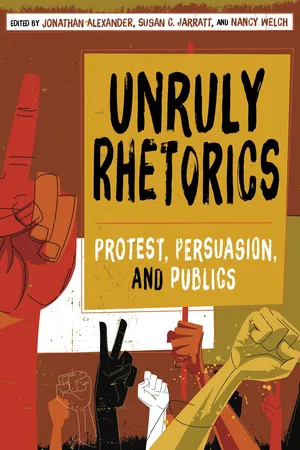
Unruly Rhetorics is a collection of essays from scholars in rhetoric, communication, and writing studies inquiring into conditions for activism, political protest, and public assembly. An introduction drawing on Jacques Rancière and Judith Butler explores the conditions under which civil discourse cannot adequately redress suffering or injustice. The essays offer analyses of "unruliness" in case studies from both twenty-first-century and historical sites of social-justice protest. The collection concludes with an afterword highlighting and inviting further exploration of the ethical, political, and pedagogical questions unruly rhetorics raise. Examining multiple modes of expression – embodied, print, digital, and sonic – Unruly Rhetorics points to the possibility that unruliness, more than just one of many rhetorical strategies within political activity, is constitutive of the political itself.
eBook - ePub
Unruly Rhetorics
Protest, Persuasion, and Publics
- English
- ePUB (mobile friendly)
- Available on iOS & Android
eBook - ePub
Unruly Rhetorics
Protest, Persuasion, and Publics
About this book
Information
Subtopic
RhetoricPART I
BRINGING BACK THE BODY
1
FEMINIST BODY RHETORIC IN THE #UNRULYMOB
TEXAS, 2013
If we don’t invent a language, if we don’t find our body’s language, it will have too few gestures to accompany our story. We shall tire of the same ones and leave our desires unexpressed, unrealized. Asleep again, unsatisfied, we shall fall back upon the words of men—who, for their part, have “known” for a long time. But not our body.
—Luce Irigaray (88)
Rhetorical appeals to decorum and civility can perform functions of social discipline. This discipline can take the form of a condemnation of affect, the condemnation of crowds and mass protest, and the condemnation of controversial views as in and of themselves “hurtful” (Cloud, “Civility”). Such disciplining rhetorics are deployed when women (whose affect is suspect), queer persons, persons of color and other minorities (whose stand-points are suspect), and activist groups (whose bodies are feared but whose demands are suspect) rise up to challenge hegemonic power. Yet sometimes a movement rises to make its demands heard and, in the process, successfully protests both oppressive policy and the conventions of politeness and decorum that mask power. Kevin Michael DeLuca has made this argument with regard to the “body rhetoric” of the activist groups ACT UP, Queer Nation, and Earth First! He describes how the invasion of hetero-familial space by queer organizations formed “radically democratic disorganizations” (9; see also Haiman). DeLuca concludes that bodies are an unorthodox resource for advocacy that rejects formal modes of public argument. Similarly, Nathan Stormer examines how the naked body can “speak” in public through the violation of norms of decorum and morality.
More than extending the idea of the body as a rhetorical resource in general, however, my purpose is to offer a specifically gendered analysis that forefronts the urgency of the recognition of women’s bodies in public discourse. Women’s bodies are simultaneously the site of ideological and political contestation in public and the repository of everything private, dangerous, disgusting, and out of bounds in politics proper. When women, in Irigaray’s terms, find “our bodies’ language,” we come up against what men in the context of hegemonic masculinity and the privatization of social responsibility (which requires women’s containment) “have known for a long time”: that women who can tell the stories of our bodies and our desires and demand their satisfaction are not just unruly but dangerous.
A case in point is the “people’s filibuster,” an uprising of thousands of Texans against a draconian omnibus antiabortion bill in the Texas legislature in 2013. Texas conservative politicians denigrated participants in the feminist uprising in Texas as an “unruly mob.” The discourse of the Texas Republicans was obsessed with the bodies of protesters, and especially the scatological and reproductive regions of those bodies. They had entrants to the Capitol searched for non-existent “jars of poop” and banned tampons from entering the premises lest they be used as projectiles or to wick Molotov cocktails. The activists, emboldened by the absurdity of the politicians’ apparent terror of women, appropriated the discourse of unruliness and the symbols of bodily leakage, wearing hats and garments made of tampons and using labels to coordinate action on Twitter around the hashtags #unrulymob and #feministarmy.1 The shift from the former (mob) to the latter (army) rearticulated the force of organized numbers as a coherent intentional political vehicle.
In what follows, I will describe the interrelated rhetorical elements of unruly rhetorics as the feminist uprising at the Texas Capitol in 2013 embodied them: the comic frame, scatology, and the material force of bodies. Each of these elements is a violation of conventional rules of decorum, and the protests against the antiabortion bills also amounted to a protest of conventional governance in which rules of decorum literally policed the public’s voices. These events generated among participants a profound sense of their bodily agency in the context of conservative political hegemony. The #unrulymob of women and men also triggered real fear on the part of conservative politicians set back on their heels by their own misogynistic terror of women and women’s bodies, in Western culture automatically fearsome and disgusting threats to reason and order.
Another dimension of such stigmatization is the opprobrium against the non-reproductive female body. Antiabortion rhetoric typically foregrounds the fetus and its personhood over that of the mother/woman, who is reduced to the status of incubator (Condit; Luker; Petchesky; Saletan). As I have argued elsewhere, antiabortion rhetoric is a component of the larger conservative project (shared by neoliberals) of privatizing social responsibility. Assigning women to the maternal role justifies the private family as the site of all caretaking. Thus for women to interject their entire bodies and voices, foregrounding their agency, into the space of deliberation over abortion is especially disruptive and paradoxical. Ultimately, however, despite the creative and powerful interruption of the legislative proceedings on the part of thousands of Texas women and men, the setback to the antiabortion forces was only temporary, as Governor Rick Perry called a second special session during which the draconian legislation passed without challenge. In this light, I conclude the chapter with a discussion of the limits of rhetorical unruliness but also the potential of an awakened sense of our bodies’ voices.
BACKGROUND: THE EMERGENCE OF THE #FEMINISTARMY
In June 2013, the Texas legislature held hearings on various versions of sweeping antiabortion legislation that ultimately would require clinics to meet standards for ambulatory surgery centers, doctors to have admitting privileges at a local hospital (resulting in the closing of all but four clinics in the state), and the state to prohibit abortion after twenty weeks’ gestation. As word spread about the bills under consideration, hundreds of women signed up to testify largely against the legislation on June 21, 2013, four days before the filibuster (see Jones, “Extraordinary”; Jones, “People”; Stutz). Among those testifying was a young woman named Sarah Slamen. Called on late in the day, she challenged the legislators bluntly:
I had some really eloquent remarks written out, but you guys have just worn me down all day. With all this terrible science, and glad-handing, and to be frank I get to move to New York next month, so I don’t have to live in fear of you Texas legislators anymore and what you’re going to do to my education system, or my healthcare system, ’cause I’m going to a state that doesn’t kill its own inmates. That’s how pro-life it is, up there.
I will thank you, though, first. It was destiny that you would discriminate against us and try to force your way inside the bodies of Texas women. Thank you! . . . You have radicalized hundreds of thousands of us, and no matter what you do for the next 22 days, women and their allies are coming for you. (Wing)
As she continued speaking, Slamen was carried out of the chamber by police. But she had summed up the moment quite aptly. Over the coming days, women and men of Texas would rise up against the legislation, inventing a body rhetoric that captured and deployed the paradoxical character of the entry of women’s bodies into political spaces.
At the end of the first special session, on June 25, state senator Wendy Davis stood more than eleven hours to filibuster the final version of the legislation, Senate Bill 5. Inspired by and responding to a call by Planned Parenthood, the organization NARAL-Pro-Choice America, and their own consciences, a diversely gendered and multiracial group of Texans flowed into the Capitol building to watch and listen in the chamber and overflow rooms. The scene became a reunion of activists who had fought for Roe v. Wade in the 1970s alongside a burgeoning number of new young activists. When Republican leaders came up with three ostensible rules violations against Davis (Davis once leaned on her podium, was wearing a back brace, and at one point “changed the subject” to a discussion of intravaginal ultrasounds), her filibuster ended. That’s when the people’s filibuster ramped up.
With nearly two hundred thousand viewers glued to the live stream of events, protesters in the chamber, in the corridors, and in the rotunda “burst into claps, then cheers, and finally a nonstop roar” (Sinclair) that lasted more than fifteen minutes, past the midnight deadline, making it impossible to hear in the chamber and therefore to pass the bill. All night long, radicalized Texans chanted and sang about their victory. Lieutenant Governor David Dewhurst charged the protesters with being “an unruly mob, using Occupy Wall Street tactics.” Protesters appropriated the label as images and updates circulated on Twitter under the hashtags #unrulymob and #feministarmy. New activist organizations emerged and rallies took place into early July, when a second special session of the legislature ultimately passed the legislation.
Throughout these events, the embodiment of protest in a specifically feminist body rhetoric was key to the victory of the insurgents. The specter of hundreds of women breaching legislative decorum was, to the leaders of the legislature, both grotesque and terrifying. For many of those protesting the legislation, the capacity of bodies to disrupt, interrupt, and exert instrumental control over the proceedings was a revelation of the agency of women. Images of the reproductive body also emerged in protest signage and public symbolism in ways that highlighted and mocked conservative fear of women’s unruly physicality. To understand these features of the unruliness of the #feministarmy, I will connect feminist theory with the rhetorical study of decorum and theories of comic inversion of the bodily grotesque before turning to a more detailed discussion of the events of June and July 2013.
Feminism, Embodiment, and the Comic Frame
As a number of feminist theorists have pointed out, the hegemony of Enlightenment thought in modern society, while progressive in many respects, depends upon the denial and symbolic exclusion of the bodily necessities of social reproduction such as childbirth and rearing, caretaking, and labor, pain, and death. The invasion of civilized talk by matters of bodily necessity—filth, blood, and labor—appears as grotesque. All of these elements are, in the history of Western philosophy, aligned with a denigrated womanhood. Elizabeth Grosz explains, “Relying on essentialism, naturalism, and biologism, misogynist thought confines women to the biological requirements of reproduction on the assumption that because of particular biological, physiological, and endocrinological transformations, women are somehow more biological, more corporeal, and more natural than men. The coding of femininity with corporeality in effect leaves men free to inhabit what they (falsely) believe is a purely conceptual order” (14). When women’s corporeality intrudes into the conceptual and material order of an oppressive society, politicians devoted to that order find their freedom challenged.
In perhaps a disorderly way of my own, I am articulating two feminist traditions in this chapter. The first is that of French radical feminism, with its insights that the feminine poses a threat to a Symbolic order naturalizing a material system that attempts to contain women in the realm of embodied intimacy and reproduction (Cavallaro). I am tying this insight to the socialist feminist theory of social reproduction (Battacharya; Laslett and Brenner). Capitalism, especially in its neoliberal incarnation, depends upon the privatization of social responsibility (Cloud, “Rhetoric of Family Values”). The private domain, understood as the realm of women, is where the reproduction—in biological and social senses—of generations of working people occurs. The assignment of women’s identities and labor to this domain solves the problem of caretaking and socialization for nation-states and the capitalist interests they sustain. Concretely, this arrangement warrants the outright abuse of labor and inattention to education, housing, health care, and material infrastructure on the part of corporations and states. The transgressive eruption, heralded by French feminisms, into political intelligibility exposes the oppressively gendered—but also shockingly porous—division of society into political (decorous and abstracted from necessity) and personal (invisible and necessary) spheres. The French feminist Hélène Cixous wrote, “It is necessary that woman write herself; that woman write about woman and bring women to writing, from which they have been driven away as violently as from their bodies; for the same reasons . . . it is necessary that woman put herself into the text—as into the world and into history—by her own movement” (875; see also Biesecker). “Write yourself,” she adds (880). “Your body must be heard.”
While the bodies, identities, and demands of women, slaves, and the laboring classes more generally were always excluded from the privileges of citizenship in every ostensibly democratic society, it is women whose porous, bleeding bodies and historical tie to reproduction pose the greatest existential challenge to the artificiality of the abstractions of public political discourse. This challenge is heightened when political elites undertake deliberation about women’s bodies (as in the case of abortion) while trying to sustain a civil façade that cannot admit knowledge of them. This tension became a deconstructive resource for the #unrulymob, as protesters foregrounded the biological, inverting Cartesian dualisms in a celebration of women’s reproductive organs and combining symbols of femininity with the historically hyper-masculine. Such tactics risked reinforcing the reduction of women to their bodies; however, the particular ways in which women deployed body imagery and their own bodies exploited contradictions in the right’s discourse.
Indeed, theorists Peter Stallybrass and Allon White have noted the enormous disruptive, transgressive inventional potential in the symbolic and practical inversion of the grotesque and the enlightened, the filthy and the refined, and the lower and the higher (in the Cartesian cartography of the body). They state, “Inversion, so dominant a feature of carnival and fairground acts, could be mobilized, then, as a way of remodeling social relations” (57). In a passage on Freudianism, they note, “It is above all the woman’s body which becomes the battle-ground in the hysterical repression of the grotesque form” (184).
Some tendencies in feminist thought recognize this power of inversion. Judith Butler’s work describing queer performativity as disruption of regulative ideals of sex and gender comes to mind. Melissa Deem, in an important article about feminist scatological rhetorics, describes how feminist manifestos afford a kind of agency for women not recognized in the political public sphere where feminism is relegated to a “minor discourse” (511). In contrast, feminist practices that render sexualized bodies—male and female—shockingly visible may have transgressive potential. Deem describes the literal castration of John Wayne Bobbit by his wife, Lorena, in 1993 alongside the manifesto of the Society for Cutting Up Men (known as the SCUM manifesto) as sites of recognizing the disavowed violations of women’s bodies by men. The politics of these tendencies is “not nice, safe, or sexy” but, rather, marked by collective rage (521). Radical feminist Andrea Dworkin once described the feminist project as “the atrocity work”—the shit work, the rape work, the incest work, the trafficking work, the pornography work, the abuse work (133). This articulation of feminism insisted upon bringing bodily atrocities into public view ...
Table of contents
- Cover Page
- Title Page
- Copyright Page
- Contents
- Acknowledgments
- Introduction
- Part I. Bringing Back the Body
- Part II. Civility Wars
- Part III. Limits and Horizons
- Afterword: Science, Politics, and the Messy Arts of Rhetoric
- Contributors
- Index
Trusted by 375,005 students
Access to over 1.5 million titles for a fair monthly price.
Study more efficiently using our study tools.
Frequently asked questions
Yes, you can cancel anytime from the Subscription tab in your account settings on the Perlego website. Your subscription will stay active until the end of your current billing period. Learn how to cancel your subscription
No, books cannot be downloaded as external files, such as PDFs, for use outside of Perlego. However, you can download books within the Perlego app for offline reading on mobile or tablet. Learn how to download books offline
Perlego offers two plans: Essential and Complete
- Essential is ideal for learners and professionals who enjoy exploring a wide range of subjects. Access the Essential Library with 800,000+ trusted titles and best-sellers across business, personal growth, and the humanities. Includes unlimited reading time and Standard Read Aloud voice.
- Complete: Perfect for advanced learners and researchers needing full, unrestricted access. Unlock 1.5M+ books across hundreds of subjects, including academic and specialized titles. The Complete Plan also includes advanced features like Premium Read Aloud and Research Assistant.
We are an online textbook subscription service, where you can get access to an entire online library for less than the price of a single book per month. With over 1.5 million books across 990+ topics, we’ve got you covered! Learn about our mission
Look out for the read-aloud symbol on your next book to see if you can listen to it. The read-aloud tool reads text aloud for you, highlighting the text as it is being read. You can pause it, speed it up and slow it down. Learn more about Read Aloud
Yes! You can use the Perlego app on both iOS and Android devices to read anytime, anywhere — even offline. Perfect for commutes or when you’re on the go.
Please note we cannot support devices running on iOS 13 and Android 7 or earlier. Learn more about using the app
Please note we cannot support devices running on iOS 13 and Android 7 or earlier. Learn more about using the app
Yes, you can access Unruly Rhetorics by Jonathan Alexander, Susan C. Jarratt, Nancy Welch, Jonathan Alexander,Susan C. Jarratt,Nancy Welch in PDF and/or ePUB format, as well as other popular books in Languages & Linguistics & Rhetoric. We have over 1.5 million books available in our catalogue for you to explore.