eBook - ePub
City of Lake and Prairie
Chicago's Environmental History
- English
- ePUB (mobile friendly)
- Available on iOS & Android
eBook - ePub
City of Lake and Prairie
Chicago's Environmental History
About this book
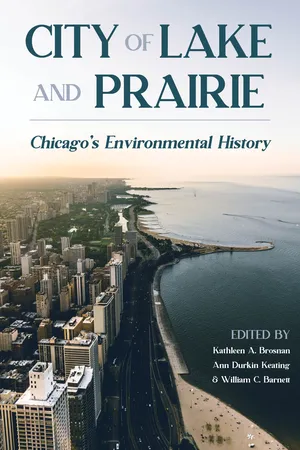
Known as the Windy City and the Hog Butcher to the World, Chicago has earned a more apt sobriquet—City of Lake and Prairie—with this compelling, innovative, and deeply researched environmental history. Sitting at the southwestern tip of Lake Michigan, one of the largest freshwater bodies in the world, and on the eastern edge of the tallgrass prairies that fill much of the North American interior, early residents in the land that Chicago now occupies enjoyed natural advantages, economic opportunities, and global connections over centuries, from the Native Americans who first inhabited the region to the urban dwellers who built a metropolis in the nineteenth and twentieth centuries. As one millennium ended and a new one began, these same features sparked a distinctive Midwestern environmentalism aimed at preserving local ecosystems. Drawing on its contributors' interdisciplinary talents, this volume reveals a rich but often troubled landscape shaped by communities of color, workers, and activists as well as complex human relations with industry, waterways, animals, and disease.
Information
Subtopic
North American HistoryPART I
WHERE PRAIRIE MEETS LAKE
Geography is not destiny, but Chicago’s location, with the Great Lakes to the east and the prairie to the west, shaped the city’s history. Chicago sits at the intersection of the eastern woodlands and the western prairie. When New Yorker Charles Butler visited in 1833, he described the prairie as “one great unoccupied expanse of beautiful land, covered with the most luxuriant vegetation—a vast flower garden—beautiful to look at in its virgin state and ready for the plough of the Farmer.” Butler envisioned the bounty of American farmers sent to eastern markets via the Great Lakes.1 However, in his essay on Native Americans Robert Morrissey contends that this region of tallgrass prairie was not virgin soil when the city of Chicago was founded. Rather, he observes, it was an “anthropogenic landscape” shaped by Indian activity for millennia.
Chicago sits on a subcontinental divide separating the Great Lakes from the Mississippi River watershed. Over centuries Native Americans had portaged between these water systems. With the arrival of more Europeans in the eighteenth century, the Potawatomi and other regional Indians increasingly engaged in a far-reaching fur trade.2 By the early nineteenth century they faced a United States engaged in a settler colonial project that sought land. White Americans worked to dispossess Indian communities and replace them with racially restrictive societies. Claiming authority, the new arrivals transformed supposedly “virgin” or “underused” indigenous lands into private property.3
Chicago’s founding is grounded in such a dispossession. Regional waterways connected Chicago to these political, economic, and social transitions and, as Ann Keating and Kathleen Brosnan also observe, to global environmental changes, including nineteenth-century cholera pandemics. Over time, as Chicagoans built their city at the junction of lake and prairie, they responded to a series of cholera outbreaks by gradually shifting from privatized, temporary services to greater municipal control of the sanitation infrastructure and public health.
The first plat at the mouth of the Chicago River by James Thompson, for the Canal Commissioners, began the process of making the land into real estate. As part of the larger western capitalist enterprise, Chicago helped to mold distant hinterlands by controlling trade in the region’s rich natural resources, commodifying the land, lumber, crops, and livestock. Domesticated animals, Katherine Macica argues, were a part of nature that was interwoven into the city’s built environment from the start, providing energy as well as food, until reformers worked to remove livestock from the twentieth-century city.
CHAPTER 1
Native Peoples in the Tallgrass Prairies of Illinois
It would be hard to overstate the achievement and far-reaching impact of William Cronon’s landmark 1992 book, Nature’s Metropolis. It was a monumental history of Chicago’s rise. It was a methodological tour-de-force. It was a reflection of Cronon’s tremendous gifts as a writer, demonstrating his genius ability to turn an improbable subject such as nineteenth-century commodity flows into a page-turning history classic.1
Perhaps the book’s most enduring contribution, however, was the way it used the case study of Chicago to challenge deeply held and problematic ideas about the relationship between city and countryside in U.S. environmental history. As Cronon argued brilliantly, much of American thinking about nonhuman nature has always imagined a fundamental disconnect between the “natural” rural landscape on the one hand and the city on the other. Reorienting our view, Cronon used the story of Chicago’s rise to show how deeply connected city and hinterland were and are. The city was not “artificial,” nor the countryside “natural.” Rather both were part of a profoundly humanized landscape, a hybrid “second nature” containing the imprint of both human and nonhuman agency. This point, which Cronon later extended in his seminal essay on the American idea of wilderness, usefully critiqued bedrock assumptions about “nature” in American culture and shaped the environmental humanities down to the present.2
As valuable as Cronon’s lesson about second nature was, however, it contained an assumption, more implied than explicit, about the environmental history of the Midwest before Chicago. Narrating the complex rise of second nature in the mid-continent, Nature’s Metropolis suggested a predecessor, a “first nature” that previously characterized the region. Although not at all a focus of Cronon’s book, the concept of “first nature” was nevertheless an important presence in his argument, the imagined alternative against which his concept of “second nature”—the linked processes of the city and countryside—could be contrasted.3 Speeding along to tell the story of the rise of the city, Cronon emphasized what constituted this “first nature”: the nonhuman forces like glaciers that created the landscape of the Midwest; the “natural legacies” that created soil types and the “vegetational geography.”4 Before Chicago, it was not people and their markets but nonhuman forces—“the land,” “energy flows,” “natural patterns,” and local “direct ecological adaptation”—which were responsible for shaping the landscape.5 Representing a profound break with the past, Chicago “redefined and reordered” the landscape in the nineteenth century, giving local ecologies “an ever larger human component,” and leaving them increasingly “improved towards human ends.”6
Cronon’s implied idea of “first nature” echoed an assumption that Americans commonly make about the landscape of the West, namely that it was largely unaltered wilderness until nineteenth-century white settlement, farm making, species shifting, and industrial development transformed it. Missing from this, however, are all the profound ways in which the landscape of the Midwest and West was already deeply humanized well before the rise of center cities such as Chicago. To be sure, Cronon did not ignore Indian people and their presence on the land, and it would be foolish to suggest that the author of Changes in the Land (a book in which one central purpose is exploring ways that Indians shaped the landscape of North America before contact) was ignorant of or incurious about midwestern Indians’ impact on their environment. Still, in Nature’s Metropolis Cronon’s narrative focus was surely on discontinuity as he contrasted Indian land use with the anthropogenic “second nature” of the nineteenth century.7 Largely underplaying all the critical ways that Indians shaped the region, Cronon followed a common simplification of midwestern Indians by casting them as “users” rather than as “shapers” of the land, and in any case not as consequential in their impacts as the market makers that followed them.8 Emphasizing discontinuity between the pre-Chicago past and its modern rise, he reified a chronological boundary which is arguably as problematic as the distinction between city and countryside he so effectively challenged.
The premise of this chapter is that the region in which Chicago grew up was a thoroughly anthropogenic landscape—a profoundly altered example of “second nature”—well before Chicago began.9 Indeed, much of Chicago’s rise as the central “city in the garden” was owed to the ways in which the long history of human occupation in the region had shaped and conditioned the soil, cropped the landscape with its distinctive mosaic-like ecozones, and encouraged its particular fauna. The environmental history of Chicago needs to begin with a recognition of the great continuity of anthropogenic change in the Midwest. The city had a profound effect on nonhuman nature through its marketplace and its capital infrastructure, of course, but it only continued—and in many ways was shaped by—a previous trajectory of human exploitation, modification, and alteration. Environmental historians have done useful work in breaking down the binary between city and hinterland, teaching us not to think of the one as “natural” and the other not. But let us go further and challenge a still-powerful chronological binary that separates the modern from the premodern: the notion of a profoundly altered “second nature” that Chicago created and the largely nonanthropogenic “first nature” that preceded it. At a time when historians are debating the concept of the Anthropocene, it may be instructive to contemplate ways in which the Midwest in the Holocene is second nature all the way down.10
Chicago grew in a distinctive borderland, at the edge of eastern oak-hickory forests, western grasslands, and within reach of northern pine forests accessible by means of Lake Michigan. The most distinctive feature of its regional ecology was surely the place where these bioregions came together, the edgy ecotone of the tallgrass prairies.11 The prairies were a landscape in transition, receiving enough moisture to support tree growth and tending toward forest over time. Given high summer precipitation, the prairies were also super-productive, creating more organic material every year than the ecosystem could consume. For this reason annual nutrient cycles resulted in the gradual accumulation of excess biomass; waste materials from frequent fires and annual decomposition, together with windswept loess, deposited layer upon layer over glacial till. Over time that accumulation constituted several feet in most places, comprising some of the richest soil on the planet. Given the presence and viability of species drawn from both grassland and woodland taxa, and climate conditions alternately favorable to either vegetation zone, the tallgrass was a distinctively biodiverse mosaic.12 I have recently argued that the edgy, transitional prairie landscape shaped human history in important ways in the period before and after contact.13 But the direction of influence was not one way.
Up until recently, nature writers, natural historians, and observers have often considered the prairie as an utterly nonhuman landscape, the product of purely “natural” forces such as climate, glaciers, wildfire, and wind. Humans, of course, destroyed much of the prairie in the nineteenth century, but the original creation of what many considered a “primeval” midwestern landscape was believed by many writers to have nothing to do with them, and indeed to date much further back than human history in the region. In her classic Shaping of America’s Heartland, for example, the geographer Betty Flanders Thomson celebrated the relic prairies that survive in rural cemeteries in Illinois, Iowa, and Minnesota. Such relics give nature-lovers the consolation of knowing what the land should look like in its “natural form,” since they are “purely natural and not the product of human manipulation.” For Thomson and many other writers, the tallgrass prairies were an ancient and “wild” landscape, not anthropogenic.14
But scientists have begun to tell a different and much more complex story about the origin of the prairie and its ecology. Exploiting natural archives from pollen deposits to tree rings, scientists can reconstruct past vegetation history with increasing specificity. In the case of the Midwest, pollen records from bogs and ponds help to pinpoint the evolution of the grassland and surrounding vegetation communities in the distant past, while rare ancient oak trees provide low-resolution temperature and rainfall series for the region over a more recent period. Interested environmental historians can gain powerful insights about regional (and sometimes local) scale vegetation change from these datasets. In addition to specific landscape histories, the paleoecological literature provides a general lesson about the ubiquity and complexity of landscape change and the perils of viewing past landscapes as stable or timeless.15
Indeed, in contrast to old stories about the prairie as a timeless, “primeval” landscape, scientists now understand that the eastern prairies were formed relatively recently, clearly during the Holocene. Far from ageless, the prairie landscape in Illinois was probably formed around 8,000–6,000 years before the present (ybp), according to recent palynological study.16 Summarizing a new consensus, Roger Anderson argues that the landscape of Illinois was covered by hardwood forests prior to and then again after the ice ages, and only came to be occupied by grasses in the mid-Holocene, probably coincidentally with the mid-Holocene warm period, or hypsithermal.17 Although popular wisdom used to hold that the main factor in prairie formation was the fifty-five-million-year-old Rocky Mountain rain shadow and resultant aridity across the mid-continent, scientists have known since the 1930s that the prairies received plenty of summer rainfall to support trees. An emerging consensus now holds that other factors were responsible for the formation of the prairies and their eastern extent and persistence.18
The most important factors were probably periodic drought and fire. Recent charcoal studies confirm that a rise in fire frequency accompanied the rise of the grassland ecotone and its eastern push. A marked spike in non-arboreal pollen (grasses and forbs) is coincidental with a dramatic increase in charcoal concentrations in sediment samples from Chatsworth Bog, in Illinois, around 6,000 ybp.19 Fire, and not just climate, seems to have been determinative in creating the prairie.20
Many scholars agree that this increased fire frequency was almost certainly anthropogenic, the mark of Archaic period peoples on the landscape.21 Indeed, as Anderson writes, while the droughts of the hypsithermal may have helped drive the eastern movement of the prairie, they cannot explain its persistence during a much wetter period beginning five thousand years ago. The emerging consensus is strong: “Most believe . . . that for the last 5,000 years, prairie vegetation in the eastern United States would have mostly disappeared if it had not been for the nearly annual burning of these grasslands by the North American Indians.”22 In other words, humans may not have created the grasslands, but they seem to have been the primary maintainers of the prairie peninsula for well over 80 percent of its life.23
It is impossible to know about the specific human ecology of the prairie eight thousand years ago, but contact-era records give us a sense of how Native peoples managed the land in the region well before Chicago.24 They burned huge swaths of the uplands each year, usually in the fall. In the seventeenth century French observers noted that the fire regime resulted in intricately diverse patches, including the upland prairies and the lowland woods. As Jesuit Priest Louis Vivier put it, the prairie fire regime created huge steppes and groves, as well as considerable dense woodlands. Meanwhile, the table-flat landscape left by the glaciers in the eastern reaches of the prairies also ensured that water could not easily drain from the land, resulting in great wetlands around the slow-moving rivers. Describing the region around the Mississippi River in southern Illinois, Vivier wrote:
Both banks of the [river] are bordered throughout the whole of its course by two strips of dense forests, the depths of which varies [sic], more or less, from half a league to four leagues. Behind these forests the country is more elevated, and is intersected by plains and groves, wherein trees are almost as thinly scattered as in our public promenades. This is partly due to the fact that the savages set fire to the prai...
Table of contents
- Cover Page
- Title Page
- Copyright Page
- Contents
- Acknowledgments
- Introduction
- Part I. Where Prairie Meets Lake
- Part II. A Freshwater City
- Part III. The Nature of Working-Class Chicagoans
- A Cartographic Interlude
- Part IV. Managing (or not) Urban-Industrial Complexity
- Part V. Reenvisioning the Lake and Prairie
- Notes
- Contributors
- Index
Trusted by 375,005 students
Access to over 1.5 million titles for a fair monthly price.
Study more efficiently using our study tools.
Frequently asked questions
Yes, you can cancel anytime from the Subscription tab in your account settings on the Perlego website. Your subscription will stay active until the end of your current billing period. Learn how to cancel your subscription
No, books cannot be downloaded as external files, such as PDFs, for use outside of Perlego. However, you can download books within the Perlego app for offline reading on mobile or tablet. Learn how to download books offline
Perlego offers two plans: Essential and Complete
- Essential is ideal for learners and professionals who enjoy exploring a wide range of subjects. Access the Essential Library with 800,000+ trusted titles and best-sellers across business, personal growth, and the humanities. Includes unlimited reading time and Standard Read Aloud voice.
- Complete: Perfect for advanced learners and researchers needing full, unrestricted access. Unlock 1.5M+ books across hundreds of subjects, including academic and specialized titles. The Complete Plan also includes advanced features like Premium Read Aloud and Research Assistant.
We are an online textbook subscription service, where you can get access to an entire online library for less than the price of a single book per month. With over 1.5 million books across 990+ topics, we’ve got you covered! Learn about our mission
Look out for the read-aloud symbol on your next book to see if you can listen to it. The read-aloud tool reads text aloud for you, highlighting the text as it is being read. You can pause it, speed it up and slow it down. Learn more about Read Aloud
Yes! You can use the Perlego app on both iOS and Android devices to read anytime, anywhere — even offline. Perfect for commutes or when you’re on the go.
Please note we cannot support devices running on iOS 13 and Android 7 or earlier. Learn more about using the app
Please note we cannot support devices running on iOS 13 and Android 7 or earlier. Learn more about using the app
Yes, you can access City of Lake and Prairie by Kathleen Brosnan, Ann Durkin Keating, William C. Barnett, Kathleen A. Brosnan,William C. Barnett,Ann Durkin Keating in PDF and/or ePUB format, as well as other popular books in Technology & Engineering & North American History. We have over 1.5 million books available in our catalogue for you to explore.