Nick Megoran explores the process of building independent nation-states in post-Soviet Central Asia through the lens of the disputed border territory between Uzbekistan and Kyrgyzstan. In his rich "biography" of the boundary, he employs a combination of political, cultural, historical, ethnographic, and geographic frames to shed new light on nation-building process in this volatile and geopolitically significant region.
Megoran draws on twenty years of extensive research in the borderlands via interviews, observations, participation, and newspaper analysis. He considers the problems of nationalist discourse versus local vernacular, elite struggles versus borderland solidarities, boundary delimitation versus everyday experience, border control versus resistance, and mass violence in 2010, all of which have exacerbated territorial anxieties. Megoran also revisits theories of causation, such as the loss of Soviet control, poorly defined boundaries, natural resource disputes, and historic ethnic clashes, to show that while these all contribute to heightened tensions, political actors and their agendas have clearly driven territorial aspirations and are the overriding source of conflict. As this compelling case study shows, the boundaries of the The Ferghana Valley put in succinct focus larger global and moral questions of what defines a good border.
eBook - ePub
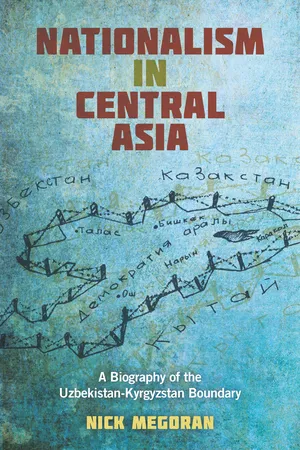
Nationalism in Central Asia
A Biography of the Uzbekistan-Kyrgyzstan Boundary
- English
- ePUB (mobile friendly)
- Available on iOS & Android
eBook - ePub
About this book
Information
Subtopic
Asian PoliticsCHAPTER 1
UZBEKISTAN
Building the Nation, Defending the Border
On December 12, 1991, the last first secretary of the Communist Party of Uzbekistan and first president of the independent Republic of Uzbekistan, Islam Karimov, landed at an airport outside the city of Ashgabat to meet his counterparts from Kazakhstan, Kyrgyzstan, Tajikistan, and Turkmenistan. Four days previously the heads of Russia, Belarus, and Ukraine had agreed to dissolve the Soviet Union. The Central Asian leaders, whose republics were tied to Russia in myriad ways, had not been consulted and feared that the sudden changes foisted on them would precipitate economic collapse. Many observers doubted whether the Central Asian republics were even viable as independent states. As Karimov and his anxious colleagues discussed how to respond, journalist Ahmed Rashid, covering the meeting, reported that a deputy foreign minister told him, “We are not celebrating—we are mourning our independence.”1
Fast-forward some two decades, and Islam Karimov was one of only two of those original five leaders still in power (along with Kazakhstan’s Nursultan Nazarbaev). His address to the nation on the twenty-first anniversary of Uzbekistani independence was light years away from the trepidation of that momentous December 1991. His speech extolled the great strides forward that his country has taken since that uncertain and fearful start. Having “put an end to dependence” on Russia, he praised the high rates of economic growth that demonstrate how Uzbekistan has ridden the global economic crisis relatively well. He stated that although twenty-one years is a very short period in the “creation of states on the world map,” over this period “Uzbekistan has undoubtedly made achievements worth a century.” Among the most demonstrable of these is that “we have turned” Uzbekistan into “one of those independent and sovereign countries which rely on their power and potential, which are able to protect their borders and defend the peaceful life of their people, which have their worthy places in the world community, and which are developing fast and steadily.”2 Although he warned darkly of the “many destructive forces” attempting to derail this startling progress, he assured his people that because “we are no more the naive people of the 1990s with no political experience,” these wrecking attempts would fail.
This chapter investigates materializations of the boundary in the creation of the modern nation-state of Uzbekistan. For President Karimov, the “border” was a site whereby a geopolitical imagination of Uzbekistan as a haven of peace and tranquility, threatened by violent, backward, and unstable neighbors could be imagined. This geopolitical vision was enacted and transmitted chiefly through the performance of border control rituals, the celebration and sanctification of border guard services, the remaking of border landscapes, and the repeated media portrayal of the apprehension of criminals, terrorists, and smugglers at the border. It will be shown how these related to the general project of nation building and the legitimization of illiberal rule. In this account, the boundary emerges as more than a line between states—it is a moral border delimiting those who belong within the Uzbek polity, and those who do not. Crucially, it was used to identify Karimov as a legitimate leader and to discredit those who threaten his rule. Nonetheless, these narratives were challenged and threatened by unofficial transboundary flows, alternative geopolitical imaginations, and the practices of border guards themselves. Understanding the multiple materializations of the boundary since 1991 thus provides important insights into the understudied topics of the nature of both illiberal rule and national ideology in Uzbekistan.3 Karimov died in September 2016, after the completion of this manuscript. At the time this book went to press it was still too early to ascertain the extent to which his successor, Karimov’s former prime minister Shavkat Mirziyoyev, would diverge from the practices Karimov established. This chapter should thus be seen as a political history of Uzbekistan, told from the border, under the rule of its first president.
THE POLITICS OF INDEPENDENT UZBEKISTAN
Uzbekistan’s two and a half decades as an independent republic have put an end to the doubts of those who questioned its viability as an independent state. Despite the massive political and economic shock of unsought independence, it has proved thus far a successful state by two of the most basic counts: it is still there, and it is still solvent. On the first point, it has avoided the civil wars, separatist struggles, or intercommunal violence that have torn apart some other former Soviet Central Asian and Caucasian republics, which many observers predicted would threaten it too. On the second, by 2013 it boasted a gross domestic product (GDP) of 150 percent of its 1989 level, whereas Kyrgyzstan had still not recovered its 1989 GDP.4 Its “gradualist” approach to economics saw it reject both Russian-style “shock therapy” and South Korean–style export-oriented economic growth. Planners have aimed at self-sufficiency in primary consumption goods rather than economic growth, a strategy Ruziev et al. contend has prioritized social stability.5 Economically, the government’s main source of foreign earnings is the export of cotton, produced to a significant degree by forced and poorly paid labor.6
The figure of Islam Karimov towers over this period: his rise and political survival over so long a time span is remarkable in itself. Born in 1938 and raised in an orphanage, he trained as an engineer and ascended through the ranks of the Uzbek Communist Party to become its first secretary in 1989. While riding the wave of the sovereignty movement in the Uzbek SSR by declaring it a sovereign state within the USSR in June 1990, at the same time he insisted on maintaining the ideological and organizational unity of the Communist Party of the Soviet Union.7 Thus in August 1991 his hardline instincts and party loyalty led him to support the anti-Gorbachev coup attempt. When it failed, he performed a striking volte-face by denouncing the plotters, banning his own Communist Party, and declaring Uzbekistan independent.
In the “thaw” of the final months of Soviet rule and in the early period of independence it seemed that a more open form of politics might be emerging.8 Indeed, President Karimov committed his newly independent state to being a “society of democracy and social justice.”9 However, the opposite proved to be the case and Karimov established a tight grip on power, making Uzbekistan one of Asia’s most illiberal regimes. The regime maintains close oversight of the political, economic, and cultural life of the republic, with information flows and access tightly controlled. No sustained dissent or political opposition is tolerated. In particular, people seen as nontraditional Muslims and thus in danger of political radicalization have come under particular suspicion. Human rights groups have long claimed that torture is “systematic,” with the Human Rights Watch’s 2014 World Report concluding that “Uzbekistan’s human rights record remained abysmal across a wide spectrum of violations.”10
Some analysts warned that this heavy-handedness could unintentionally hasten the growth of forms of Islam the government saw as undesirable, and that economic policies creating a “new poor” would lead the Uzbek population to rise up and press for change.11 True enough, as constitutional forms of opposition became effectively difficult, clandestine or spontaneous forms mushroomed. The pan-Islamist movement Hizb ut-Tahrir grew rapidly in small underground cells that clandestinely distributed leaflets denouncing governmental corruption and calling for the reestablishment of the caliphate.12 The Islamic Movement of Uzbekistan (IMU), a Tajikistan-based anti-Karimov group composed originally largely of Uzbek exiles, staged guerrilla incursions into Kyrgyzstan’s Batken region and southeastern Uzbekistan in 1999 and Uzbekistan in 2000 (see next chapter), calling for the replacement of Karimov’s secular regime with a government based on Islamic legal precepts, and demanding release of what the group claimed were 100,000 wrongfully jailed Muslims. This group was also blamed for bomb attacks on prominent symbolic targets in the Uzbek capital Tashkent on February 16, 1999, which killed sixteen people and apparently missed the president by a matter of minutes.13 By the mid-2000s isolated protests against rises in food prices, gas supply cuts, regulations on market traders, house demolitions, and so on had become regular occurrences, sometimes forcing local administrations to back down and abandon or postpone changes.14 From exile in Norway, where he had been granted political asylum, a high-profile opponent of Islam Karimov, Muhammad Solih, continued his political activities against the regime.15 In 2004 Islamist gunmen and suicide bombers struck in Tashkent and Bukhara, leaving nearly fifty people dead. Most seriously, in 2005 hundreds of people were killed in the city of Andijon when the state’s armed forces put down what the government claimed was a terrorist and religious extremist revolt backed by outsiders as part of the color revolution conspiracy, and what others saw as popular protest against local government oppression and hardship caused by unfair economic policies.16
Following the Tashkent bombings in 1999, the government responded with a massive crackdown on actual and potential sources of opposition and dissent, employing means such as mass discriminatory arrests, incommunicado detention, harassment of relatives, show trials, severe prison sentences, public rallies to denounce “enemies of the state,” border closures, and the progressive militarization of society.17 In many cases these targeted people whose only apparent crime was to be pious.18 At the same time, the previously highly porous state border formed a vital front in this reaction, being militarized and, at times, completely sealed off. Border defense units were reorganized and upgraded. New checkpoints were established and unmanned crossings closed, as control of passport, customs,19 and visa regulations were tightened. Over time, this culminated in a massive remaking and militarization of the border landscape.
But coercion alone was not what allowed Islam Karimov to remain in power for over two and a half decades. Alisher Ilkhamov asks how the regime survived for so long with so few effective challenges to it despite failing to solve social and economic problems. His answer is “neopatrimonal authoritarianism”: the way that Karimov effectively used patronage to create and maintain loyalties through the “networks of influence” constructed through various coalitions of allegiance, which are “an essential part of the social and political reality in Uzbekistan.”20 Karimov himself, argues Ilkhamov, was a product of that system, but developed it in novel ways that have tightened his control over it. These include the hypercentralization of the administrative system, the partial adoption of the market economy allowing ruling elites to legalize resource and capital accumulation, the selective use of legal-administrative system to neutralize opposition to the regime, the frequent rotation of regional leaders, and the expansion of patronage networks around key administrative departments in central government (especially security, law enforcement, taxation, custom, finances, and export procurement).21 Through the control and reworking of these networks, the command of economic resources to finance them, and the exercise of coercion through them, President Karimov was able to hold the nascent Uzbek state together, keep it solvent, and maintain his position at the helm.
THE IDEOLOGY OF NATIONAL INDEPENDENCE
In explaining the apparent success of the Karimov regime in the face of significant challenges I emphasized economic interests, coercion, and the creation and exploitation of interest-based networks. These matter, but they do not fully explain political behavior. However cynical or instrumentalist we might be about politics the world over, every politician holds or at least espouses ideas about how the world should work. Every political actor operates within a context framed by notions that, however dimly or imperfectly in practice, index beliefs about what is good, right, and true. Politics cannot escape ideology.
This is as true for Karimov’s Uzbekistan as it is for anywhere. With the collapse of Soviet Socialism in 1991, Yalcin argues, “an ideological vacuum emerged, raising the need for a new doctrine.”22 This opinion echoed a post-1991 flurry of often highly speculative literature assessing contenders to fill this supposed vacuum such as nationalism, democratic civil society, and Islam.23
It is certainly correct that new leaders of Uzbekistan and Kyrgyzstan regularly identified the need for a political ideology. However, it is not true that the one that had dominated, socialism, disappeared and that there was an open field for a “new” one. Rather, as we saw in the previous chapter, the Soviet Union’s unique and paradoxical federal structure institutionalized national Soviet republics as the building blocks of a socialist Soviet state.24 The Uzbek SSR thus had always existed in a tension between two ideologies—socialism and nationalism. When the first of these vanished with the Soviet Union, the second remained as the default organizing idea of the republic. Independence was simply a logical extension of this ideology in a world of independent nation-states, and provided a ready framework to begin rethinking political futures. Perhaps the leaders of the Soviet Central Asian republics meeting in Ashgabat that chilly December night in 1990 were not as clueless as Rashid believed.
This Soviet-era Uzbek nationalism formed the basis of what Karimov terms “the ideology of national independence.”25 For Karimov, the Uzbek nation was artificially divided for centuries under the weak feudal khanates that succeeded the fifteenth-century putative Uzbek state of the Shaybanids. It was then repressed by tsarist and Soviet overlords. Thus independence in 1991 was “the most significant event in the centuries-long history of the nation,”26 a teleological fulfillment of the desire of the Uzbek people. This position has framed a vast, multidisciplinary reworking of the cultural, scientific, literary, and historical legacies of putative Uzbek history. Many works have revisited the importance of past Central Asians to the modern culture, from single studies such as Bo‘riev’s introduction to Al-Farg‘oniy,27 to Hayrullaev’s volume outlining the significance of almost 100 past luminaries.28 Uzbek historians have critically revised accounts of the Russian conquest of Central Asia.29 Journals such as Tafakkur have celebrated the intellectual significance of thinkers and poets like Alisher Navoiy.30 Philosophers have found new freedom to explore the wider significance of the intellectual legacy of Uzbekistan, arguing that it was repressed under Soviet ideology.31 The Uzbekistan Academy of Sciences published a “popular-scientific” dictionary of independence, including references to the ideas, institutions, events, and individuals significant to the ideology of national independence.32 A comprehensive statement of the ideology of national independence was provided by one contributor to this volume, To‘lanov, in his mammoth work A Philosophy of Values, which attempts to ground philosophically and historically the broad sweep of Karimov’s ideology and politics of national independence.33 The contrast between this and his Soviet-era works such as The Collective Is a Mighty Force (a polemic against “bourgeois individualism”) and Philosophy (a weighty Marxist tome with barely a dozen pages devoted to Central Asian thought) illustrates the dramatic change in thinking since 1991 linked to the ideology of national independence.34
This reworking of the p...
Table of contents
- Cover Page
- Title Page
- Copyright Page
- Dedication
- Contents
- Acknowledgments
- Note on Place Names and Transliteration
- Introduction: Making Borders, Making Worlds
- Chapter 1. Uzbekistan: Building the Nation, Defending the Border
- Chapter 2. Kyrgyzstan: Contested Visions of the Nation
- Chapter 3. Caught in the Middle: Life in the “Neutral Zone”
- Chapter 4. Osh’s Borders: A Matter of Life and Death
- Conclusion: The Destruction of the Ferghana Valley
- Appendix I: Transliteration Tables
- Appendix II: Divergent Spellings
- Notes
- Bibliography
- Index
Trusted by 375,005 students
Access to over 1.5 million titles for a fair monthly price.
Study more efficiently using our study tools.
Frequently asked questions
Yes, you can cancel anytime from the Subscription tab in your account settings on the Perlego website. Your subscription will stay active until the end of your current billing period. Learn how to cancel your subscription
No, books cannot be downloaded as external files, such as PDFs, for use outside of Perlego. However, you can download books within the Perlego app for offline reading on mobile or tablet. Learn how to download books offline
Perlego offers two plans: Essential and Complete
- Essential is ideal for learners and professionals who enjoy exploring a wide range of subjects. Access the Essential Library with 800,000+ trusted titles and best-sellers across business, personal growth, and the humanities. Includes unlimited reading time and Standard Read Aloud voice.
- Complete: Perfect for advanced learners and researchers needing full, unrestricted access. Unlock 1.5M+ books across hundreds of subjects, including academic and specialized titles. The Complete Plan also includes advanced features like Premium Read Aloud and Research Assistant.
We are an online textbook subscription service, where you can get access to an entire online library for less than the price of a single book per month. With over 1.5 million books across 990+ topics, we’ve got you covered! Learn about our mission
Look out for the read-aloud symbol on your next book to see if you can listen to it. The read-aloud tool reads text aloud for you, highlighting the text as it is being read. You can pause it, speed it up and slow it down. Learn more about Read Aloud
Yes! You can use the Perlego app on both iOS and Android devices to read anytime, anywhere — even offline. Perfect for commutes or when you’re on the go.
Please note we cannot support devices running on iOS 13 and Android 7 or earlier. Learn more about using the app
Please note we cannot support devices running on iOS 13 and Android 7 or earlier. Learn more about using the app
Yes, you can access Nationalism in Central Asia by Nick Megoran in PDF and/or ePUB format, as well as other popular books in Politics & International Relations & Asian Politics. We have over 1.5 million books available in our catalogue for you to explore.