![]()
1
Border Entries and Reentries
As the peripheries of nations, borderlands are subject to frontier forces and international influences that mold the unique life of borderlanders, prompting them to confront myriad challenges stemming from the paradoxical nature of the setting in which they live.
—Oscar J. Martínez, “Border People,” 25
Entry
“Comalapa, Comalapa, Comalapa,”1 the van driver’s assistant yelled from a cement building off the Pan-American highway in Comitán, Chiapas. He played with the tone of his voice, alternately stressing different syllables of CO-ma-lap-a. He beckoned travelers to board the minivans, or combis, destined for the municipality of Frontera Comalapa. With seats for seven to eight passengers, vans generally pack in at least fifteen people with their goods. Inhabitants from the border region travel to Comitán to shop for cheaper used clothing and furniture. They shop in fruit and vegetable markets, flea markets, and recent installations of Walmart and Sam’s Club. I boarded the combi, my backpack and I crammed into a window corner. I held my breath as the driver crossed himself and touched the Jesus ornament hanging from his rearview mirror each time we rounded a curve. We hurtled down the Pan-American Highway from the cool highlands of Comitán into the hot, dry Frontera Comalapa lowlands. I convinced myself that the faster the combi traveled the curves, the better it could cling to the hillside due to pure friction and momentum . . . or perhaps it was the driver’s prayer.
It was the summer of 2005 and my first trip to the border to choose a field site to conduct research. Juan Carlos Velasco,2 a research assistant from ECOSUR (El Colegio de la Frontera Sur) in San Cristóbal de las Casas, was taking me on excursions throughout the border region where he had been part of a research team conducting a multisited study on the integration of former Guatemalan refugees into Mexico.3 I did not know what to expect when we got to Frontera Comalapa, a small town with a colonial square, municipal building, open-air market, stores, a few restaurants and motels, and the recent arrival of cyber cafes and agencias de viaje, or tourist agencies, advertising trips to Tijuana, Altar Sonora, and Tecate.4 Anyone who has been to Altar Sonora knows it is not a tourist destination. These buses occupy a lucrative niche providing transport through Mexico for those wishing to journey into the United States, dropping them in Mexico’s northern desert, where they can contact smugglers or attempt to traverse the desert on their own. The proliferation of tourist agencies reflects the role that the Mexico–Guatemala border plays as a migrant sending and transit zone. In the past decade, Frontera Comalapa has transformed into a hub for migration, petty commerce, prostitution, and the drug trade.
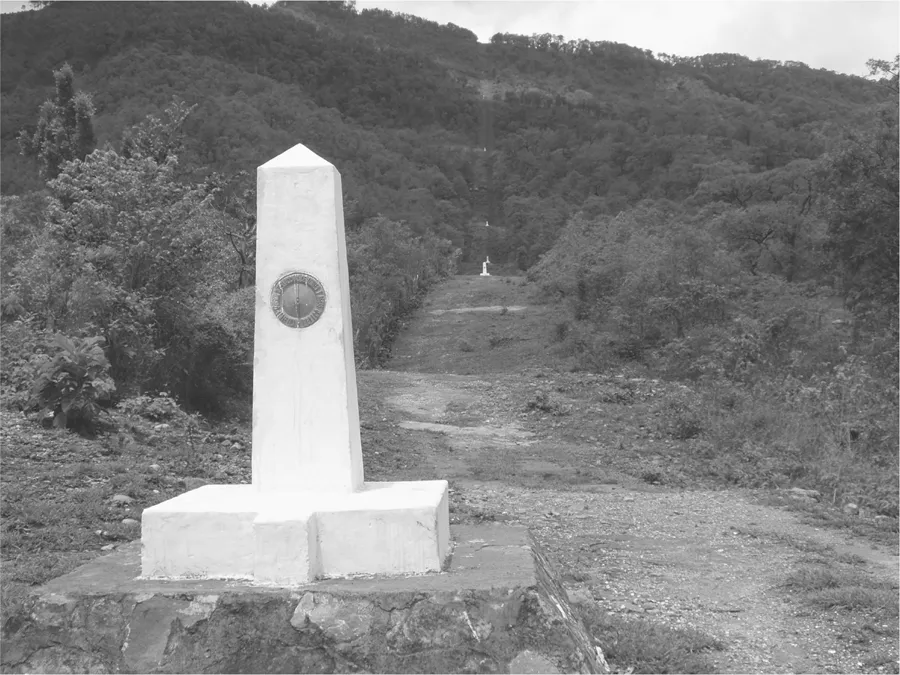
Juan Carlos knew that combis destined for communities residing along the particular unmonitored border route where I ended up conducting fieldwork left from the corner across from the market stalls in Frontera Comalapa. As we boarded the combi, Juan Carlos began chatting with a man I call Federico. From their friendly interchange, I assumed they must have met before, but Juan Carlos had a knack for ethnographic serendipity. Federico not only spoke with us for the entire ride but also proceeded to take us on a tour of his Mexican community of Santa Rosa5 and introduce us to his Guatemalan neighbors across the border. We hopped into the back of his friend’s pickup truck to traverse the unmonitored road through the three Mexican border communities of Santa Rosa, La Maravilla, and El Nance and directly uphill into the two Guatemalan border communities of El Girasol and Nueva Vida. Because we were not transporting any commerce, we were waved through each community’s cadena, or chain. Each border community erects a chain across a section of the road to demarcate its territory and establish a tollbooth to levy tolls on smugglers using the road. Federico laughed off our need for a passport as we traveled up a rocky hill, past some white monuments that were the only indication that we were crossing the international border into Guatemala. The first house we saw in Guatemala had a Guatemalan flag on one side of its fence and a Mexican flag on the other. The house’s owner laughed when we commented that his goat was technically grazing in Mexico. Were we in Mexico or Guatemala? This chapter details my initial and multiple entries into the border and fieldwork in an unmonitored crossing. Moving from my own entry, it details the making of the borderlands and the border communities in relation to the regional and national contexts. Local inhabitants have historically been marginalized by both nation-states as they also helped shape them from their margins6 (see Figure 1.1).
Figure 1.1. Border monuments delineating the division between Mexico and Guatemala.
SOURCE: Author photo.
Reentry
In September 2006 when I returned to live at the border for a year, Juan Carlos arranged for my husband and me to rent a home in Santa Rosa, Mexico. We were then on our own. I learned the limitations of Juan Carlos’s connections due to time constraints on the larger project on refugee integration. His research team had not crossed into Guatemala because it was outside their scope. After hearing rumors that journalists had been run out of the Mexican border community of El Nance in the past, I grew nervous.
Paco, a lanky seventeen-year-old from El Nance, luckily became my local guide. Jokingly called “El Gringo” due to his interest in the United States, Paco knew everyone and sought out a friendship with my husband and me. He explained how nearly all of his community’s 100 households belonged to four families, introduced me to local merchant smugglers, took me to meet friends in Guatemala, and extended invitations to parties, soccer games, and meals. “Puro Hernández,”7 he laughed, referring to how people on both sides of the border shared surnames and kinship ties. His family included local smugglers, cousins in North Carolina factories, and his father, who worked as a cargo loader for coffee smugglers and as a field hand.
Paco wanted to become an immigration agent like his cousin, Rigo. He showed me Rigo’s two-story house near the international borderline. At first, when I heard a man who worked for immigration lived there, I assumed it was an outpost of state surveillance. I learned, though, that Rigo had lived there his entire life and worked most of his career in other parts of Mexico. Recently, his post changed to rotating between various Chiapas immigration offices, meaning that border residents could call on him, or mention his name, for favors. Paco’s desire to become an immigration agent was the first blow to my preconceived notions of security and illegality at the border. A young man whose life was intimately shaped by smuggling also wanted to work for a state agency supposedly committed to policing unauthorized flows.
When I first arrived at the border, I explained my research in the assembly meetings of each community and met key local authorities; most people were receptive. Looking back, I think people appreciated that I wanted to hear their points of view in contrast to how officials and journalists often associated the border with criminality. When I went to the immigration office in Ciudad Cuauhtémoc to register my fieldwork residence according to Mexican regulations for foreign researchers, the agent derisively commented, “That is a place without law. The people there [think] they are above the law. It is no good. The communities make the law.” When interviewing officials, I subsequently did not mention where I resided. The longer I lived at the border, the more suspicions subsided as people witnessed my daily activities, got to know me, and saw nothing was changing. Some residents laughed off the notion that I could threaten their enterprises. They knew where the threats originated and were compensating these individuals accordingly. Their livelihoods depended on it.
This crossing is also not as hidden as it appears. This is the myth of illegality—that is it hidden and unknown. In fact, clandestinity may be key to the maintenance of state sovereignty and the justification of border policing. In her work on undocumented migrants in the United States, Susan Coutin defines clandestinity as the “hidden, but known,” drawing from Gupta and Ferguson (1997) to show how disruptions and exclusions are critical to defining territorial integrity.8 This route is legally prohibited from existing even though officials, regional inhabitants, and merchants admit it provides a central corridor for the movement of goods and people. Vacillations between depicting the crossing as selectively invisible or hypervisible reinforce the myth of an orderly border while enabling extra flows on which regional inhabitants depend to proceed.9 At the same time, periodically drawing attention to these gaps justifies dramatic displays of state violence to recover authority.10 The route is well known to anyone involved in transnational commerce, as well as to officials and the Mexican, Guatemalan, and U.S. governments. I have been following policy briefs from Mexico, Guatemala, and the United States that mention this crossing since 2004, and I have yet to see any changes. Still, because the situation is uncertain, I disguise the names of the communities, some of their characteristics, and individual identities. I acknowledge that the responsibility for information taken out of context to support further criminalization is my own. I balance this fear of misrepresentation with the importance of giving voice to those rendered illegal by official designations, who illustrate firsthand the spirals of violence and insecurity that may ensue from militarized approaches to combating illegality.
A Gringa Amid Male Smugglers
How does a young, white, North American female anthropologist gain access to the world of border smuggling? Mexican researchers who knew about my fieldwork, and had visited me, worried about my safety. My family thought I was crazy. However, I rarely felt unsafe at the border. Ethnography situates extralegal practices within the everyday, which in the rural borderlands is also filled with family meals, harvesting corn, making tortillas and tamales, and sipping coffee on patios. The extralegal does not belong to a separate shadowy underworld. Smuggling goods and facilitating the passage of truckers are a part of daily life. Being embedded in border life, and developing relationships with local families, also helped me develop border smarts, knowing where I should not go, whom I should talk to, and what I should not talk or write about. I started my ethnography not as one about smuggling or migration, but one about what it meant to people to live at the border. I initially asked what people liked and did not like about the border, and the common theme that emerged was the benefit of the business opportunities offered by the border. Yet business could not be separated from border relationships, histories, and the course of social life. I grew to understand why journalists were unwelcome and why communities were suspicious of parachute research, as one resident told me about a previous researcher she had met who “took pictures of us, but I don’t know what happened to them.” Only paying attention to, and reporting on, the extraordinary or the criminal divorces extralegal activity from its social context, making illegality seem like the defining characteristic of the border and its inhabitants. With time, people began to share their lives with me and look out for me. Midway through my fieldwork, my parents came to visit, and we traveled for a week in Guatemala. During the trip, I received phone calls from border residents who were worried about me because they had heard on the radio that criminals assaulted a gringa in the nearby border crossing of La Mesilla, Guatemala.
The border communities had never hosted a foreign academic researcher for an extended period of time. They were familiar with the mandates of a thesis because some youth now attend university, write theses, and conduct a social service in rural communities. They wondered, however, why I was working there and not in an indigenous community, which is a legacy of academic research, especially anthropology, in Mexico (and in U.S. anthropology to an extent). Some people struggled to place me despite my insistence that I was a researcher who was writing a thesis. Was I sure I wasn’t with a church? A friend or relative of a migrant’s friends or relatives in the United States? A member of AFI, the equivalent of the Mexican FBI? These were the only avenues through which many could imagine a gringa residing in their community. Even after I established substantial rapport, a resident confided that one man was suspicious and was following me on his motorcycle for a week to see what “I was really doing.” There were always some people who preferred not to speak with me. I therefore began and continued research slowly, having to constantly maintain rapport.
Being a young married femal...