An innovative framework for advancing human rights
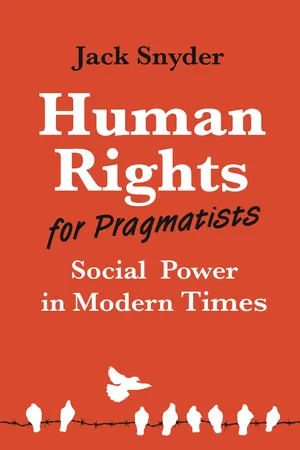
Human rights are among our most pressing issues today, yet rights promoters have reached an impasse in their effort to achieve rights for all. Human Rights for Pragmatists explains why: activists prioritize universal legal and moral norms, backed by the public shaming of violators, but in fact rights prevail only when they serve the interests of powerful local constituencies. Jack Snyder demonstrates that where local power and politics lead, rights follow. He presents an innovative roadmap for addressing a broad agenda of human rights concerns: impunity for atrocities, dilemmas of free speech in the age of social media, entrenched abuses of women's rights, and more.
Exploring the historical development of human rights around the globe, Snyder shows that liberal rights–based states have experienced a competitive edge over authoritarian regimes in the modern era. He focuses on the role of power, the interests of individuals and the groups they form, and the dynamics of bargaining and coalitions among those groups. The path to human rights entails transitioning from a social order grounded in patronage and favoritism to one dedicated to equal treatment under impersonal rules. Rights flourish when they benefit dominant local actors with the clout to persuade ambivalent peers. Activists, policymakers, and others attempting to advance rights should embrace a tailored strategy, one that acknowledges local power structures and cultural practices.
Constructively turning the mainstream framework of human rights advocacy on its head, Human Rights for Pragmatists offers tangible steps that all advocates can take to move the rights project forward.
- 304 pages
- English
- ePUB (mobile friendly)
- Available on iOS & Android
eBook - ePub
About this book
Information
Publisher
Princeton University PressYear
2022Print ISBN
9780691231556
9780691231549
eBook ISBN
9780691231532
1
Power Leads, Rights Follow
HISTORICAL ADVANCES of human rights since the Reformation and the Enlightenment have always depended on the rising social power of the people who benefit from those rights. These successes have been based on a new way of organizing society. Boiled down to its essence, the path to human rights is a journey from personalistic social relationships based on favoritism toward the individual right to equal treatment according to impersonal rules. The success of this revolutionary system depends on the power of its core supporters, the pragmatism with which they advance toward their goals, and the persuasiveness of their ideas to those who remain ambivalent. Victories for rights have always fused power, self-interest, and principle.
The battle to establish the social order based on rights is both very old and very new, and remains only half won. The early prehistory of rights gained impetus from the increase of trade among the townspeople of northern Europe, who challenged aristocratic privileges constraining commerce and labor, and whose Protestant Reformation proclaimed the right of all believers to read the Bible in their vernacular languages.1 The development of commercial society created powerful constituencies for due process of law to protect property, regulate contracts, guarantee the free flow of speech and information (the shipping news vital to their livelihoods), and to protect individuals, including wealthy religious dissenters, against abuses by authorities.2 The expansion of literacy and commerce gave educated, industrious subjects greater bargaining leverage against their kings. This made plausible the idea of national self-determination of the “chosen people” through sometimes orderly, sometimes revolutionary processes of accountability.3 Later, industrialization and the organization of trade unions provided clout behind demands for economic, social, and labor rights for the working class.4
Setbacks to rights have happened when the underpinnings of the social power of rights beneficiaries have come unglued. The worst historic setback to the world’s rights project occurred in the first half of the twentieth century, when structural flaws in the global economy undermined the still-shaky, rights-expanding coalitions of export industry and labor in Weimar Germany and Taisho Japan.5 This shift in power and interests created an opening for a rights-hostile mass politics of militarized nationalism in these two great powers. After 1945 those flaws in the liberal system were repaired with the help of Keynesian tools of economic management and the Bretton Woods international economic institutions. These pragmatic adjustments helped the liberal rights project get back on track with the Universal Declaration of Human Rights and the consolidation of democratic welfare states in the non-Communist great powers. The eventual collapse of the Soviet Union seemed to put the icing on the liberal cake, the crucial ingredient of which was human rights.
This period of liberal near-hegemony and great ambitions for the global human rights movement turned out to be short-lived. The social power base on which it rested eroded, while its detractors and free riders grew in strength and assertiveness.6 Mainstream ruling coalitions frayed in the wealthy democracies as some of their key support constituencies decided that liberal business as usual—including the worldwide promotion of human rights, democracy, and free trade—was not in their immediate interest. Liberal failures to solve problems and serve tangible interests piled up: the world financial crisis of 2008, increased economic inequality, deindustrialization in struggling communities, the inability to integrate Muslim immigrants into European society, America’s failed nation-building wars abroad, and the mismanagement of the coronavirus pandemic.
These repeated shortcomings convinced critics on the left and the right that the core systems of liberalism—its markets, institutions of representative government, courts, and media—were broken or somehow rigged against the people to whom they were meant to be accountable. Some formerly mainstream progressive constituencies, including the ethnic majority working class, increasingly backed sharp limits on refugees and immigration, suppression of voting by minorities, economic protectionism, torture of suspected terrorists, and populist political candidates, especially those on the nationalist right. Astonishing proportions of young adults, especially in the United States, told pollsters it doesn’t matter if their country is a democracy.7
Ideological trends within the liberal rights camp have contributed to this crisis. Economic libertarians, who tout the unfettered freedoms of global capital, have relentlessly undermined the regulatory structures that stabilized liberal markets and media, hollowing out the pragmatic class compromise of the welfare state. These were sins of commission, whereas the shortcomings of the liberal human rights movement were mainly sins of omission. Trying to maintain an unconvincingly apolitical façade, rights activists adopted a stance of legalism, moralism, and idealistic universalism that distanced them from an earlier, more successful tradition of pragmatic progressive reform. This wariness toward pragmatism has limited the power of the human rights message at a moment of precarity not only for the rights movement but for the liberal project as a whole.
The Argument of the Book: The Pragmatic Path to Rights in Modern Times
Human rights are central to how the modern social system works. Thinking about them in a narrower way—as just ethics or law, or as an isolated niche endeavor—misses the point and leads practical recommendations astray.8
The purpose of this book is to advance a theory of human rights that places them in their broad social, political, and economic context. Chapters explore their historical development, their contemporary manifestation in diverse issue areas, and their tailoring for diverse local settings. The goal is both to understand the rights systems that actually exist and to prescribe how to move the rights project forward. These prescriptions are pragmatic in the sense that they apply outcome-oriented criteria for judging the appropriateness of tactics for advancing human rights, taking into account short-term considerations of power and interest as well as longer term effects on the power of pro-rights coalitions and the institutional entrenchment of a rights-based system. Some prescriptions are directed to the community of human rights activists and to aspiring activists who are training to join that community. Most, however, are directed to anyone in any country—students, scholars, policy makers, reformers in the opposition, journalists, businesspeople, community organizers, citizens—who seeks a pragmatic, results-oriented yet wide-angle view of problems of human rights.
My guiding hypotheses are that rights thrive (1) when the prevailing mode of social organization is no longer based on repression and favoritism but has evolved toward social relations among individuals based on impersonal rules of equal treatment, (2) when rights serve the interest of a dominant coalition, and when they are stabilized by (3) implementing institutions and (4) a locally persuasive ideology. This book is an attempt to show in general and for specific issues and national contexts how these conditions come about. Thus, a fifth hypothesis: (5) in sequencing the shift to a rights-based society, power and politics lead, and rights follow. In addition to elaborating this argument, I also argue that the mainstream approach to rights activism and scholarship has not adequately taken these points into account and is in trouble because of it.
Each of these five hypotheses stipulates a logic of the emergence and success of the rights project, as well as the corresponding logic of barriers to its success. The first hypothesis proposes that rights provide significant functional advantages for the modern mode of production and governance. I define modernity as a system that sustains economic growth through technological innovation and achieves political stability. I treat as an empirical question what institutions and ideas are used to achieve that stable outcome. The rights-based liberal form of modernity depends on impersonal social relations based on impartial rules and free contracts enforced by accountable political authority. The emergence and success of the rights program corresponds with the development of that modern mode, as it replaces the traditional mode of social order based on personalistic social relations, patronage in economic exchange, and favoritism in the arbitrary exercise of authority.
Struggles between rights-based and favoritism-based systems of social order fill the long periods of transition between tradition and modernity. These struggles destroy the supports of the old order and create the structural preconditions for the modern system to function. While economic development has tended over the long run to create a social constituency for expanding the rights-based order, this trend has by no means been a smoothly linear progression.9 Ambivalent interests of rising constituencies and shifting alliances between rising and traditional elites have often sent liberal rights down a detour of “two steps forward, one step back.” When societies first embark on the process of modern development, illiberal technocratic systems sometimes succeed in building some precursors of modernity, but their internal contradictions have so far prevented them from sustaining economic success and political stability. To succeed, they have had to liberalize, or else they get stuck in the middle-income trap, collapse from their inefficiencies, or flame out from the volatile politics that accompanies illiberal modernization.
The second hypothesis holds that rights prevail when they serve the interests of the dominant political coalition. The core groups of a successful rights-seeking coalition define rights in a way that serves their own interests, advancing their economic power and personal security. To succeed, their rights project must serve the interests of the majority of the society or those that control the preponderance of social resources. To win such preponderance and to gain acquiescence from those who might be indifferent or opposed to rights, bargaining and side payments among diverse interests are necessary. To neutralize potential spoilers, groups that embody the logic of the modern rights-based system normally need to bargain with still-powerful remnants of the old favoritism-based regime. Even when many of the structural facilitating conditions for a rights-based order are in place, a bungled coalition strategy can produce a setback for the rights project. While the particulars of a pro-rights coalition strategy vary with local conditions, a rule of thumb is to avoid alignments based on exclusionary social identities such as ethnicity and aim instead for inclusive groups that draw in middle and working classes that cut across cultural identities. In forging a powerful coalition, rights pragmatism provides a direction-finding compass, not an invariant recipe.
The third hypothesis posits that the emergence and stabilization of the rights-based system and the empowering of its dominant coalition depend on the creation of impartial institutions to carry out its functions and enforce its rules. These must be strong institutions in the sense that their rules shape people’s expectations of everyone else’s behavior. If rights-supportive institutions are weak, existing only on “parchment,” expectations will revert to the habit of coordinating around the personalistic norms of relations based on patronage, discrimination, corruption, and the arbitrary use of coercive power. In the absence of effective rights-based institutions, these traditional default behaviors are locked in place by decentralized routines that sustain all manner of abuses, ranging from child marriage to ethnic cleansing. Creating effective institutions is a step-by-step process in which incentives and performance must align with power and interests at every step along the way. Sometimes effective institutions can be formed by repurposing and making more inclusive the rule-based institutions that had previously stabilized relations among elite groups in premodern or early modern society.10
The fourth hypothesis proposes that a successful rights system depends on the promotion of a locally persuasive ideology and culture. The main advocate for rights-based norms is the powerful group that will benefit most from their adoption and from the weakening of traditional favoritism. This advocacy must necessarily begin in an aspirational mode in an attempt to persuade other groups of the benefit of rights. In justifying the new normative approach, advocates must criticize to some degree the unfairness and inefficiency of traditional social practices, but successful advocates also typically try to adapt a usable normative legacy of religion or folk practices to modern purposes. Just as coalition building and institution building require compromise with and adaptation to the remnants of the old order, so too does rights ideology require the integration of modern rights ideas and traditional notions of virtue through a cultural revitalization movement.11 Failure to adapt rights ideas to the local cultural idiom plays into the hands of traditional cultural elites who can characterize modern rights as the leading edge of an imperialist conspiracy.
The fifth hypothesis, on sequencing, envisions that all four elements—a rights-based mode of production and political relations, groups and coalitions benefiting from rights, institutions based on these practices, and ideologies justifying them—will emerge partially and gradually in the course of the transition out of the traditional system and toward the hegemony of the rights-based system. Just as mainstream human rights theory posits a norms cascade that begins with normative persuasion and culminates in institutionalization and interna...
Table of contents
- Cover
- Series Page
- Title Page
- Copyright
- Contents
- Preface and Acknowledgments
- 1. Power Leads, Rights Follow
- 2. Power and Rights in the Modern State
- 3. Building Blocks and Sequences
- 4. Crossing the Political Threshold
- 5. Crossing the Economic Threshold in China
- 6. Aligning with Mass Movements, Reform Parties, and Religion
- 7. Regulating the Marketplace of Ideas, with Tamar Mitts
- 8. Backlash against Human Rights Shaming
- 9. Entrenched Abuses of Women and Children
- 10. Human Rights at a Time of Global Stalemate
- Notes
- Index
Trusted by 375,005 students
Access to over 1.5 million titles for a fair monthly price.
Study more efficiently using our study tools.
Frequently asked questions
Yes, you can cancel anytime from the Subscription tab in your account settings on the Perlego website. Your subscription will stay active until the end of your current billing period. Learn how to cancel your subscription
No, books cannot be downloaded as external files, such as PDFs, for use outside of Perlego. However, you can download books within the Perlego app for offline reading on mobile or tablet. Learn how to download books offline
Perlego offers two plans: Essential and Complete
- Essential is ideal for learners and professionals who enjoy exploring a wide range of subjects. Access the Essential Library with 800,000+ trusted titles and best-sellers across business, personal growth, and the humanities. Includes unlimited reading time and Standard Read Aloud voice.
- Complete: Perfect for advanced learners and researchers needing full, unrestricted access. Unlock 1.5M+ books across hundreds of subjects, including academic and specialized titles. The Complete Plan also includes advanced features like Premium Read Aloud and Research Assistant.
We are an online textbook subscription service, where you can get access to an entire online library for less than the price of a single book per month. With over 1.5 million books across 990+ topics, we’ve got you covered! Learn about our mission
Look out for the read-aloud symbol on your next book to see if you can listen to it. The read-aloud tool reads text aloud for you, highlighting the text as it is being read. You can pause it, speed it up and slow it down. Learn more about Read Aloud
Yes! You can use the Perlego app on both iOS and Android devices to read anytime, anywhere — even offline. Perfect for commutes or when you’re on the go.
Please note we cannot support devices running on iOS 13 and Android 7 or earlier. Learn more about using the app
Please note we cannot support devices running on iOS 13 and Android 7 or earlier. Learn more about using the app
Yes, you can access Human Rights for Pragmatists by Jack Snyder in PDF and/or ePUB format, as well as other popular books in Politics & International Relations & Modern History. We have over 1.5 million books available in our catalogue for you to explore.