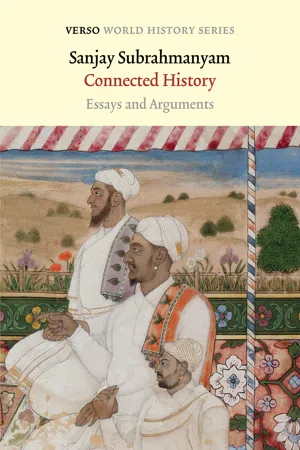
Sanjay Subrahmanyam is becoming well known for the same sort of reasons that attach to Fernand Braudel and Carlo Ginzburg, as the proponent of a new kind of history - in his case, not longue dur?e or micro-history, but 'connected history': connected cross-culturally, and spanning regions, subjects and archives that are conventionally treated alone. Not a research paradigm, he insists, it is more of an oppositionswissenschaft, a way of trying to constantly break the moulds of historical objects.
The essays collected here, some quite polemical - as in the lead text on the notion of India-as-civilization, or another, assessing such a literary totem as V. S. Naipaul - illustrate the breadth of Subrahmanyam's concerns, as well as the quality of his writing. Connected History considers what, exactly, is an empire, the rise of 'the West' (less of a place than an idea or ideology, he insists), Churchill and the Great Man theory of history, the reception of world literature and the itinerary of subaltern studies, in addition to personal recollections of life and work in Delhi, Paris and Lisbon, and concluding remarks on the practice of early-modern history and the framing of historical enquiry.
- 304 pages
- English
- ePUB (mobile friendly)
- Available on iOS & Android
eBook - ePub
About this book
Information
1
Is ‘Indian Civilization’ a Myth?
Two radically different conceptions of India have informed discussions amongst both academics and normal human beings in the past few decades, and it is the tension between these two conceptions that I wish to treat here. On the one hand, we have the view that ‘India’ as we know it was invented in the not-too-distant past, probably by the British, or perhaps by Indians and Britons acting together in the period of colonial rule. This is what we may call the constructivist approach, one that from its academic origins has percolated to other parts of elite Indian society which have, willy-nilly, absorbed the best and the worst of postmodernist gobbledygook by now. There is of course some truth to the notion that the idea of India altered significantly in the nineteenth and twentieth centuries, but one may legitimately doubt whether the whole thing was made up in recent times as a sheer act of will.
The second view, which is radically opposed to the first, and which today finds more extensive political expression than academic support, is the idea that some very stable and autarchic notion of India has been around for a very long time, indeed from the time when a classical Indian civilization put down its roots in the Indo-Gangetic plain. This is a view that sees Indian society in terms of three (or two-and-a-half) phases: a formative one, ending at the close of the first millennium of the Christian era; a second phase of confusion and decline that is roughly coterminous with Islamic rule; and then a third—which may yet be incomplete—of resurgence and a return to the roots. We can all identify the crudest versions of the last in the writings of the ideologues of the RSS or their Neanderthal counterparts elsewhere, including rabble-rousing European journalists in India, but the problem is that this view is far more widely shared than one often suspects.
Some thoughts on ‘India’ as a term may be useful to set the stage. The word itself derives, most of us know, from the medieval Arabic term ‘Hind’, which is itself a deformation of the far older and far more limited ‘Sind’. When one reads the Arabophone encyclopaedists and geographers writing in medieval times, it soon becomes clear though that they are quite ambiguous as to the limits of ‘al-Hind’. Of the core areas there is little doubt: everyone includes the Indo-Gangetic plain from the Punjab to Bengal. But the status of the peninsula is already less clear, and we know that, as late as the fifteenth and sixteenth centuries, ‘Hind’ and ‘Hindustan’ sometimes did not include the Deccan and areas south of it. If this minimal view exists, there were also other writers who thought in medieval times that Indonesia, Thailand, Cambodia, and (in a few odd cases) even Yemen belonged to Hind. All in all, we have three major geographical categories that stand out in these materials: Hind, Sin (or China), and ‘Ajam (the Persian-speaking area). The problem was that the borders of the three were not unambiguous.
What of people in the Indian subcontinent? Did they have some definite notions of the limits of their identity? Once again, matters are far from clear. One measure could be the limits of the spread of Sanskrit or of Brahmanic culture, but both of these take us far into Central Asia on the one hand, and South East Asia on the other. Nor do the epics, and the limits of their spread, prove particularly helpful. It is true that the partisans of a theory of ‘Greater India’ wished in the 1930s and 1940s to make grandiose claims on this basis for the extended limits of Indian sovereignty, but such claims could be equally made then by India’s neighbours using very similar sorts of evidence. It may nevertheless be useful to reflect a little bit on the ‘Greater India’ thesis, and its corollary, namely the idea of the ‘Indianization’ of cultures elsewhere. At the heart of the matter is the notion that at some distant point in the past, say about AD 500, the concept of ‘Indian civilization’ had already been perfected. Everything of any importance was in place: social structure, philosophy, the major literary works. Then, we can imagine the process of ‘Indianization’ as the transportation of these elements to distant lands such as Cambodia or Champa, to be transplanted in more or less fertile soil.
But little in the history of South East Asia actually provides much comfort to this view. At the same time, we must ask ourselves whether it is really convincing to think of an Indian ‘civilization’ that had been perfected as long ago as the Gupta dynasty. Many writers in the twentieth century have held to this view. These include some of the best-known Western Orientalists, such as A.L. Basham and Madeleine Biardeau. But the protagonists of this position also include writers from V.S. Naipaul to Jawaharlal Nehru, whose Discovery of India is quite remarkable from this point of view.
The central idea here is of India-as-civilization, and it very soon becomes the same as a notion of closed India. Indian civilization is portrayed as self-sufficient and homeostatic, and it can only export culture but never really be influenced by the outside save in a negative sense. Somewhat paradoxically, in view of his later reputation as an apostle of secularism, Nehru seems by and large to have accepted a very negative view of Islam. This is why he portrays the situation in India after AD 1200 in negative terms, as the decline and atrophy of an already perfect civilization. Writing more recently, Naipaul draws upon similar images, adding to it a dash of the ‘clash of civilizations’ thesis: the faultline between Islam and Hinduism (which can be read as ‘Indian civilization’) passes for him through the heart of the subcontinent.
One of the examples that Naipaul chooses to illustrate his sad tale of medieval decline is the fate of the imperial state of Vijayanagara in the Deccan, portrayed by him as one of the last bastions of Hindu civilization that held out against the Muslim invader. Now, most historians of Vijayanagara today would see matters rather differently. They would point to the dependence of Vijayanagara on Muslim military specialists and horse-traders, Portuguese firearms, and an imperial ideology that was based not on ancient precepts but newly-formulated sectarian ideas from the fourteenth and fifteenth centuries. In terms of court ritual, fiscal structure, and imperial style, Vijayanagara shares far more with the Bahmani sultanate and its successors at Bijapur and Golkonda than with the Pallavas and Cholas. Politically, the rulers of Vijayanagara were as often allied to these sultanates as opposed to them, while amongst their major rivals and enemies were the Gajapati rulers of Orissa. In order to understand this, however, we need to see India not as a civilization but as a crossroads, as a space open to external influences rather than a simple exporter of culture to its neighbours.
Where did this misunderstanding arise, and since when has Vijayanagara been seen as a Hindu kingdom struggling against Muslim enemies? One part of the answer lies with the Portuguese in the sixteenth century. Looking for help against the Muslim rulers of peninsular India, they thought the ‘Gentile’ kings of Vijayanagara were their natural friends. By the middle years of the sixteenth century they had partially given up this illusion, but some parts of it persisted into the views of later writers, including those from Holland and France. It may be useful at this point to insist on one particular fact. It is clear that most of these writers were not liars or prevaricators; they did not simply make up things about India. What they did, however, was read Indian society selectively and produce an image of it that, while often based on true elements, was also one in which these elements had been shorn of their real context.
Still, several centuries after the arrival of Vasco da Gama on Indian shores, there was no single dominant idea of India in writings by Westerners: several contradictory views existed, depending on whether one wrote from Madurai or Agra, whether one was Protestant or Catholic, whether one knew Persian or Sanskrit, and so on. However, by the late-eighteenth and early-nineteenth centuries, a new homogeneity can be found in views of what India was. This picture, produced by Western Orientalists and their Indian assistants, tended to focus on Sanskrit as the true source of Indian culture (demoting Persian in the process), and there was also a search for an Indian Golden Age. Minority voices contested this view, but they were few and far between. Indian popular culture was also largely set aside in favour of an obsession with high culture.
It is remarkable that both Indian reformers and neo-traditionalists of the nineteenth century bought into this view, and a strange complicity came to exist between these two apparently opposed strands. The epoch from the twelfth to the eighteenth centuries was portrayed in dark hues, and if some felt Westernization was the antidote to the malady, others proposed a return to the ‘real’ roots of Indian civilization. But what was this pristine culture to which a return was proposed? In the case of South India, many ‘purists’ found such immaculate culture in Carnatic music played on the violin (actually an eighteenth-century import from Europe), or dances performed to the texts of the great sixteenth-century poet and composer Kshetrayya that also came precisely from this ‘dark’ period! In North India, ultra-purists insisted that Dhrupad should be favoured over Khayal, and invented a bogus Vedic genealogy for the former, forgetting that it was heavily influenced by Mughal court culture. As for devotional religion, such as we know it today in India, most of it is the product of the period from the fourteenth century onwards, whether in Maharashtra, Punjab, or Bengal.
This takes me to an observation of the poet and literary critic Velcheru Narayana Rao, who has often argued that all we have real access to in our past is that part which goes back five or six centuries. Beyond that, we have intellectual constructions and wishful thinking, but little that exists in our everyday life which connects us instinctively to things so distant from us in time. So, ancient India is not a reality for us in the same way as medieval India, and it can never achieve the same status. Further, this intermediate past is one which we can only think through in terms of the idea of a crossroads, where not only did regions and regional cultures influence one another, but things came and went from far more distant lands, whether Europe, Central Asia, Iran, and the Ottoman empire, or South East Asia and East Africa. It will do us no good to pretend that these processes of exchange were not linked to violence. Empires were built and cities sacked; religious sites were desecrated and political opponents massacred. This was the way it was in our part of the world, just as it was in medieval Iran, the Germany of the Thirty Years War, and the empire of the Incas. This is the only past we have, and we had best make as good a job as we can of it.
Take the example of the Indian connection to Africa—this is one that has been really neglected. On the one hand it is linked to the Indian Ocean slave trade, since Africans were brought as slaves to serve in the states of medieval India; on the other it is linked to the complex history of western Indian merchant communities who profited from Africa and the African trade. The point to be made is that it will simply not do to always portray Indians and Indian society as victims of the greed and depredations of others while conveniently whitewashing those parts of our own past that do not suit us today. In similar vein, the relations between Indian traders and moneylenders and peasants in Central Asia were often exploitative, a fact that partly explains the resentment against Indian traders in the early years of the twentieth century.
Some of my Indian intellectual friends believe it is their task to use history in order to demonstrate the illegitimacy of Indian nationalism. This is not my view, nor do I believe that historians are really up to this task. The point I wish to make instead is that we have by now come to terms in surprising measure with a truly traumatic period in our not-too-distant past, namely that of about two centuries of British colonial rule. No one really questions the existence of key institutions that the British left behind in India; there is no current proposal to dismantle the railway network or blow up the city of Kolkata simply because they were created under colonial rule. The same holds for the status of the English language, which has if anything grown stronger in India in the last three decades. It would be truly bizarre if the price to be paid for this acceptance of the legacy of colonial rule were to be the transfer of nationalist resentment onto an earlier period in order to cast the blame for everything that is wrong with Indian society today on medieval invaders from Central and West Asia. True, all nationalisms seem to need negative stereotypes in order to shore up their self-images. But a national culture that does not have the confidence to declare that, like all other national cultures, it too is a hybrid, a crossroads, a mixture of elements derived from chance encounters and unforeseen consequences, can only take the path to xenophobia and cultural paranoia. A last modest suggestion: if cultural cleansing is to start in India, we might begin by returning the khaki shorts of the RSS to their place of origin.
Some afterthoughts may not be out of place here on these questions. On 1 June 2004, the Royal Geographical Society in London held a debate whose motion was ‘The British Empire was a Force for Good’. The motion was supported, amongst others, by the historian Niall Ferguson, the recent one-man industry justifying empire, both British and American. In extremis, he made use of a shallow but ingenious counterfactual argument: If Indian soldiers had not fought in the Second World War, he argued, Hitler would not have been defeated. These soldiers were recruited by the British empire, therefore the empire was a force for the good. QED! The motion was passed by a popular vote of the audience.
Such an argument has a familiar ring to it. It could be used, for example, to defend Stalin and the gulag. Without them, surely Hitler would not have been defeated either. We can thus easily see where such opportunistic arguments take us. Reading through the public debate in India after Prime Minister Manmohan Singh’s remarks to the convocation of my former university, Oxford, puts me in mind of some of these exercises. As I see it, Singh was careful to not simply praise the British empire; he first criticized it, on the basis of some rather bogus statistics produced by Angus Maddison on the change in India’s share in world GDP, allegedly 22.6 per cent in 1700 compared to 3.8 per cent in 1952. No one knows what India’s GDP was in 1700. But let us admit a part of the premise and say that India’s share did fall over these years. Three questions then arise. First, was this fall the result of British rule? Second, in the absence of British rule, what was the most plausible alternative? Third, is this the most useful way of looking at the effects of British rule in India, and of British imperialism more generally?
Singh also implied that while the economic consequences of British rule were negative, the global effects on liberal institutions and political culture were really quite positive. These consequences cannot be measured in numbers (though the issue is worth thinking about), nor were they planned or intended as positive by the British, which is unfortunately implied in Singh’s remarks. Despite periodically using the rhetoric of paternalism, it is clear that British colonial policies were not primarily designed to promote economic growth in India. The British often and insistently said this themselves. Growth between 1800 and 1950 was thus slow and fitful, and many other parts of the world (including Japan’s colonies in Taiwan and Korea) clearly did better than India.
It may be argued very plausibly that some institutions that came under British rule, such as the railways, would have come even without such rule. After all, many modern institutions fell into place in Iran, nineteenth-century Latin America, China, Japan, and parts of South East Asia (e.g. Thailand) that were not colonized. Why is it a plausible assumption then that Britons, whose primary allegiance was to Britain, would have done better for India than Indians? Would any historian of Britain be willing to accept, say, that Britain would have performed better economically if only it had been ruled over by Indians? So, much depends too on the answer to the second question: If not Britain, then what? Here, each writer will have his own alternative scenario. Had the French under Bussy conquered peninsular India, would French colonial rule have produced a better outcome? Perhaps French revolutionary republicanism would have worked marvels on India. I have my doubts, but we cannot simply measure this by looking at France’s performance in Algeria. Would India not have fragmented into many small states in the absence of British rule? I have my doubts about that too, since I believe that the Mughal empire left a powerful cultural and institutional legacy of cohesion, which we tend to neglect today because of Hindu right-wing rhetoric.
But the most important question is the third. The British empire was a complex and multifaceted motor. Two aspects of it are worth keeping in mind. First, the British practised selective forms of acculturation, which were less brutal than those of the Spaniards in America but also less nuanced than those of the Ottomans. Unlike the Spaniards, British attempts at conversion to Christianity remained muted for the most part, but in this they were not that much more tolerant than the Ottomans. Again, linguistically, the Ottomans encouraged far greater diversity than either the Spaniards or the British, and the interplay of Persian, Arabic, and Ottoman Turkish led to a great literary and cultural efflorescence. However, acculturation is always a many-sided process. It was not just a question of what the British brought to the table, but the cultural resources that other parties disposed of. In the settler colonies, where indigenous populations over time came to have a highly reduced role, metropolitan culture could impose itself with far greater ease and in the face of far more limited opposition than in South Asia or East Africa. Even the contrast between New Zealand and Australia, with the latter possessing a far less resilient indigenous demography and culture than the former, is instructive in this respect. This is why the British empire produced such different outcomes in different parts of the world, and even within South Asia itself. It is also why nostalgia about British rule is not equally shared. Second, despite Ferguson’s arguments, most historians of even Britain today would admit that ‘modernity’ was not something that the British produced domestically and then exported. Britain and British society were also deeply affected by the empire. Therefore, we cannot see what happened in colonial India simply as a transfer or a gift—not even a poisoned gift. By once more making the colonial encounter in India a meeting between rigid, timeless, Indian society and its frozen values, and egalitarian and fair-minded Britons, we are caricaturing India. We are also caricaturing Britain. There is comfort in this, but only for those comforted by clichés.
2
Back to the Future
Why the West Rules the World*
Why the West Rules the World*
For some years now, we have frequently been told in universities that the historical profession is in a crisis and that no one wants to read history any more. At the same time, despite what is sometimes claimed, especially by over-enthusiastic publicists and their academic accomplices, there is currently no shortage in the market of large books of general or popular history making ambitious claims to attract the attention of distracted potential readers. The evidence can be found in any bookstore (if one still exists in your city). If bookstores such as Borders and Barnes & Noble often carry a section amusingly entitled ‘oversized anthropology’ (apparently referring to large-format works), there could easily be another called ‘overweight history’ for books that weigh in at between 600 and 1200 pages. The greater part of such books are produced by trade publishers, or are otherwise ‘crossover’ books from university presses trying to edge into the trade market. In the past two decades this proliferation of doorstops has been accompanied by ever more stringent restrictions on academic history books, especially by first authors, which are often expected to be under 300 (or even 250) pages and heavily subsidized in one fashion or the other. Even so, they usually cannot be found in Borders or Barnes & Noble. This growing polarization of the market—short books in ever-shrinking printruns and enormous volumes aiming at massive sales—has struck many of us by now, especially when one is approached, at least three or four times a year nowadays, by agents or trade publishers asking that one abandon one’s usual modest monographic mode to write the next mammoth blockbuster. Like the population at large, history books too now seem to lurch between the obese and the anorexic.
Why the West Rules—for Now is clearly not a part of the second category. Its author Ian Morris is a prolific, distinguished, British-educated historian of the classical period in Europe who teaches at the prestigious Stanford University after having taught in Chicago. According to his Stanford biography page he has written some fourteen books, mostly on ancient history and archaeology, including some quite wide-ranging o...
Table of contents
- Cover Page
- Halftitle Page
- Title Page
- Copyright Page
- Dedication
- Contents
- Preface
- Acknowledgements
- 1. Is ‘Indian Civilization’ a Myth?
- 2. Back to the Future: Why the West Rules the World
- 3. Secularism and the Happy Indian Village
- 4. Indian Political History and Ramachandra Guha
- 5. V.S. Naipaul’s Pride and Prejudices
- 6. The Booker and ‘India Shining’
- 7. Thugs, Thuggee, and Things Thuggish
- 8. What, Exactly, is an Empire?
- 9. Márquez, Hemingway, and the Cult of Power
- 10. Do Civilizations Suffer from Altitude Sickness?
- 11. Churchill and the Great Man Theory of History
- 12. Fiction, Islam, and The Satanic Verses
- 13. The Global Market for Indian History
- 14. India’s Discovery of Vasco da Gama
- 15. Philanthropy, Warren Buffett, and the Bhagavad Gita
- 16. 9/11, Islam, and the USA
- 17. ‘D. School’ Days
- 18. An Ambiguous Parisian
- 19. A Lisbon Summer
- 20. Across Three Continents: An Interview
- 21. History Speaks Many Languages: A Further Interview
- Notes
- Index
Trusted by 375,005 students
Access to over 1.5 million titles for a fair monthly price.
Study more efficiently using our study tools.
Frequently asked questions
Yes, you can cancel anytime from the Subscription tab in your account settings on the Perlego website. Your subscription will stay active until the end of your current billing period. Learn how to cancel your subscription
No, books cannot be downloaded as external files, such as PDFs, for use outside of Perlego. However, you can download books within the Perlego app for offline reading on mobile or tablet. Learn how to download books offline
Perlego offers two plans: Essential and Complete
- Essential is ideal for learners and professionals who enjoy exploring a wide range of subjects. Access the Essential Library with 800,000+ trusted titles and best-sellers across business, personal growth, and the humanities. Includes unlimited reading time and Standard Read Aloud voice.
- Complete: Perfect for advanced learners and researchers needing full, unrestricted access. Unlock 1.5M+ books across hundreds of subjects, including academic and specialized titles. The Complete Plan also includes advanced features like Premium Read Aloud and Research Assistant.
We are an online textbook subscription service, where you can get access to an entire online library for less than the price of a single book per month. With over 1.5 million books across 990+ topics, we’ve got you covered! Learn about our mission
Look out for the read-aloud symbol on your next book to see if you can listen to it. The read-aloud tool reads text aloud for you, highlighting the text as it is being read. You can pause it, speed it up and slow it down. Learn more about Read Aloud
Yes! You can use the Perlego app on both iOS and Android devices to read anytime, anywhere — even offline. Perfect for commutes or when you’re on the go.
Please note we cannot support devices running on iOS 13 and Android 7 or earlier. Learn more about using the app
Please note we cannot support devices running on iOS 13 and Android 7 or earlier. Learn more about using the app
Yes, you can access Connected History by Sanjay Subrahmanyam in PDF and/or ePUB format, as well as other popular books in History & Historical Theory & Criticism. We have over 1.5 million books available in our catalogue for you to explore.