An edited collection of essays exploring the work and legacy of the academic and theatre-maker Clive Barker. Together, the essays trace the development of his work from his early years as an actor with Joan Littlewood's company, Theatre Workshop, via his career as an academic and teacher, through the publication of his seminal book, Theatre Games (Methuen Drama).
The book looks beyond Barker's death in 2005 at the enduring influence of his work upon contemporary theatre training and theatre-making.
Each writer featured in the collection responds to a specific aspect of Barker's work, focusing primarily on his early and formative career experiences with Theatre Workshop and his hugely influential development of Theatre Games. The collection as a whole thereby seeks to situate Clive Barker's work and influence in an international and multi-disciplinary context, by examining not only his origins as an actor, director, teacher and academic, but also the broad influence he has had on generations of theatre-makers.
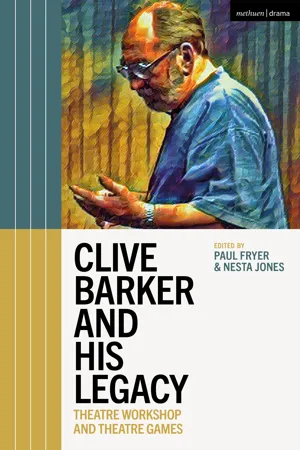
- 240 pages
- English
- ePUB (mobile friendly)
- Available on iOS & Android
eBook - ePub
About this book
Information
CHAPTER 1
INTRODUCTION: CLIVE’S LEGACY
Nesta Jones and Paul Fryer
This book is not a biography of Clive Barker, although inevitably it contains much biographical information. Rather, it is an attempt to explore his continuing legacy through a series of responses to the many and varied aspects of his work: his early and highly formative years with Joan Littlewood’s Theatre Workshop; a varied career as an actor and director/deviser/creator in both the established environments of repertory/regional theatre and the West End, and the highly creative (political) world of the ‘alternative’ theatre of the 1960s and 1970s; the development of his own approach to performance which led to the publication of his seminal book Theatre Games, and beyond; an academic career in the UK university and training sectors; a range of highly influential writing including his early association with Theatre Quarterly (TQ), and his joint editorship of New Theatre Quarterly (NTQ).
This is only a partial list because to describe Clive as a man of eclectic interests is something of an understatement. Could ‘polymath’ be an appropriate word, or perhaps in its best and most positive sense, ‘the consummate generalist’? It seemed that Clive could engage in a meaningful conversation on just about any topic, and would have something worthwhile to contribute on any subject, because he shared so many interests – able to talk just as enthusiastically on Shakespeare and Brecht as he would on Madonna or Morecambe and Wise.
That broadness of interest is reflected in the range of chapters included in this collection. Each of the authors has a very direct connection to Clive, either personally, having worked with him or been taught by him at some stage of his career, or has been fundamentally influenced by his work.
Few people knew Clive better than the late Simon Trussler, his colleague at New Theatre Quarterly, who provided us with a biographical ‘memory’ of Clive, which sadly remained unfinished at the time of Simon’s own death in 2019. Murray Melvin joined Joan Littlewood’s Theatre Workshop at the Theatre Royal Stratford East as an assistant stage manager in 1957, and appeared on stage with Clive in The Hostage and Oh What a Lovely War. Susan Croft identifies Clive as ‘a man for the alternative approach’, utilizing not only her own invaluable project, Unfinished Histories, but also her experience of Clive’s own archive, gained as Clive Barker Research Fellow at Rose Bruford College of Theatre and Performance. Nadine Holdsworth first encountered Clive when he interviewed her for a place to study on his theatre programme at the University of Warwick. She explores his experiences with Littlewood’s Theatre Workshop. Aleks Sierz, distinguished theatre critic and specialist in contemporary British theatre, explores Barker’s first opportunity to flex his muscles as a professional director, of Shelagh Delaney’s ill-fated second play, The Lion in Love (1960). Ceri Pitches remembers Clive from their first meeting in 1988, when she became his student at Warwick. She provides a snapshot of Barker the university teacher, ‘enigmatic and esoteric’, ‘puzzling and often provocative’. Dick McCaw, who authored the introduction to the second edition of Theatre Games (2010) and collaborated with Clive on the International Workshop Festival, focuses on the importance of movement in Barker’s work. Chris Baldwin, who chaired the ‘Evening with Clive Barker’ event in 2003 (see Chapter 11) explores Barker’s ‘defiant anti-authoritarianism’, tracing his influence through the development of Teatro de Creación, and several large-scale European projects. Joseph Dunne-Howrie has interrogated the archives in order to assess ‘Barker’s legacy in the future tense’, examining the influence of the notion of Fun Palaces and Game Theatre upon the legacy of the 2012 London Olympics. Chrissie Poulter’s first encounter with Clive, when she became one of his students at Birmingham University in 1973, established a close, influential and long-lasting link which she explores here via a series of ‘Letters to Clive’. She revisits Barker’s writings via Theatre Games, and other sources, testing our understanding of these ideas in a contemporary context.
One of the challenges in compiling this book was to find a phrase which would sum up the different aspects of Clive’s life, career and influence. In choosing a title, we finally settled upon two parts of his career which seem, in some ways, to encapsulate origins and outcomes: his early work with Joan Littlewood’s legendary Theatre Workshop with whom Clive worked from 1955, and the publication of the seminal book for which he is now best known, Theatre Games: A New Approach to Drama Training, first published by Eyre Methuen in 1977.
After Clive died in 2005, the journal with which he was so closely associated as co-editor with Simon Trussler, New Theatre Quarterly, published an edition to celebrate his ‘life, work and legacy’ – only the second time that the journal had published an issue devoted to a single person. Many distinguished contributors offered personal insights and analyses of his work, but perhaps the most revealing of all comes in the form of an article entitled, ‘A Brief History of Clive Barker’, written by the man himself.
This article provides the link to the first part of this book’s title: ‘All of my life has been a search for a community – and in saying this I do not mean to devalue the importance to me of my children and grandchildren. This search has thrown me into two tribes. The first was Theatre Workshop’.1 At the end of his training at Bristol Old Vic Theatre School, he was introduced to Littlewood’s work by the designer John Blezard. He contacted John Bury to ask for work and came to London, where he ‘met Joan Littlewood and became an actor’2 (although, in reality, he described his new job as ‘stage manager and bit-part actor’3). He made his debut in the Lope de Vega play, Fuente Ovejuna.
Clive claims: ‘The other tribe is the group of practitioners and scholars who centre on Eugenio Barba and Odin Teatret. With them I feel at home.’4 Barba describes Clive’s emergence from Theatre Workshop ‘as an actor and director, expert in theatre games, an intellectual and a university teacher, with one foot in the library and the other on the stage. He had devoured his master, didn’t always have her before his eyes as a warning and a constraint. He bore her in his guts.’5 Barba and Barker met in 1980 in London during Odin Teatret’s first visit to the UK, based at the Cardiff Theatre Laboratory. Barba recalled that Clive travelled to Wales ‘several times … not only to see our performances, but also to observe barters and anonymous working situations in faraway villages. He was the only one who displaced himself in an effort to grasp our theatre better, without limiting his knowledge of it to the impressions of just one performance’.6 Barba valued their collaboration of many years enabled through Clive’s base at Theatre Quarterly and New Theatre Quarterly, and his at Odin Teatret and ISTA, the International School of Theatre Anthropology, ‘but above all with a glass in our hands, walking, travelling by car, speaking on the phone, making brief and intense sorties among possible theatres during his visits to Holstebro and his hospitality in Warwick.’7
The actor Brian Murphy joined the Theatre Workshop company at the same time as Clive in 1955, and later made the point that they were ‘often clinging together for support in [their] efforts to understand the method, vagaries and waywardness of the genius of Joan Littlewood’.8 They first appeared together in The Sheep Well (Fuente Ovejuna) in September 1955, and later in Ewan McColl’s adaptation of The Good Soldier Schweik (1956) and the musical Fings Ain’t Wot They Use...
Table of contents
- Cover
- Half-Title Page
- Dedication
- Title Page
- Contents
- Notes on contributors
- Acknowledgements
- 1 Introduction: Clive’s legacy
- 2 Clive Barker: a biographical memory
- 3 Clive Barker: my Einstein
- 4 Clive Barker and alternative theatre
- 5 Clive Barker as tribal Scribe: Memory, Embodied Knowledge and the power of Anecdotes
- 6 ‘A New Team’: Clive Barker and Shelagh Delaney’s The Lion in Love
- 7 Theatre gains: remembering Clive
- 8 Clive Barker and movement
- 9 On supplanting oligarchy: Clive Barker’s defiant anti-authoritarianism
- 10 Hacking the archives: the 2012 Olympic legacy, Fun Palaces and game theatre
- 11 An Evening with Clive Barker: an edited transcript of a unique event
- 12 Nine lives and counting
- Appendix I: Authorial bibliography and professional credits
- Appendix II: Teaching and training
- Index
- Copyright
Trusted by 375,005 students
Access to over 1.5 million titles for a fair monthly price.
Study more efficiently using our study tools.
Frequently asked questions
Yes, you can cancel anytime from the Subscription tab in your account settings on the Perlego website. Your subscription will stay active until the end of your current billing period. Learn how to cancel your subscription
No, books cannot be downloaded as external files, such as PDFs, for use outside of Perlego. However, you can download books within the Perlego app for offline reading on mobile or tablet. Learn how to download books offline
Perlego offers two plans: Essential and Complete
- Essential is ideal for learners and professionals who enjoy exploring a wide range of subjects. Access the Essential Library with 800,000+ trusted titles and best-sellers across business, personal growth, and the humanities. Includes unlimited reading time and Standard Read Aloud voice.
- Complete: Perfect for advanced learners and researchers needing full, unrestricted access. Unlock 1.5M+ books across hundreds of subjects, including academic and specialized titles. The Complete Plan also includes advanced features like Premium Read Aloud and Research Assistant.
We are an online textbook subscription service, where you can get access to an entire online library for less than the price of a single book per month. With over 1.5 million books across 990+ topics, we’ve got you covered! Learn about our mission
Look out for the read-aloud symbol on your next book to see if you can listen to it. The read-aloud tool reads text aloud for you, highlighting the text as it is being read. You can pause it, speed it up and slow it down. Learn more about Read Aloud
Yes! You can use the Perlego app on both iOS and Android devices to read anytime, anywhere — even offline. Perfect for commutes or when you’re on the go.
Please note we cannot support devices running on iOS 13 and Android 7 or earlier. Learn more about using the app
Please note we cannot support devices running on iOS 13 and Android 7 or earlier. Learn more about using the app
Yes, you can access Clive Barker and His Legacy by in PDF and/or ePUB format, as well as other popular books in Media & Performing Arts & Theatre. We have over 1.5 million books available in our catalogue for you to explore.